Showing posts with label Monarda punctata. Show all posts

Tuesday, May 25, 2021

Native Annuals revisited

The ubiquitous black-eyed Susan, Rubeckia hirta,
can bloom in its first season from seed
but may persist for up to 3 years.

A little over 10 years ago I kicked off this blog with an introduction to the idea of using native annuals in the home landscape.  I thought it was time to revisit this theme and add a little more detail with a focus on native annuals and biennials that can be used in the Mid-Atlantic garden.

While there is a growing interest in native trees, shrubs and herbaceous perennials there are very few native annuals promoted for landscape use in native landscape designs.  This lack of focus is due in large part because the longer-lived species can be counted on year after year to uphold the integrity of the design.  When included in a design, conventional annuals are often used as temporary accent pieces, just to add interest or fill a gap in the permanent landscape. 

In general, many of the annuals used in designed landscapes and home gardening are of exotic origin and have been further improved horticulturally for maximum visual affect.  These plants and methods are not bad or evil; they are just a several steps away from what would be considered natural to a given area.  While beautiful, these plants lack local character, certainly on a regional, if not continental scale.  To the extent that they are different from the local flora, they may not provide the same ecological value, such as food and shelter for wildlife in the area, as native species do. 

In contrast, native annuals may function more as perennials.  Those that are adapted to the local environment will die back after a season or two, but they will maintain a presence in the garden, by reseeding, though not necessarily in the same location.   For some people, this may be a problem since the plants will move around, disrupting the design.  Others would consider this as a natural phenomenon and appreciate how plants are able to find their proper niche.  The ideal native annual could be considered as a plant that develops quickly with more flowers, a longer flowering cycle than perennials, and that reseeds but is not invasive.

Plant Selection for the Mid-Atlantic

To generate my initial list of Mid-Atlantic annuals and biennials I used the USDA Plants database.  This database contains a listing of all plants identified as growing wild in the United States.  It does not, however, distinguish whether the plants in a location are indigenous or have escaped cultivation. Using the 'Advanced Search' function I first selected North American native species. Then I selected NJ, PA, MD, WV and VA as my Mid-Atlantic States.  For duration I selected annual and biennial and I selected 'forb' for plant type.  This resulted in a list of over 700 taxa.  This list of plant names included some duplication since varieties and sub-species are listed in addition to the species.  This database has since been revised but you can get similar results for your region using its new “Characteristics Search” feature.  Alternatively you can use the Wildflower Center’s combination plant search function on their database, but there you would be doing one state at a time.

Here are three short-lived Mid-Atlantic natives,
spotted beebalm over growing a patch of
American pennyroyal and
 backed up with black-eyed Susans.

Next, I scanned the list for species that I was familiar with that, in my opinion, had some garden value.  The attributes I considered included form, appearance of foliage or flower, scent of flower or foliage, or value to wildlife.  I came up with a list of over 40 species that I have or would like to have in my gardens.  These criteria are of course arbitrary in the sense that I am looking at features from a human perspective.  In reality each of these species has evolved to fill an ecological niche and, as such, has a real value in their natural home.  Most gardens, however, are created and curated by humans, and are not complete, natural ecosystems.  This is especially the case in urban and suburban settings where soils, water courses and wildlife corridors have been disrupted; although, we can aspire to create naturalistic areas where some semblance of a natural ecosystem can catch hold, particularly with the use of native plant species.

The Plants

Here’s a partial listing of the native annuals and biennials grouped according to their garden function.

Big Plants

Bearded beggarticks can grow from seed to about
5' tall in a season.  Bloom time is in late summer.
Despite their short life times some native annuals and particularly biennials can grow quite large, 4-6 feet tall.  These plants are best located in the background or in a larger format setting.

Bearded beggarticks (Bidens aristosa), American bellflower (Campanulastrum americanum), tall thistle (Cirsium altissimum), biennial gaura (Oenothera gaura, formerly Gaura biennis), jewelweed (Impatiens capensis), and evening primrose (Oenothera biennis).


Showy Plants

These species are of more manageable size and have good sized and/or showy flowers.

Climbing fumitory (Adlumia fungosa), partridge pea (Chamaecrista fasciculata and C. nictitans), plains coreopsis (Coreopsis tinctoria), Corydalis sempervirens, fleabanes (Erigeron annuus and E. philadelphicus), firewheel (Gaillardia pulchella), annual sunflower (Helianthus annus), cucmberleaf sunflower (Helianthus debilis), sneezeweed (Helenium amarum), standing cypress (Ipomosis rubra), spotted beebalm (Monarda punctata), sweet everlasting (Pseudognaphalium obtussifolium), black-eyed Susan (Rudbeckia hirta), clasping Venus looking glass (Triodanis perfoliata), and blue vervain (Verbena hastata).


Partridge pea returns reliably from seed
each year if open soil is available


Philadelphia fleabane is a prolific reseeder and
can grow anywhere there is an opening, such as a thin
 lawn.  Commonly grows as a biennial in my yard.

 Fillers

These plants will fill in space and while each has some interesting features, will not steal the show.

Hog peanut (Amphicarpaea bracteata), yellow corydalis (Corydalis flavula), American pennyroyal (Hedeoma pulegioides), Indian tobacco (Lobelia inflata), clearweed (Pilea pumila), red-whisker clammyweed (Polanisia dodecandra), Pennsylvania smartweed (Polygonum pensylvanicum), field pansy (Viola bicolor), and common blue violet (V. sororia).

American pennyroyal has very small flowers
but produces a strong minty scent when disturbed. 
Its tiny seeds can find their way into the smallest cracks.

Special Requirements.  

Most native annuals owe their long-term success to being adapted to some form of disturbance which makes it difficult for long-lived plants to get established.  Some species are adapted to very special conditions.  One common example is jewelweed (Impatens capensis).  This annual can grow quite large and sports distinctive orange flowers but it needs very wet soils to survive. 

Some interesting native annuals are hemiparasitic, their roots tap into nearby plants to help them develop fully.  Two examples are the False foxgloves, such as fernleaf false foxglove (Aureolaria pedicularia), which are parasitic on oaks, and Scarlet Indian paintbrush, (Castilleja coccinea), which grows with assistance from the roots of grasses. 

Winter annuals are a group of plants that have adapted their life cycles to avoid the heat and dryness of summer, or competition for sun light in a wooded setting, by doing most of their growth from fall into springtime, when light and moisture are more plentiful.


Spring blue-eyed Mary germinates in the fall and
blooms in early spring.  It is often found growing
under deciduous trees.

Some winter annuals found in the Mid-Atlantic include: Spring blue-eyed Mary, (Collinsia verna), Yellow fumewort (Corydalis flavula), Old field Toadflax (Nuttallanthus canadensis), Fernleaf phacelia (Phacelia bipinnatifida), Miami mist (Phacelia purshii), and Field pansy (Viola bicolor).

One trick with growing winter annuals is that you need to avoid pulling them out while you are cleaning up flower beds in the early spring. 


This clasping Venus looking glass came up on its
 own and bloomed in early June.  To encourage its
 return I avoided mowing the area so that it could
 set seed, but it will need open soil the following
 year so that it can grow.

A few of these species are commercially available as potted plants right now.  Others may be had by getting seed from native plant suppliers.  For others, these plants may occur naturally on your site and one just needs to be observant when they show up and then to take care that they are able to develop and set seed to create a new generation.


Monday, February 13, 2017

New Plants for 2017: Just Getting Started

The seed and plant catalogs have been coming since late December and I've made a few selections already.  Here's a run down on seeds and shrubs that I have ordered so far.

The tubular flowers of fireweed mature into long
seed pods, as seen on the lower right.
Fireweed, Chamerion angustifolium (formerly of the genus Epilobium) is a tall perennial that puts out hot pink flowers in mid-summer.  Growing in part to full sunshine and average soil moisture this will be a welcome addition to the small meadow that I am developing.  The tubular flowers are very attractive to a number of native bees as well as hummingbirds.

Fireweed is named for its tendency to appear in great numbers after fire has cleared the competing vegetation.

The tiny seeds, ca. 1 mm long, need to be cold-moist stratified for 60 days for good germination.  The tiny seeds also need to be surface sown, as they need light for germination.  I started the stratification in damp sand last week, so I should be able to get them into trays in early April.


When stratification is done, I'll just smear the damp sand/seed mixture on top of the soil.
Another new species for me will be goat's rue, Tephrosia virginiana.  This member of the legume family likes dryish sandy soils in part to full sun light.  It has feathery foliage and puts out pink and yellow pea-like flowers in early to mid-summer.  Since this plant has a deep taproot, I will use it on an embankment that I want to stabilize.

Relative to fireweed, the seeds of goat's rue are huge, 3-4 mm long and about half as wide.  These seeds have a thick outer coating and will need to be scarified before giving it about 2 weeks of cold-moist stratification.  In addition to this I also got a packet of inoculum that contains the bacteria this plant needs to fix nitrogen from the air. I'll mix this with the seeds prior to starting the stratification process.  I think seeds will germinate with it, but not having the right bacteria can compromise their development.  

I have encountered this with another legume, partridge pea, Chamaecrista fasciculata, where I saw much better growth from seeds that had been treated with inoculum than for those sown without it.


In addition to these I got some additional seeds for rose verbena, Glandularia canadensis, and spotted beebalm, Monarda punctata.  I was pleased with the rose verbena I planted last year.  While it does not call for it, I moist stratified the seed for a month and got excellent germination rates.  It formed a nice ground cover and bloomed well with clusters of deep magenta flowers.  I purchased more seed because it is listed as marginally hardy in zone 6 and I was afraid that there would not be enough seed produced last season to produce another crop for this year.  Since our winter low temperatures this year have not dropped below 15 F, we are having more of a zone 8 winter, this species may make it through until spring.  In any case I'll have more plants to fill in and maybe share a few with others.

Rose verbena as it's looking in mid-February.  It's taken some damage,
but it's looking good close to the ground level.


The spotted beebalm I had a few years back has petered out.  I think it lost out to more competitive plants around the vegetable garden.  It is a short lived perennial and relies on having good places for new seed to germinate to continue in the garden.   For this new crop I will put it in spots with leaner soil and where its seed can germinate without being covered by other plants.


As far as shrubs, I'm just reinforcing some of what I got last year:
Eastern Red Cedar, only one from the three I planted last year was successful.  This year I'll get them in the ground sooner and do a better job of clearing away competitive plants.

Chokecherry, I'm 1 for 2 on this species.  For these I will need to clear a larger space so they can get established.  Once established they should grow quickly on their own.

American hazelnut, these are surviving well in somewhat shady locations.  I have identified several other woodland edge areas where it would be nice to have this native shrub fill in.

Monday, July 14, 2014

A Pollinator Border


When I planned my new vegetable garden last year I included a double fence design to help keep out the deer.  At the outer fence I planned for a border of pollinator-friendly native plants.  This border would help attract pollinators to the garden and also provide shelter for predatory insects to hang out.  By providing cover for the predators, damage due to insect pests is significantly reduced without the use of pesticides.


The border around the garden has a variety of native plants.  A bluebird is currently nesting in the box,
I try to avoid walking by, but it happens

The plants for this border need to provide pollen or nectar for the pollinators, be low maintenance, bloom sometime during the growing season and be somewhat to very resistant to deer browsing.  I also looked for plants that might deter smaller mammals that could burrow into the garden.  The garden location is in full sun and can get dry. 

Plants that are native to the area are the best choice for a pollinator garden.  These plants are natural food sources for the native insects that will be doing most of the work.  It is nearly impossible to find a single plant that will bloom the entire garden season, so a mixture of plants with staggered blooming times will provide some food for insects throughout the season.  The Xerces Society has guidelines for creating a pollinator friendly garden.  

When I put in the garden last year, most of the pollinator plants I put in were liners or seedlings.  Being young and of small size, they did not mature enough to bloom.  With a year in the ground they are really looking good now.  Here's a listing of plants I used in by pollinator border.

The earliest blooming plant in the border was Wild Columbine, Aquilegia canadensis.  The nodding red and yellow flowers are attractive to hummingbirds.  Blooming period is typically April through May.  The seeds are held loosely in the upright pods.  

I did not get a photo of my Columbine this season, but here you can see
the seed pods mixed in with some Black-eyed Susans.  I need to shake out
the seed pods to get more plants for next year.

Last year I planted both black-eye and Brown-eyed Susans (Rudbeckia hirta and R. triloba).  The deer were constantly eating the flowers and leaves of both species.  This year only the Black-eyed Susans returned.  I have been more diligent about spraying them with hot pepper solution, which seems to work.  While not as upright as Yellow Cone Flower (R. fulgida) I like the extended blooming season of R. hirta, lasting from June through September.

Here's Spotted Beebalm in a mixed border of Black-eyed Susans and False Pennyroyal.
The flowers are actually small yellow tubes hidden by the large pinkish bracts.
Spotted Beebalm, Monarda punctata, was grown from seed and actually matured enough to bloom the first year.  This year it really went to town.  Peak blooming season is June and July.  This plant is very resistant to deer browsing and attracts mostly bees and wasps.

This is a short-lived perennial so it needs to set seed to maintain a presence in the garden.

The flowers of Wild Bergamot are more exposed than Spotted Beebalm's
 making it easier for large butterflies to access them.
Another member of the Monarda genus in the garden is Wild Bergamot, M. fistulosa.  This is a much taller species, easily over 4 feet in this garden.  The flowers attract bees, butterflies and hummingbirds.  The bloom time is from early July through August.

These two Monarda species do well in dry to medium soils.  If the soil were moister Oswego Tea, M. didyma, would be a good choice, as well.


I had a difficult time with deer munching on the young Butterfly Weed, Asclepias tuberosa, plants last year.  This year they are doing much better and are coming into full bloom now (early July).
I have not seen any Monarch butterflies around these milkweeds,
mostly small greenish bees (Sweat bees?)

I have established a dense hedge of American Pennyroyal
 along one edge of the garden.
We'll see if it keeps out the moles, etc.
One of the first native annuals I put around the garden was American or False Pennyroyal, Hedeoma pulegioides.  This diminutive member of the mint family has a strong minty scent when touched.  It can act as a repellent for some insects, possibly mosquitoes.  I am interested to see if it will also discourage deer and small mammals from entering the garden.  Direct seeding in the garden last spring gave few plants, but these seeds came up in full force this year.  Despite what it says on the seed packet, fall sowing of some moist stratification (30 days, moist at 35-40 F) helps break seed dormancy.
I'm pretty sure this is one of the Nodding Onions.
I'll know better once it reaches full bloom -
will the flower continue to droop or turn upright.

Another plant to help form a barrier to invasion by burrowing mammals is Alliums.  I planted a long row of Nodding Onions, Allium cernuum, in the border. The idea is that they will be repelled by the presence of the onion bulb underground.  I've seen a few come up in the mix of plants, but sometimes they are hard to tell from the stray grasses also in the garden.  As we get later into blooming season (June-August) they should be easier to pick out.  


In the garden there is some white Yarrow, Achillea millefolium, that just blew in.  I also added a more colorful cultivar call 'Strawberry Seduction' to jazz things up a little.  I had problems last year with deer browsing, but not so this year.  Is this due to a more mature plant, or is it random choice by the deer?

I don't usually go for the flashy cultivars, but
I wanted to add some more red to the garden
The middle of the garden provides a refuge
for the more deer-sensitive species.

In the center of the garden I put a ring of tall flowers that was meant to draw the pollinator further into the garden.  Since these are more protected from deer, they don't have to be so deer resistant.  This year I have some Purple Cone Flower (Echinacea purpurea), False Sunflower (Heliopsis helianthoides 'Summer Sun', Beach Sunflower (Helianthus debilis 'Pan') and 'Autumn Beauty' Sunflower (Helianthus annuus).  The first two species bloom for the first half of summer and the sunflowers carry the load into the fall.

I selected the 'Autumn Beauty' cultivar of sunflower because it only grows to 6 feet, keeping it in scale with the rest of the plants and reducing the risk of tipping over.

My deer really like to eat various species of Helianthus, so I could not grow these in unprotected areas.  I'm not sure how they would treat the False Sunflower, but I'm sure they would give it a taste.  

Daisy Fleabane (Erigeron annuus) and Heal-all (Prunella vulgaris) are a couple of indigenous plants that have found a welcome place in this border.  Heal-all is edible (haven't tried it) and has many herbal/medicinal applications.  It can be used as a native ground cover, growing between 2 and 12 inches tall.

Heal-all is widely disbursed through the Northern Hemisphere.
It is a larval host for the Clouded Sulphur butterfly.

In the new part of the border I'm trying some new native annuals.  I have grown Sulphur Cosmos, Cosmos sulphureus, by direct sowing in Boston before.  It did germinate well in the border here, but has since disappeared.  I also sowed some Plains Coreopsis, Coreopsis tinctoria, in the same area.  Germination wasn't as good, but the plants are persisting.  In another area the deer sampled the Coreopsis, but did not actually eat it.  Another native Coreopsis species that could be used in the border is Threadleaf Coreopsis (C. verticillata).  It is easy to care for and fairly resistant to deer.

Plains Coreopsis starts out kind of wiry, but straightens up as it matures.

 One additional note about the border.  My outer fence is a 5-wire electric fence, but it is not energized.  If it were, it would immediately ground out because of all the plants growing on the wires.  If you have an energized fence it must be free of plants.  A flowering border should be sited well inside or outside the electrified wires.

Thursday, June 27, 2013

Co-existing with Nature

There is a conflict between nature and designed human space.  We like to have our nature neatened up and easily readable with beautiful plants arranged just so.  Nature is just do what it needs to survive, with each of its members seeking out their basic needs: food, shelter and reproduction.  Conflict arises when our focal plantings become a meal or natures breeding habitat becomes a lawn.

In putting in our new garden and new plantings I have been trying to work with nature to achieve my design goals and keep our vegetables ‘safe’ without destroying too much habitat or employing chemical weaponry. 

The double fence has been keeping the deer at bay.  The outer border has been planted with seedlings of
pollinator-friendly perennials.  I may not get too many flowers this year as these plants get established.

To help control garden insects I have left some meadow areas intact that provide habitat for predatory insects.  I have also planted a border around the garden with pollinator friendly plants.  In selecting these plants I chose ones that are listed as deer-resistant.  To combat the beetle population I have a jug of soapy water.  This works well on some of the bugs whose escape strategy is to drop to the ground.  I just hold the jug under them and they drop in when nudged.

Here are some photos of predatory insects that are in the yard.  In addition to these I have seen the 6-spotted Tiger Beetle, very cool!
This nymph of a Wheel Bug looks like something from
the movie, Starship Troopers.
This 2-inch mantid was hopping from stem to stem in a patch of
moss phlox as I was looking for a Tiger Beetle.

Compared to the green sweat flies, Long-legged flies are aptly named.  
This 1/2 inch fly is a general insect predator.


Most of the landscape plantings I have selected are not deer favorites.  For those plants that are on the deer’s menu I have been using repellents that are either scent-based (putrescent eggs) or taste-based (capsaicin/hot pepper).  The hot pepper spray seems to be effective at getting the deer or rabbits to stop feeding on a plant even after they have gotten a first taste. 

You can tell deer damage by the ragged edges they leave where they tear off leaves and stems (deer don't have upper incisors).  Rabbits have sharp teeth and will leave a clean cut, or they will consume a plant right to the ground.  

The following are lists of plants that have I have put in that are 1, deer candy; 2, occasionally browsed; 3, not bothered by deer.  It is still early in the season and these comments are based on how they treat the foliage.  Flowers will be another subject (see some comments).  While it is risky to proclaim a plant to be deer proof, I have not seen any damage to the plants on this list (yet).

The buds on this Magnolia were being eaten off
until I put on the chicken wire cage 
1.  Heavily Browsed
Apios americana 
Helianthus tuberosus 
Magnolia virginiana 
Rudbekia triloba 
Campanulastrum americanum* 
Zizia aurea

*These were very small and eaten to the ground so rabbits or some other critters were responsible for this damage. 

The pinnate leaves of the ground nut have been
chewed off in more exposed locations


This Jerusalem Artichoke was being browsed to the ground until the fences went up.
Now (June 27) these are 6-7 feet tall.


This Filipendula was nearly ready to bloom when the deer
ate off most of the upper growth.  Note the rough edge
where the deer ripped off the tip of the plant.

2.  Occasionally Browsed
Achillea millefolium (flowers were removed, the foliage was left behind)
Aronia melanocarpa 
Hibiscus moscheutos (just once)
Filipendula rubra (just once leaves and flower buds, not after hot pepper spray) 
Lobelia siphilitica 
Physostegia virginiana 
This Hibiscus had the tips chewed off, but no more
damage since I applied some hot pepper spray.
Rudbeckia hirta 

(The Lobelia had been untouched until yesterday.)


3.  Resistant, so far
Aquilegia canadensis 
Asclepias tuberosa 
Asclepias incarnata 
Ceoanthus americanus 
Chamaecrista fasciculata  
Chelone glabra 
Dicentra eximia 
Hedeoma pulegiodes 
Iris versicolor 
Monarda didyma 
Monarda fistulosa 
Monarda punctata 
Spiraea alba 


As far as keeping the critters out of the garden, the double fence method is still working.  I’ve been able to harvest snap peas, lettuce, chard and collards, so far.

I did notice some evidence of moles digging around the property.  For these I put down a perimeter treatment of MoleMax, a castor oil based product that moles and other burrowing species do not like. 


Friday, July 29, 2011

A Rainbow of Colors


As I was trying to think of some deep topics to discuss on my blog in late July, I was working in the garden and realized that just about everything was in bloom. In fact there are North American natives blooming in all the colors of the rainbow right now. So I thought I would share examples of each color from my garden.


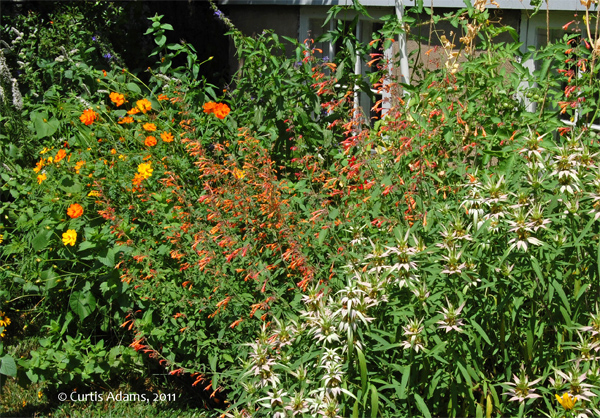
Mixed border with Cosmos, Agastache and Spotted Beebalm


I’ll start with some of the warmer shades. I reintroduced the annual Sulfur Cosmos, Cosmos sulphureus, this year (it had been pushed out by the overly vigorous Bearded Beggarticks). These along with Orange Hummingbird Mint, Agastache aurantiaca ‘Navaho Sunset’, and the Spotted Beebalm, Monarda punctata, form a rather dense border on the south side of the house. 
 

A self-seeded Blood Sage


 Mixed in with these are a few Blood Sage, Salvia coccinea, a Texas native that reseeded from last year. Overall the red shades are underrepresented, the only other red is some Drummond Phlox, Phlox drummondii, also from Texas.


A native bee is sampling from a Wine Cup


For a really hot magenta I have Wine Cups, Callirhoe involucrata, native to the central U.S. This viney perennial has been doing well on it’s own for 5-6 years on the east side of the house. 


Cooling down to the pinks, I have been really surprised with the Pink Tickseed, Coreopsis rosea; a Massachusetts native. It prefers moist soils and this one seems very happy growing in a crack in the driveway. There must be runoff collecting under the pavement. Another pink flowering native I have is Butterfly Gaura, Gaura lindheimeri. While native to Texas and Louisiana, it can be found growing in many gardens in the Northeast.

This Pink Tickseed has been growing in the driveway for more than 5 years.


Butterfly Weed

A new addition for me is the orange Butterfly Weed, Asclepias tuberosa. As it is quite drought tolerant, I’m trying it out in the ‘Hell Strip’ along the road.  This area is exposed to a lot of sun and it is difficult to get water to soak in.  Hopefully this tap-rooted plant can get established here.


Yellow seems to be the most commonly seen color for native plants. You see Black-eyed Susans and Yellow Coneflowers everywhere. I have them too. A couple of less commonly used species are the Prairie Coneflower, Rabitida pinnata, with its paler, more lax petals, and Whorled Rosinweed, Silphium trifoliatum. The coneflower has been just getting by, popping out from a dense border of Purple Coneflowers and a variety of native asters. On the other hand the Rosinweed stands tall (actually it leans forward) in the dry shade under a Norway Maple.

Whorled Rosinweed, leaves in whorls of three.


Prairie Coneflower


Inland Sea Oats turn golden in fall.
There is lots of green in the garden from all the leaves, but there are also some other green features. The green flowers of my Strawberry Blite, Chenopodium capitatum, are forming now, to be followed by bright red berries. Also there are grasses, such as the Inland Sea Oats, Chasmantheum latifolium, shown here.


'Victoria'


Moving on to blue, may last post was about the American Bellflower that is all over my garden. Instead I’ll show you the Mealycup Sage, Salvia farinacea ‘Victoria’, that I have in my flower boxes. This tender perennial native to the south-central U.S. it a common garden annual available at many nurseries in the Northeast. While not native up here it does get a fair amount of traffic from both native and honey bees.


For lavender I’ll show you my Wild Petunias, Ruellia humilis. This plant is native to the Eastern U.S., but not New England. I started this one from seed in 2007 and it slowly spreading into some of the sunnier and drier spots around the house.

Wild Petunia, late to emerge,
but in full bloom in early July.


Of course there is the ever popular Purple Cone Flower, Echinacea purpurea. Mine are from seed and I am seeing a lot of variation in size and color. Instead I’ll show the less popular Swamp Verbena, Verbena hastata. This somewhat weedy plant is found all over North America. It reseeds vigorously and will grow under a wide variety of conditions. I have been cutting mine back by half in mid-June to control their size and get a few more blooms. I started seeds for both the species (violet) and a naturally occurring pink form, ‘Rosea’, in 2008. As you can see I am still seeing examples of each, though the violet is much more prevalent.
A pink form of Swamp Verbena along with the more common Violet form.

Philadelphia Fleabane is found throughout North America


I have no black native flowers, but I do have a lot of white ones. There’s the long-blooming shrub Meadowsweet, Spiraea latifolia, the Bigleaf Asters, now known as Eurybia macrophylla, and purple-leaved Heuchera villosa. All of which I grew from seed from the New England Wildflower Society. Here I have Philadelphia Fleabane, Erigeron philadelphicus, that just blew in on its own.


Blooming is not over, there are still more plants to come, but it nice to see everything that is going on despite the heat of summer.