Showing posts with label Silphium. Show all posts

Monday, July 16, 2012

Early Summer Blooms

Bees visit American Bellflower in both sunny
and shady locations
Now that we are getting into the hot days of summer, blooming of many native plants and the associated pollinator activity are picking up.  Here at home I saw my first Monarch Butterfly in many years.  You'll have to take my work for it, since it was gone by the time I got my camera.

One plant that has been blooming for awhile is the American Bellflower, Campanulastrum americanum.  This is particularly attractive to a medium sized black bee, probably a Miner Bee.  This plant blooms nearly as well in the shade as it does in the sun.


This Miner Bee is the primary visitor to the Bellflower
This Miner Bee draws nectar from the open face of the flower.  To do this it lands on the stamen and style of the flower.  Apparently the flower's stigma is situated to receive pollen from the bee as it makes its approach to the flower.


Nearby, on the sunny side of the driveway the Echinacea is in full bloom.  These attract a variety of pollinators, such as this Green Sweat Bee.  The Meadowsweet, Spiraea latifoia, has finished it's first round of blooms.  This year I cut some of the plants back significantly to keep the growth in check.  (I'm pretty sure it will put out a second growth.)  So for now the bees will be visiting other flowers for pollen and nectar.


It's interesting to note that with all the activity on the native flowers, I have seen very few insects visiting the flowers on my nearby shrub rose (other than a couple of Japanese Beetles).

Another early bloomer in the dry shade of my Norway Maple is Rosin Weed, Silphium integrifolium.  I chose this species of of Silphium because it does not get as big as the more familiar Cup Plant, S. perfoliatum.  This plant has slowly been expanding its mass, but I have not seen it show up in other parts of the garden.

A Hover Fly monitoring a cluster of Rosinweed blooms.


The flowers on this particular plant tend to form on the shady side.
This makes for a difficult photograph.

A new native annual that I'm trying out this year is Partridge Pea, Chamaecrista fasciculata.  This plant will grow in poor, dryish soils.  So far I'm favorably impressed.  One grouping that I planted near a highway is growing and blooming, despite receiving no additional moisture, other than the small amount of rain this summer.  Like its relative the Sensitive Plant, its leaves will fold up when the plant is handled roughly.  The leaves also fold up when it gets dark.  I wonder if this behavior helps it to survive under dry conditions (by limiting transpiration).


Some drifts are still intact, like the lavender-color Beebalm, Monarda fistulosa;
the orange Butterflyweed has blown over from another part of the
Wildflower Meadow at Mount Auburn Cemetery.
A Monarch Butterfly passing over
some Beebalm and Hoary Vervain


Over at Mount Auburn Cemetery, in Cambridge, MA, there is a good sized native wildflower meadow installed about 5 years ago.  Here I have seen many more butterflies than in my urban backyard.  This meadow features a number of native grasses as well as many showy flowering plants.  The original planting had the plants arranged in drifts, but the management plan is to let the plants move around as they will, to create a dynamic garden with plants finding there best locations.

In another part of the cemetery I noticed this Bottlebrush Buckeye, Aesculus parviflora, in full bloom.  While native to the Southeastern US, this shrub is very attractive to the bees up in the Northeast.  I spent some time watching how the bees interacted with the flower.  It was more like a mugging than a gentle approach to sip some nectar.  The bee grabs onto to the outside of the flower and extracts nectar from between the petals and the calyx.  In the process the bee's abdomen rubs all over the anthers and the stigma, thus achieving pollination of the flower.  


This bee on the Buckeye flower is about 1.5" long.

Other flowers are about to open up here, like the Scarlet Sage, Woodland Sunflower and Prairie Coneflower, so the show has only just begun.

Thursday, October 20, 2011

Under the Norway Maple - Part 2

As the growing season is slowly coming to a close I thought I would revisit the status of the native species I have be evaluating under my Norway Maple.  There have been some improvements and some failures and one plant that I thought I lost has returned in a different spot.  In general many of the plants continuing to grow, only slower and smaller due to competition from the mature Maple.


Maturing berries of Winterthur Viburnum start off
bright green, then turn pink, then finally dark blue.
First the good news.  After 4 years of growing with no berries, I finally got a good crop from my Winterthur Viburnum (Viburnum nudum 'Winterthur').  While it had been slogging along at the edge of the tree canopy, it produced no fruit until I brought in a native form last fall.  This year, with the cross pollination, mature berries were produced for the first time here.

Another plant the seems to be catching on is the Northern Sea Oats (Chasmantheum latifolium) that I moved in last year.  These overwintered and grew fairly well in the shade along the back fence.  I would like this grass to grow up and obscure the chain-link fence.  A new addition, that seems to be working out is the Bluestemmed Goldenrod (Solidago caesia).  The native habitat for this plant is in open woods, so at least this plant is used to the shade.


The Northern Sea Oats are doing well along the fence. 
The new Bluestemmed Goldenrod is in full bloom (late September)
and the Witchhazel is just getting started 

The Green and Gold (Chrysogonum virginianum) that I thought had faded away returned in a new spot and looked healthier this year than when it was first planted 4 years ago. 

I transplanted a lot of 2nd year American Bellflowers (Campanulastrum americanum, a biennial) along the back edge of the garden.  These did well though early and mid-summer until they died out after completing their bloom cycle.  The test will be whether new plants return from the seed. 

The biennial Allegheny Vine (Adlumia fungosa) did not come back with any new seedlings this year (unless they were lost in the spreading Virginia Creeper).  A new addition that I thought would work but did not do well was Canada anemone (Anemone canadensis); I will keep a eye out for this next spring.

Successes
Other plants that are expanding are:
The Rosinweed is standing tall while the Smooth Aster
and Showy Goldenrod have flopped forward toward the sun.
American Pennyroyal (Hedeoma pulegioides, an annual returning from seed), Smooth Aster (Symphyotrichum laeve), Heartleaf Aster (Symphyotrichum cordifolium), Rosinweed (Silphium integrifolium), Showy Goldenrod (Solidago speciosa), Virginia Creeper (Parthenocissus quinquefolia, now the dominant grond cover), and Wafer Ash (Ptelea trifoliata).

I should give a shout out to the Rosinweed.  While it does not have the prettiest flowers, it was in bloom all summer.  Then, I cut the spent blooms back to some new flower buds and got the second flush shown in the photo.  (Cutting back when no buds are present just leaves you with a leafy stem; I tried that last year.)


Plants holding their own:
  
Christmas Fern, Bellwort and Wild Bleeding Heart
have looked good all season.
 Male Fern (Dryopteris filix-mas), Christmas Fern (Polystichum acrostichoides), Rosey sedge (Carex rosea), Alumroot (Heuchera villosa),  Black Huckleberry (Gaylussacia baccata), Black-eyed Susan (Rudbeckia hirta), Lowbush Blueberry (Vaccinium angustifolium), Dutchman's Pipe (Aristolochia macrophylla), Largeflower bellwort (Uvularia grandiflora), Twinleaf (Jeffersonia diphylla), Wild Bleeding Heart (Dicentra eximia), Witchhazel (Hamamelis virginiana )


Fading or gone:
Barren Strawberry (Waldsteinia fragariodes) has disappeared and the Canada Mayflower (Maianthemum canadense) was down to only two sprigs in the spring before it disappeared.  Hairy Solomon’s Seal (Polygonatum pubescens) has been in this area for 4 years but it now seems to be in decline.  I put in a new one this fall and am hoping for its return.

Plants that should work, planned for next season:
Last year I planned to put in Labrador violet (Viola labradorica) and Maple-leaf viburnum (Viburnum acerifolium) but didn't.  I'll try to get those for next spring.  I will will also give the Canada Anemone another shot.  I also have some Large-leaf Aster (Eurybia macrophylla) that I should move over, seeing as it usually does well in dry shade.
In addition to using plants that are strong competitors that can get their share of moisture there are some maintenance practices that will help the understory plants survive under the Norway Maple (or other mature tree for that matter).  Limbing up and thinning the canopy to let in more sunlight helps a lot. Also, new plants should be irrigated deeply the first year to get them established, as well as under droughty conditions (mid-summer). I have a rain barrel with a special low pressure soaker hose to help with this.  Returning the leaf mulch to the understory area helps to build the soil.

Friday, July 29, 2011

A Rainbow of Colors


As I was trying to think of some deep topics to discuss on my blog in late July, I was working in the garden and realized that just about everything was in bloom. In fact there are North American natives blooming in all the colors of the rainbow right now. So I thought I would share examples of each color from my garden.


Mixed border with Cosmos, Agastache and Spotted Beebalm


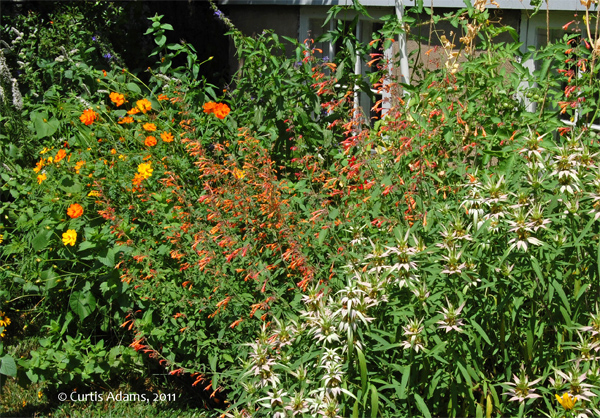
I’ll start with some of the warmer shades. I reintroduced the annual Sulfur Cosmos, Cosmos sulphureus, this year (it had been pushed out by the overly vigorous Bearded Beggarticks). These along with Orange Hummingbird Mint, Agastache aurantiaca ‘Navaho Sunset’, and the Spotted Beebalm, Monarda punctata, form a rather dense border on the south side of the house. 
 

A self-seeded Blood Sage


 Mixed in with these are a few Blood Sage, Salvia coccinea, a Texas native that reseeded from last year. Overall the red shades are underrepresented, the only other red is some Drummond Phlox, Phlox drummondii, also from Texas.


A native bee is sampling from a Wine Cup


For a really hot magenta I have Wine Cups, Callirhoe involucrata, native to the central U.S. This viney perennial has been doing well on it’s own for 5-6 years on the east side of the house. 


Cooling down to the pinks, I have been really surprised with the Pink Tickseed, Coreopsis rosea; a Massachusetts native. It prefers moist soils and this one seems very happy growing in a crack in the driveway. There must be runoff collecting under the pavement. Another pink flowering native I have is Butterfly Gaura, Gaura lindheimeri. While native to Texas and Louisiana, it can be found growing in many gardens in the Northeast.

This Pink Tickseed has been growing in the driveway for more than 5 years.


Butterfly Weed

A new addition for me is the orange Butterfly Weed, Asclepias tuberosa. As it is quite drought tolerant, I’m trying it out in the ‘Hell Strip’ along the road.  This area is exposed to a lot of sun and it is difficult to get water to soak in.  Hopefully this tap-rooted plant can get established here.


Yellow seems to be the most commonly seen color for native plants. You see Black-eyed Susans and Yellow Coneflowers everywhere. I have them too. A couple of less commonly used species are the Prairie Coneflower, Rabitida pinnata, with its paler, more lax petals, and Whorled Rosinweed, Silphium trifoliatum. The coneflower has been just getting by, popping out from a dense border of Purple Coneflowers and a variety of native asters. On the other hand the Rosinweed stands tall (actually it leans forward) in the dry shade under a Norway Maple.

Whorled Rosinweed, leaves in whorls of three.


Prairie Coneflower


Inland Sea Oats turn golden in fall.
There is lots of green in the garden from all the leaves, but there are also some other green features. The green flowers of my Strawberry Blite, Chenopodium capitatum, are forming now, to be followed by bright red berries. Also there are grasses, such as the Inland Sea Oats, Chasmantheum latifolium, shown here.


'Victoria'


Moving on to blue, may last post was about the American Bellflower that is all over my garden. Instead I’ll show you the Mealycup Sage, Salvia farinacea ‘Victoria’, that I have in my flower boxes. This tender perennial native to the south-central U.S. it a common garden annual available at many nurseries in the Northeast. While not native up here it does get a fair amount of traffic from both native and honey bees.


For lavender I’ll show you my Wild Petunias, Ruellia humilis. This plant is native to the Eastern U.S., but not New England. I started this one from seed in 2007 and it slowly spreading into some of the sunnier and drier spots around the house.

Wild Petunia, late to emerge,
but in full bloom in early July.


Of course there is the ever popular Purple Cone Flower, Echinacea purpurea. Mine are from seed and I am seeing a lot of variation in size and color. Instead I’ll show the less popular Swamp Verbena, Verbena hastata. This somewhat weedy plant is found all over North America. It reseeds vigorously and will grow under a wide variety of conditions. I have been cutting mine back by half in mid-June to control their size and get a few more blooms. I started seeds for both the species (violet) and a naturally occurring pink form, ‘Rosea’, in 2008. As you can see I am still seeing examples of each, though the violet is much more prevalent.
A pink form of Swamp Verbena along with the more common Violet form.

Philadelphia Fleabane is found throughout North America


I have no black native flowers, but I do have a lot of white ones. There’s the long-blooming shrub Meadowsweet, Spiraea latifolia, the Bigleaf Asters, now known as Eurybia macrophylla, and purple-leaved Heuchera villosa. All of which I grew from seed from the New England Wildflower Society. Here I have Philadelphia Fleabane, Erigeron philadelphicus, that just blew in on its own.


Blooming is not over, there are still more plants to come, but it nice to see everything that is going on despite the heat of summer.


Tuesday, July 6, 2010

What comes after June? Native Blooms for the 4th of July

When I changed the calendar over from June to July I felt a little sad because it is really too late to put in any new plants in the ground for the season. Of course, I really should have finished all that at the beginning of June. But then I started to look around the garden and found that many of the native plants I have were just starting to bloom. For some, I think they are 2-3 weeks ahead of time due to the warm and sunny spring we had this year in the Boston area. Here is a round-up of my native plants that are in bloom at the beginning of July.


Winecups, Callirhoe involucrata, was one my first North American natives that I put in. The first time I saw it was during a wildflower photography class I took in the Ft. Worth area. This native to the west-central US, has settled nicely into a sunny spot in front of my house. In this photo it is backed up by a clump of Northern Sea Oats, with their newly formed seed stalks.


The Purple Coneflower, Echinacea purpurea, shown here was grown from wild seed that I got from NEWFS. These plants show quite a bit of variation in the blossoms and sizes of the plants. For me, I like the surprise of finding an unexpected flower, or plant, in the garden.


Whorled Rosinweed, Silphium trifoliatum, is a very unfortunate name for this tough native perennial. It is slightly smaller than the more familiar and more fortunately named Cup Plant (Silphium perfoliatum). I have had these plants growing within the dripline of a Norway Maple for 3-4 years and they are multiplying, that’s a tough plant!


Big-Leafed Aster, Aster macrophyllus (now Euribia macrophylla) grows well in dry shade and will spread by seed and underground runners. My colony started as a single plant and is now beginning to dominate the space. I think this one is blooming several weeks early this year. It provides some interest in what can sometimes be a very drab location. Another similar native plant for dry shade is the White Wood Aster, but that doesn’t bloom until fall.
  

Pink Tickseed, Coreopsis rosea, can be tricky to grow. This colony moved from the border to some cracks in the driveway and has been going strong for over 5 years. I tried moving some back into ‘good’ soil but the plants couldn’t handle the competition. I likes moist soil, so maybe there is runoff being channeled under the asphalt.


Wild Petunia, Ruellia humilis, will bloom for at least 2 months starting in late-June. It can survive dry conditions in poor soil, but it is not a strong competitor when mixed with other plants in good soil.


The next three plants are from my Native Annuals Experiment.  One is a return from seed and the other two are new for me. 

 
Beach Sunflower, Helianthus debilis, has retuned from seed from last year’s plants. This annual sunflower is a cultivar called ‘Pan’. 

Lacy Phacelia, Phacelia tanacetifolia, is an annual from the southwestern deserts. While it is reported to tolerate hot dry conditions, our recent heat wave has cooked at least one plant (3 weeks with no rain can be tough). These plants are recommended as an agricultural cover crop and as a great nectar source.  This one is only 6" tall, but it normally grows to 3' tall.  There are precautions about not letting it go to seed, as this species can get weedy.


 Annual Indian blanket, Gaillardia pulchella, is from one of the seed packets I got at the Wildflower Center in Austin. Compared to the hybrid and perennial Blanket Flowers this one appears to have a more relaxed habit.