Showing posts with label Coreopsis rosea. Show all posts

Thursday, June 13, 2019

Designing with Native Plants


Designing with native plants is not that different from designing with any other plant palette.  You still use basic design concepts, using the shapes, colors and textures of plants to create rhythm and flow in the landscape.  What is different is that your selection of plants is more focused on native species, ideally ones that are regionally or locally native.

Advantages


What you gain from using native species in your landscape is greater benefit to the nearby wildlife, better fit with the local ecology and character of the region, and, if your plant selection was right lower maintenance and increased sustainability.

There are North American native plants species that will grow under just about any landscape situation imaginable.  That doesn't mean that any North American plant will grow anywhere in North America.  Beyond the many geographic climate zones there are also differences in soil chemistry, texture, moisture, exposure to sunlight and competition both from other plants as well as animals.

By looking at nearby native plant communities you can get some inspiration about what to combine in your landscape.  At Mount Auburn Cemetery in Cambridge MA they created a meadow using many species of grasses and wildflowers native to the Northeast. 


This constructed 'Northeast Meadow' features showy goldenrod (Solidago speciosa),
little bluestem (Schizachyrium scoparium), New England blazing star (Liatric scariosa), hyssopleaf thoroughwort (Eupatorium hyssopifolium) and brown-eyed Susan (Rudbeckia triloba).


When I was designing a planting for a sloping path I selected some species that I observed along a nearby hiking trail in Maryland Heights.

Bottlebrush grass (Elymus hystrix) and clustered mountain mint
(Pycnanthemum muticum) are major components of this hillside garden.


While I stress about how you need to match plants to their ideal conditions, there are often surprising exceptions.  Test their adaptability by trying a plant or two in unusual locations, they just might catch hold.  This is why I like to use natives that produce a lot of seed, particularly native annuals.  The seed is able to spread around and find new places to grow, some of which will be a good fit.


This pink tickseed was originally planted in a near-by bed but found a better home when seed fell into a crack in the driveway.


Challenges

Some natives are generalists and are able to grow well under a wide variety of conditions.   Others are more specialized, having adapted to some very specific growing conditions.  Some of the frustration of working with natives is that while it is implied that they are adapted to grow in North America, a given native will not necessarily do well everywhere on the continent. 

Another factor to realize is that residential landscapes often have very different soil conditions than near-by natural areas.  Depending on where they are located around a building, light exposure and moisture levels can also be very different from undisturbed areas.  Newer construction areas often have compacted soils.  Many times the native top soil has been removed and replaced with soil from another location.

Reasons for failure of new plantings include competition from other plants, incorrect soil chemistry, texture or drainage, or missing  companion plants.  Also consider age of plants and the original conditions when they were planted.  Many shrubs growing in shade were planted when there was less competition both for light and root space.  Planting new specimens into an established wooded area is more challenging now than when the area was originally planted.  I have been fooled into planting new rhododendrons under established shade trees based on seeing mature shrubs in woodland settings.  In many cases, there is too much competition in the root zone for water and nutrients and too much shade cover for the new plants to get established.  Options here include opening up or raising the tree canopy, clearing a wider root zone (without damaging the existing trees), or  opting for more shade tolerant species.

Sometimes when I see native species dominating some harsh environmental conditions and I think, wow that could grow anywhere.  That is often faulty reasoning.  In many cases these plants excel because they have adapted to those conditions in specific ways to use those harsh conditions to their advantage to out compete other species.  


Rock harlequin will excel in thin rocky soils but does
 not compete well in normal soils against other plants.

One example is rock harlequin (Corydalis sempervirens) a short lived perennial that needs to reseed itself to maintain a garden presence. It's native to rocky slopes in the Northeast where there are shallow pockets of soil and exposure to full sun for a good portion of the day.  When planted in richer soil or 'better' conditions it often fails due to competition from other plants. 

Almost all plants in nature grow in a community of some sort.  There are a few  species that require a host plant to help them grow and develop.  Indian paint brush (Castilleja sp.) tap into the roots of neighboring plants, such as little bluestem or penstemons, for nourishment.  False foxgloves (Aureolaria sp.) are partially parasitic on the roots of oak trees.  And , like many members of the pea family, Texas bluebonnets (Lupinus texensis and sp.) do better when there are specific soil bacteria present to help them fix nitrogen. 


Texas bluebonnets are winter annuals that blanket open fields with their iconic blue and white flowers in early spring.  They are well adapted to the calcareous soils with the assistance of a soil bacteria.  Performance in other regions is erratic. 


Plant Selection and Sources


The nature of native plants are that they are native to particular areas of the country based on climate, soil chemistry and evolutionary history. As such there are very few 'nationally native' plants, nor should there be.  If you search the garden centers you can often find sections devoted to native plants.  The nice thing about many commercially available native plants, though there may not be many of them, is that most have been selected to be commercially viable, that is they work in many residential situations and are fairly robust.  We need to expand the offerings by asking for more of these plants.  American Beauties is one program based in the Northeast that is supplying a variety of native species.  There are also a number of native plant suppliers that you can find on the web.   Izel Plants is a clearing house for a number of native plant nurseries primarily in the Eastern US and has an extensive catalog of native species.  The Plant Native link below also has listings of native plant nurseries by state.   You can also search the web for nurseries in your region that specialize in native plants. 

To help with the selection of which species to use there are a number of websites that allow you to search for plants based on the site conditions.  You can find plant search websites for a given area by using search terms like 'Native Plant Database for  '  My favorite site to search is from the Wildflower Center.  It allow you to search by where a plant is native as well as specific growing conditions and plant attributes such as size and bloom color.  Plant Native is another good site.  While the plant lists are smaller, the plants listed are mostly commercially available.  Missouri Botanical Garden has an excellent search platform, but it is not solely native species.

Strategies for Designing with Native Species

  • Try to match the preferred conditions/habitats of a new plant to your local conditions (much easier than trying to match your conditions to those of a given plant).
  • Start small, when in doubt.  Before doing a massive planting put in a couple of plants as a test to see if they survive.
  • Try a new species in a couple of different locations to see where it grows well. 
  • Don't just drop a new plant into an established bed.  Clear some area to allow for roots to get established without competition.  Also open up the canopy to let in some light.  Water well, but don't feed perennials, shrubs or trees until the roots are established (about one growing season).
  • Build a plant community by learning about which plants grow together in nature.
  • When starting perennials from seedlings, like you get with liners or sizes one quart or smaller, it will take as many as three seasons for them to reach their full glory.  The adage 'sleep, creep, then leap' really does hold true when start from small specimens.


Sunday, February 5, 2012

Winter Weeds, Part 1


On nice winter days it is fun and interesting to take a walk through some of the wilder areas to see what plants are still standing.  An excellent guide book for this is Weeds in Winter by Lauren Brown.   This book has all kinds of useful information for winter plant ID in New England.  There’s a glossary of terms, a dichotomous key for plants described in the book and some really great illustrations of the winter appearance of these plants.  

Since this winter has been so mild in southern New England, I was able to find many of these plants right around my house.  These normally would have been crushed under piles of snow.  In fact, I found so many of them I need to split this post into two parts.  Most of these photos were taken at the end of January this year.  Here is the first of two installments of photos of my winter weeds.  

This Prairie Aster retains its strong
stems through the winter
These photos are roughly in alphabetical order.  I had already decided on the order when I remembered the name changes for the asters, so Symphyotrichum is coming first.
Aster can be difficult to ID in the winter.
Fortunately, I remembered which is which in this case.
Many of these native asters have long lasting stems.  For example, the 'bush' on the far right in the topmost photo is a Prairie Aster.

The Bigleaf Aster still has some of its seeds.
When I came across this old stem of the American Bellflower I was not sure what I was looking at.  After I few minutes I remember what had been growing in that location and narrowed it down to this species.  One advantage of using the plants around the house is that ID is a lot easier than when working in the field.
American Bellflower has distinctive seed capsules.

Sweet Pepper Bush looks like a tangle of branches in winter.  Closer examination of the older branches shows that it has exfoliating bark.  It is more easily identified by its flower spikes that stay on through the winter.
The long styles of the pistil are retained
on these dried Sweet Pepper Bush flowers.

I usually don't see the Pink Tickseed in winter.  It's growing out of the driveway and is usually covered with snow.  On close examination you can see the narrow little leaves have already started coming up.
Pink Tickseed is only 6-8" tall.


The new buds on this Sweetfern are beginning to swell.
The hairs on the stem really show up in the afternoon light.


The low angle of the sun really enhances the appearance of the stems and spent flowers of these plants.  This is particularly true for the taller plants like these River Oats.

The seeds of the River Oats are shed
slowly over the coarse of the winter.

Purple Coneflower is one of the easier plants to identify.  The old flowers retain their cone-shape even thought the seeds are long gone, either eaten by birds or scattered in the wind.
Seeds of the Purple Coneflower are all gone now

Even though it's dried up American Pennyroyal
still has its minty scent.
The last plant in this post is the American Pennyroyal.  This low growing annual is usually buried under snow there is nothing left of it when the snow melts.  The dried calyxes are arranged in whorls around the stem.  These are much easier to see now that all the leaves are gone.

Well pregame is nearly over, so it's time to close down the computer and start watching the Super Bowl.

Go Pats!!!!


Friday, July 29, 2011

A Rainbow of Colors


As I was trying to think of some deep topics to discuss on my blog in late July, I was working in the garden and realized that just about everything was in bloom. In fact there are North American natives blooming in all the colors of the rainbow right now. So I thought I would share examples of each color from my garden.


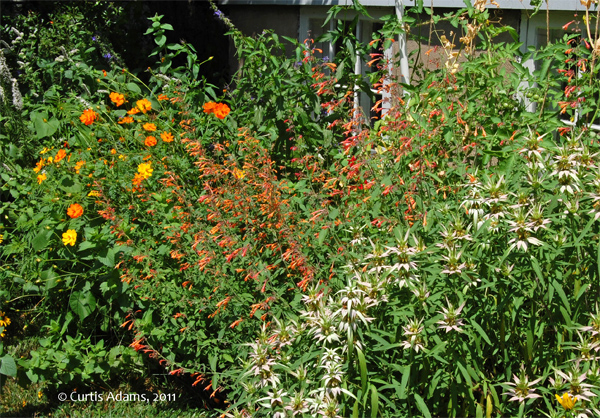
Mixed border with Cosmos, Agastache and Spotted Beebalm


I’ll start with some of the warmer shades. I reintroduced the annual Sulfur Cosmos, Cosmos sulphureus, this year (it had been pushed out by the overly vigorous Bearded Beggarticks). These along with Orange Hummingbird Mint, Agastache aurantiaca ‘Navaho Sunset’, and the Spotted Beebalm, Monarda punctata, form a rather dense border on the south side of the house. 
 

A self-seeded Blood Sage


 Mixed in with these are a few Blood Sage, Salvia coccinea, a Texas native that reseeded from last year. Overall the red shades are underrepresented, the only other red is some Drummond Phlox, Phlox drummondii, also from Texas.


A native bee is sampling from a Wine Cup


For a really hot magenta I have Wine Cups, Callirhoe involucrata, native to the central U.S. This viney perennial has been doing well on it’s own for 5-6 years on the east side of the house. 


Cooling down to the pinks, I have been really surprised with the Pink Tickseed, Coreopsis rosea; a Massachusetts native. It prefers moist soils and this one seems very happy growing in a crack in the driveway. There must be runoff collecting under the pavement. Another pink flowering native I have is Butterfly Gaura, Gaura lindheimeri. While native to Texas and Louisiana, it can be found growing in many gardens in the Northeast.

This Pink Tickseed has been growing in the driveway for more than 5 years.


Butterfly Weed

A new addition for me is the orange Butterfly Weed, Asclepias tuberosa. As it is quite drought tolerant, I’m trying it out in the ‘Hell Strip’ along the road.  This area is exposed to a lot of sun and it is difficult to get water to soak in.  Hopefully this tap-rooted plant can get established here.


Yellow seems to be the most commonly seen color for native plants. You see Black-eyed Susans and Yellow Coneflowers everywhere. I have them too. A couple of less commonly used species are the Prairie Coneflower, Rabitida pinnata, with its paler, more lax petals, and Whorled Rosinweed, Silphium trifoliatum. The coneflower has been just getting by, popping out from a dense border of Purple Coneflowers and a variety of native asters. On the other hand the Rosinweed stands tall (actually it leans forward) in the dry shade under a Norway Maple.

Whorled Rosinweed, leaves in whorls of three.


Prairie Coneflower


Inland Sea Oats turn golden in fall.
There is lots of green in the garden from all the leaves, but there are also some other green features. The green flowers of my Strawberry Blite, Chenopodium capitatum, are forming now, to be followed by bright red berries. Also there are grasses, such as the Inland Sea Oats, Chasmantheum latifolium, shown here.


'Victoria'


Moving on to blue, may last post was about the American Bellflower that is all over my garden. Instead I’ll show you the Mealycup Sage, Salvia farinacea ‘Victoria’, that I have in my flower boxes. This tender perennial native to the south-central U.S. it a common garden annual available at many nurseries in the Northeast. While not native up here it does get a fair amount of traffic from both native and honey bees.


For lavender I’ll show you my Wild Petunias, Ruellia humilis. This plant is native to the Eastern U.S., but not New England. I started this one from seed in 2007 and it slowly spreading into some of the sunnier and drier spots around the house.

Wild Petunia, late to emerge,
but in full bloom in early July.


Of course there is the ever popular Purple Cone Flower, Echinacea purpurea. Mine are from seed and I am seeing a lot of variation in size and color. Instead I’ll show the less popular Swamp Verbena, Verbena hastata. This somewhat weedy plant is found all over North America. It reseeds vigorously and will grow under a wide variety of conditions. I have been cutting mine back by half in mid-June to control their size and get a few more blooms. I started seeds for both the species (violet) and a naturally occurring pink form, ‘Rosea’, in 2008. As you can see I am still seeing examples of each, though the violet is much more prevalent.
A pink form of Swamp Verbena along with the more common Violet form.

Philadelphia Fleabane is found throughout North America


I have no black native flowers, but I do have a lot of white ones. There’s the long-blooming shrub Meadowsweet, Spiraea latifolia, the Bigleaf Asters, now known as Eurybia macrophylla, and purple-leaved Heuchera villosa. All of which I grew from seed from the New England Wildflower Society. Here I have Philadelphia Fleabane, Erigeron philadelphicus, that just blew in on its own.


Blooming is not over, there are still more plants to come, but it nice to see everything that is going on despite the heat of summer.