Showing posts with label Salvia. Show all posts

Thursday, July 3, 2014

Visit to Martha Walker Habitat Garden in Napa, CA


In mid-June we had an opportunity to return to the Napa/Sonoma valley region of California.  Most of this trip was involved with tasting some really good wine.  Between tastings we took in some beautiful scenery along the Russian River and the Coastal redwoods near Bodega Bay.   One morning in Napa we paid a visit to the Martha Walker Native Habitat Garden.  

While I grew up in California and learned something of the state's ecology, all of my plant ID skills were learned on the East Coast.  I was a little overwhelmed at first not knowing the plants that I was looking at.  I did find some plant tags to get started.  After a while I started recognizing relatives to plants that I knew from the East.

Here are some photos of some of the plants I recognized.  (There are many more that I don't.)   The Calflora.org website was helpful in confirming some of the ID's.

The California Poppy was in bloom throughout the region.
It does well on well drained soils.


The California Buckeye was also in full bloom in the middle of June.
The palmate leaves and large panicles of flowers are similar to the eastern species.

It was easy to spot this Western Sycamore.  Note that the seed pods are hanging in a chain (raceme).
This is different from the American Sycamore (P. occidentalis) which has singly borne pods
and London Plane (P. x acerfolia) which has pairs of pods. 


When I saw this branch I immediately thought of our Eastern Redbud (C. canadensis).
 I found the tag indicating that it was a Western Redbud.  Instead of having
heart-shaped leaves of the eastern species, these are roundish,
many with an indention at the tip (retuse).


This Spiraea looks a lot like Steeplebush (S. tomentosa),
but that species is not listed as native to California.
 It may be S. douglasii, Rose Spiraea


Here is one of many Monkey Flowers in the garden.
There are over 70 species of Mimulus native to California.
I put some Allegheny Monkey Flower (M. ringens) in my garden
at home this year and am still waiting for it to bloom.

This is one of the many oak species in California (I couldn't find a label).
This is a quintessential tree to the coastal hills and valleys.

The dappled shade under the oak tree provided a very soothing resting spot.  

I had to look on the Calflora site to learn about this Matilija Poppy.
There are two very similar species on Romneya.  These plants
were common along the highways in Napa. (Note the state bird in the background.)


This is one of a number of Sage species in the garden.  I liked this one
because of the interesting form of the spent flowers.
I can image this having an impact all through the summer and fall.


If you are in the Napa Valley area I highly recommend a visit to the Martha Walker Garden for an overview of many native California plants grouped according to their natural habitats.

Friday, July 29, 2011

A Rainbow of Colors


As I was trying to think of some deep topics to discuss on my blog in late July, I was working in the garden and realized that just about everything was in bloom. In fact there are North American natives blooming in all the colors of the rainbow right now. So I thought I would share examples of each color from my garden.


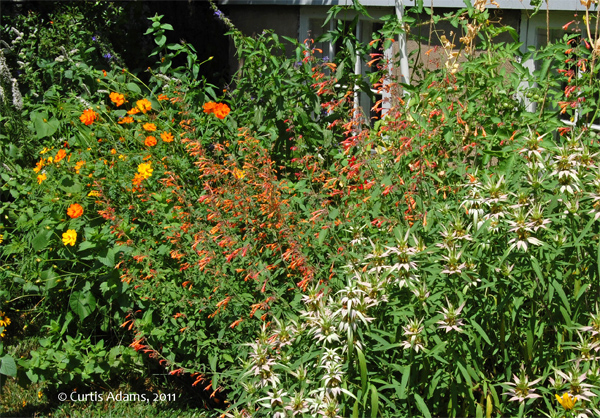
Mixed border with Cosmos, Agastache and Spotted Beebalm


I’ll start with some of the warmer shades. I reintroduced the annual Sulfur Cosmos, Cosmos sulphureus, this year (it had been pushed out by the overly vigorous Bearded Beggarticks). These along with Orange Hummingbird Mint, Agastache aurantiaca ‘Navaho Sunset’, and the Spotted Beebalm, Monarda punctata, form a rather dense border on the south side of the house. 
 

A self-seeded Blood Sage


 Mixed in with these are a few Blood Sage, Salvia coccinea, a Texas native that reseeded from last year. Overall the red shades are underrepresented, the only other red is some Drummond Phlox, Phlox drummondii, also from Texas.


A native bee is sampling from a Wine Cup


For a really hot magenta I have Wine Cups, Callirhoe involucrata, native to the central U.S. This viney perennial has been doing well on it’s own for 5-6 years on the east side of the house. 


Cooling down to the pinks, I have been really surprised with the Pink Tickseed, Coreopsis rosea; a Massachusetts native. It prefers moist soils and this one seems very happy growing in a crack in the driveway. There must be runoff collecting under the pavement. Another pink flowering native I have is Butterfly Gaura, Gaura lindheimeri. While native to Texas and Louisiana, it can be found growing in many gardens in the Northeast.

This Pink Tickseed has been growing in the driveway for more than 5 years.


Butterfly Weed

A new addition for me is the orange Butterfly Weed, Asclepias tuberosa. As it is quite drought tolerant, I’m trying it out in the ‘Hell Strip’ along the road.  This area is exposed to a lot of sun and it is difficult to get water to soak in.  Hopefully this tap-rooted plant can get established here.


Yellow seems to be the most commonly seen color for native plants. You see Black-eyed Susans and Yellow Coneflowers everywhere. I have them too. A couple of less commonly used species are the Prairie Coneflower, Rabitida pinnata, with its paler, more lax petals, and Whorled Rosinweed, Silphium trifoliatum. The coneflower has been just getting by, popping out from a dense border of Purple Coneflowers and a variety of native asters. On the other hand the Rosinweed stands tall (actually it leans forward) in the dry shade under a Norway Maple.

Whorled Rosinweed, leaves in whorls of three.


Prairie Coneflower


Inland Sea Oats turn golden in fall.
There is lots of green in the garden from all the leaves, but there are also some other green features. The green flowers of my Strawberry Blite, Chenopodium capitatum, are forming now, to be followed by bright red berries. Also there are grasses, such as the Inland Sea Oats, Chasmantheum latifolium, shown here.


'Victoria'


Moving on to blue, may last post was about the American Bellflower that is all over my garden. Instead I’ll show you the Mealycup Sage, Salvia farinacea ‘Victoria’, that I have in my flower boxes. This tender perennial native to the south-central U.S. it a common garden annual available at many nurseries in the Northeast. While not native up here it does get a fair amount of traffic from both native and honey bees.


For lavender I’ll show you my Wild Petunias, Ruellia humilis. This plant is native to the Eastern U.S., but not New England. I started this one from seed in 2007 and it slowly spreading into some of the sunnier and drier spots around the house.

Wild Petunia, late to emerge,
but in full bloom in early July.


Of course there is the ever popular Purple Cone Flower, Echinacea purpurea. Mine are from seed and I am seeing a lot of variation in size and color. Instead I’ll show the less popular Swamp Verbena, Verbena hastata. This somewhat weedy plant is found all over North America. It reseeds vigorously and will grow under a wide variety of conditions. I have been cutting mine back by half in mid-June to control their size and get a few more blooms. I started seeds for both the species (violet) and a naturally occurring pink form, ‘Rosea’, in 2008. As you can see I am still seeing examples of each, though the violet is much more prevalent.
A pink form of Swamp Verbena along with the more common Violet form.

Philadelphia Fleabane is found throughout North America


I have no black native flowers, but I do have a lot of white ones. There’s the long-blooming shrub Meadowsweet, Spiraea latifolia, the Bigleaf Asters, now known as Eurybia macrophylla, and purple-leaved Heuchera villosa. All of which I grew from seed from the New England Wildflower Society. Here I have Philadelphia Fleabane, Erigeron philadelphicus, that just blew in on its own.


Blooming is not over, there are still more plants to come, but it nice to see everything that is going on despite the heat of summer.