Showing posts with label Erigeron. Show all posts

Friday, December 31, 2021

Why Won't My Garden Grow?

 I’ve noticed that I’ve been having less success growing vegetables from seed in my garden over the past few years.  That is particularly the case for small seeded crops like lettuce and chard.  This is in spite of increased organic fertilization.  True, I don’t water as much as I should for seedlings, but I never do.  I tend to rely on rain.  Still I have become suspicious that something else may be going on.  This has led me to consider allelopathy.  My question is whether there is something that is growing or has grown recently in the garden is affecting the ability of new seeds to germinate and develop?
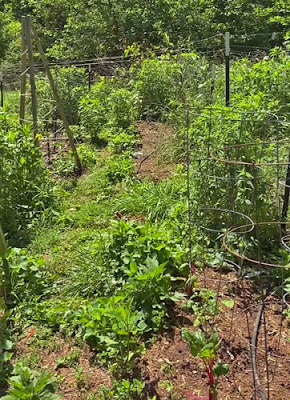
Garden in mid-June: Vegetables still small in
 relatively clean beds, but Monardas
and Rudbeckias are coming on strong.

Allelopathy refers to the beneficial or harmful effects one plant has on another. It arises from the release of allelochemicals from plant tissues though leaching from leaves or roots, volatilization or decomposition of plant parts in or on the soil.  Through these allelochemicals one plant is able to suppress germination or development of other plant species in the immediate area.  In some cases these chemicals may have a beneficial effect on some neighboring species while having a negative effect on others.  There is a lot of research in this area, particularly to find crop plants that are able to produce their own weed suppressive chemicals rather than relying on added herbicides.

There are a couple of non-traditional practices that I have been employing in my vegetable garden that I am beginning to question.  One is that I allow native species to run rampant along the edges and between the rows of vegetables, particularly wild bergamot (Monarda fistulosa) and black- and brown-eyed Susans (Rudbeckia hirta and triloba).  The other is that I leave the roots of the previous year’s plants in place.  I just cut the old plants off at ground level and throw them into the compost pile.  I do this as a means of increasing the organic matter in the soil and reducing soil disturbance. 

Following the adage, “a month in the laboratory can often save an hour in the library” (Frank Westheimer) I decided to do a little research first.  I searched the internet for information on the allelopathic potential of all the native and non-native species that are growing in my vegetable garden.  After searching those, that I turned to looking at the vegetable themselves. 

The tables below list many of the weeds, native species and lastly the vegetables that are common in my garden along with the existence of any documented evidence that these plants possess any allelopathic properties.

Garden Weeds:

Common Name

Botanical name

Evidence of Allelopathy

Chickweed

Stellaria media

        Yes

Ground ivy

Glechoma hederacea

        Yes

Hairy bittercress

Cardamine hirsuta

        No

Indian strawberry

Duchesnea indica

        No

Mulberryweed

Fatoua villosa

        No

Ladies thumb

Polygonum persicaria

        Yes

Nut sedge

Cyperus esculentus 

        Yes

Persian speedwell

Veronica persica

        Yes


Native Annuals & Perennials:

Common Name

Botanical Name

Allelopathic?

Annual sunflower

Helianthus annuus

        Yes

Common Milkweed

Asclepias syriaca

        Yes

Butterfly weed

Asclepias tuberosa

        No?

Common and Daisy Fleabanes

Erigeron philadelphicus and annuus

        Yes

Honeyvine

Cynanchum laeve

        No

Wild Bergamot

Monarda fistulosa

        No

Scarlet beebalm

Monarda didyma

        Yes

Purple Coneflower

Echinacea purpurea

        Yes

False sunflower

Heliopsis helianthoides

        No

Goldenrods

Solidago sp.

Yes (some species, at least)

Browneyed Susan

Rudbeckia triloba

        No

Wild Blackberry

Rubus sp.

        ?

Sealheal

Prunella vulgarus

        No

Pennsylvania smartweed

P. pensylvanicum

        Yes

Wingstem

Verbesina alternifolia

        No*

*Golden crownbeard, V. encelioides, a native of western North America does have allelopathic properties.

Garden Vegetables:

Vegetable

Botanical Name

Allelopathic?

Arugula

Eruca vesicaria ssp. Sativa

        No

Basil

Onicum basilicum

        Yes

Collards

Brassica oleracea var. viridis

        Yes

Cucumber

Cucumis sativus

        Yes

Green Beans

Phaseoleus vulgaris

        Yes

Lettuce

Lattuca sativa

        No

Peppers

Capsicum annuum

        Yes

Squash

Cucurbita pepo

        Yes

Swiss chard

Beta vulgaris var. cicla

        Yes

Tomato

Solanum lycopersicum

        Yes


While doing these searches I came across some interesting studies on the potent allelopathic effects of many invasive species.  This is one of the factors that allow invasive species to outcompete native ones.  One study treated radish seeds with the aqueous extracts from leaves of a number of invasive species.  The radish seeds were then evaluated for germination rate and root growth.  The following list is ranked in order of negative effect on germination, most to least:  Ailanthus altissima, > Microstegium vimineum, Alliaria petiolata, Celastrus orbiculatus,> Ligustrum vulgare, Rosa multiflora, Rubus phoenicolasius, and Acer platanoides.  There are multiple studies that document the allelopathic effects of Japanese knotweed, Polygonum cuspidatum.  It seems that many species of the genus Polygonum have some allelopathic character.

From this research it looks like the fleabanes (Erigeron annuus and philadelphicus) and purple coneflower would be the most likely allelopathic culprits among the native species in my garden.  However, most of the allelopathic candidates on these lists are from the weeds and garden vegetables.  Of these, ground ivy, nut sedge and ladies thumb are the most prolific weeds in my garden.  Among the vegetables in my garden, collards, peppers and cucumber are the most likely suspects to be causing some troublesome effects.

Allelopathy experiments.  In general experiments that measure allelopathy are tricky to interpret.  Many are based on bioassays, where the allelopathic effect is measured by such things as the germination rates and root growth of a target species.  In many cases radish or lettuce seeds are used.  Many of these studies use extracts of leaves, stems or roots of the species being studied applied at various concentrations to isolated seeds of the target species in a Petri dish.  Another approach is to test the soil itself.  Due to the complex nature of plant-soil and plant-plant interactions, most studies on allelopathy are correlative rather than causative. 

To help me understand whether there was a problem with the soil (and all the things that come with it), or the cultural effects like moisture and sunlight, I decided I would try a bioassay comparing surface soil samples from various parts of the yard and garden.  I tested to see how each of these soils affected germination and growth of some lettuce seeds which had performed well when started indoors this past spring.
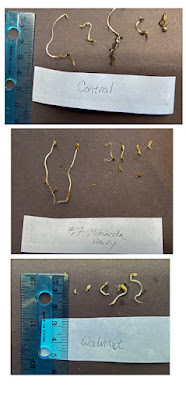
Germinated seeds:  Control (top);
near wild bergamot (middle);
 under English walnut (bottom)
I adapted a procedure from Environmental Inquiry/Cornell University for performing lettuce seed bioassays using materials I had on hand.  I took three samples of surface soil, 0-1/2” deep, from each area of interest.  This is the zone that I normally plant small seeds like lettuce in.  I mixed the soil samples in a baggie then pulled out about a tablespoon’s worth.  This was put into a fresh baggie (as I didn’t have any Petri dishes) and moistened with a few drops of water to make the soil damp, but not wet.  I disinfected the lettuce seeds in dilute bleach, according to the procedure, and then put 8 seeds into each baggie.  The baggies were sealed, put into the dark for 5 days at 60-80°F.  I used a moistened, peat-based seed starting mix as the control.  Samples were taken in November so there was no active growth of vegetables except for the sample near actively growing collards.  I tested the following areas: 1) garden soil under green beans, near daisy fleabane; 2) garden soil under wild bergamot; 3) garden soil near where tomatoes and cucumber had grown; 4) garden soil near collards; 5) typical lawn soil (fescue and weeds); 6) under an English walnut with vinca groundcover.

After five days I separated out the germinated lettuce seeds, counted the number of germinated lettuce seeds and measured the length of the roots.  I found I was able to pluck out the germinated seeds from the soil in the baggies by suspending the entire sample in water with a little dish soap.  This allowed the soil to fall away from the roots without damaging them.  The root growth measurements had a lot of variation.  This is not too surprising considering the many uncontrolled variables, like variable soil moisture and soil contact within each baggie, and small sample size.


Graphical comparison of various soil samples on germination and root
growth of 'New Red Fire' lettuce seeds.

Results and Conclusions

While the differences in root length and germination rate among these samples are not highly significant, due to the small samples size, there is an indication that the soil around the collards is not as favorable to seed germination and growth as any of the other garden samples and is on the order of that for soil under an English walnut tree.  (English walnut, Juglans regia, is much less allelopathic than our native black walnut.)  These results also indicate that the presence of wild bergamot (Monarda) is not detrimental to the initial stages of seed growth.  Another indication was that root growth in the soil around the green beans was less than the control sample.  This is consistent with a study that looked at the effect of leaf extracts of several lines of common beans on seedling growth, including lettuce.  That study made no mention of the effect on seed germination.

Lettuce or radish seed bioassays are also good for checking for herbicide residues in soils and mulches.  General information about testing whole soil samples for herbicide residues can be found at this link from NC State.

Based on the literature it seems like many of the plants in my garden have some degree of allelopathic behavior.  This brings up another important question; how long does that effect last.  The sense I get is that it’s more on the order of weeks than months.  In field trials some brassica family cover crops have shown allelophatic effects on the order of weeks to months after being tilled in. I found another post discussing the use of cover crops, many of which are allelopathic.  It suggested waiting 3 weeks after tilling them in before planting.  Leaving allelopathic plant residues in place as a mulch, will increase the time over which they have the suppressive effect.

 So, based on my little experiment and all the literature I scanned, it seems there is no single clear cut culprit exerting a negative influence on my gardens fertility.  This research has led me instead to a list of suspects and actions to control their effects.   It may be that my practice of leaving roots in the ground, particularly the collards, over the winter may be negatively affecting my gardens ability to grow grow directly from seed. I will need to dig these out at least a month before planting in the spring.  I will also pull out any remaining roots of the curcurbits and chard which remain, as well.  The ubiquitous weeds, particularly chickweed, ground ivy, and ladies thumb need to be removed, especially during the growing season.  As much as I like the prolific flowers of the native daisy fleabane, I will be removing those from the vegetable beds, as well.

Another less traditional garden practice I have been using is flame weeding.  This involves using a hand-held propane torch to kill weed seedlings before they can establish.  This was done prior to planting, or transplanting crops.  An advantage of this practice is that it doesn’t disturb the soil surface.  I have not looked into any literature on possible negative effects of this practice, but for next year I will not use this method in the growing beds themselves. 

So with these changes we will see if I get any better results in the garden, or will I need to dig deeper?

Wishing you all the best for the New Year!!!

Friday, August 23, 2013

Mid-summer's Little Blooms

In the middle of summer there are many big blooming native plants like Cone Flowers and Black-eyed Susans.  A next post I will take a look at some of the 'prettier' natives that are in bloom now.  But this post I will show you some of the natives blooming with small pale or white flowers.  Many of these could be considered weeds, but I had not ID'ed many of them before, and, of course as native species they are part of the 'original' ecology of the area.

This Virginia Stickseed is about 2 feet tall.  The horizontal
sprays of seed pods give it a unique texture.
The first plant that literally caught my attention was Virginia Stickseed, Hackelia virginiana.  As I was clearing stilt grass from a planted area several branches from this plant caught hold of my sleeve.  When I pulled back These branches broke off, transferring the sticky burr-like seeds onto my shirt.  Originally about 4 feet tall, parts of this plant fell over due to the weight of seeds.  Rather than noticing the small white flowers, what I see now is a a textural affect from the horizontal branches laden with burrs.
Here you can see the progression from flower to burr.  This bee fly is a pollinator
 for many small flowers.  Its larvae are parasites that feed on other insects.


This plant has a highly branched forms, others
in less disturbed areas grow as a single upright stem.

Nearby was one of my favorite little natives, Indian Tobacco, Lobelia inflata.  It is not really showy.  The blue flowers are not very big and the small flowers are spaced widely on the stalk.  What I think is so cool are the swollen ovaries (hypanthium) that form after the flower fades.  This feature is the reason for the species name, inflata.  This plant is used as an herbal remedy for many ailments, particularly as an emetic, but it is also quite toxic.  I've tried growing these from seed indoors under lights with limited success.  It seems to grow better as a 'weed', than as a cultivated plant.

Here you can see both the pale blue flowers
and the inflated hypanthium.

The coarsely toothed, oppositely arranged leaves
on long petioles are similar to those of nettles.


White VervainVerbena urticifolia, has spikes of tiny white flowers.  The plant has a rough appearance with its large, coarsely toothed leaves.  The species name uricifolia refers to it having nettle-like leaves.  This is not a particularly attractive plant, but its flowers are visited by a variety of bees and its seeds are consumed by birds.

Here's a closer view of the flowers of White Vervain.  It seems like the tips of the flower stalks are the place for small insects to hang out.

The current botanical name for this
Horseweed is Conyza canadensis.


When I looked past the white Vervain I saw what thought was more of the same, but on second glance I realized that I had yet another plants with little white flowers.  I keyed this one out as Horseweed, Erigeron canadensis, which has been updated as Conyza canadensis. On examination its form is very different from the verbena, with narrow leaves occurring alternately along the stem.  The main similarity was that the flower stalks originated from the leaf axils.  Similar to members of the genus Erigeron, its flower is composite type with many small rays.  This annual is commonly seen in waste areas and fence rows.

A green sweat bee visiting a Horseweed flower.

My last plant for this post was discovered with its flower stalk sticking out of some berry vines in a woodland edge habitat.  Normally I leave a plant in place until I know what it is, but this one had me worried.  It had characteristics of Polygonum (Knotweed) and with its white flowers I immediately thought of Japanese Knotweed.  When I brought the cutting in for examination I learned that it was actually a native knotweed, Polygonum virginianum, aka Jumpseed or Virginia Knotweed.  It is also known and sold as Persicaria virginiana and Tovara virginiana.  This particular specimen had dark green leaves; however many plants have a red chevron on otherwise green leaves.  

This stem got beat up a bit after I pulled it out from a mass of wineberries.
I would have left it alone had I known what it was.
Of these five natives, I think Jumpseed is the most easily adapted to a landscaped garden.  In addition to the red striped leaves and more compact habit, the long flower stalks (up to 3 ft) turn from pale yellow to red as they age.   A cultivar with particularly strong red markings is called 'Lance Corporal'.  Another cultivar called 'Painters Palette' has multicolored leaves.  The biggest negative is that it can reseed vigorously.  Jumpseed does well in dry shade.  I had a client in the Boston area with a large patch of these growing on the north side of the garage in full shade.   I will keep an eye out for more of these so that I can see how the red color develops on the flower stalk.


Friday, July 29, 2011

A Rainbow of Colors


As I was trying to think of some deep topics to discuss on my blog in late July, I was working in the garden and realized that just about everything was in bloom. In fact there are North American natives blooming in all the colors of the rainbow right now. So I thought I would share examples of each color from my garden.


Mixed border with Cosmos, Agastache and Spotted Beebalm


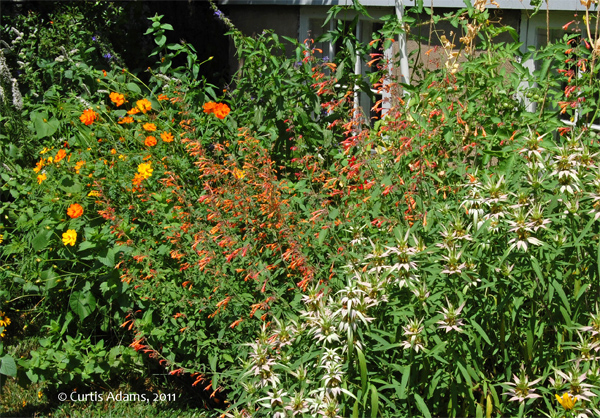
I’ll start with some of the warmer shades. I reintroduced the annual Sulfur Cosmos, Cosmos sulphureus, this year (it had been pushed out by the overly vigorous Bearded Beggarticks). These along with Orange Hummingbird Mint, Agastache aurantiaca ‘Navaho Sunset’, and the Spotted Beebalm, Monarda punctata, form a rather dense border on the south side of the house. 
 

A self-seeded Blood Sage


 Mixed in with these are a few Blood Sage, Salvia coccinea, a Texas native that reseeded from last year. Overall the red shades are underrepresented, the only other red is some Drummond Phlox, Phlox drummondii, also from Texas.


A native bee is sampling from a Wine Cup


For a really hot magenta I have Wine Cups, Callirhoe involucrata, native to the central U.S. This viney perennial has been doing well on it’s own for 5-6 years on the east side of the house. 


Cooling down to the pinks, I have been really surprised with the Pink Tickseed, Coreopsis rosea; a Massachusetts native. It prefers moist soils and this one seems very happy growing in a crack in the driveway. There must be runoff collecting under the pavement. Another pink flowering native I have is Butterfly Gaura, Gaura lindheimeri. While native to Texas and Louisiana, it can be found growing in many gardens in the Northeast.

This Pink Tickseed has been growing in the driveway for more than 5 years.


Butterfly Weed

A new addition for me is the orange Butterfly Weed, Asclepias tuberosa. As it is quite drought tolerant, I’m trying it out in the ‘Hell Strip’ along the road.  This area is exposed to a lot of sun and it is difficult to get water to soak in.  Hopefully this tap-rooted plant can get established here.


Yellow seems to be the most commonly seen color for native plants. You see Black-eyed Susans and Yellow Coneflowers everywhere. I have them too. A couple of less commonly used species are the Prairie Coneflower, Rabitida pinnata, with its paler, more lax petals, and Whorled Rosinweed, Silphium trifoliatum. The coneflower has been just getting by, popping out from a dense border of Purple Coneflowers and a variety of native asters. On the other hand the Rosinweed stands tall (actually it leans forward) in the dry shade under a Norway Maple.

Whorled Rosinweed, leaves in whorls of three.


Prairie Coneflower


Inland Sea Oats turn golden in fall.
There is lots of green in the garden from all the leaves, but there are also some other green features. The green flowers of my Strawberry Blite, Chenopodium capitatum, are forming now, to be followed by bright red berries. Also there are grasses, such as the Inland Sea Oats, Chasmantheum latifolium, shown here.


'Victoria'


Moving on to blue, may last post was about the American Bellflower that is all over my garden. Instead I’ll show you the Mealycup Sage, Salvia farinacea ‘Victoria’, that I have in my flower boxes. This tender perennial native to the south-central U.S. it a common garden annual available at many nurseries in the Northeast. While not native up here it does get a fair amount of traffic from both native and honey bees.


For lavender I’ll show you my Wild Petunias, Ruellia humilis. This plant is native to the Eastern U.S., but not New England. I started this one from seed in 2007 and it slowly spreading into some of the sunnier and drier spots around the house.

Wild Petunia, late to emerge,
but in full bloom in early July.


Of course there is the ever popular Purple Cone Flower, Echinacea purpurea. Mine are from seed and I am seeing a lot of variation in size and color. Instead I’ll show the less popular Swamp Verbena, Verbena hastata. This somewhat weedy plant is found all over North America. It reseeds vigorously and will grow under a wide variety of conditions. I have been cutting mine back by half in mid-June to control their size and get a few more blooms. I started seeds for both the species (violet) and a naturally occurring pink form, ‘Rosea’, in 2008. As you can see I am still seeing examples of each, though the violet is much more prevalent.
A pink form of Swamp Verbena along with the more common Violet form.

Philadelphia Fleabane is found throughout North America


I have no black native flowers, but I do have a lot of white ones. There’s the long-blooming shrub Meadowsweet, Spiraea latifolia, the Bigleaf Asters, now known as Eurybia macrophylla, and purple-leaved Heuchera villosa. All of which I grew from seed from the New England Wildflower Society. Here I have Philadelphia Fleabane, Erigeron philadelphicus, that just blew in on its own.


Blooming is not over, there are still more plants to come, but it nice to see everything that is going on despite the heat of summer.