Showing posts with label Native Plants. Show all posts

Friday, December 19, 2025

Purple Passion Vine, Is it right for you?

I first saw passion vine when I was growing up in Southern California.  It was a woody vine covering a fence in my Grandmother's back yard.  It was probably blue crown passionflower, Passiflora caerulea, a native of South America. The flowers reminded me of flying saucers, perhaps from 'Lost in Space' in the 1960's.   Ever since then I have been drawn to having some of my own.  

The flowers of purple passion vine are beautiful and have
a pleasant sweet scent.  It's native to the Southeastern US to
Southern Virginia.  Winter hardy to USDA zone 5 (5-9).

There are over 500 species of passionflowers worldwide.  About 15 species are native to the continental US. Only two are found growing naturally from Virginia northward, purple passionflower and yellow passionflower (Passiflora incarnata and P. lutea, respectively).  Purple passionflower is the showier of the two and the most cold hardy, surviving as far north as USDA zone 5, but more common in zone 7a and warmer.  It will die back to the ground in zones 8 and colder.  In my zone 6b landscape it dies back to the ground each fall by comes back strongly and by mid-July when it starts to climb over neighboring shrubs. 

Variegated fritillary, Euptoieta claudia, is one of the butterfly species
that uses purple passion vine as a larval host.

Purple and yellow passionflowers are the larval host plants for the gulf fritillary butterfly (Dione vanillae).  This is primarily a southern species of butterfly.  Not surprisingly the  natural range of the gulf fritillary roughly corresponds to that of the purple passionflower.  Other butterflies common to the Mid-Atlantic region that utilize purple passionflower are the pearly crescent and variegated fritillary.  There are a variety of insects that feed on the leaves and fruits including Japanese beetles, grasshoppers and katydids. I have observed some spotted lantern flies on the vines but not to the extent that they feed on Virginia creeper or grapes.

In addition to the beautiful and fragrant flowers purple passion vine also produces edible fruits.  The structure of the fruits is similar to a pomegranate, with a sweet-tart gel surrounding a small hard seed.  The flavor is similar to guava with citrus and floral notes.  It can be eaten raw by sucking the pulp off the seeds or used to make jellies or syrup.  I prepared a syrup with sugar, water and pulp that could be used to add a 'tropical' note to mixed drinks.  Other names  for purple passionflower include Maypop and Liane de Grenade.  These are in reference to the noise that the fruits make when stepped on and popped.  Fruits ripen 8 or more weeks after pollination (mid-July to Mid-September, here).  They are fully ripe when slightly wrinkly and ready to fall off the vine.  

These fruits are not fully ripe yet, a little more tart than sweet,
but still good for making syrup. A ripe fruit would be a
little wrinkly and easy to pluck off the vine.
 

I bought a single plant in the fall of 2013.  Each year it got a little bigger.  After 6 or 7 years it was popping up in the lawn about 5 yards from the initial location.  It took nearly that long before the first fruits appeared.  The reason for this is that  purple passion vine  is not self-compatible, i.e. it does not self fertilize easily.  There are several mechanisms it employs to prevent self-fertilization.  One is biochemical, where pollen is inhibited from growing if it lands on a stigma of the same plant (a plant with the same genetic makeup).  There are also a couple of 'mechanical' means to discourage self-pollination.  


Here in mid-August the vine is growing over and shading
the asters and goldenrods.  In addition to the flowers,
passion vine can be recognized by its deeply cut
trilobed leaves and long tendrils.


Here you can see the separate male and female flower parts.  This photo was
taken in the afternoon after the stigmas have dropped.  The nectaries
attract large bees that walk in a circle around the pistil,
picking up and depositing pollen in the process.

One mechanism involves physical separation of male and female parts within a single flower.  When flowers open in the morning the female stigmas are held upright, while the male anthers, bearing pollen are facing downwards, hovering over the nectaries.  Flowers are exquisitely designed so that larger bees, especially the eastern carpenter bee, gathers pollen on its back as crawls over the nectaries.  Later in the day the stigmas drop down over the nectaries to pick up pollen from bees that had visited other flowers earlier in the day.  You can find more detailed photos of the flower at this post from Botany Nerd.  Another mechanism is that there is only one open flower at a time on a given stem.   Since that flower can't self pollinate, cross-pollination is the only option.  For detailed information  on how purple passion vine grows check out this article by Christopher M. McGuire in Economic Botany.

Even though all of the sprouts I have are from a single parent, it is now large enough to produce sufficient stems so that there is ripe pollen from distant stems finds its way to a receptive stigma.  This fall I got over a gallon of fruits from this single parent.  I imagine the yield would have been much higher if there were multiple parent plants around.

These are the vines that I pulled down at the beginning of October
with the jug of fruits that I pulled off.  It generally takes 8 weeks
for the fruit to mature, so these were probably 1-2 weeks too soon.

As noted above purple passion vine can be very aggressive.  The vines, growing up to 30', are supported by tendrils.  These tendrils are weaker and less permanent that those of wild grapes but they are still a nuisance when trying to bring a vine under control.  These vines can shade out supporting shrubs and block the view to other elements in your landscape.  

For this reason I would not recommend purple passion vine for smaller gardens or in gardens where plantings are well defined.  It is suitable for large spaces that can tolerate an aggressive vine that can cover the details.  Some suggest growing it in pots where the roots can be contained.  I have not tried that, but it does seem like a reasonable solution for this spreading vine.  I have found that I can control the spread with glyphosate, either normal foliar spray or by treating the cut stems with 20% glyphosate.  Next year I will make an attempt to contain the spread by treating shoots that come up outside the desired zone.  This approach has worked to stop the spread of new vines into the surround lawn areas; actually setting the reemergence back by more than a year.

I am a little concerned that this vine could escape and become a nuisance weed, considering that I am outside its native range (though only a few hundred miles).  I am somewhat comforted by its sensitivity to frost, where underground buds need to remain above freezing to survive.  A random seedling is not likely to survive its first winter.  Native Americans were known to use the vine medicinally and as food as far north as Virginia,  That it hasn't moved further north in the last 500 years is comforting.   Also there are a number of common insects that feed on the plant so there are biological controls in place.  

So the question remains, is this a good plant to introduce to your landscape?  As is often the case the answer is... it depends.  Among the positives are it has beautiful, fragrant flowers, it supports a variety of native insects, it has edible fruits, it dies back in winter in cooler climates and does little physical damage to supporting plants. (It does however persist as a woody vine in climates warmer than zone 8).  On the negative side it's an aggressive grower that can shade out other plants, and obscure their form, it's not compatible with a formal landscape, it is attractive to native carpenter bees (+/-) and the wide spreading rhizomes that can sprout up in random locations.  

Overall for me it brings more joy than it does frustration.  I think my joy can be increased with just a little more management early in the season.


Wednesday, December 28, 2022

What to do with Wild Persimmons?


When we first moved to this relatively spacious property in Maryland just over 10 years ago I knew that I wanted to grow more native plants that could provide food, primarily for wildlife, but also food that I might enjoy.  One of those target species was wild or common persimmon, Diospyros virginiana.  I’ll admit that going into this I did not have any firsthand knowledge of how to grow persimmons or really just what they tested like.

An 10 year old persimmon tree, about 25' tall. 
It has a nice upright form angular branching. 
Fall color is yellow for my trees

A little internet research got me started.  I learned that wildlife really liked to eat persimmons, but not until they were ripe.  An unripe persimmon is loaded with tannic acid giving them an extremely astringent taste.  I've tried some partially ripe persimmons and it is  like having bitter sawdust in your mouth.  Also when growing persimmons for harvest you need to know that they are dioecious, that is there are distinct male and female plants. You need to have at least one of each sex to get fruit.  The native range for Diospyros virginiana is from New Jersey down to Florida and westward to East Texas and eastern Kansas.  So Maryland is well within it native range.  


Most female flowers are well spaced along the stem and are usually solitary. 
These have sterile anthers around the ovary so, superficially, 
male and female flowers look similar.

Male flowers are more tightly packed along the stems in clusters of
1-3 at a node. The number and distribution of flowers is
a good way to tell if you have a male or female tree.

Unripe fruits are dark green and can be difficult to locate.  
As they ripen they turn orangey-yellow.  A perfectly 
ripe fruit is mushy and somewhat wrinkly.

The fruits of common persimmon are 1-1.5” in diameter.  Initially green the fruits turn bright orange as they ripen.  A fully ripe persimmon is deep orange in color and somewhat to very mushy.   Around here I was picking ripe fruits from the end of September through October.  While visually unappealing it tastes great and is very sweet.  To me, it tastes like a mixture of very ripe apricot and banana.  Unfortunately this means that there is a very narrow window of opportunity for harvesting edible persimmons.  A ripe persimmon is too mushy to transport any distance in bulk.  Another less attractive feature is that they have several relatively large seeds that hold tightly to the tasty flesh.


The deeply furrowed bark on this mature tree is
a distinctive feature of persimmon trees

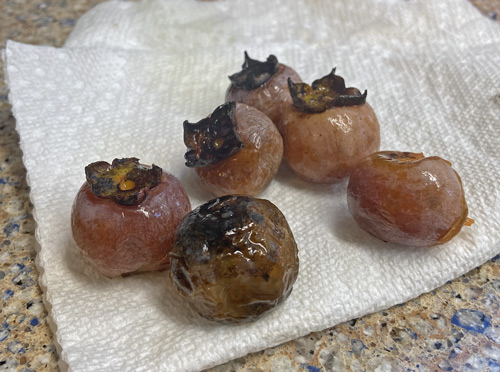
Ripe common persimmons.  Nice and mushy. The one in front is perfectly ripe.


In a grocery store, the persimmons you are likely to find are from an Asian species, Diospyros kaki.  The most common types are Fuyu and Hachiya.  The smaller Fuyu persimmon has seeds and is less astringent, while the larger Hachiya is seedless, but is more astringent until fully ripe (mushy).  I did a taste comparison among these two and my homegrown common persimmons.   The Fuyu had a milder taste and was palatable even when not fully ripe.  The seedless Hachiya needs to be completely ripe (mushy) before it can be fully enjoyed.    As it is seedless it has the additional advantage of having much more edible fruit than either the Fuyu or common persimmons.  Asian persimmons will ripen sitting on a counter top or, more quickly, in a bag with an apple or banana. 

Of the three I found the common persimmon to be the sweetest and most flavorful.  However, the flesh to seed ratio is very low and it, like the Hachiya, must be fully ripe to enjoy its full flavor.  Probably the biggest drawback of the common persimmon is that it is really not that common.  It is not commercially available and is at its best when used within a couple of day of picking. 

Store-bought Asian persimmons


Fuyu persimmon on left has a few seeds, the Hachiya (right) is seedless.


So if you really want firsthand experience with common persimmons you need to have access to a tree, a female one specifically.  Growing a persimmon tree is not too difficult.  The trick is to have both a male and female tree close enough together to allow for pollination.  Common persimmon trees are classified as small canopy trees, growing 50-75 feet in height and a spread of 35-50 feet.  It has an ovoid shape.  The foliage is medium textured with most leaves being 3-4” long.  The trees are tolerant of a range of soil conditions, but they need full sun.  They are winter hardy to zone 5a.

When purchasing a common persimmon tree from the nursery there is no indication whether it is a male or female plant.  There is, however, one cultivar referred to as a Meader Persimmon that is self-fertile and produces seedless fruits.  The best strategy is to get at least 5 trees and hope that you will have a mix of sexes.  For the trees that I planted it took about 5 years before they bore flowers so that I could tell which were male and which were female.  At 7 years in the ground I started getting fruits.  Of the 6 trees that I planted 9 years ago, 2 are male, two are female and two have yet to bear flowers.  (One of these is in a shady location and the other started as a 6” bare root plant.)  I took about 7 years before I began to get any fruits.  Now each year the yields have been increasing significantly.

What Now?

Now that I have invested 7 years in growing my persimmon trees I needed to figure out what to do with them.  Because of the short shelf life of wild persimmons the best way to enjoy them over time is to preserve them in some way.  The mushy flesh of ripe persimmons can be separated from the seeds using a food mill.  The resulting pulp can be frozen for later use or processed into jams or jellies.  There are a number of articles and videos on-line that demonstrate how to process wild persimmons.  Here’s a link to a video that I found useful.  And here’s an article from Indiana Public Media that describes an easy way to make persimmon jam.  This year I only had about a dozen ripe fruits at a time so I opted to make wild persimmon simple syrup that could be easily scaled to the amount of fruit I had.

The ingredients for a persimmon simple syrup that just highlights the flavor of the fruit are:

1 pound of persimmons
1 cup water
1 cup sugar
1 tsp lemon juice

Persimmons, seeds and all are simmered with sugar and water for about a half hour


The whole ripe (mushy) persimmons, water and sugar are combined in a small saucepan and simmered for a half hour.  I peeled the persimmons because it the pulp slipped out of the skins so easily. (This minimized the risk of having some astringency from the peels; however, when fully ripe the skin has no taste.)  Mash up the pulp in the hot liquid several times while simmering.  After about 20 minutes, add the lemon juice.  After 30 minutes of simmering allow the mixture to cool then put it into a cheesecloth and squeeze out the nearly clear liquid.  This recipe yields about a cup of simple syrup.  The remaining pulp had very little flavor left in it.  The syrup can be stored in the refrigerator for several weeks.

The syrup is separated from the pulp by squeezing it 
through a couple of layers of cheesecloth.  

I tried this simple syrup in several cocktails that call for simple syrup.  I found that it worked really well in a whiskey or rum sour.  I also tried it in a lemon drop recipe, but the flavors didn’t work well together, to my taste.

Next year, assuming I will get even more persimmons maybe I'll try making a persimmon pudding.

Wednesday, November 9, 2022

Why Lawn


Lawn maintenance consumes an incredible amount of time and money.  But what is the purpose of a lawn, and could those resources be put to better use?

Let’s first start with the question:  Why have a lawn?  There are some practical reasons.  Recreation - lawns are often used as open and safe places for children, and some adults, to play.  Protection - having open sightlines around your dwelling, with few hiding spaces can make one feel safer.   Buffer space - keeping nature at a ‘safe’ distance.  This could be to control insects or wildlife, or, in fire prone areas, an open, healthy, lawn can protect a dwelling from fire. Status - a perfect lawn is often equated with ones class.  Going back a century or so, if you had the resources to expend on maintaining a perfect lawn then one must be pretty well off.  

A pretty common sight: large lawns on multiacre lots.  

In his 1841 treatise on landscape gardening, A. J. Downing advocated for the need of having a proper lawn to have a tasteful and civilized property.  He translated the Romantic style of late 18th-century English landscape architects into a form more suited to the United States, particularly in the Hudson Valley and Mid-Atlantic.   Downing was extremely influential in setting the course for American landscape design into the 20th century.  Another key event in making the lawn a standard feature was around 1870 when the reel lawnmower, which had been invented in England, came to the US.  This made keeping a mown lawn more practical. 

Achieving the ‘perfect’ weed-free lawn was made much easier with the development and marketing of the herbicide 2,4 D (1944) for residential use.  A lawn treated with this was made free of nearly all non-grass (dicot) plants.  This meant that most flowering plants which could support pollinators (e.g. clover, fleabanes and heal-all) could be eliminated from lawns.  The result was a nearly flawless (one could say featureless) green carpet of only grass-like (monocot) plants.     

Considering the history of landscape design from earliest times, there seems to be a need for humans to exert control over nature, despite the costs.  People, in general, feel much more comfortable in a landscape that is readable or understandable.  These are places where they can see the ins and outs and how to move through the space.  Think of the composition of a photograph or painting.  There are elements that draw the eye through the piece to a focal point.  Crisp or well defined edges are also important in creating readability.  I’ll admit that I do feel a sense of satisfaction when I look back on an evenly mown and edged green carpet. 


Let’s look at some data about lawns in the United States:

Acreage of lawns   Looking on the internet I found figures of between 40 and 50 million acres of residential turf grass in the US.  Compare that to the total amount of land used to grow corn which averaged at about 90 million acres between 2018-2022 (USDA data).  These figures are based on satellite imagery.  Most corn is grown without irrigation.  If you compare the irrigated acreage for corn of about 12 million acres to that for turf, then you come up with 3-4 times as much lawn as irrigated corn. 

Amount of gas used   Based on EPA figures from 2005, 800 million gallons of gasoline were used to power lawn care equipment each year.  Using this weeks’ national average of $3.72/gal you are talking about $3 billion dollars annually.  On top of that, lawn mowers and other small-engine powered lawn equipment, which have no pollution control devices, are significant contributors to air pollution.  Estimates are that combined landscape care equipment contributes about 5% of the total air pollution, CO, hydrocarbons and NOx .

Amount of water used on residential landscapes   EPA estimates of water use for landscape purposes is 9 billion gals/day (WaterSense 2013).  Most of that is treated potable water that could be used for domestic consumption rather than poured onto the ground.  With the increasing severity of droughts, particularly in areas of the Southwest where population is shifting towards, there are very real problems with providing all the water that is needed. 

So considering that lawns and lawn care have increasing costs and negative effects it is time to ask why and how much lawn can we afford and what are the alternatives.

Trends away from lawns:

No mow May.  Started in England as a push to provide early season pollinators with flowers that are common in English lawns.  Blindly adhering to a no-mow-May program in a country with so many diverse climates and types of lawns as the US is often inappropriate.  To be useful, the lawn or property in question needs to have a population of plants with early blooming flowers that the pollinator population likes.   Depending on the climate the appropriate time for suspending mowing could be as early as February or into the later part of May.  If you have a monoculture of Kentucky blue grass there is little benefit to pollinators in skipping a month of mowing, there is just nothing of benefit there for them.  If you have a diverse ‘lawn’ containing native weeds like violets, self-heal (Prunella vulgaris), fleabanes (Erigeron sp.), spring beauties (Claytonia virginica) and the like, then allowing those to come into bloom would have a positive effect.  If you really need to mow, take the effort to mow around the blooming plants until they are done.  Lawns can also be interplanted with spring bulbs.  While not native, very early bulbs like Crocus, Chionodoxa and Scilla can add interest to an early spring lawn.  These bulbs have usually completed their growth and blooming cycle by the time the need for mowing kicks in.

I have been allowing this patch of Philadelphia fleabane
to develop without mowing.  It reaches peak bloom
in mid-May.  I usually mow it down in early June
after it sets some seed. When not in bloom plants survive
as low-growing rosettes.  

While there is the oft repeated advice to never cut more than one third of the length of the grass blade at a time, I rarely let that force me to cut the lawn before I’m ready.  I can’t say that I have ever noticed a problem by occasionally letting the lawn get too long between cuts.  In those cases when I do the biggest problem is the long clippings left on top.  A mulching mower can help deal with that.  All these problems are magnified on the ‘perfect’ lawn, where any imperfection becomes blaringly obvious.  In a diverse, multispecies lawn imperfections blend into the mosaic of plant colors and textures.

Lose the Lawn  This is a phase that is used by many people when voicing their concern about the amount of resources being pouring into and onto lawns.  You can get excellent advise on this subject for university extension services.  Doing an internet search on ‘lose the lawn’ and your state of region can give you information on lawn alternatives suitable for your area.  For example try this link to the UMD extension for the Mid-Atlantic region.

Climate appropriate landscaping   This is another phrase used when talking about more sustainable landscape practices.  Simply put, it is using plants that grow well with the resources that are naturally available.  Native species appropriate to the local climate require much less water and other inputs than turf or other non-adapted species.  When there are no plants suitable, look to using other materials to achieve the design goals.  It also means avoiding the use of plants and materials that require an extraordinary amount of inputs to maintain them.  

As droughts are becoming more frequent and severe, many municipalities are instituting water restrictions and/or offering enticements for installing water efficient landscaping.


What can one do?

>If you have a lawn, mow and water when lawn needs it, rather than on a preset schedule.  This can be difficult with lawn services since making a flexible schedule with multiple clients can be very difficult.  I did see on the web some services that offer options for having a less frequent mowing schedule.  That may be a move in the right direction.  In general lawns maintained at 3-4" have deeper roots making them less dependent on frequent watering.  Also the taller turf shades the soil which reduces weed seed germination and evaporation or soil moisture.

>Replace high maintenance lawn grasses with climate appropriate turf.  The US is divided into 3 zones for turf grass, cool season, warm season and the transitional zone between them.  A nice overview of turf grass types for the various regions of the United States can be found in this blog post from Landscape America.  While most turf grasses are not native to North America a few are.  Buffalo grass (Bouteloua dactyloides) is a native species found in the plains from Southern Canada to Northern Mexico.  It has been developed as a drought tolerant turf grass.  A native of the Gulf States, St. Augustine grass (Stenotaphrum secundatum) has been cultivated and planted along the east and west coastal areas of the US.  Fine fescues are well adapted to the Pacific Northwest and Northeastern states.  A few subspecies of red fescue (Festuca rubra) are native to North America; however, the blends suited for turf usage contain a variety of fine fescues most of which are not native.  There are at least three blends of these fine fescues that have been selected for use in cool season growing zones that are drought tolerant, need little fertilization.  Look for Eco-Lawn, Eco-grass or No Mow fine fescue blends. 

This patch of lawn is mostly fine fescues that is mown about every two weeks. 
It looks like regular 'grass'.  If I did not mow it it would would develop a
 fine silky, mounded texture that fine fescues are noted for.  

>Develop a tolerance for having mowable green, rather than a perfect cloned lawn.  My lawn, in the Mid-Atlantic region, is a mixture of tall and fine fescues, nimblewill (Muhlenbergia schreberi, a local native species), probably some purple top (Tridens flavus, also native), violets, fleabanes, clover and some less desirable (but tolerable) weedy stuff.  A diverse lawn requires fewer inputs to maintain.

>Consider alternative ground covers.  Regionally native species are preferred because, in addition to requiring little to no mowing, they also support local wildlife.  Some lower growing North American natives that can replace, or be incorporated into a lawn include frog fruit (Phyla sp.); pussy toes (Antennaria sp., for sunny dry conditions), and golden ragwort (Packera aurea, partly sunny, moist conditions).  Moss is perfect for a shady spots. Again, doing a search on ‘lose the lawn’ coupled with your region yields results that offer a list of alternative ground covers.  I recommend focusing on web sites managed by university extension services as providing the most unbiased results.

This patch of golden ragwort bursts into bloom in April. 
It is semi-evergreen and grows to about 6" tall.  It is slowly expanding,
but can be kept under control with mowing.

>Reduce or eliminate fertilization.  In many situations it is a vicious cycle.  Fertilizer is needed to replace the nutrients removed when grass clippings are removed while mowing.  Then, the more fertilizer you add, the more the lawn grows, then the more there is to mow.  By leaving grass clippings in the first place and mowing in the leaves in the fall, you are recycling the nutrients in place and feeding the microbes living in the soil.  Using a mulching mower will reduce the amount of clippings visible on the lawn.

>Reduce area committed to lawn and replace with bedding, meadow-type plantings, successional plantings, or cropping (hay fields).  When reshaping the lawn, go for simple shapes that can be mown efficiently, avoid tight turns and acute angles.  I have one triangular area that requires a lot of backtracking to mow.  A rectangle or oval could be done with less backtracking. 
A successional planting builds on the natural process of succession.  Succession is the natural process where the mix of plants on a site changes over time, and it begins when one stops mowing.  East of the Mississippi River, the sequence is usually bare land becomes grasslands, which in turn becomes shrublands which eventually turns into forests.  This process usually takes many years.  The land owner could  speed up the process by planting desirable shrubs and trees to create an idealized version of the natural landscape.  Intervention by the landowner can also pause succession at various stages such as as a meadow or shrubland.


Here is a possibility of allowing some succession of  local native species
(redbuds, dogwoods, asters, etc.).  Clean edges and sightlines to and
from the dwelling confer intention to the landscape.  This more
diverse landscape offers much more to the local ecology. 

>When creating a new space, clean edges, whether straight or curved, convey a sense of intention in the landscape.  A wilder space surrounded by a clean edge is visually more comforting than a totally wild area.

>Where climate is not suitable for growing plants, use hardscape or inorganic mulches. Hardscape does not have to be impermeable concrete.  Dry laid stones and pavers allow for water infiltration which reduces runoff problems.

>Be creative with the space, put in artwork to fill the space and send a message.  On a recent trip to Sebastapol, CA we visited Florence Ave where many of the residents have sculptures in the front yards by local artist Patrick Amiot. 

This owl sculpture is complemented by a variety of
perennials in this lawn-free front yard.


The minimal landscaping around this catfishing dog works quite well. 
The colors of the spiky New Zealand flax play well with the colors in the statue.


Reducing the area committed to lawn does not have be be done all at once.  It can be done one area at a time, or by expanding planted beds or wilder areas a little bit each year.  I would love to hear about your experiences with reducing resources committed to maintain a lawn.

Saturday, July 2, 2022

Smooth Hydrangea

 Smooth hydrangea, Hydrangea arboescens, is a North American native shrub with a native range is from New York and Massachusetts, south to Florida and west to Oklahoma and Kansas.  In the wild it is found in dry to moist woods and hillsides.  I thought that the name Hydrangea referred to it growing in, or preferring wet areas.  In fact, the name refers to the shape of its seed capsule which resembles that of a water vessel, a hydriai, in Greek.


Here's an example of wild type of smooth hydrangea growing along the
Potomac River near Sharpsburg, MD.  This photo was taken in mid-spring. 
I was surprised to see that flower buds had already formed.   

I really like this plant for landscaping purposes, particularly in the colder regions.  Unlike many of the blue and pink bigleaf hydrangeas (H. macrophylla), which bloom on year-old stems, smooth hydrangea blooms on new wood.  So whether you prune it or not you will reliably get blooms.  Also there is no need to protect the plants from winter cold.

This shrub grows really well in shade, in average to moist soils, and will tolerate sun if provided consistent moisture.  It is also tolerant of juglone produced by black walnut trees.  This makes it an excellent choice for growing under the canopy of walnuts and hickories.  Depending on how and when you prune them smooth hydrangea grows as a mounding shrub 3-5’ tall and wide.  Flower types are either mophead, large balls of mostly sterile flowers, or lacecap, flattish inflorescences of small fertile flowers surrounded by a rim of larger sterile blooms.  One drawback to smooth hydrangea is that, at least in my area, deer really like to eat the leaves.  I’ve found that surrounding young plants with chicken wire cages and using deer repellant on larger plants are sufficient to allow the plant to survive deer browsing.  Another problem, particularly with the large-flowered cultivars, is flopping.  I help support them by running a matrix of strings about 30" off the ground around and between 5 or 6 posts.


Here's a mass of the 'Annabelle' cultivar a couple of days after
a heavy June rainstorm.  Once the large blooms dry out,
they usually bounce back up.  


At the end of May flower bud formation is well underway. 
This is the stage when I will selectively cut back the taller, bud-bearing stems
by about a foot, just above the leaf  node.  This will lead to a
second flush of flowers in late summer.

My usual maintenance routine starts in early spring when I cut all the stems back to 1 or 2 pairs of viable leaf buds.  This will give me a rounded mass about 3-4 feet tall.  (Unpruned, they would grow to 5’ or more.)  When flower buds begin to form in mid spring I cut  about half of the tallest stems by about 1/3.  This will give me a second flush of flowers in mid to late summer, as the first set of blooms are fading.  I usually leave most or all of the stems in place through the winter since the dried up flower heads still have some interest.  Also some bees are able to use the cut stems as nesting sites.


A typical mophead inflorescence of  an 'Annabelle' hydrangea. 
This one is about 9" across. The large sterile flowers start out
greenish white, then become white as they fully open. 
A very few fertile flowers are buried in the center. 

 ‘Annabelle’ is the most widely known cultivar.  I was discovered in the wild in 1910 by Harriet Kirkpartick in the woods near Anna, Il.  It has a large white mophead inflorescence of mostly sterile florets.  They maintain their appearance for 6-8 weeks.  They age to a straw color that is also attractive.  These flowers can be dried and used in arrangements for several months (sometimes years).  As I have become more aware of how our landscapes affect nature I’ve decided to try to broaden the selection of smooth hydrangea and include some more ecologically useful species and cultivars.  In particular I wanted ones that would support pollinators.

Recently the Mt. Cuba Center published an exhaustive trial of smooth hydrangea cultivars and related species.  In addition to the horticultural aspects this trial looked at the number and types of pollinators that visited the flowers.  Not surprisingly, the lacecap types, both wild type and cultivars, had at least 3 times as many insect visitors as the ‘Annabelle’ cultivar.  Two years ago I planted some quart sized lacecap ‘Haas Halo’ cultivars.  This year they are producing large blooms.  


Here's a photo of the lacecap type of flower, this one is from the 'Haas Halo' cultivar. 
Note that the middle of the inflorescence consists of fertile flowers,
 evidenced by their erect stamen.  The large white flowers along the rim are sterile.   
On closer examination you can see that there are also a variety of insects
on the fertile flowers, collecting nectar and pollen.

This year I’ve also added a wild-type plant.  I don’t know exactly what this will look like when it blooms, but in general these carry much less visually impressive flowers (to humans) but provide a good source of pollen and nectar for the insects and a big increase in genetic diversity for any seeds that may be produced. 

So if you are looking for a medium sized native shrub that blooms in shade take a look at smooth hydrangea, especially the lacecap types that offer a little more back to your wildlife.


Thursday, February 10, 2022

Plans for 2022


For 2022 I have a smaller list of plants that I will be adding to my landscape than in years past.  There are a number of reasons: I’m running out of space to tuck in new plants, I’m moving more seedlings of successful native species around, rather than purchasing new plants, and I am getting more selective about using regionally native species.  However, I am not beyond adding a few species for decoration.  New plants that I am adding are prairie willow (Salix humilis), creeping lespedeza (Lespedeza repens), a wild type smooth hydrangea (Hydrangea arborescens) and I’m trying winecups (Callirhoe involucrata) again in a less competitive environment.

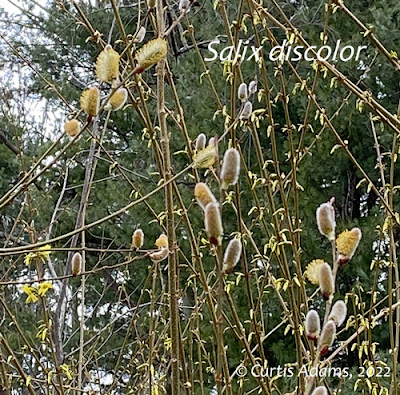
I have been looking for native willows to replace the mounds of forsythia on my property.  Willows bloom early in the spring, like forsythia.  But unlike them, willows do provide a benefit to the native insects: early flowers for bees and as a host species for a number of insects.  Early on I put in some native pussy willows (Salix discolor).  These are doing well but mine tend to have a taller upright form (nearing 20’) rather than a more rounded shape that I was looking for.  Prairie willow has the form I’ve been after, 4-7’ tall with a loose vase-shaped habit.  It is also tolerant of drier conditions than most willows.  I’ve got some on order, so we will see later this spring if my search is finally over. 

Pussy willow blooms at about the same time as
forsythia (shown here in the background).  


Another species that I have been trying to expand in my landscape is smooth hydrangea.  Most of mine are the huge mophead type, most likely ‘Annabelle’.  These grow really well with lots of flowers, but since most of these flowers are sterile, they offer little benefit to wildlife.  Two years ago I planted planted some tiny pots of the ‘Haas Halo’ cultivar.  These were highly rated in a recent study done at the Mt. Cuba Center.  These have large lace cap flowers which consist of mostly small fertile flowers in the center surrounded by a ring of large sterile flowers.  The plants grew to over 2’ tall last season, so I’m hoping I might see some flowers this year.  To build on this diversity I ordered a wild-type smooth hydrangea to add to the mix.  Wild-type plants usually have smaller flowers than the cultivars, but I’m hoping to see a benefit in the production of some seeds that could help the birds.

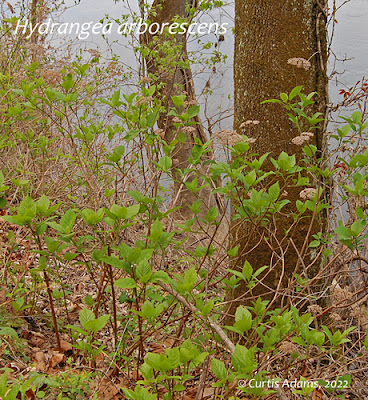
These wild hydrangeas are growing along the Potomac River
in Maryland. This photo was taken in late April. 
It seems kind of early for buds to be forming, considering
that 'Annabelle' hydrangeas normally bloom in June
.


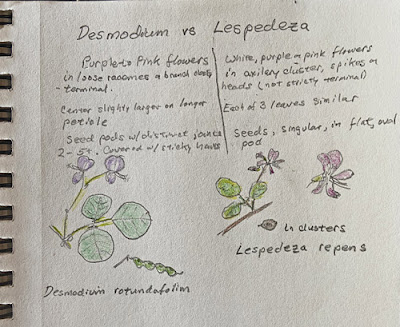
An ongoing project that I have is to find replacements for vinca, particularly in dry shade.  I am expanding the scope to include a replacement for the yellow archangel (Lamiastrum galeobdolon) that is spreading in my pine woods.  Last year I got some round leafed tick trefoil (Desmodium rotundifolium) for which I had been searching for 10 years (we’ll see how that has overwintered). It trails along the ground sporting three round leaflets on each stem. While examining catalogues I came across another trailing plant for dry shade, creeping lespedeza (Lespedeza repens).  While not super attractive on its own, it may work nicely in a matrix planting. 

I didn't have a photo of the Lespedeza, so I'm sharing an image
from my botanical sketchbook.  Included are some notes on
how to tell Desmodium and Lespedeza species, both
members of the pea family, apart.


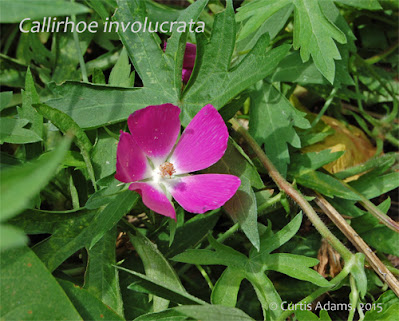
The wine cups are an exception to my focus on regional natives.  These are native more to the mid-west and southern plains, than to the east, but I became enamored with them ever since I saw them in a field in the Ft. Worth area.  I was able to grow them in the Boston area and had them for awhile here in Maryland.  The problem was that they were not able to compete with dense growth of asters, goldenrods, and Virginia creeper that surrounded them.  This time I will plant them where they have a little more of their own space to get established.

The magenta flowers of wine cups are hard to miss.  It has a
sprawling habit and can form a ground cover 
where competing vegetation is sparse.


As I mentioned above (and last year at this time) I will also be moving many native seedlings out of my vegetable garden, particularly Rudbeckia sp., Monarda fistulosa, Asclepias tuberosa, and Echinacea purpurea, and into the beds where I am fighting Japanese stiltgrass.  I started that process last year.  It’s too soon to see a difference, though some of the transplants appear to have overwintered.  Their real value will be if they are able to reseed themselves and become self-sustaining.


Friday, December 31, 2021

Why Won't My Garden Grow?

 I’ve noticed that I’ve been having less success growing vegetables from seed in my garden over the past few years.  That is particularly the case for small seeded crops like lettuce and chard.  This is in spite of increased organic fertilization.  True, I don’t water as much as I should for seedlings, but I never do.  I tend to rely on rain.  Still I have become suspicious that something else may be going on.  This has led me to consider allelopathy.  My question is whether there is something that is growing or has grown recently in the garden is affecting the ability of new seeds to germinate and develop?

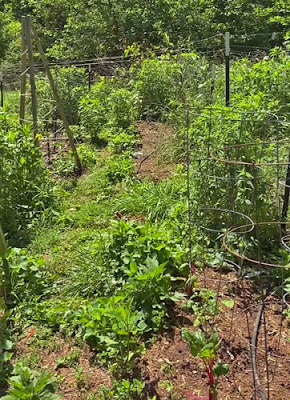
Garden in mid-June: Vegetables still small in
 relatively clean beds, but Monardas
and Rudbeckias are coming on strong.

Allelopathy refers to the beneficial or harmful effects one plant has on another. It arises from the release of allelochemicals from plant tissues though leaching from leaves or roots, volatilization or decomposition of plant parts in or on the soil.  Through these allelochemicals one plant is able to suppress germination or development of other plant species in the immediate area.  In some cases these chemicals may have a beneficial effect on some neighboring species while having a negative effect on others.  There is a lot of research in this area, particularly to find crop plants that are able to produce their own weed suppressive chemicals rather than relying on added herbicides.

There are a couple of non-traditional practices that I have been employing in my vegetable garden that I am beginning to question.  One is that I allow native species to run rampant along the edges and between the rows of vegetables, particularly wild bergamot (Monarda fistulosa) and black- and brown-eyed Susans (Rudbeckia hirta and triloba).  The other is that I leave the roots of the previous year’s plants in place.  I just cut the old plants off at ground level and throw them into the compost pile.  I do this as a means of increasing the organic matter in the soil and reducing soil disturbance. 

Following the adage, “a month in the laboratory can often save an hour in the library” (Frank Westheimer) I decided to do a little research first.  I searched the internet for information on the allelopathic potential of all the native and non-native species that are growing in my vegetable garden.  After searching those, that I turned to looking at the vegetable themselves. 

The tables below list many of the weeds, native species and lastly the vegetables that are common in my garden along with the existence of any documented evidence that these plants possess any allelopathic properties.

Garden Weeds:

Common Name

Botanical name

Evidence of Allelopathy

Chickweed

Stellaria media

        Yes

Ground ivy

Glechoma hederacea

        Yes

Hairy bittercress

Cardamine hirsuta

        No

Indian strawberry

Duchesnea indica

        No

Mulberryweed

Fatoua villosa

        No

Ladies thumb

Polygonum persicaria

        Yes

Nut sedge

Cyperus esculentus 

        Yes

Persian speedwell

Veronica persica

        Yes


Native Annuals & Perennials:

Common Name

Botanical Name

Allelopathic?

Annual sunflower

Helianthus annuus

        Yes

Common Milkweed

Asclepias syriaca

        Yes

Butterfly weed

Asclepias tuberosa

        No?

Common and Daisy Fleabanes

Erigeron philadelphicus and annuus

        Yes

Honeyvine

Cynanchum laeve

        No

Wild Bergamot

Monarda fistulosa

        No

Scarlet beebalm

Monarda didyma

        Yes

Purple Coneflower

Echinacea purpurea

        Yes

False sunflower

Heliopsis helianthoides

        No

Goldenrods

Solidago sp.

Yes (some species, at least)

Browneyed Susan

Rudbeckia triloba

        No

Wild Blackberry

Rubus sp.

        ?

Sealheal

Prunella vulgarus

        No

Pennsylvania smartweed

P. pensylvanicum

        Yes

Wingstem

Verbesina alternifolia

        No*

*Golden crownbeard, V. encelioides, a native of western North America does have allelopathic properties.

Garden Vegetables:

Vegetable

Botanical Name

Allelopathic?

Arugula

Eruca vesicaria ssp. Sativa

        No

Basil

Onicum basilicum

        Yes

Collards

Brassica oleracea var. viridis

        Yes

Cucumber

Cucumis sativus

        Yes

Green Beans

Phaseoleus vulgaris

        Yes

Lettuce

Lattuca sativa

        No

Peppers

Capsicum annuum

        Yes

Squash

Cucurbita pepo

        Yes

Swiss chard

Beta vulgaris var. cicla

        Yes

Tomato

Solanum lycopersicum

        Yes


While doing these searches I came across some interesting studies on the potent allelopathic effects of many invasive species.  This is one of the factors that allow invasive species to outcompete native ones.  One study treated radish seeds with the aqueous extracts from leaves of a number of invasive species.  The radish seeds were then evaluated for germination rate and root growth.  The following list is ranked in order of negative effect on germination, most to least:  Ailanthus altissima, > Microstegium vimineum, Alliaria petiolata, Celastrus orbiculatus,> Ligustrum vulgare, Rosa multiflora, Rubus phoenicolasius, and Acer platanoides.  There are multiple studies that document the allelopathic effects of Japanese knotweed, Polygonum cuspidatum.  It seems that many species of the genus Polygonum have some allelopathic character.

From this research it looks like the fleabanes (Erigeron annuus and philadelphicus) and purple coneflower would be the most likely allelopathic culprits among the native species in my garden.  However, most of the allelopathic candidates on these lists are from the weeds and garden vegetables.  Of these, ground ivy, nut sedge and ladies thumb are the most prolific weeds in my garden.  Among the vegetables in my garden, collards, peppers and cucumber are the most likely suspects to be causing some troublesome effects.

Allelopathy experiments.  In general experiments that measure allelopathy are tricky to interpret.  Many are based on bioassays, where the allelopathic effect is measured by such things as the germination rates and root growth of a target species.  In many cases radish or lettuce seeds are used.  Many of these studies use extracts of leaves, stems or roots of the species being studied applied at various concentrations to isolated seeds of the target species in a Petri dish.  Another approach is to test the soil itself.  Due to the complex nature of plant-soil and plant-plant interactions, most studies on allelopathy are correlative rather than causative. 

To help me understand whether there was a problem with the soil (and all the things that come with it), or the cultural effects like moisture and sunlight, I decided I would try a bioassay comparing surface soil samples from various parts of the yard and garden.  I tested to see how each of these soils affected germination and growth of some lettuce seeds which had performed well when started indoors this past spring.

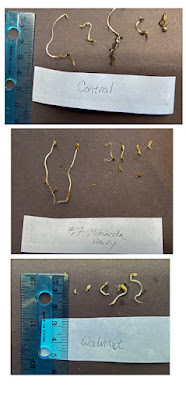
Germinated seeds:  Control (top);
near wild bergamot (middle);
 under English walnut (bottom)
I adapted a procedure from Environmental Inquiry/Cornell University for performing lettuce seed bioassays using materials I had on hand.  I took three samples of surface soil, 0-1/2” deep, from each area of interest.  This is the zone that I normally plant small seeds like lettuce in.  I mixed the soil samples in a baggie then pulled out about a tablespoon’s worth.  This was put into a fresh baggie (as I didn’t have any Petri dishes) and moistened with a few drops of water to make the soil damp, but not wet.  I disinfected the lettuce seeds in dilute bleach, according to the procedure, and then put 8 seeds into each baggie.  The baggies were sealed, put into the dark for 5 days at 60-80°F.  I used a moistened, peat-based seed starting mix as the control.  Samples were taken in November so there was no active growth of vegetables except for the sample near actively growing collards.  I tested the following areas: 1) garden soil under green beans, near daisy fleabane; 2) garden soil under wild bergamot; 3) garden soil near where tomatoes and cucumber had grown; 4) garden soil near collards; 5) typical lawn soil (fescue and weeds); 6) under an English walnut with vinca groundcover.

After five days I separated out the germinated lettuce seeds, counted the number of germinated lettuce seeds and measured the length of the roots.  I found I was able to pluck out the germinated seeds from the soil in the baggies by suspending the entire sample in water with a little dish soap.  This allowed the soil to fall away from the roots without damaging them.  The root growth measurements had a lot of variation.  This is not too surprising considering the many uncontrolled variables, like variable soil moisture and soil contact within each baggie, and small sample size.


Graphical comparison of various soil samples on germination and root
growth of 'New Red Fire' lettuce seeds.

Results and Conclusions

While the differences in root length and germination rate among these samples are not highly significant, due to the small samples size, there is an indication that the soil around the collards is not as favorable to seed germination and growth as any of the other garden samples and is on the order of that for soil under an English walnut tree.  (English walnut, Juglans regia, is much less allelopathic than our native black walnut.)  These results also indicate that the presence of wild bergamot (Monarda) is not detrimental to the initial stages of seed growth.  Another indication was that root growth in the soil around the green beans was less than the control sample.  This is consistent with a study that looked at the effect of leaf extracts of several lines of common beans on seedling growth, including lettuce.  That study made no mention of the effect on seed germination.

Lettuce or radish seed bioassays are also good for checking for herbicide residues in soils and mulches.  General information about testing whole soil samples for herbicide residues can be found at this link from NC State.

Based on the literature it seems like many of the plants in my garden have some degree of allelopathic behavior.  This brings up another important question; how long does that effect last.  The sense I get is that it’s more on the order of weeks than months.  In field trials some brassica family cover crops have shown allelophatic effects on the order of weeks to months after being tilled in. I found another post discussing the use of cover crops, many of which are allelopathic.  It suggested waiting 3 weeks after tilling them in before planting.  Leaving allelopathic plant residues in place as a mulch, will increase the time over which they have the suppressive effect.

 So, based on my little experiment and all the literature I scanned, it seems there is no single clear cut culprit exerting a negative influence on my gardens fertility.  This research has led me instead to a list of suspects and actions to control their effects.   It may be that my practice of leaving roots in the ground, particularly the collards, over the winter may be negatively affecting my gardens ability to grow grow directly from seed. I will need to dig these out at least a month before planting in the spring.  I will also pull out any remaining roots of the curcurbits and chard which remain, as well.  The ubiquitous weeds, particularly chickweed, ground ivy, and ladies thumb need to be removed, especially during the growing season.  As much as I like the prolific flowers of the native daisy fleabane, I will be removing those from the vegetable beds, as well.

Another less traditional garden practice I have been using is flame weeding.  This involves using a hand-held propane torch to kill weed seedlings before they can establish.  This was done prior to planting, or transplanting crops.  An advantage of this practice is that it doesn’t disturb the soil surface.  I have not looked into any literature on possible negative effects of this practice, but for next year I will not use this method in the growing beds themselves. 

So with these changes we will see if I get any better results in the garden, or will I need to dig deeper?

Wishing you all the best for the New Year!!!