Showing posts with label Hibiscus moscheutos. Show all posts

Sunday, August 31, 2014

It's late August and I'm seeing Red.....and some other colors, too


In direct sun the red of this Lobelia stands in
perfect contrast to the green background.
This is the first year for my Cardinal Flowers, Lobelia cardinalis, to bloom and I must say it really pops on a grass green back ground.  I planted these as seedlings last year and they never got very big.  Part of that was due to deer browsing.  This year the deer ate a little early in the season, but did not come back after the buds began to form.  I don't know if that has to do with a change in the taste of the maturing plant, or if it was due to spraying the plants with a new deer repellent, Bobbex.  Besides delighting the eye, the cardinal flowers are a big hit with the butterflies.

This Scarlet Sage is growing in a partly sunny garden.


Before I had a place with moist soil I relied on this Blood or Scarlet Sage, Salvia coccinea, to get an intense shade of red in late summer.  It grows well in moist to dry soils and will tolerate some shade.  Scarlet sage is usually grown as an annual.  In the past it has reseeded itself in my warm zone 6 garden in Boston.  We'll see how it does in my less protected Maryland garden next year.  I have seen hummingbirds feeding on this sage, as well as many bees. 

This photo taken early in the morning contrasts the yellow of evening primrose,
Oenothera biennis, with the violet of NY ironweed, Veronia noreboracensis.
These two tall plants complement each other toward the back of this planting.
Another major presence in the garden is New York Ironweed, Veronia noveboracensis.  This year they are growing to 8 feet.  I cut one back by 1/3 at the beginning of July and it quickly grew back fuller than before.  This plant is very attractive to butterflies, it has about as many as a nearby exotic butterfly bush.
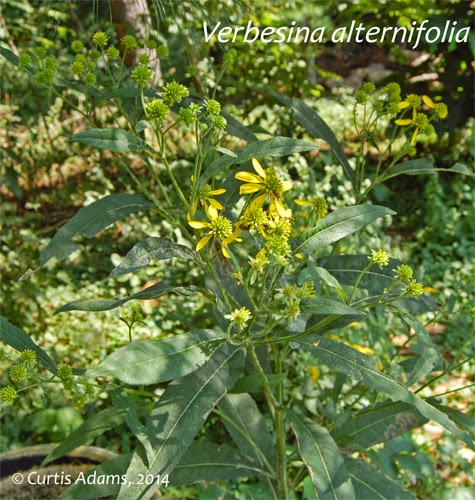
Wingstem is named for the rough appendages growing along its stems.


The predominant open meadow flower of late summer here is WingstemVerbesina alternifolia.   In the full sun they grow straight up to 3 to over 8 feet.   I have allowed a few to grow in the partly sunny gardens near the house.  Under these conditions they still grow tall, but they lean forward to get more sun, eventually flopping over.  Blooming period is about a month long, mid August to late September.

Under the shade of pines I am trying out several species of Goldenrods. The first to bloom is Elm-leaved Goldenrod, Solidago ulmnifolia.  As with the cardinal flower, these were browsed heavily by the deer in their first year, but this year they are reaching bloom (maybe with the help of Bobbex).  Other goldenrods I am trying in the shade are Zigzag, Bluestemmed and Showy Goldenrods.


The little whitish flowers of Jumpseed wiggle their way out of the undergrowth.
The foliage of this plant is tattered since it is often eaten by some as yet unidentified insects.
Another shade-tolerant native that is blooming now is Virginia Jumpseed, Persicaria virginiana.  Not particularly showy by itself, en mass it adds some interesting texture to a shady scene.  There are some forms of this plant with more colorful leaves and red flowers, but those are not in bloom just yet. 


Aromatic Aster is just beginning its long season of bloom.
One of the newer additions to the garden is Aromatic Aster, Symphyotrichum oblongifolius 'October Skies'.  Despite its name it has started blooming in late August (this cultivar is actually named for the flower color, not the bloom time).  This cultivar is compact and densly blooming.  Growing to about 2 feet tall it is a great choice for near the front of a border.  In addition to the good-sized blooms the foliage of this little bush has a pleasing scent.

I just wanted to share this last image of a patriotic color combination of Hibiscus moscheutos, Lobelia cardinalis, and L. siphilitica. It's not a great photographic composition, but it is an example of red, white and blue native flowers blooming at the same time (mid-August).  

This photo could have been improved had I bothered to remove the
chicken wire protection from around the Hardy Hibiscus.  

Thursday, June 27, 2013

Co-existing with Nature

There is a conflict between nature and designed human space.  We like to have our nature neatened up and easily readable with beautiful plants arranged just so.  Nature is just do what it needs to survive, with each of its members seeking out their basic needs: food, shelter and reproduction.  Conflict arises when our focal plantings become a meal or natures breeding habitat becomes a lawn.

In putting in our new garden and new plantings I have been trying to work with nature to achieve my design goals and keep our vegetables ‘safe’ without destroying too much habitat or employing chemical weaponry. 

The double fence has been keeping the deer at bay.  The outer border has been planted with seedlings of
pollinator-friendly perennials.  I may not get too many flowers this year as these plants get established.

To help control garden insects I have left some meadow areas intact that provide habitat for predatory insects.  I have also planted a border around the garden with pollinator friendly plants.  In selecting these plants I chose ones that are listed as deer-resistant.  To combat the beetle population I have a jug of soapy water.  This works well on some of the bugs whose escape strategy is to drop to the ground.  I just hold the jug under them and they drop in when nudged.

Here are some photos of predatory insects that are in the yard.  In addition to these I have seen the 6-spotted Tiger Beetle, very cool!
This nymph of a Wheel Bug looks like something from
the movie, Starship Troopers.
This 2-inch mantid was hopping from stem to stem in a patch of
moss phlox as I was looking for a Tiger Beetle.

Compared to the green sweat flies, Long-legged flies are aptly named.  
This 1/2 inch fly is a general insect predator.


Most of the landscape plantings I have selected are not deer favorites.  For those plants that are on the deer’s menu I have been using repellents that are either scent-based (putrescent eggs) or taste-based (capsaicin/hot pepper).  The hot pepper spray seems to be effective at getting the deer or rabbits to stop feeding on a plant even after they have gotten a first taste. 

You can tell deer damage by the ragged edges they leave where they tear off leaves and stems (deer don't have upper incisors).  Rabbits have sharp teeth and will leave a clean cut, or they will consume a plant right to the ground.  

The following are lists of plants that have I have put in that are 1, deer candy; 2, occasionally browsed; 3, not bothered by deer.  It is still early in the season and these comments are based on how they treat the foliage.  Flowers will be another subject (see some comments).  While it is risky to proclaim a plant to be deer proof, I have not seen any damage to the plants on this list (yet).

The buds on this Magnolia were being eaten off
until I put on the chicken wire cage 
1.  Heavily Browsed
Apios americana 
Helianthus tuberosus 
Magnolia virginiana 
Rudbekia triloba 
Campanulastrum americanum* 
Zizia aurea

*These were very small and eaten to the ground so rabbits or some other critters were responsible for this damage. 

The pinnate leaves of the ground nut have been
chewed off in more exposed locations


This Jerusalem Artichoke was being browsed to the ground until the fences went up.
Now (June 27) these are 6-7 feet tall.


This Filipendula was nearly ready to bloom when the deer
ate off most of the upper growth.  Note the rough edge
where the deer ripped off the tip of the plant.

2.  Occasionally Browsed
Achillea millefolium (flowers were removed, the foliage was left behind)
Aronia melanocarpa 
Hibiscus moscheutos (just once)
Filipendula rubra (just once leaves and flower buds, not after hot pepper spray) 
Lobelia siphilitica 
Physostegia virginiana 
This Hibiscus had the tips chewed off, but no more
damage since I applied some hot pepper spray.
Rudbeckia hirta 

(The Lobelia had been untouched until yesterday.)


3.  Resistant, so far
Aquilegia canadensis 
Asclepias tuberosa 
Asclepias incarnata 
Ceoanthus americanus 
Chamaecrista fasciculata  
Chelone glabra 
Dicentra eximia 
Hedeoma pulegiodes 
Iris versicolor 
Monarda didyma 
Monarda fistulosa 
Monarda punctata 
Spiraea alba 


As far as keeping the critters out of the garden, the double fence method is still working.  I’ve been able to harvest snap peas, lettuce, chard and collards, so far.

I did notice some evidence of moles digging around the property.  For these I put down a perimeter treatment of MoleMax, a castor oil based product that moles and other burrowing species do not like. 


Thursday, June 24, 2010

Natives in Pots

There are many reasons to grow outdoor plants in containers. You may not have space in the ground, or they can be used as decorations on a deck or patio, or you may just want to bring the plants closer to where the people are. The main reason I have been growing native plants in pots is that I do not have the right growing conditions in the ground to raise the the plants I want from seed. This is particularly the case for annuals from some of the hotter parts of the country.


Here are some of the plants that I am growing this year. Lantana, Lantana camara, is technically a North American native, since its native range includes Mexico and Puerto Rico. It behaves well as a bedding or potted plant in colder climates, but it is invasive in the warmer parts of the US, particularly Florida and Texas. I really love the red-orange-yellow multi-colored flowers and long blooming period.  These I bought from a nursery and mixed in with other classic annuals like the Lobelia, shown here.  The rest of the annuals I have grown from seed.

While on a trip to Austin, TX, I picked up seeds for Drummond phlox, Phlox drummondii, and the annual Indian Blanket, Gaillardia pulchella, at the Lady Bird Johnson Wildflower Center. These appeared to be species plants and not any crazy cultivars. So far the Phlox has made it to bloom, with its scarlet red flower. The Indian blanket is just a week or so away. Another Texas native I have growing in pots and in the ground is Scarlet Sage, Salvia coccinea. None of these plants really started growing until the temps here got well into the 80’s.

I was really happy to see that some seed from the Beach Sunflower, Helianthus debilis ‘Pan’, that I grew last year had germinated in the same pot. Native to the Texas coast, this species has spread up the East Coast all the way to Maine. Here it is in bloom last year in the same pot. I have also grown Bearded Beggarticks (Bidens aristosa) in pots. Given half a chance, this eastern native reseeds itself readily.


Some native annuals that I had in pots last year are Devil’s Claw (Proboscidea louisianica), Yellowdicks (Helenium amarum ‘Dakota Gold’), and Bird’s Eye Gilia (Gilia tricolor).


The native perennial that I have in a pot is the Crimson-eyed Rosemallow, Hibiscus moscheutos, that I bought from the New England Wildflower Society. While it is native to New England, I just don’t have the sunny moist site it would like to keep it in. I over-wintered this in its pot by storing in a plastic bag with salt marsh hay in an unheated garage. It looks pretty happy so far. The blooms are expected in late summer.