Showing posts with label Verbena hastata. Show all posts

Sunday, February 12, 2012

Winter Weeds, Pt 2


Continuing from last week's post, here are 10 more native wildflowers that, though dried out, are still standing in the middle of winter.

Fertile fronds of the Sensitive Fern
The first is the fruiting stalks of the Sensitive Fern.  While the fronds of this fern are among the first to die back in the fall, these stalks are quite persistent through the winter.


The next image is of Shrubby Cinquifoil.  While not a wildflower per se, it does have a similar appearance in the winter.  Left to their own these small shrubs can form a tangled mass of branches.  Annual removal of about 1/3 of the older branches gives a good balance of flowers, neatness and size.
These dried flowers of Shrubby Cinquifoil
stand above a mass of branches.
The Orange Coneflowers and Black-eyed Susans are classics in the winter landscape.  The Orange Coneflower has spiky, black to dark-brown seed heads.  These look really nice sticking out of the snow, and the seeds provide food for overwintering birds.
Orange Coneflower seed heads are nearly round,

Black-eyed Susan's seed heads are definitely cone-shaped
and are lighter in color than the Orange Coneflower.
Next I have the annual/biennial Black-eyed Susan.  During bloom season the flowers look very similar to the Coneflower, but this species has a laxer habit.  In winter you can see that the light colored seed head is very different.


Wild Petunia after a rare snowfall (this year).

My Wild Petunia is usually crushed under the snow in the winter.  But this year it is still upright.  The dried stems have a silvery cast that is enhanced by the long fine hairs that cover this plant. 


This Blue-stemmed Goldenrod
still has its narrow leaved attached.


Many of the Goldenrods (Solidago ssp.) persist well into winter.  I've captured three species here.  The first is the Blue-stemmed Goldenrod.  This species has flower clusters in the leaf axils all along the stem.  Zig-zag Goldenrod (S. flexicaulis) is another species that also has flowers originating from the leaf axils.  
The second goldenrod I'm showing here is the Seaside Goldenrod.  It has flowers in long terminal sprays.  
The third species is Showy Goldenrod.  This one grow tall and upright with flowers in a terminal plume.  It blooms early in the season, but stays upright through most of the winter.

Seaside Goldenrod blooms later in the season
 and tends to hold its fuzzy white seeds later, as well.


Showy Goldenrod has a strong presence even though
 the flowers are long gone.
Another species that I wanted to show is Stiff Goldenrod (S. rigida), but this early blooming species does not hold up well into the winter.  My plants tend to disappear around the middle of December.

Meadowsweet is lanky spreading shrub that may be difficult to use in a formal landscape.  But it grows under many difficult conditions, blooms all summer and is very attractive to native bees, so I am using it around my house and trying to learn how to tame it.  It also has a nice presence through the winter.
Meadowsweet flowers remain intact all winter.
Swamp Verbena is free-seeding native perennial.  It started in the flower bed and is now growing out of the driveway.  The flowers, borne on little spikes, are rather small considering the overall size of this plant, but I have found that they can be cut back by nearly 1/2 in June and be of a more appropriate size for the garden.
The afternoon sun caught on these Swamp Verbena flower spikes
inspired me to take a closer look at the other plants in my yard this winter.

Now that I've checked out the plants around my house, I'll need to make a trip out to some 'wilder' places to see what's happening.




Friday, July 29, 2011

A Rainbow of Colors


As I was trying to think of some deep topics to discuss on my blog in late July, I was working in the garden and realized that just about everything was in bloom. In fact there are North American natives blooming in all the colors of the rainbow right now. So I thought I would share examples of each color from my garden.


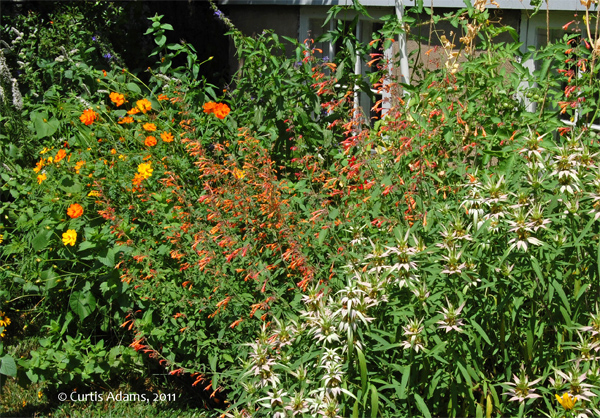
Mixed border with Cosmos, Agastache and Spotted Beebalm


I’ll start with some of the warmer shades. I reintroduced the annual Sulfur Cosmos, Cosmos sulphureus, this year (it had been pushed out by the overly vigorous Bearded Beggarticks). These along with Orange Hummingbird Mint, Agastache aurantiaca ‘Navaho Sunset’, and the Spotted Beebalm, Monarda punctata, form a rather dense border on the south side of the house. 
 

A self-seeded Blood Sage


 Mixed in with these are a few Blood Sage, Salvia coccinea, a Texas native that reseeded from last year. Overall the red shades are underrepresented, the only other red is some Drummond Phlox, Phlox drummondii, also from Texas.


A native bee is sampling from a Wine Cup


For a really hot magenta I have Wine Cups, Callirhoe involucrata, native to the central U.S. This viney perennial has been doing well on it’s own for 5-6 years on the east side of the house. 


Cooling down to the pinks, I have been really surprised with the Pink Tickseed, Coreopsis rosea; a Massachusetts native. It prefers moist soils and this one seems very happy growing in a crack in the driveway. There must be runoff collecting under the pavement. Another pink flowering native I have is Butterfly Gaura, Gaura lindheimeri. While native to Texas and Louisiana, it can be found growing in many gardens in the Northeast.

This Pink Tickseed has been growing in the driveway for more than 5 years.


Butterfly Weed

A new addition for me is the orange Butterfly Weed, Asclepias tuberosa. As it is quite drought tolerant, I’m trying it out in the ‘Hell Strip’ along the road.  This area is exposed to a lot of sun and it is difficult to get water to soak in.  Hopefully this tap-rooted plant can get established here.


Yellow seems to be the most commonly seen color for native plants. You see Black-eyed Susans and Yellow Coneflowers everywhere. I have them too. A couple of less commonly used species are the Prairie Coneflower, Rabitida pinnata, with its paler, more lax petals, and Whorled Rosinweed, Silphium trifoliatum. The coneflower has been just getting by, popping out from a dense border of Purple Coneflowers and a variety of native asters. On the other hand the Rosinweed stands tall (actually it leans forward) in the dry shade under a Norway Maple.

Whorled Rosinweed, leaves in whorls of three.


Prairie Coneflower


Inland Sea Oats turn golden in fall.
There is lots of green in the garden from all the leaves, but there are also some other green features. The green flowers of my Strawberry Blite, Chenopodium capitatum, are forming now, to be followed by bright red berries. Also there are grasses, such as the Inland Sea Oats, Chasmantheum latifolium, shown here.


'Victoria'


Moving on to blue, may last post was about the American Bellflower that is all over my garden. Instead I’ll show you the Mealycup Sage, Salvia farinacea ‘Victoria’, that I have in my flower boxes. This tender perennial native to the south-central U.S. it a common garden annual available at many nurseries in the Northeast. While not native up here it does get a fair amount of traffic from both native and honey bees.


For lavender I’ll show you my Wild Petunias, Ruellia humilis. This plant is native to the Eastern U.S., but not New England. I started this one from seed in 2007 and it slowly spreading into some of the sunnier and drier spots around the house.

Wild Petunia, late to emerge,
but in full bloom in early July.


Of course there is the ever popular Purple Cone Flower, Echinacea purpurea. Mine are from seed and I am seeing a lot of variation in size and color. Instead I’ll show the less popular Swamp Verbena, Verbena hastata. This somewhat weedy plant is found all over North America. It reseeds vigorously and will grow under a wide variety of conditions. I have been cutting mine back by half in mid-June to control their size and get a few more blooms. I started seeds for both the species (violet) and a naturally occurring pink form, ‘Rosea’, in 2008. As you can see I am still seeing examples of each, though the violet is much more prevalent.
A pink form of Swamp Verbena along with the more common Violet form.

Philadelphia Fleabane is found throughout North America


I have no black native flowers, but I do have a lot of white ones. There’s the long-blooming shrub Meadowsweet, Spiraea latifolia, the Bigleaf Asters, now known as Eurybia macrophylla, and purple-leaved Heuchera villosa. All of which I grew from seed from the New England Wildflower Society. Here I have Philadelphia Fleabane, Erigeron philadelphicus, that just blew in on its own.


Blooming is not over, there are still more plants to come, but it nice to see everything that is going on despite the heat of summer.