Showing posts with label Sassafras albidum. Show all posts

Tuesday, October 27, 2020

Oh Deer

Even though as winter sets in deer metabolism slows and feeding/browsing damage becomes less obvious, deer still manage to cause some major damage to the landscape


A willow, Salix discolor, that has suffered multiple deer attacks, yet has survived. 
The trunk guards were put on after the fact.


Last February I came to the realization that if I wanted to grow new trees, especially conifers, I would need to protect them from the deer, especially the males during mating season. Here in the Mid-Atlantic November brings on rutting season, the time when white tailed deer mate.  During rutting season male deer rub their antlers against trees and shrubs to remove the velvet from the newly grown horns.  They also will rub trees to mark their territory and to take out their heightened aggressions as mating season kicks in.  What deer prefer for this rubbing behavior are trees and shrubs 1-4” in diameter with smooth bark, like willows and magnolias.  Aromatic cedar and other conifers are also favorites.  Once a tree is marked they will often return to the same one.  At one time I had a nice little Canaan fir, Abies balsamea var phanerolepis,  that I surrounded with chicken wire after it had been rubbed a little.  Two days later all that was left was a bare splinter of a tree.  Now is the time to put up some protection to save some of our precious young plants before they are destroyed.  Following are some of the actions I've taken.

Trunk Protection
Last year I tried horizontal fencing for the first time and did not have great results.  It did not protect a young magnolia from rubbing, but a number of small evergreens did not take any damage.  Based on the photos I have, the deer appeared to skirt the areas with fencing lying on the ground. 
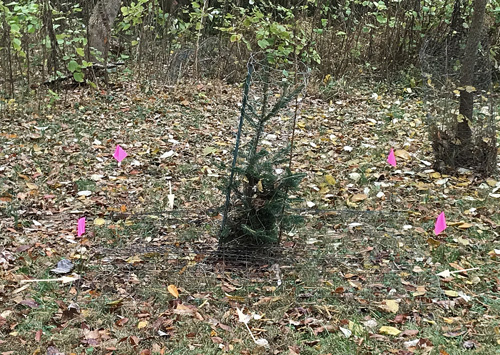
The pink flags indicate where I have put 2"x4"welded wire fencing on the ground around this little Canaan fir tree. 
The idea is that it creates unstable footing that the deer don't like.  The flags help me avoid the fence when mowing. 
I want to add some block underneath to lift the fencing further off the ground.

This year I have plastic mesh poultry fencing wrapped around the trucks of most of the stag-susceptible trees.  For others I have a heavier duty  4” drain pipe around the trunk.  (I’m a little concerned about heat build up under these black tubes.  For that reason I drilled ¾” holes every 6”to aid in ventilation.)  I also used some paper tree wrap on some smaller specimens.  One product that looks very good to me is a white spiral plastic.  It looks like it will protect the bark from rubbing and is open enough to prevent heat build up and not harbor insects.  I haven't bought any of that, yet.  A welded wire barrier surrounding the tree trunk has also proven very effective.  This is most efficient with single trunked trees with few lower branches.  Chicken wire may do a good job of limiting browsing but I've seen it ripped away from small trees that had been rubbed by a buck.

I wrapped the trunks of this fringe tree, Chionanthus virginicus, with plastic poultry fencing. 
It's easy to cut and can be tied together with zip ties or wire.  This material should protect the bark,
but will not support the trunk.


Here I am using a spiral cut 4" drain pipe to protect the trunk of this persimmon tree,
Diospyros virginiana.  I drilled holes in it every 6" to reduce heat build up.  This is
pretty tough material and should hold up to attack.


This Sassafras is being protected with a conventional welded wire cage. 
It's been here 4 years, but now it's of prime size for a deer attack. 
Hopefully the large size cage will be a good deterrent. 
I pulled the cage away during the summer to strengthen the trunk.  
  
Except for the open mesh materials it is a good idea to remove bark protection in the spring.  Heat and moisture build up can damage the bark and in some cases can harbor insects.  Also too much rigid support can keep a tree from developing a strong trunk.  I found this with my young sassafras.  It was getting floppy and the truck was not able to support the top growth on its own.  I pulled away the support this past spring and now the truck is much firmer.

Here  on this willow I'm comparing a variety of protection devices. 
On the right is a paper tree wrap.  Not sure how that would hold up versus a buck.


Repellents
In winter deer’s metabolism slows down, but they are still out there browsing.  Evergreens, branch tips and leaf buds are at risk.  Fencing and cages are effective at keeping deer far enough away to prevent browsing.  Burlap warps that are used to prevent winter burn on arborvitae should also work.  Repellents are also helpful.  In colder weather taste-based repellents have an edge because they do not need to be volatile.  It is often recommended to alternate among different repellants through the season so that deer don't get used to any one of them.   So far I haven't done that.  

Reading about all the different recommendations for deer repellants, as well as deer resistant plants, it has become clear that not all deer are the same in regards to their likes and dislikes. Be flexible and try different recipes and products.  I've had good success using Bobbex which contains a variety of taste and odor deterrents. 


Planning Ahead
I’ve seen a number of people on Facebook ask about starting gardens in areas with lots of deer.  My deer seem to test every new plant that goes in the garden.  For new shrubs I usually put a chicken wire cage around them.  As far as planning an new large planting, I like the advice I’ve read in ‘Deerproofing Your Yard & Garden’ by Rhonda Hart.  She recommends fencing in the new garden space before doing any planting.  This is because deer are creatures of habit.  If they have never found anything of interest in an area, then they are not likely to return.  But, once they have found something tasty there, they will make every effort to return.


On the Bright Side?
Deer browsing results in some unsightly damage to many landscape plants.  It is not uncommon to find hedges of arborvitae and junipers chewed back up to about four feet off the ground.  There are some aspects of deer browsing behavior that could be considered beneficial.  The following two photos show where deer have pruned away branches from the lower 4 feet of a yew and a rhododendron.  This sort of pruning opens up the ground plane for lower growing herbs to fill in. In the absence of deer these would be mounds of foliage.  I've also seen this with spicebush, Lindera benzoin, in the woods. This can happen when there is not excessive deer pressure.  Had there been more deer here say 10 years ago these shrubs may not have grown more than a foot tall before being destroyed, unless they were being protected with cages and repellants.

The lower branches of this yew have been munched away over the years.

This rhododendron has been 'limbed up' by deer.

What methods have worked for you during rutting season?  I'd love to hear about them.


Sunday, July 5, 2020

Getting More Fruits

Sassafras blooms in the first part of spring. 
This photo was taken on April 12th.

I have been planting more native trees and shrubs with the goal of increasing the amount of food available for birds.  Particularly fruits that are available in fall and winter.  In many cases these plants are dioecious. That is, an individual plant of the species is either male or female.  To get berries you need at least one male to fertilize the female flowers.  Sometimes getting male and female plants is easier when you are buying cultivars.  It is often documented somewhere (but not always) if a cultivar is male or female.  When buying seed-grown natives it is difficult to tell unless they happen to be in bloom when you are shopping.  If plants are not in bloom the recommended approach is to get 5 random plants so that there will be a good chance that you will get at least one of each.

This year I have spotted some firsts in my campaign to produce more native berries.  The first success that I noted was that my newly planted sassafras tree, Sassafras albidum, was a female [note structure of female flower].  There is a number of wild sassafras in the area, but the flowers are way up in the tree so I have not been able to distinguish their gender.  About a month after blooming I noted that there were a couple of berries forming.  They are green right now, but will turn dark blue when ripe.
Female flowers have 6 sterile stamen (staminodia) surrounding
a central pistil.  Male flowers have 9 stamen.
Here at the beginning of July you can see the green berries.  When ripe these berries
will turn dark blue and the pedicels will turn red.


The second species I spotted with fruit forming was persimmon, Diospyros virginiana.  There has been male tree on the property for some time.  I don’t know if it’s wild or was planted by the previous owners.  When I moved 7 years ago I planted a number of native persimmons all of unknown gender.  To improve the chances that I had at least one female I planted 6 new plants.  Last year one of them bloomed that proved to be a male.  This year two additional trees bloomed, both of which were female.  Shortly after the flower petals fell off I noticed that two of the female flowers had swollen ovaries.  Now I can hope that they survive long enough to ripen.  I may need to build a little fence around them to keep the deer away.  
Female flowers are usually solitary and have 8 sterile anthers around the pistil.
 On male trees flowers are clustered and are typically packed with 16 anthers.

About a month later this persimmon is developing. 
Green now it will turn orange when it ripens in the fall.


Another recently planted native tree that is now showing some berries is fringe tree, Chionanthus virginicus.  Fortunately these bloomed the second year after planting.  The first three of these I planted either appeared to be females or had not bloomed after two years.  The following year in early June I was in a native plant nursery when these were in bloom.   I was able to identify one specimen as a male (paddle-shaped anthers in throat of flower) and bring it home for the girls.  Now 4 years later I’ve spotted the first berries on the fringe trees.  Like with the sassafras these start out green then turn dark blue when ripe. 
This green berry on the fringe tree will turn dark blue when it ripens in early fall.


Two years ago I replaced some invasive leatherleaf mahonia, Mahonia bealii, with some inkberries, Ilex glabra.  I wasn’t able to get a male cultivar locally.  I found a suggestion on the internet that other hollies could fertilize inkberries.  To try this I planted an early blooming winterberry holly, Ilex verticillata ‘Jim Dandy’ nearby.  After planting my collection of inkberries including the ‘Nigra’ and ‘Shamrock’ cultivars I took a close look at the flowers.  While the flowers on ‘Nigra’ were exclusively female, ‘Shamrock’ appeared to have both male and female flowers.  Unfortunately this year I forgot to take a close look at these flowers to confirm my earlier observations.  I can say that this year I am seeing a lot of berries developing on the ‘Nigra’ plants, as well as on a single wild-type plant.  The ‘Shamrock’ cultivars bloomed this year but are lacking berries.  They had a lot of berries in their first year here.  
This female flower has a large central ovary surrounded by six sterile stamen. 
In male flowers these stamen will have yellow pollen on the anthers.

Also on the holly front, this year I added another winterberry holly, ‘Winterred.’  This is a later blooming female.  Its blooming cycle is perfectly timed with the male, ‘Southern Gentleman.’  While it was still in its pot I placed the ‘Winterred’ next to the ‘Southern Gentleman’ until the blooming period was nearly completed.  This should ensure some berries as long as it doesn’t get stressed too much from being planted out in late June.

Some other species that are not dioecious have mechanisms that encourage cross pollination. This ranges from clever flower construction that prevents self-pollination, to offset timing of pollen release and receptivity, to outright rejection of pollen with the same genetic material as the ovary.  To encourage fruit and seed production you should have at least two genetically distinct individuals within pollination range. 

This is what I’m thinking about my single American plum, Prunus americana.   Despite several years of impressive blooming I have not seen any fruits on this tree.  I don’t know how long these need to mature before they are ready to bear fruit.  To help with cross pollination I’ve planted several bare root American plums in the area but I think it will be a few more years before these begin to bloom.

Another fruit-bearing native that has appeared on my property is black raspberry.  I’d like to think that these have been encouraged by the removal/reduction of invasives like Japanese stiltgrass, wineberry and garlic mustard.
Black raspberry has round stems and first year canes are glaucous. 
Flowering occurs in mid-May

The black fruits ripen around the end of June and have a distinctive sweet flavor. 
These ripen a week or two before the wild blackberries, which are much tarter.

Saturday, February 15, 2020

Deer Wars

Well maybe not full scale wars, but I need to find an acceptable balance where some new plants are allowed to survive to maturity.  The first battle was in creating a vegetable garden.  There using a double fence, two 4-5' tall fences about 4' apart, has been pretty effective at keeping the deer out.  Next was controlling deer browse on shrubs and new trees.  In those cases I have been having some success with repellent sprays, like Bobbex, and using wire cages around susceptible plants.  Plant selection is also important, by avoiding deer favorites like arborvitae and roses, I save a lot of heartbreak.

This pussy willow (Salix discolor) has survived repeated
deer 'rubs'.  The cambium layer has healed but left
the original heartwood exposed.  The short trunk guards
are not tall enough to protect all of the trunk
 susceptible to deer rubbing.
The next phase of the battle to wage is rutting season when the bucks look for the perfect tree or shrub to rub their antlers against to clear them of velvet, the outer layer that supports the growth of their antlers.  Here in the Mid-Atlantic rutting season begins around the end of October and runs for 1-2 months  The ideal targets for velvet removal are flexible saplings, 1-2" in diameter and over 2' tall.  Small evergreens seem to be a particular favorite.  This is bad news for the few Christmas trees that I am trying to grow.  I’ve lost a number of nicely shaped trees once they reach about 3 feet in height.  Trees with lots of stiff branches low down on the trunk are not as desirable.


I have a stiff 4' tall welded wire cage around this young sassafrass. 
This guards against deer browse but an aggressive buck
may be able to tear it loose.
I have been protecting the newly planted evergreens with chicken wire, which is good for a couple of years.  Once the trees get taller I had the bucks tear away the chicken wire.  Another problem with chicken wire cages is that they interfere with the shape of the tree. 

This year I tried a new technique that I heard about a number of years ago.  Lay chain-link fencing horizontally on the ground around the trees you want to protect.  The idea is that this creates an uneven surface on the ground that the deer find uncomfortable to walk on.  To be effective the fencing needs to be held a little bit above the ground level to create an unstable surface, particularly for hooved animals. It's kind of like a cattle guard. I was not able to get hold of any scraps of chain link, but it did salvage some 5 foot tall welded wire fencing to test this concept out.  The nice thing about the welded wire is that it is stiff enough that it can be held above the ground surface with fewer supports than chain link. 

The pink flags mark the corners of the horizontal fence.
I cut 6 foot long sections of the fence and cut a slit half way though in the middle to accommodate the tree trunk.  I turned the edges down so that once put on the ground the fencing would not lie flat, but would arch up a little.  The last week of October I laid out these horizontal fences around several small Christmas trees, a pussy willow (that had been damaged in the past) and a sweet bay magnolia (about 1.5” in diameter)

Here is a deer just skirting along the edge of the horizontal fence,
keeping a couple of feet away from the tree trunk.
It could probably lean in to munch on the branches if it needed to.

Results were mixed at best.  I didn't lose any Christmas trees (either with or without protection), but it did get some damage to other young trees despite having both the horizontal fence and a chicken wire cage.  Where it wasn't effective it may not have been raised enough off the ground or it may need a wider protection zone.  Another reason may be that it is just not very effective.  Advantages (if done right) are that it has a low low impact on appearance of the landscape (can't be seen from a distance) and it does not interfere with form of the tree or shrub.

This Douglas fir is getting some attention from a buck.  The tree is surrounded
by chicken wire but does not have the horizontal fencing.  This particular tree
has multiple trunks so it may not be a choice candidate for antler rubbing.

This 4" drain pipe was cut in a spiral using a hacksaw.
Note the ventilation holes.

I was very sad that the deer attacked my magnolia.  It had finally gotten tall enough that the leaves were out of reach of the browsing deer.  For single-trunked trees some sort of bark protection may be the best route.  You can buy these like the spiral wound tape, plastic mesh, tubes.  Also chicken wire, hardware cloth or welded wire fencing can be wrapped around the trunk.  Alternatively you can make them from flexible drainage pipe.  One concern with this black pipe is heat build-up in the pipe during the winter.  To reduce this I drilled ¾” holes every 6 inches to let in air.  It would be better to use white-colored piping (does that even exist?).   You need to be careful not to damage the bark when putting rigid tubing around a tree.  Another feature of the  plastic pipe is that it makes the trunk appear larger than the 1-2" diameter that the bucks prefer.

 Bugs can also hide out under the protective pipe or wraps.  So you need to watch out for that.  This year I put truck protectors on too late, after the damage was done.  But I went ahead and put them on anyway, just in case a buck came back to finish the job.  For the spring and summer I will remove the tubes so that the trunk can heal and develop naturally.  I will just need to remember to put them back on in early fall.  


Here's my sweetbay magnolia with the  protective tube in place. 
The arrow indicates how high up the deer damage went
 before the tube was put on.  The antler rubbing happened despite having
 both the horizontal fence and a 3' tall chicken wire cage.

I also tried wrapping some plastic mesh fencing around some trees.  This was easier to do but I’m not sure if it will offer as much protection as a solid tube (better than nothing?)


This plastic fencing was very easy to put around the tree. 
Heat build up is not an issue, but I'm not sure how much
 protection it will really offer.


So, in review, for single-trunked trees a trunk wrap or protector of some sort should do the job.  For trees and shrubs with low branches, a perimeter cage, well anchored to the ground, should do the job.  The horizontal fencing as described here still needs some fine tuning but holds some promise since it does not interfere with the growth of the plant and it has a low visual impact.