Showing posts with label Diospyros virginiana. Show all posts

Wednesday, December 28, 2022

What to do with Wild Persimmons?


When we first moved to this relatively spacious property in Maryland just over 10 years ago I knew that I wanted to grow more native plants that could provide food, primarily for wildlife, but also food that I might enjoy.  One of those target species was wild or common persimmon, Diospyros virginiana.  I’ll admit that going into this I did not have any firsthand knowledge of how to grow persimmons or really just what they tested like.

An 10 year old persimmon tree, about 25' tall. 
It has a nice upright form angular branching. 
Fall color is yellow for my trees

A little internet research got me started.  I learned that wildlife really liked to eat persimmons, but not until they were ripe.  An unripe persimmon is loaded with tannic acid giving them an extremely astringent taste.  I've tried some partially ripe persimmons and it is  like having bitter sawdust in your mouth.  Also when growing persimmons for harvest you need to know that they are dioecious, that is there are distinct male and female plants. You need to have at least one of each sex to get fruit.  The native range for Diospyros virginiana is from New Jersey down to Florida and westward to East Texas and eastern Kansas.  So Maryland is well within it native range.  


Most female flowers are well spaced along the stem and are usually solitary. 
These have sterile anthers around the ovary so, superficially, 
male and female flowers look similar.

Male flowers are more tightly packed along the stems in clusters of
1-3 at a node. The number and distribution of flowers is
a good way to tell if you have a male or female tree.

Unripe fruits are dark green and can be difficult to locate.  
As they ripen they turn orangey-yellow.  A perfectly 
ripe fruit is mushy and somewhat wrinkly.

The fruits of common persimmon are 1-1.5” in diameter.  Initially green the fruits turn bright orange as they ripen.  A fully ripe persimmon is deep orange in color and somewhat to very mushy.   Around here I was picking ripe fruits from the end of September through October.  While visually unappealing it tastes great and is very sweet.  To me, it tastes like a mixture of very ripe apricot and banana.  Unfortunately this means that there is a very narrow window of opportunity for harvesting edible persimmons.  A ripe persimmon is too mushy to transport any distance in bulk.  Another less attractive feature is that they have several relatively large seeds that hold tightly to the tasty flesh.


The deeply furrowed bark on this mature tree is
a distinctive feature of persimmon trees

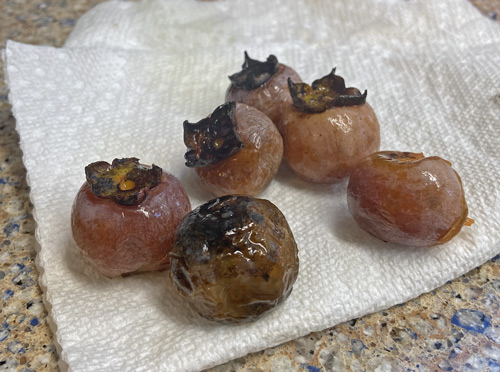
Ripe common persimmons.  Nice and mushy. The one in front is perfectly ripe.


In a grocery store, the persimmons you are likely to find are from an Asian species, Diospyros kaki.  The most common types are Fuyu and Hachiya.  The smaller Fuyu persimmon has seeds and is less astringent, while the larger Hachiya is seedless, but is more astringent until fully ripe (mushy).  I did a taste comparison among these two and my homegrown common persimmons.   The Fuyu had a milder taste and was palatable even when not fully ripe.  The seedless Hachiya needs to be completely ripe (mushy) before it can be fully enjoyed.    As it is seedless it has the additional advantage of having much more edible fruit than either the Fuyu or common persimmons.  Asian persimmons will ripen sitting on a counter top or, more quickly, in a bag with an apple or banana. 

Of the three I found the common persimmon to be the sweetest and most flavorful.  However, the flesh to seed ratio is very low and it, like the Hachiya, must be fully ripe to enjoy its full flavor.  Probably the biggest drawback of the common persimmon is that it is really not that common.  It is not commercially available and is at its best when used within a couple of day of picking. 

Store-bought Asian persimmons


Fuyu persimmon on left has a few seeds, the Hachiya (right) is seedless.


So if you really want firsthand experience with common persimmons you need to have access to a tree, a female one specifically.  Growing a persimmon tree is not too difficult.  The trick is to have both a male and female tree close enough together to allow for pollination.  Common persimmon trees are classified as small canopy trees, growing 50-75 feet in height and a spread of 35-50 feet.  It has an ovoid shape.  The foliage is medium textured with most leaves being 3-4” long.  The trees are tolerant of a range of soil conditions, but they need full sun.  They are winter hardy to zone 5a.

When purchasing a common persimmon tree from the nursery there is no indication whether it is a male or female plant.  There is, however, one cultivar referred to as a Meader Persimmon that is self-fertile and produces seedless fruits.  The best strategy is to get at least 5 trees and hope that you will have a mix of sexes.  For the trees that I planted it took about 5 years before they bore flowers so that I could tell which were male and which were female.  At 7 years in the ground I started getting fruits.  Of the 6 trees that I planted 9 years ago, 2 are male, two are female and two have yet to bear flowers.  (One of these is in a shady location and the other started as a 6” bare root plant.)  I took about 7 years before I began to get any fruits.  Now each year the yields have been increasing significantly.

What Now?

Now that I have invested 7 years in growing my persimmon trees I needed to figure out what to do with them.  Because of the short shelf life of wild persimmons the best way to enjoy them over time is to preserve them in some way.  The mushy flesh of ripe persimmons can be separated from the seeds using a food mill.  The resulting pulp can be frozen for later use or processed into jams or jellies.  There are a number of articles and videos on-line that demonstrate how to process wild persimmons.  Here’s a link to a video that I found useful.  And here’s an article from Indiana Public Media that describes an easy way to make persimmon jam.  This year I only had about a dozen ripe fruits at a time so I opted to make wild persimmon simple syrup that could be easily scaled to the amount of fruit I had.

The ingredients for a persimmon simple syrup that just highlights the flavor of the fruit are:

1 pound of persimmons
1 cup water
1 cup sugar
1 tsp lemon juice

Persimmons, seeds and all are simmered with sugar and water for about a half hour


The whole ripe (mushy) persimmons, water and sugar are combined in a small saucepan and simmered for a half hour.  I peeled the persimmons because it the pulp slipped out of the skins so easily. (This minimized the risk of having some astringency from the peels; however, when fully ripe the skin has no taste.)  Mash up the pulp in the hot liquid several times while simmering.  After about 20 minutes, add the lemon juice.  After 30 minutes of simmering allow the mixture to cool then put it into a cheesecloth and squeeze out the nearly clear liquid.  This recipe yields about a cup of simple syrup.  The remaining pulp had very little flavor left in it.  The syrup can be stored in the refrigerator for several weeks.

The syrup is separated from the pulp by squeezing it 
through a couple of layers of cheesecloth.  

I tried this simple syrup in several cocktails that call for simple syrup.  I found that it worked really well in a whiskey or rum sour.  I also tried it in a lemon drop recipe, but the flavors didn’t work well together, to my taste.

Next year, assuming I will get even more persimmons maybe I'll try making a persimmon pudding.

Tuesday, October 27, 2020

Oh Deer

Even though as winter sets in deer metabolism slows and feeding/browsing damage becomes less obvious, deer still manage to cause some major damage to the landscape


A willow, Salix discolor, that has suffered multiple deer attacks, yet has survived. 
The trunk guards were put on after the fact.


Last February I came to the realization that if I wanted to grow new trees, especially conifers, I would need to protect them from the deer, especially the males during mating season. Here in the Mid-Atlantic November brings on rutting season, the time when white tailed deer mate.  During rutting season male deer rub their antlers against trees and shrubs to remove the velvet from the newly grown horns.  They also will rub trees to mark their territory and to take out their heightened aggressions as mating season kicks in.  What deer prefer for this rubbing behavior are trees and shrubs 1-4” in diameter with smooth bark, like willows and magnolias.  Aromatic cedar and other conifers are also favorites.  Once a tree is marked they will often return to the same one.  At one time I had a nice little Canaan fir, Abies balsamea var phanerolepis,  that I surrounded with chicken wire after it had been rubbed a little.  Two days later all that was left was a bare splinter of a tree.  Now is the time to put up some protection to save some of our precious young plants before they are destroyed.  Following are some of the actions I've taken.

Trunk Protection
Last year I tried horizontal fencing for the first time and did not have great results.  It did not protect a young magnolia from rubbing, but a number of small evergreens did not take any damage.  Based on the photos I have, the deer appeared to skirt the areas with fencing lying on the ground. 

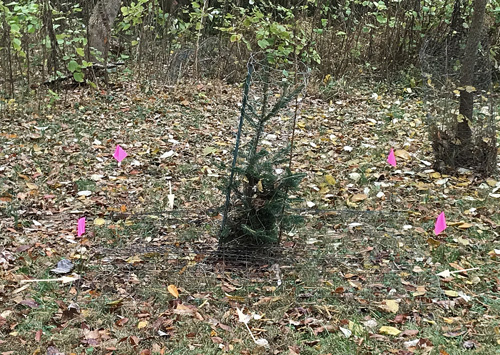
The pink flags indicate where I have put 2"x4"welded wire fencing on the ground around this little Canaan fir tree. 
The idea is that it creates unstable footing that the deer don't like.  The flags help me avoid the fence when mowing. 
I want to add some block underneath to lift the fencing further off the ground.

This year I have plastic mesh poultry fencing wrapped around the trucks of most of the stag-susceptible trees.  For others I have a heavier duty  4” drain pipe around the trunk.  (I’m a little concerned about heat build up under these black tubes.  For that reason I drilled ¾” holes every 6”to aid in ventilation.)  I also used some paper tree wrap on some smaller specimens.  One product that looks very good to me is a white spiral plastic.  It looks like it will protect the bark from rubbing and is open enough to prevent heat build up and not harbor insects.  I haven't bought any of that, yet.  A welded wire barrier surrounding the tree trunk has also proven very effective.  This is most efficient with single trunked trees with few lower branches.  Chicken wire may do a good job of limiting browsing but I've seen it ripped away from small trees that had been rubbed by a buck.

I wrapped the trunks of this fringe tree, Chionanthus virginicus, with plastic poultry fencing. 
It's easy to cut and can be tied together with zip ties or wire.  This material should protect the bark,
but will not support the trunk.


Here I am using a spiral cut 4" drain pipe to protect the trunk of this persimmon tree,
Diospyros virginiana.  I drilled holes in it every 6" to reduce heat build up.  This is
pretty tough material and should hold up to attack.


This Sassafras is being protected with a conventional welded wire cage. 
It's been here 4 years, but now it's of prime size for a deer attack. 
Hopefully the large size cage will be a good deterrent. 
I pulled the cage away during the summer to strengthen the trunk.  
  
Except for the open mesh materials it is a good idea to remove bark protection in the spring.  Heat and moisture build up can damage the bark and in some cases can harbor insects.  Also too much rigid support can keep a tree from developing a strong trunk.  I found this with my young sassafras.  It was getting floppy and the truck was not able to support the top growth on its own.  I pulled away the support this past spring and now the truck is much firmer.

Here  on this willow I'm comparing a variety of protection devices. 
On the right is a paper tree wrap.  Not sure how that would hold up versus a buck.


Repellents
In winter deer’s metabolism slows down, but they are still out there browsing.  Evergreens, branch tips and leaf buds are at risk.  Fencing and cages are effective at keeping deer far enough away to prevent browsing.  Burlap warps that are used to prevent winter burn on arborvitae should also work.  Repellents are also helpful.  In colder weather taste-based repellents have an edge because they do not need to be volatile.  It is often recommended to alternate among different repellants through the season so that deer don't get used to any one of them.   So far I haven't done that.  

Reading about all the different recommendations for deer repellants, as well as deer resistant plants, it has become clear that not all deer are the same in regards to their likes and dislikes. Be flexible and try different recipes and products.  I've had good success using Bobbex which contains a variety of taste and odor deterrents. 


Planning Ahead
I’ve seen a number of people on Facebook ask about starting gardens in areas with lots of deer.  My deer seem to test every new plant that goes in the garden.  For new shrubs I usually put a chicken wire cage around them.  As far as planning an new large planting, I like the advice I’ve read in ‘Deerproofing Your Yard & Garden’ by Rhonda Hart.  She recommends fencing in the new garden space before doing any planting.  This is because deer are creatures of habit.  If they have never found anything of interest in an area, then they are not likely to return.  But, once they have found something tasty there, they will make every effort to return.


On the Bright Side?
Deer browsing results in some unsightly damage to many landscape plants.  It is not uncommon to find hedges of arborvitae and junipers chewed back up to about four feet off the ground.  There are some aspects of deer browsing behavior that could be considered beneficial.  The following two photos show where deer have pruned away branches from the lower 4 feet of a yew and a rhododendron.  This sort of pruning opens up the ground plane for lower growing herbs to fill in. In the absence of deer these would be mounds of foliage.  I've also seen this with spicebush, Lindera benzoin, in the woods. This can happen when there is not excessive deer pressure.  Had there been more deer here say 10 years ago these shrubs may not have grown more than a foot tall before being destroyed, unless they were being protected with cages and repellants.

The lower branches of this yew have been munched away over the years.

This rhododendron has been 'limbed up' by deer.

What methods have worked for you during rutting season?  I'd love to hear about them.


Sunday, July 5, 2020

Getting More Fruits

Sassafras blooms in the first part of spring. 
This photo was taken on April 12th.

I have been planting more native trees and shrubs with the goal of increasing the amount of food available for birds.  Particularly fruits that are available in fall and winter.  In many cases these plants are dioecious. That is, an individual plant of the species is either male or female.  To get berries you need at least one male to fertilize the female flowers.  Sometimes getting male and female plants is easier when you are buying cultivars.  It is often documented somewhere (but not always) if a cultivar is male or female.  When buying seed-grown natives it is difficult to tell unless they happen to be in bloom when you are shopping.  If plants are not in bloom the recommended approach is to get 5 random plants so that there will be a good chance that you will get at least one of each.

This year I have spotted some firsts in my campaign to produce more native berries.  The first success that I noted was that my newly planted sassafras tree, Sassafras albidum, was a female [note structure of female flower].  There is a number of wild sassafras in the area, but the flowers are way up in the tree so I have not been able to distinguish their gender.  About a month after blooming I noted that there were a couple of berries forming.  They are green right now, but will turn dark blue when ripe.
Female flowers have 6 sterile stamen (staminodia) surrounding
a central pistil.  Male flowers have 9 stamen.
Here at the beginning of July you can see the green berries.  When ripe these berries
will turn dark blue and the pedicels will turn red.


The second species I spotted with fruit forming was persimmon, Diospyros virginiana.  There has been male tree on the property for some time.  I don’t know if it’s wild or was planted by the previous owners.  When I moved 7 years ago I planted a number of native persimmons all of unknown gender.  To improve the chances that I had at least one female I planted 6 new plants.  Last year one of them bloomed that proved to be a male.  This year two additional trees bloomed, both of which were female.  Shortly after the flower petals fell off I noticed that two of the female flowers had swollen ovaries.  Now I can hope that they survive long enough to ripen.  I may need to build a little fence around them to keep the deer away.  
Female flowers are usually solitary and have 8 sterile anthers around the pistil.
 On male trees flowers are clustered and are typically packed with 16 anthers.

About a month later this persimmon is developing. 
Green now it will turn orange when it ripens in the fall.


Another recently planted native tree that is now showing some berries is fringe tree, Chionanthus virginicus.  Fortunately these bloomed the second year after planting.  The first three of these I planted either appeared to be females or had not bloomed after two years.  The following year in early June I was in a native plant nursery when these were in bloom.   I was able to identify one specimen as a male (paddle-shaped anthers in throat of flower) and bring it home for the girls.  Now 4 years later I’ve spotted the first berries on the fringe trees.  Like with the sassafras these start out green then turn dark blue when ripe. 
This green berry on the fringe tree will turn dark blue when it ripens in early fall.


Two years ago I replaced some invasive leatherleaf mahonia, Mahonia bealii, with some inkberries, Ilex glabra.  I wasn’t able to get a male cultivar locally.  I found a suggestion on the internet that other hollies could fertilize inkberries.  To try this I planted an early blooming winterberry holly, Ilex verticillata ‘Jim Dandy’ nearby.  After planting my collection of inkberries including the ‘Nigra’ and ‘Shamrock’ cultivars I took a close look at the flowers.  While the flowers on ‘Nigra’ were exclusively female, ‘Shamrock’ appeared to have both male and female flowers.  Unfortunately this year I forgot to take a close look at these flowers to confirm my earlier observations.  I can say that this year I am seeing a lot of berries developing on the ‘Nigra’ plants, as well as on a single wild-type plant.  The ‘Shamrock’ cultivars bloomed this year but are lacking berries.  They had a lot of berries in their first year here.  
This female flower has a large central ovary surrounded by six sterile stamen. 
In male flowers these stamen will have yellow pollen on the anthers.

Also on the holly front, this year I added another winterberry holly, ‘Winterred.’  This is a later blooming female.  Its blooming cycle is perfectly timed with the male, ‘Southern Gentleman.’  While it was still in its pot I placed the ‘Winterred’ next to the ‘Southern Gentleman’ until the blooming period was nearly completed.  This should ensure some berries as long as it doesn’t get stressed too much from being planted out in late June.

Some other species that are not dioecious have mechanisms that encourage cross pollination. This ranges from clever flower construction that prevents self-pollination, to offset timing of pollen release and receptivity, to outright rejection of pollen with the same genetic material as the ovary.  To encourage fruit and seed production you should have at least two genetically distinct individuals within pollination range. 

This is what I’m thinking about my single American plum, Prunus americana.   Despite several years of impressive blooming I have not seen any fruits on this tree.  I don’t know how long these need to mature before they are ready to bear fruit.  To help with cross pollination I’ve planted several bare root American plums in the area but I think it will be a few more years before these begin to bloom.

Another fruit-bearing native that has appeared on my property is black raspberry.  I’d like to think that these have been encouraged by the removal/reduction of invasives like Japanese stiltgrass, wineberry and garlic mustard.
Black raspberry has round stems and first year canes are glaucous. 
Flowering occurs in mid-May

The black fruits ripen around the end of June and have a distinctive sweet flavor. 
These ripen a week or two before the wild blackberries, which are much tarter.

Thursday, June 16, 2016

Finding a mate for my Plants, part 2

One of my goals in creating a more wildlife friendly landscape is to use plants that produce fruits and berries in addition to pollen, nectar and habitat.  While for some plants that is not a big deal.  A single specimen may be self fertile, or there are other nearby plants for cross-pollination.  Where I have been having more trouble is with some of the less common species to my neighborhood.

A good number of fruit bearing trees and shrubs are dioecious, that is, they have male and female flowers on separate plants.  You need one of each in order for the female to bear fruit.  The classic example of this in horticulture is with the hollies (Ilex sp.).  Fortunately, the industry knows that customers expect to see red berries on their winterberry hollies, so they have provided distinctly named male cultivars to interplant with the more attractive females.  Usually one male plant is sufficient to fertilize five females.

Finding information on the genders of other plant species is more challenging.  Many maples are dioecious, but it is rare to find its gender in the plant description.  Most folks don't care much about the flowers on a maple, they are too far away to see and the foliage is the main feature anyway.  However gender is an issue for many allergy suffers.  Male trees produce loads of pollen and if it's wind borne, that's a lot of pollen in the air.

This Sassafras was blooming at the beginning of April.
Males have showier flowers because of all of the stamen.
The female flowers are more subdued.
My goal is to have mating pairs so that I can get fruit production for the birds and other wildlife.  On my property I have a number single specimens.  In order to find out which genders I have, I need to be out there observing them while in bloom.  I learned that my big sassafras tree is a male since I was out there in early spring while it was blooming.  I didn't see any others in bloom.  I recently purchased a new seed grown sassafras, but it will be maybe 10 years before I learn its gender.

One approach to getting mates when buying young plants is just to buy a lot of them and then play the odds.  I often buy 3 at a time, but 5 gives you a better shot. This is only certain for seed-grown plants.  Plants propagated from cuttings will have the gender of the 'parent' plant.  Then you need to hope that the propagator started from a mix of plants and not a single cultivar.


This fringe tree is probably 4 years old and
has a few blooms on it.


Another approach is to be at the nursery and find plants in bloom.  I got lucky this year when I found small fringe trees in bloom at my favorite nursery.  I went home and saw that both of mine were also in bloom and they were both females.  I headed back to the nursery and looked though their plants until I found a male and bought it.  Now I'm all set for next year.

This is the female flower, there are two stigma held closely in the center.
The male flowers have two paddle-shaped anthers that protrude from the flower center.

Tupelo, Nyssa sylvatica, is another tree that is dioecious.  I put in two of them in a couple of years ago.  Then I realized it was a big gamble that I would have one of each, so a added a third this year.  These mature into fairly large trees, so I don't want to fill up the yard with a bunch of them.

I have a mature persimmon tree that is female.  The first year we moved here I added 5 more saplings.  Now, 4 seasons later they are about 10 feet tall, but still no sign of blooming.  Maybe next year.

Here's the female persimmon in bloom.  I haven's seen what the male looks like, yet.
CORRECTION: This is actually a male plant.  See comment 6-14-2020 below.


The native pussy willow (Salix discolor) also comes as separate male and female plants.  The male is showier with its large fuzzy stamen.  These plants do bloom when they are small, so you might have luck determining which to buy at the nursery.  These bloom in mid-April around here and, unfortunately, many nurseries aren't open for business then.  The one I purchased two years ago was male.  Willows are very easy to propagate by cuttings.  So I was able to quickly grow several new plants, but these will all be male.  I did pick up another this spring, but it was not in bloom.  The vendor said it was seed grown so I'm working blind.

The male flower of this pussy willow is adorned with bright yellow stamen.
The flowers on female plants are green and somewhat scaly in appearance.

I did get a couple of goatsbeard (Aruncus diocus) which turned out to be both male.  This is a case where I am happy not to have a mate.  The male has the showier flower and two plants take up more than enough to space in the garden.
The stamen on these male goatsbeard flowers really catch the light.

Thursday, November 28, 2013

Finding a Mate for My Plants

Berries of Winterberry Holly persist into well into winter
 when they provide late season food for birds.

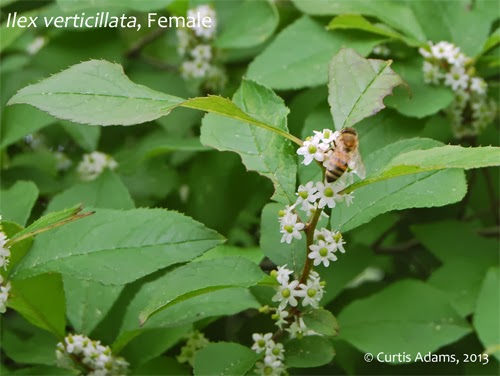
Shortly after we moved into to our new place I identified a nice looking Winterberry Holly (Ilex verticillata) growing near the front door.  It was mid fall and I didn't see any berries on the shrub.  This meant that either it was a male plant or that there were no compatible males within 100 feet to provide pollen.  The bright red berries of Winterberry are its main ornamental and ecological feature. 

Female flowers have a large central ovary surrounded by undeveloped
stamen-like structures (lacking anthers).  This plant was blooming in early June.

I had to wait until the following June to get a good look at the flowers.  After careful examination it turned out that this plant was in fact a female.  The solution was to find a suitable mate, that is one with a similar bloom time.  I found a male cultivar at a nearby nursery called ‘Jim Dandy’.  I sat him next to the established female for a few days while I located a nearby spot to plant him.  

Male flowers have well developed stamen and a very small ovary-like center.
The male plant seemed to attract smaller sized insects.


By September I noticed a few of red berries on the plant.  Success!  I hope to see more berries next year as there will be a much longer time for pollination to occur. 

These red berries were formed by mid-August.  

One of my goals in designing a landscape is its habitat value.  That is, what does the landscape gives back to wildlife in the form of food and shelter.  So when I select plants I look for ones that produce flowers, fruits and/or seeds that wildlife can use.  When selecting plants from a commercial nursery many of them are cultivars, which are genetically identical.  This becomes an issue in the habitat garden if the plants are single sexed (dioecious).  It is also a problem for plants that have both male and female flowers on the same plant (monoecious) or have perfect flowers (both male and female parts in the same flower) if the plants are not self fertile. 

All this plant fertility can have a down side.  In a formal garden production of viable fruits and seeds may lead to increased weeding and spreading of plants out of their designed boundaries.  Also, some consider that the mess that falling fruits create outweighs providing food for birds and other wildlife.  Personally I think of the landscape as a dynamic thing that changes over time.  In the designed landscape plants need to be kept under some degree of control, but I really enjoy seeing native species spreading to new areas where they are happier than in my initial design.

Here are the flowers of a female persimmon.  They have large ovary structures.
Male flowers are narrow at the base.
My experience with the Winterberry Holly has heightened my awareness of dioecious plants.  I want to generate as much natural food for wildlife as possible.  Also I would like to grow some ‘wild’ fruits and berries.  Persimmons (Diospyros virginiana) are dioecious.  My established persimmon is a female, but I have not seen any fruit on it.  I have brought in four more new wild-type plants, at least one of these should be male.  I don’t know of any named male cultivars of persimmon; however there is one called ‘Meader’ that is self-fertile. 

In general female plants need at least one pollen source (male) close enough that pollen can be transferred.  This transfer can be by wind (grasses and many trees) or by insects (vectors) most flowering plants.  For native hollies, like Winterberry, a male should be located with in 50 ft for effective pollination, though pollination over greater distances (100-200 ft) may be possible. 

Female Box Elders are covered with seed pods (samara) in the fall.
I noticed some squirrels eating them right off the tree.

Some other dioecious plants that I have are Box Elders (Acer negundo), Junipers, Tupelos (Nyssa sylvatica), Yews and Goatsbeard (Aruncus diocus). 

Some plants with perfect flowers are not self-fertile.  This may not be convenient for a habitat gardener with limited space for lots of plants. However, it works out on the larger scale to provide the greater genetic diversity adaptation to change and continuation of the species.  I have posted a number of times about the difficulty of getting Viburnums to bear fruit when only a single cultivar was planted.

There are some practical situations where limiting plant fertility and reproduction is called for.  In urban landscapes Ginkgos are very successful street trees.  The fruits, however, are loaded with butyric acid and smell of dog poo when stepped on.  For this reason most cultivars in the trade are males.  In my last post about Jerusalem Artichokes I noted that these are not self-fertile.  By only using only a single cultivar one limits the risk that this somewhat aggressive native will spread by seed. 

Another issue for some in urban and suburban landscapes is pollen allergies.  In many cases these are due to the (over) use of male cultivars.  Males don’t produce messy fruits, but they still send out their pollen.  This results in a type of air pollution that effects sensitive individuals.  While searching for information about dioecious plants I came across an excellent resource book by Thomas Ogren titled Allergy-Free Gardening.  This book contains a lengthy list of dioecous plants and the sex of individual cultivars.  There is also an allergy rating for a wide variety plants including monoecious plants and those with perfect flowers.  I did not realize that many maples, such as Red and Silver Maples, came as separate male and female plants.  Since I am more interested in facilitating plant fertility for enhancing habitat value I see using this book differently than the author intended.  But, if I had a client with particular allergy problems this book would be an excellent resource for plant selection to design a low-allergen garden.