Friday, March 25, 2011

Snowplows and Roadside Plantings, a Case for Native Annuals

Last week I did the spring clean-up of a roadside bed I designed. The plants used were all Eastern North American species.  As I was working I was reflecting on what did and did not work well. For the most part it has been doing quite well with little input from me. Up away from the main traffic flow Aronia (Aronia arbutifolia), Meadowsweet (Spiraea latifolia) and Shrubby Cinquefoil (Potentilla fruticosa) are growing well as are the perennials including Prairie Aster (Symphyotrichum turbinellum), Purple Coneflower (Echinacea purpurea), Appalachian Blazing Star (Liatris squarrulosa), Stiff Goldenrod (Solidago rigida), Red Columbine (Aquilega canadensis) and my favorite grass, Prairie Dropseed (Sporobolus heterolepis).


When I designed this roadside bed back in 2006, I selected plants that I thought would withstand drought conditions, salt spray, full sun and wind. The one aspect that I had not fully appreciated was tolerance to disturbance, particularly resistance to snow plows! Where the bed is protected by a curb there is not much of an issue, but down near the highway the surface of the bed is often scraped over, either directly by the plows or as a result of snow being pushed up and over the sidewalk.
    
When I first learned that blueberries were salt tolerant I happily incorporated them into the roadside position.  I thought people going by would be impressed at how versatile of a shrub blueberries were. I was shocked the following spring when I found the bushes pushed nearly a foot further into the bed, the result of plowing of the snow. Well, the plants are still there 4 years later, but just hanging by a thread. This is obviously the wrong place for what would otherwise be the right plant.


Problem area, after a fresh layer of leaf mulch. 
The blueberry twigs are still in there.

Down by the road Seaside Goldenrod, Solidago sempervirens, is performing well. In fact, this is an example of a native species that is expanding into the urban environment in disturbed areas where road salt makes it difficult for other species to establish. The Prairie Dropseed in this area (those that haven’t been plowed over) are not doing as well. However, Sand Love Grass, Eragrostis trichodes, a new addition to this area does seem to be doing better.

Considering the conditions at this end of the planting I really need a plant (or plants) that will have a continued presence despite a nearly annual scraping of the top layer of soil. Use of a native annual, or perennial, that vigorously self-seeds should fit the bill. Since the plant starts each year anew, disruption of the crown and roots would not be an issue.

This year I have seeded in some American Pennyroyal, Hedeoma pulegioides, a true annual that grows in dry disturbed locations and produces a lot of seed. I also added seeds for a couple of perennials, Spotted Beebalm, Monarda punctata, and Butterfly Weed, Asclepias tuberosa, that are known to reseed effectively and have some salt resistance. By starting from seed I am testing whether this site has the right conditions for germination, a critical factor if they are to get established there.

To get some new ideas I turned to the Advanced Search  function on the USDA Plants database. Here I looked for plants that will tolerate full-sun, drought and salt. While not every plant in the database is searchable in this way, it can provide many leads. Among the results was the Seaside Goldenrod that is already thriving there. A new lead that was generated was Beach Sunflower, Helianthus debilis. I’ve been growing this from seed in pots at home for a couple of years, now it’s time to put it to the test in the field!


Monday, March 7, 2011

Strawberry Blite, it's not a disease!

Despite it’s common name (formerly of the genus Blitum) Strawberry Blite, Chenopodium capitatum, also known as Beetroot and Strawberry Spinach, has some attractive features.  The small ball shaped flower clusters (up to ½ inch) start out green but shortly turn bright red. These flowers mature to bright red edible fruit clusters (to ¾ inch) that contribute to the plant’s common name. The leaves of this species, as with other members of the genus, can be eaten like spinach, fresh or cooked.

Since I was interested in seeing how the aesthetic value of this plant developed, I did not taste the leaves or roots, both of which are edible.  I did try the red berries on several occasions.  They were slightly sweet and not unpleasant, but the seeds were rather large and hard.


Nice leafy example of Strawberry Blite in good soil, late spring.
 This plant is in the same genus as naturalized species Lamb’s Quarters, C. album, and as such I expected it to be equally vigorous.  My experience with this plant has been mixed. I was able to get good germination of the seed under lights without any pretreatment, but I did have problems getting plants to develop after transplanting, in a variety of soils.  I had better results direct sowing the seeds.  The seed pack indicates that they should reach maturity in 40-60 days.  In my crowded New England garden it took nearly 2 months for the plant to reach good size.  It has an upright and branching form, 8-24 inches in height. The gray-green leaves are triangular (as much as 4 inches on the lower branches) and alternately disposed on the branches.  The overall appearance is somewhat coarse.

The wild distribution of C. capitatum is throughout the northern half of North America including Alaska and into the Southwest.  It is not usually found in the Southeast or lower Plains States.  It is listed as a native to Connecticut, but as an introduced species to Massachusetts.  The native habitat is in open woods and can also be found along roadsides. It is often observed reappearing after fires.  It is noted the Sierra Club Naturalist's Guide to Southern New England that the seeds are very long lived.  As with other members of the genus, it produces large amounts of seed.  This may be a consideration in the garden, for once established, it may be difficult to permanently eliminate this plant from the site.

Overwintered plant developing flowers at end of May.
While listed by many sources as annual, I found that it is actually monocarpic.  Well at least I did after I looked up what that means.  A monocarpic plant lives to produce a single crop of seeds then it dies. In my case a couple of clumps of this plant grew as a leafy mass after transplanting and then developed flowers and fruits the following year before passing on.  A monocarp is not necessarily short-lived.  For example, Black Bamboo, Phyllostachys nigra, is also monocarpic, but it may take 70 years before it reaches maturity to produce a crop of seed.  After that the plant will die a natural death.

The genus Chenopodium has high wildlife value.  It is a food source for many birds including the snow bunting, catbird and morning dove.  This species serves as a larval host for the common sootywing butterfly (Pholisora catullus).  In addition to its value as a food plant, the red berries have been used dyes by several Native American groups.

The seeds are available from B&T World Seeds and Horizon Herbs (my source).  While I would really like to use seeds from my own eco-region, the provenance of these seeds is not likely from this area seeing as one supplier is in Europe and the other in Oregon.

For me the jury is still out on this plant.  Since I let most of the berries go to seed, I will watch for its return and test the flavor of the roots and leaves this time.  As a garden plant, its habit was too lax to be a featured highlight, although it could work in the background.  Has anyone else had experience growing this plant?   Stay tuned.

Monday, February 28, 2011

Wild Urban Plants

Ever since hearing Peter DelTredici speak about Wild Urban Plants and his ideas on urban ecology last November at the 13th Annual Trees in the Urban Landscape Symposium at Tower Hill Botanic Garden, I have been wrestling with how that fits in with my approach to the use of native plants in urban and suburban environments. This talk explored the plants that are flourishing in the wild, unmanaged spaces in our cities, where they came from and why they are there. While 25-35% of these species are native to North America, many more are introduced species from other parts of the world. The difficulty for me was the apparent acceptance of many invasive and potentially invasive species as the new order of things. To help sort things out and not jump to conclusions, I read over a copy of his book, Wild Urban Plants of the Northeast.


I’m of two minds about this book. On one hand it is an excellent field guide for plants growing without cultivation in an urban setting. It is organized in the same way as Uva, Neal and DiTomaso’s Weeds of the Northeast, but with additional historical and cultural notes on how and why the plant has gotten itself established in the urban environment. These notes were very interesting to me in gaining a better understanding of why many of these introduced plants are so common. DelTredici includes over 200 species that are found growing in cities in the Northeast, from Detroit to Boston and Montreal to Washington, D.C. In the introductory sections this book points out the difficulty of doing strict botanical restoration on an area where the original conditions no longer exist and restoration of those conditions is unlikely, if not impossible. The plants described in this book are examples of ones that have proven to be adaptable to the built environment that is the modern city.

Where I began to have real differences with this book was its description of the ‘Brave New Ecology.’ Here it states that the cosmopolitan collection of plants (natives and introduced species) is the default vegetation for cities in the Northeast. While most would agree that having some vegetation is better than nothing (with some exceptions), I believe that we could be operating at a higher level of ecological function if there were more native species filling the urban niches, than introduced species. The major ecological function that natives support better than most introduced species is supplying nutrition to insect larvae, one of the most basic levels on the food web. I would refer you to Douglas Tallamy’s Bringing Nature Home for a fuller discussion of the role of native plants in the food web.

Also in this book DelTredici tends to treat the urban ecosystem as isolated from more rural, less disturbed ecosystems. If it were the case that the cosmopolitan plants were ill-adapted to life outside the city and did not spread beyond highly developed areas, I would have fewer issues with these conclusions. But the seed from many of the introduced species do not respect any borders, being spread by wind (black swallowwort) or birds (porcelainberry, buckthorns & barberries) into the wider environment.


Many of the introduced species in the ‘cosmopolitan collection’ got their foothold 200-300 years ago as new settlements and, later, cities were being built. These plants were imported along with the new settlers and were preselected for these new urban habitats being built. This made me think, what would happen in an urban site without the addition of exotic plants? If instead of the European mixed seed banks that were brought into the developing urban areas of the North American continent, there were only indigenous plants present to fill the urban niches. We may then see a greater array of regionally native plants in the urban environment. One reason this has not happened is that the native seed banks were not as large or as close to the urban environment as those of the cosmopolitan plants.


For nearly any habitat on earth there seems to be a plant or two that are able to grow there, as this book documents. In the case of the urban environment the ‘problem’ is that many introduced species were given first shot at these newly created lands, while otherwise appropriate native species were nowhere nearby. It would be interesting to see how some natives fared in the city when better matched to the actual growing conditions. Perhaps some more native species that grow on calcareous outcrops or cliffs would be found growing in sidewalk cracks. Looking at the plant community for calcareous outcrops in Massachusetts (found in west and central Massachusetts) there are a number of desirable plants, including red columbine, purple clematis and downey arrowwood.


A roadside planting of Seaside Goldenrod
and Appalachian Blazing Star
with some indigenous Milkweed
What I would like to see is a resource that looks for similarities between habitats in and around urban areas (the built environment) and natural areas that have similar chemical and physical attributes. In addition, there are many plant species that require disturbance to survive, in fact, many of these are on the threatened and endangered lists dues to a decline in ‘natural’ disturbance like fire and agriculture in the Northeast. Some of these may be candidates for native urban plants.

One example of a native plant that is expanding its range, included in his presentation but not cited in the book, is Seaside Goldenrod, Solidago sempervirens. This seaside species has been spreading inland along highways that have similar cultural (growing) conditions as in its native habitat, that is, sandy, salty soils with lots of wind and other disturbance.


Looking around the foundation and at cracks in the pavement around my house I have several native species flourishing. These include the understory tree, Wafer Ash (Ptelea trifoliata) and herbaceous species, like pink tickseed (Coreopsis rosea), swamp verbena (Verbena hastata), a variety of asters and the ever-spreading bearded-beggarticks (Bidens aristosa).

These have been speading in cracks in my driveway
for over 5 years.


Introduced plants are not evil, they are just growing and reproducing as they were made to do. But, as the dominant sentient species, we have choices of what to use in our landscapes. Selecting plants that appropriate to the location and support the local ecology is more responsible than just picking plants for use as ornamentation. With a little work, and trial-and-error, we can find more native species to enrich our urban and suburban environments.

If you would like to hear more about native plants and urban ecology check you the Ecological Landscaping Association conference this week (March 3rd) in Springfield, MA. There will be a panel discussion titled "Native, Introduced, Invasive and Endangered Plants in the Landscape:Untangling the Roots of the Problem", the panel features three experts including Peter Del Tredici, Bill Cullina, a native plant expert and author and Jono Neiger a leading figure in permaculture.

Monday, February 14, 2011

Not Quite Spring in Charlotte

I spent last week in the Charlotte, NC area to see what late winter is like a few zones warmer than New England. While for me it was a great break from 2+ feet of snow , the locals were complaining that, because of the unusually cold weather, they were running 2-4 weeks behind normal. Never-the-less it was nice to see some bare ground.
My first visit was to the botanical gardens at the UNC-Charlotte. Here you can see the 3-acre Susie Harwood Garden which contains mostly exotic ornamentals planted in an oriental-styled garden. Since there were not a lot of plants blooming, or leafed out, it was easier to appreciate the structure of the garden. Some early spring bloomers were familiar like the ‘Jelena’ Witchhazel (Hamamelis x intermedia ‘Jelena’).


This Wintersweet, at 15', perfumed the air beneath.


Two shrubs that I had not seen before were the Wintersweet (Chimonanthus praecox) and Yellow Paperbush (Edgeworthia chrysantha). The Wintersweet had a very powerful, pleasant fragrance and was in full bloom. The buds of the Paperbush were quite striking in the winter garden; I’m sorry I could not hang around another week or two for them to open up. As zone 7 plants I will just have to enjoy the photos of these two.

 
This Dragon-eye Pine (Pinus wallichiana ‘Zerbina’) with its yellow-banded needles really caught my eye as I entered this garden.  It grows as far north as zone 6 and could make it in southern New England.  While there were several example of this species in the garden, I particularly liked this prostrate-growing cultivar.


Just across from the Harwood Garden is the 7-acre Van Landingham Glen featuring plants native to the Carolinas. The plants here are sorted out by habitat, including Pine Woods, Flood Plain and Costal Plain. In addition to the native species there is a collection of hybrid rhododendrons. Unfortunately for me, most of this garden was still at rest with only a few plants, such as Wild Columbine (Aquilegia canadensis) just beginning to stir.
Footbridge in the Van Landingham Glen

The next day was a little warmer, pushing 50°F, and I drove across Lake Wylie to see the Daniel Stowe Botanical Garden in Belmont, NC. While relatively new, opened in 1999, the gardens here are very impressive. The current installations are primarily ornamental with a mix of native and exotic species and cultivars. 
Canal Garden at Daniel Stowe Botanical Garden

It was very nice for the winter visitor that the gardening staff left many of the dried perennials and grasses in place to show off their winter-interest. This is certainly true to their mission of being a four-season garden. The native Possumhaw Holly (Ilex decidua) really popped out in the winter landscape.

In addition to the fountains and walks in the ornamental gardens there is a ½ mile woodland walk that is very well done with signage indicating key native species in a natural setting. Opening in May 2011 will be a ‘Meadowood’ walk featuring more native species in a natural setting. For the color starved there is an orchid conservatory that was in full bloom. This garden certainly merits future visits!


Another ‘garden’ in the Charlotte area is the Latta Plantation Nature Preserve just a little north in Huntersville, NC. Here are over 600 acres of land with native species, flora and fauna, in their native habitats. If spring had been a bit closer I would have made time to spend an afternoon here to see how the native plants really grow here – maybe next time.


Monday, January 24, 2011

Native Seeds for 2011

After assessing what did and did not do well last year, I placed my seed orders for native seeds. Here’s a run down on what I’ll be trying this year.

New Plants
Pearly Everlasting (Anaphalis margaritacea) A perennial with white, long lasting flowers. I’ve been frustrated growing the related annual Sweet Everlasting (see below), so I thought I would try a perennial version.

Butterfly Weed (Asclepias tuberosa) This perennial that does well in dryer sunny locations and attracts many pollinators. I’ve seen a few plants commercially available but I wanted to make sure I had some growing this year.

Rosey Sedge (Carex rosea) I was given a small clump of this foot-tall perennial grass for nearly 5 years ago. I thought I should test it out in some different locations. This sedge prefers part to full shade.

Flowering Spurge (Euphorbia corollata) This perennial is also known as Prairie Baby’s Breath. I thought this could be good for general landscape use, with white flowers through mid-summer.

Woodland Sunflower (Helianthus divaricatus) This perennial sunflower grows well in dry shade. It can be weedy in the garden, but I really want to test it out under the Norway Maple. I’ve seen this brightening up shady oak woodlands in the middle of summer.  This is the first year that I have been able to find seed.


Repeats
Alleghany vine (Adlumia fungosa) I’ve written a lot about this biennial vine. I just can’t get enough. Note that these seeds need 90 days of cold stratification, so don’t wait if you want to try this one!

Orange Hummingbird Mint (Agastache aurantica ‘Navaho Sunset’) grew quite well last year and now I need more to try with clients. I really like the scent of the gray-green foliage and the flowers are pretty nice, too.

Rock Harlequin (Corydalis sempervirens) This another plant that I love.  I just need more rocky places to put it.

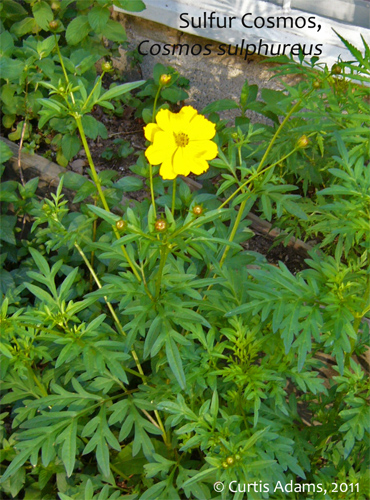
Sulfur Cosmos (Cosmos sulphureus) This native of Mexico (a part of North America) grows as an annual in the Northeast.  I had a crop that returned for 4-5 years until it got crowded out by some Bidens. I thought I would try to start it up again. While the bloom is similar to that of the swamp marigold (B. aristosa), this Cosmos starts blooming earlier and for a longer time.  Also, the foliage is not as dense.

American Pennyroyal (Hedeoma pulegioides) has been getting established from a planting 2 years ago, but I’d like to try more in some different locations. This will do well along a path.

Spotted Beebalm (Monarda punctata) was pretty successful last year and I need more to try with some clients.

Sweet Everlasting (Pseudognaphalium obtusifolium) has given me trouble on transplanting in the past two years. I’ll try this again, this time seeding directly in the garden in prepared soil (not in compacted turf).

One last try...
These three plants did not germinate for me last year, but I’ll try one more time with a lengthy stratification in moist starter mix.

Fern-leaf False Foxglove (Aureolaria peduculata) This biennial is parasitic on oaks, but, reportedly, does not need them for germination. I also have some of these scattered around a nearby oak. Stay tuned…

Tall Swamp Marigold (Bidens coronata) is an annual, with good-sized yellow flowers. I'm curious to see how if differs from the other Bidens I have around.

Brown-eyed Susan (Rudbeckia triloba) is a short-lived perennial, that while taller, has a more delicate appearance than the typical Black-eyed Susan (R. hirta).  I've posted a number of photos of this species over the past year.

Returning on their own:
I'm sure the Swamp Marigold (Bidens aristosa) will be back, but I will be pulling these up to make room for new plants.  I will have a lot of the biennial American Bellflower (Campanulastrum americanum) in 2011, judging by the large number of rosettes in the 2010 garden.  Also, I will keep an eye out for the return of any of the Texas native annuals: Indian Blanket (Gallardia pulchella), Drummond Phlox (Phlox dummondii) and Scarlet Sage (Salvia coccinea), that bloomed so nicely last year.

Monday, January 10, 2011

Upcoming Conferences in the New England Area


'Tis the season for landscaping conferences and meetings.  Before we get too busy with the physical work, the wintertime is a time to do some learning and meet others who are doing similar work, as well as seeing what new plants and products are out there. 

The following is a listing of some of the conferences happening in the New England area over the next 3 months.  There may be others, but these are the ones that have crossed my desk recently. 

22nd Annual Landscape Design Symposium on January 20th and 21st, 2011, titled: Uncharted Territory: An Expansive Approach to Environmental Landscape Design.  This series of symposia was developed by Larry Weaner, one of the top people in the area of naturalistic design and the use of native species in the landscape.  This 2-day event features 11 speakers covering a range of topics including history, plant selection, sustainable practices and natural landscape design.  The conference is held at Connecticut College in New London, CT.

For the landscape professional you can't beat the 3-day long New England Grows, from Feb 2-4, 2011 at the new Boston Convention and Exposition Center.  This is a huge show featuring both landscape equipment and supplies, plant materials, and consulting services.  In addition there are a series of talks covering a wide range of landscape industry topics.

Natural Landscape Design: Meadows & Woods, Feb 16-18th, at Tower Hill Botanic Garden in Boylston, MA, is another Larry Weaner sponsored course.  This is focused on the landscape design professional who wants to learn more about the natural design process and management of a naturalistic design, especially in the context of Meadows and/or Woods. 

The ELA  (Ecological Landscaping Association) conference is March 3, 2011.  This one day conference is focused on using ecological methods in the landscape and is accessible to anyone interested in improving the ecological functioning of their landscape.  In addition to a very good line up of speakers, there is a marketplace where you can see many new products and speak with the vendors.  This conference is in Springfield, MA, so you can connect with people outside the Boston area.  This was the very first landscaping conference I attended 6 years ago, and I have been there every year since.


2010 Flower Show
And finally there is the New England Spring Flower Show, March 16-20, 2011, at the Seaport World Trade Center in Boston.  This event is sponsored in part by the Massachusetts Horticultural Society.  This year the theme is "A Burst of Color: Celebrating the Container Garden".  Program detail do not appear to be available yet, but the topic of container gardening should be well suited to the Flower Show format.  Last year I saw some crazy items and got some good ideas. 


Check out the links for more information about each of these meetings.  Except for the Tower Hill course, I am planning to attend all of these events.  People ask me 'what do you do in the off-season', I tell them I attend conferences and get juiced-up for the spring.  What are some other meetings that should not be missed this winter?

Monday, January 3, 2011

Native Annual Seeds that I tested in 2010

As I get ready to order seeds for 2011, I’m looking back on the native annuals and biennials that I tried out last year.  Some were successful and bear repeating while others went nowhere.  Some of the failures were not surprising while others just wouldn’t germinate and I’m not sure why.  So here’s a review of last years seeds.

Native to Massachusetts:

Adlumia fungosa (Allegheny vine, biennial) I got a few more plants from seed I collected in 2009.  Even better, I saw several plants coming up on their own from the previous season’s plants! 

Aureolaria pedicularia (Fernleaf yellow false foxglove, annual)  None of these germinated.  Since these plants are partially parasitic on oaks, my seed starting mix may not have been right, or they may not have been conditioned properly.

Bidens coronata (Crowned beggar’s ticks, annual)  Very few of these seeds germinated and those few that did failed to mature.  This was a surprise to me since other Bidens species tend to run wild in the garden.  I’ll give this one another try, directly in the garden.

Corydalis sempervirens (Rock harlequin, short-lived perennial)  These had good germination and transplanted well. I really love this plant.  I’ll need to find more places with thin rocky soil for this plant.


Hedeoma pulegiodes (American pennyroyal, annual) sprouted freely in the garden near where I had planted seedlings in 2009 – even under the Norway Maple.  While I couldn’t see them all, I could detect their aromatic aroma whenever I stepped on or mowed over them in the lawn.  It is reported that these plants act as an insect repellant when rubbed on the skin.  I hope to give that a try this year. 

Neither the Hypoxis hirsuta (Eastern yellow star grass, perennial) nor the Polygala sanguinia (Purple milkwort, annual) seeds germinated for me this year.  I will give up on these two for now, also I have run out of seed. 

Pseudognaphalium obtusifolium (Sweet everlasting, annual)  These seeds germinate well, but the transplants do not mature well in the yard or in pots.  Its native habitat is in depleted soils with little competition from other plants. However, I was surprised to find one out of the lawn, near the one successful plant from 2009.  I’ll try these again with direct seeding in a prepared area. 


Native to New England:

Monarda punctata (Spotted bee balm, biennial) germinated and transplanted well.  It also bloomed quickly and was a big hit with the bees and some very interesting wasps in the garden.  Since this Monarda prefers drier conditions, I have a roadside spot that would benefit from this plant that I would like to try it in this year.

Rudbeckia triloba (Brown-eyed Susan, biennial) failed to germinate for me.  The germination conditions on the packet were fairly complex, especially when compared to relative Rubeckia hirta (Black-eyed Susan) which germinates freely after a month of cold moist stratification.  A small population of R. triloba is getting established at the Wildflower Meadow at Mount Auburn Cemetery in Cambridge, MA.


For plants Native to other parts of North America I found the following:

Salvia, Spotted Beebalm, Agastache and Gallardia
all mixed together in my South-facing bed.
Agastache aurantiaca ‘Navaho Sunset’ (Golden hyssop, perennial)  This cultivar germinated reasonably well and while it was a little slow to get started growing in the garden, it was up to full size and blooming by mid-July, producing a cloud of orangy-pink flowers.  The foliage also smells really good when disturbed. We’ll see how well these overwinter/reseed.  I’ll be growing more of these this year!

Cleome serrulata (Rocky Mountain Bee Plant, annual) again failed to sprout for me, either indoors or out. I can get the seeds to germinate, but not develop into seedlings.  Again, there may be something wrong with my starter mix or the newly germinated seed may be too delicate to sow into the growing mix.  In either case, I think I need to move on. 

Eschscholzia californica (California poppy, annual/tender perennial) germinates well in the garden, but my site is a bit too cool to allow many of them to reach maturity.  I usually get only a handful of blooms each year. This plant also shuts down when it gets too hot.  While I loved this plant in my native California, I think it is time to move on from this one too.

Euphorbia marginata ‘Summer Icicle’ (Snow-on-the-Mountain, annual) is a tap rotted annual and is reported not to transplant well.  So after soaking the seeds in warm water for a few hours these were planted directly in the ground in early June.  When mature they provided foot-tall mounds of white foliage and flowers.  This cultivar is shorter than the species (1-3’). 

Gallardia pulchella (Annual blanket flower, annual)  These seeds came from the Wildflower Center in Austin, TX.  These germinated and transplanted well after 30 days of cold stratification (may not have been necessary).  This species has a laxer form than the commercial cultivars, but it bloomed well both in pots and in the garden where it intermingled with the Spotted Beebalm and the Agastache.  This plant was very popular with the bees. I allowed the flowers to go to seed so we’ll see if they are still viable in the spring. 


Helianthus debilis ‘Pan’ (Beach sunflower, annual) reseeded itself into the same pot from last year.  This is not too surprising since there are naturalized populations of this Texas native scattered along the Eastern seaboard up to the Northeast.  This second generation had the same upright branching form of its parent.

Phacelia tanacetifolia (Lacy phacelia, annual) germinated very well and grew well in potting soil, but did not take well to being transplanted.  It has been recommended as a cover crop, with the warning not to let it go to seed in agricultural fields.  I may try this again as a direct sow plant.

Phlox drummundii (Drummond phlox – straight species, annual) also came from the Wildflower Center. These seeds germinated and transplanted well.  The flowers were true to the species scarlet red, but there was some variation in flower shape.  While I am not too hopeful that about the seeds overwintering outside, I did get a second generation late in the summer.  Relative to other flowers in my Massachusetts garden, these flowers were not very attractive to the pollinating insects.


This petal shape, with the white edging,
was unique from the other plants I had this year

Salvia coccinea (Texas sage, annual/tender perennial) is another Texas native.  Seeds for this plant germinated and transplanted well.  It grew equally well in a pots and in the garden bed and was very attractive to the bees.  Based on the native range of this species I don’t expect that any of the seeds would overwinter in my garden.

If you have any advice for growing the plants I listed here, I love to hear it.  What new native plants are you thinking about trying for next year?