Showing posts with label Euphorbia corollata. Show all posts

Wednesday, May 30, 2012

Seedling's Progress - New Natives from Seed

One of my goals is to increase awareness of Native Annuals and their possibilities in the garden.  A major part of that is encouraging the plants to reseed themselves into the garden.  This is starting to get complicated, especially where I have combined a number of different plants.  It behooves me to learn what the seedlings of both the desired and undesired plants look like.  I getting to the point where I can tell which seedlings are familiar, even if I'm not sure which one it might be.  Here are some photos from this spring of some native seedlings, both 'wild' and ones that I have started in pots.

Lilium seedlings are just a single blade.
The seeds that I am most excited about are for Philadelphia Lily, Lilium philadelphicum.  I wanted to get some experience with a native lily and I chose this one because it's habitat is most like what I keep at home, dry upland woods.  Since I thought that germination would be tricky, I tried several methods: cold moist sand for 60 days, moist soilless mix for 2 weeks at room temperature then 60 days in the frig, room temperature seeding and winter-sowing.  The cold moist stratification gave me nearly 100% germination.  All the other methods were about 50%.  Now it is time to pot these guys up.  I think it will be several years before these will be mature enough to bloom, but I think (hope) it will be worth it.


Partridge Pea is a native annual found in the eastern half of the US.  It germinated well after a 10 day cold stratification.  This plant is able to fix nitrogen from the atmosphere though its association with rhizobial bacteria.  The seed I purchased form Prairie Moon Nursery came with a packet of inoculum to ensure that these bacteria would be present for the new plant.  The leaflets fold together at night and when it is being roughly handled.  I have already planted out a bunch of these along a roadside, where I am hoping they will be able to reseed themselves. 


Indoor sown plants are lankier than these outdoor plants.
Another one of the new plants I started this year was Vigin's Bower, Clematis virginiana.  While it is a pretty common woodland species, I have never noticed it before.  I want to test it out under the dreaded Norway Maple.  I got excellent germination from plants started indoors after 2 month moist stratification in sand.  I also started some outdoors in mid-January, using the Winter Sowing technique.  I think I got better germination using the refrigerator-stratified seeds, but the outdoor plants are more compact.

I also started more Woodland Sunflower, Helianthus divaricatus, and Crowned Beggarticks, Bidens coronata, using the Winter Sowing method.  Germination was moderate, but the resulting plants are of good size and require no hardening off before transplanting.  This was probably a poor year to really evaluate the winter-sowing method.  Since it was quite warm and relatively dry, the covered containers did not get very much moisture in through the pour-spout, making them warmer and drier - not what you want for cold stratification of seeds.

Random Seedlings: 1. Sulfur Cosmos (blunt leaf tips); 2. Annual grass
(single blades); 3. Oxalis (3 leaflets); Tomato (hairy stems and smell)

When you are counting on plants reseeding themselves in the garden, weeding and maintenance become a big issue.  In this photo of random seedlings I can recognize some of these as desirable and other as definite 'weeds'.  Possible desirable seedlings here include  Agastache 'Navaho Sunset', Bidens coronata, Cosmos sulphureusMonarda punctata, Salvia coccinia, and Rudbeckia hirta.  The largest seedling in the photo is most likely a Sulfur Cosmos, though it could also be a Bidens.  This is a keeper.  The easy to ID weeds are the grasses and Oxalis.  The grasses have only single leaves (monocots) and the Oxalis has a 3-lobed clover-like leaf.  All of the desired plants in this area are dicots, they have two cotyledon leaves.  This makes them easy to distinguish from the grasses.  Where it gets tricky is all of the tomato seeds that come in with the compost.  (I know, I don't cook my compost hot enough.) These seedlings have a tomato smell when bruised and the stem is covered with little hairs.  At this juncture my strategy is to remove only those weeds I'm sure about (grass, oxalis and tomatos) and watch to see how the others develop.

These seedlings are about an inch tall, but strongly aromatic.
One of my favorite Native Annuals that is catching hold around the house is False Pennyroyal, Hedeoma pulegioides.  It's a small plant that will grow on poor soil and in the gaps in the sidewalk.  It is most easily recognized by it powerful aromatic/minty scent.  Usually just lightly touching a leaf is enough to release the scent.

This is the second year these have managed come back on their own.
Red-whisker Clammyweed, Polanisia dodecandra, is naturally found in gravelly soil along creek beds.  I had a hard time getting it to grow under cultivation (I think it resented being transplanted), but now it is showing up in other potted plants which had been nearby the previous season.

These rosettes may be from fall-germinated seeds
American Bellflower, Campanulastrum americanum, has gotten pretty well established since I first started it in 2009.  The first year rosette will stay small all year and take off, growing to 4+ feet, in year two.  I have a few second year plants that are 2 foot tall already.


Fresh shoots from a plant that was started last year.
While I have the feeling that everything is coming early this year I nearly tossed out some pots that I thought were empty.  Just before I did, I found that the Flowering Spruge, Euphorbia corollata, was sprouting in good form.  Another late riser is Butterfly Weed, Asclepias tuberosa.  While one plant has been up for several weeks, a second, less established neighbor, is just now sprouting.

Now the watching continues.  Will there be more seedlings coming up?  Will I figure what's what before it's too late?

Friday, June 24, 2011

Update: Native Seeds for 2011

Following up on the Native Seeds for 2011 post, here’s a status report on what has and has not worked so far…

Did not germinate:

Allegheny vine (Adlumia fungosa) I’ve written a lot about this biennial vine. I just can’t get enough of it. I was surprised that the new seeds I bought this year did not germinate; however, I do have one self sown plant that is doing great and should be blooming soon. I also have overwintered and planted out some from last year. I’ll need to make a point of harvesting my own seeds this year.

Fern-leaf False Foxglove (Aureolaria peduculata) This biennial is parasitic on oaks, but, reportedly, does not need them for germination. None of these have germinated, despite trying several different germination conditions. 


Butterfly Weed (Asclepias tuberosa) This is the first year I’ve tried these and alas, none had germinated. Fortunately I did get some bare root plants from Prairie Moon Nursery, and these are developing nicely.


Rosey Sedge (Carex rosea) I’ve had a small clump of this perennial grass for nearly 5 years. I was not able to get the seeds I bought this year to germinate. I understand that Carex is generally a difficult plant to grow from seed.


Good germination:

Pearly Everlasting (Anaphalis margaritacea) This is a perennial with white, long lasting flowers similar to the annual Sweet Everlasting (Pseudognaphalium obtussifolium) that I’ve tried several times before. These germinated really well, but have grown on very slowly and so far have not transplanted well. I just may not have the right touch, or location, for these plants.


Tall Swamp Marigold or Crowned Beggarticks (Bidens coronata) is an annual, with good-sized yellow flowers. These did not germinate last year when I cold stratified them in moist sand for 60 days, so this year I got a new batch of seed and conditioned them in moist soil for 60 days in the refrigerator. I was thrilled to see that they were sprouting within 5 days of coming to room temperature. I’ve got these blooming in the garden already! So far I would rate these better than the Bidens aristosa, for early bloom and a manageable size; however it’s still early so we’ll see how long the bloom continues and how vigorously they reseed themselves (a little, a lot or none at all?).

Browneyed Susan and American Pennyroyal in a pot.


Brown-eyed Susan (Rudbeckia triloba) is a short-lived perennial, that while taller has a more delicate appearance than the typical Black-eyed Susan (R. hirta). Last year when I conditioned these in damp sand I got no germination. This year moist stratification in the soilless mix resulted in good and rapid germination after just 4 days of coming out of the refrigerator. I’ve moved some of these to pots and some into the garden. I don’t know if these will grow on to bloom this year, or if they need a season to get established.


Some germination:

Flowering Spurge (Euphorbia corollata) Perennial also known as Wild Baby’s Breath. I thought this could be good for general landscape use, with white flowers through mid-summer. I got a low rate of germination and the plants seem slow to develop. Once the temperatures got over 90, the seedlings began to take off. I’m trying this in several locations and have this one in a pot. So I’m hopeful that at least one of these will mature.


Woodland Sunflower (Helianthus divaricatus) Perennial for dry shade. This plant can be weedy in the garden, but I really want to test it out under the Norway Maple where its vigor may be tempered by this challenging environment. Only 4 of these germinated, but these are developing nicely. I’ve already moved a couple under the 'nasty' Maple and they are continuing to grow.


Repeats, with good results:

Orange Hummingbird Mint (Agastache aurantica ‘Navaho Sunset’) grew quite well last year and I got good germination from the same crop of seeds as last year. Last year’s plants are a dense mass about 18” tall, not ready to bloom yet, but the foliage smells really great, even as tiny plants.


Native to rocky slopes, these transplants
are doing well among some Bearded Iris.
Rock Harlequin (Corydalis sempervirens) Even though the seed was for 2010, still gave a very good rate of germination. Some seedlings that I transplanted into rich humusy soil died immediately, while those interplanted with the Bearded Iris, in unimproved soil, are doing quite well.


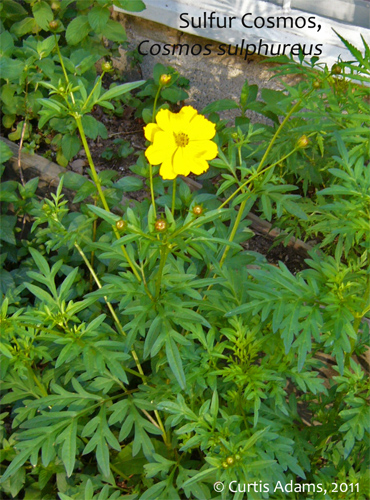
Sulfur Cosmos (Cosmos sulphureus) these germinated well both indoors under lights and direct sown in the garden. I was concerned that I would confuse the seedlings with those from the Bidens aristosa that has reseeded itself all over the garden beds. There are a couple of features that distinguish the seedlings. The first pair of leaflets from the Cosmos are each nearly an inch long, compared to about ¼” for the Bidens, the Cosmos germinate about 2 weeks later than the Bidens (although the Bidens continue to germinate from late April to the middle of June) and while the leaves of both species are deeply divided, the Cosmos have broader rounder tips than those of the Bidens. I am pulling up and discarding the Bidens seedlings, this will be a test of whether I can eliminate this species from the garden so that I can test other plants.


Note the long cotyledon leaves and rounded leaf tips
 
Compare the first pair of leaves with
those of the Cosmos.


The annual American Pennyroyal (Hedeoma pulegioides) has been getting established from a planting 2 years ago. I’ve found that these reseed themselves rather well and grow well under lights (after 30 days cold stratification), but did not come up where I seeded them directly in the garden. I guess these do better when they find their own home. I’ve planted out a few of these and am growing some in pots. I plan to snag a few leaves to rub on my arms to test their mosquito repellent properties.


Spotted Beebalm (Monarda punctata) had germinated within 6 weeks in damp sand, while still in the dark in the refrigerator. I moved the germinated seedlings to starter mix and still ended up with a healthy crop of little plants.


Sweet Everlasting (Pseudognaphalium obtusifolium) has given me trouble on transplanting in the past two years. An this year is no exception – lots of seedlings that do not transplant well. The directly sown seeds did not germinate. I think need to be put into really well drained coarse soil and are not appropriate to my garden conditions.


This seedling is developing faster than ones transplanted from
indoors.  Monarda and Agastache are also cropping up.

Some other seedlings that are showing up on there own in the garden are from the Scarlet Sage (Salvia coccinea), Biennial Gaura (Gaura biennis), Strawberry Blite (Chenopodium capitatum) and of course the Swamp Marigold (Bidens aristosa). I was not certain if the seeds of the Salvia could overwinter here in the Northeast.  Seeing these appear in new locations points out the importance of knowing what the seedlings for these annuals and biennials look like, otherwise I would have weeded them out as I was preparing the beds for other plants.


The reseeded catnip has deeper teeth on the leaf margin than for the Salvia coccinea,
the catnip leaf is also has a fleshier texture.


Monday, January 24, 2011

Native Seeds for 2011

After assessing what did and did not do well last year, I placed my seed orders for native seeds. Here’s a run down on what I’ll be trying this year.

New Plants
Pearly Everlasting (Anaphalis margaritacea) A perennial with white, long lasting flowers. I’ve been frustrated growing the related annual Sweet Everlasting (see below), so I thought I would try a perennial version.

Butterfly Weed (Asclepias tuberosa) This perennial that does well in dryer sunny locations and attracts many pollinators. I’ve seen a few plants commercially available but I wanted to make sure I had some growing this year.

Rosey Sedge (Carex rosea) I was given a small clump of this foot-tall perennial grass for nearly 5 years ago. I thought I should test it out in some different locations. This sedge prefers part to full shade.

Flowering Spurge (Euphorbia corollata) This perennial is also known as Prairie Baby’s Breath. I thought this could be good for general landscape use, with white flowers through mid-summer.

Woodland Sunflower (Helianthus divaricatus) This perennial sunflower grows well in dry shade. It can be weedy in the garden, but I really want to test it out under the Norway Maple. I’ve seen this brightening up shady oak woodlands in the middle of summer.  This is the first year that I have been able to find seed.


Repeats
Alleghany vine (Adlumia fungosa) I’ve written a lot about this biennial vine. I just can’t get enough. Note that these seeds need 90 days of cold stratification, so don’t wait if you want to try this one!

Orange Hummingbird Mint (Agastache aurantica ‘Navaho Sunset’) grew quite well last year and now I need more to try with clients. I really like the scent of the gray-green foliage and the flowers are pretty nice, too.

Rock Harlequin (Corydalis sempervirens) This another plant that I love.  I just need more rocky places to put it.

Sulfur Cosmos (Cosmos sulphureus) This native of Mexico (a part of North America) grows as an annual in the Northeast.  I had a crop that returned for 4-5 years until it got crowded out by some Bidens. I thought I would try to start it up again. While the bloom is similar to that of the swamp marigold (B. aristosa), this Cosmos starts blooming earlier and for a longer time.  Also, the foliage is not as dense.

American Pennyroyal (Hedeoma pulegioides) has been getting established from a planting 2 years ago, but I’d like to try more in some different locations. This will do well along a path.

Spotted Beebalm (Monarda punctata) was pretty successful last year and I need more to try with some clients.

Sweet Everlasting (Pseudognaphalium obtusifolium) has given me trouble on transplanting in the past two years. I’ll try this again, this time seeding directly in the garden in prepared soil (not in compacted turf).

One last try...
These three plants did not germinate for me last year, but I’ll try one more time with a lengthy stratification in moist starter mix.

Fern-leaf False Foxglove (Aureolaria peduculata) This biennial is parasitic on oaks, but, reportedly, does not need them for germination. I also have some of these scattered around a nearby oak. Stay tuned…

Tall Swamp Marigold (Bidens coronata) is an annual, with good-sized yellow flowers. I'm curious to see how if differs from the other Bidens I have around.

Brown-eyed Susan (Rudbeckia triloba) is a short-lived perennial, that while taller, has a more delicate appearance than the typical Black-eyed Susan (R. hirta).  I've posted a number of photos of this species over the past year.

Returning on their own:
I'm sure the Swamp Marigold (Bidens aristosa) will be back, but I will be pulling these up to make room for new plants.  I will have a lot of the biennial American Bellflower (Campanulastrum americanum) in 2011, judging by the large number of rosettes in the 2010 garden.  Also, I will keep an eye out for the return of any of the Texas native annuals: Indian Blanket (Gallardia pulchella), Drummond Phlox (Phlox dummondii) and Scarlet Sage (Salvia coccinea), that bloomed so nicely last year.