Showing posts with label Bidens. Show all posts

Monday, January 24, 2011

Native Seeds for 2011

After assessing what did and did not do well last year, I placed my seed orders for native seeds. Here’s a run down on what I’ll be trying this year.

New Plants
Pearly Everlasting (Anaphalis margaritacea) A perennial with white, long lasting flowers. I’ve been frustrated growing the related annual Sweet Everlasting (see below), so I thought I would try a perennial version.

Butterfly Weed (Asclepias tuberosa) This perennial that does well in dryer sunny locations and attracts many pollinators. I’ve seen a few plants commercially available but I wanted to make sure I had some growing this year.

Rosey Sedge (Carex rosea) I was given a small clump of this foot-tall perennial grass for nearly 5 years ago. I thought I should test it out in some different locations. This sedge prefers part to full shade.

Flowering Spurge (Euphorbia corollata) This perennial is also known as Prairie Baby’s Breath. I thought this could be good for general landscape use, with white flowers through mid-summer.

Woodland Sunflower (Helianthus divaricatus) This perennial sunflower grows well in dry shade. It can be weedy in the garden, but I really want to test it out under the Norway Maple. I’ve seen this brightening up shady oak woodlands in the middle of summer.  This is the first year that I have been able to find seed.


Repeats
Alleghany vine (Adlumia fungosa) I’ve written a lot about this biennial vine. I just can’t get enough. Note that these seeds need 90 days of cold stratification, so don’t wait if you want to try this one!

Orange Hummingbird Mint (Agastache aurantica ‘Navaho Sunset’) grew quite well last year and now I need more to try with clients. I really like the scent of the gray-green foliage and the flowers are pretty nice, too.

Rock Harlequin (Corydalis sempervirens) This another plant that I love.  I just need more rocky places to put it.

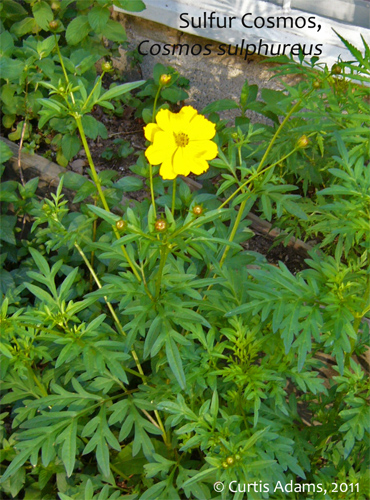
Sulfur Cosmos (Cosmos sulphureus) This native of Mexico (a part of North America) grows as an annual in the Northeast.  I had a crop that returned for 4-5 years until it got crowded out by some Bidens. I thought I would try to start it up again. While the bloom is similar to that of the swamp marigold (B. aristosa), this Cosmos starts blooming earlier and for a longer time.  Also, the foliage is not as dense.

American Pennyroyal (Hedeoma pulegioides) has been getting established from a planting 2 years ago, but I’d like to try more in some different locations. This will do well along a path.

Spotted Beebalm (Monarda punctata) was pretty successful last year and I need more to try with some clients.

Sweet Everlasting (Pseudognaphalium obtusifolium) has given me trouble on transplanting in the past two years. I’ll try this again, this time seeding directly in the garden in prepared soil (not in compacted turf).

One last try...
These three plants did not germinate for me last year, but I’ll try one more time with a lengthy stratification in moist starter mix.

Fern-leaf False Foxglove (Aureolaria peduculata) This biennial is parasitic on oaks, but, reportedly, does not need them for germination. I also have some of these scattered around a nearby oak. Stay tuned…

Tall Swamp Marigold (Bidens coronata) is an annual, with good-sized yellow flowers. I'm curious to see how if differs from the other Bidens I have around.

Brown-eyed Susan (Rudbeckia triloba) is a short-lived perennial, that while taller, has a more delicate appearance than the typical Black-eyed Susan (R. hirta).  I've posted a number of photos of this species over the past year.

Returning on their own:
I'm sure the Swamp Marigold (Bidens aristosa) will be back, but I will be pulling these up to make room for new plants.  I will have a lot of the biennial American Bellflower (Campanulastrum americanum) in 2011, judging by the large number of rosettes in the 2010 garden.  Also, I will keep an eye out for the return of any of the Texas native annuals: Indian Blanket (Gallardia pulchella), Drummond Phlox (Phlox dummondii) and Scarlet Sage (Salvia coccinea), that bloomed so nicely last year.

Monday, January 3, 2011

Native Annual Seeds that I tested in 2010

As I get ready to order seeds for 2011, I’m looking back on the native annuals and biennials that I tried out last year.  Some were successful and bear repeating while others went nowhere.  Some of the failures were not surprising while others just wouldn’t germinate and I’m not sure why.  So here’s a review of last years seeds.

Native to Massachusetts:

Adlumia fungosa (Allegheny vine, biennial) I got a few more plants from seed I collected in 2009.  Even better, I saw several plants coming up on their own from the previous season’s plants! 

Aureolaria pedicularia (Fernleaf yellow false foxglove, annual)  None of these germinated.  Since these plants are partially parasitic on oaks, my seed starting mix may not have been right, or they may not have been conditioned properly.

Bidens coronata (Crowned beggar’s ticks, annual)  Very few of these seeds germinated and those few that did failed to mature.  This was a surprise to me since other Bidens species tend to run wild in the garden.  I’ll give this one another try, directly in the garden.

Corydalis sempervirens (Rock harlequin, short-lived perennial)  These had good germination and transplanted well. I really love this plant.  I’ll need to find more places with thin rocky soil for this plant.


Hedeoma pulegiodes (American pennyroyal, annual) sprouted freely in the garden near where I had planted seedlings in 2009 – even under the Norway Maple.  While I couldn’t see them all, I could detect their aromatic aroma whenever I stepped on or mowed over them in the lawn.  It is reported that these plants act as an insect repellant when rubbed on the skin.  I hope to give that a try this year. 

Neither the Hypoxis hirsuta (Eastern yellow star grass, perennial) nor the Polygala sanguinia (Purple milkwort, annual) seeds germinated for me this year.  I will give up on these two for now, also I have run out of seed. 

Pseudognaphalium obtusifolium (Sweet everlasting, annual)  These seeds germinate well, but the transplants do not mature well in the yard or in pots.  Its native habitat is in depleted soils with little competition from other plants. However, I was surprised to find one out of the lawn, near the one successful plant from 2009.  I’ll try these again with direct seeding in a prepared area. 


Native to New England:

Monarda punctata (Spotted bee balm, biennial) germinated and transplanted well.  It also bloomed quickly and was a big hit with the bees and some very interesting wasps in the garden.  Since this Monarda prefers drier conditions, I have a roadside spot that would benefit from this plant that I would like to try it in this year.

Rudbeckia triloba (Brown-eyed Susan, biennial) failed to germinate for me.  The germination conditions on the packet were fairly complex, especially when compared to relative Rubeckia hirta (Black-eyed Susan) which germinates freely after a month of cold moist stratification.  A small population of R. triloba is getting established at the Wildflower Meadow at Mount Auburn Cemetery in Cambridge, MA.


For plants Native to other parts of North America I found the following:

Salvia, Spotted Beebalm, Agastache and Gallardia
all mixed together in my South-facing bed.
Agastache aurantiaca ‘Navaho Sunset’ (Golden hyssop, perennial)  This cultivar germinated reasonably well and while it was a little slow to get started growing in the garden, it was up to full size and blooming by mid-July, producing a cloud of orangy-pink flowers.  The foliage also smells really good when disturbed. We’ll see how well these overwinter/reseed.  I’ll be growing more of these this year!

Cleome serrulata (Rocky Mountain Bee Plant, annual) again failed to sprout for me, either indoors or out. I can get the seeds to germinate, but not develop into seedlings.  Again, there may be something wrong with my starter mix or the newly germinated seed may be too delicate to sow into the growing mix.  In either case, I think I need to move on. 

Eschscholzia californica (California poppy, annual/tender perennial) germinates well in the garden, but my site is a bit too cool to allow many of them to reach maturity.  I usually get only a handful of blooms each year. This plant also shuts down when it gets too hot.  While I loved this plant in my native California, I think it is time to move on from this one too.

Euphorbia marginata ‘Summer Icicle’ (Snow-on-the-Mountain, annual) is a tap rotted annual and is reported not to transplant well.  So after soaking the seeds in warm water for a few hours these were planted directly in the ground in early June.  When mature they provided foot-tall mounds of white foliage and flowers.  This cultivar is shorter than the species (1-3’). 

Gallardia pulchella (Annual blanket flower, annual)  These seeds came from the Wildflower Center in Austin, TX.  These germinated and transplanted well after 30 days of cold stratification (may not have been necessary).  This species has a laxer form than the commercial cultivars, but it bloomed well both in pots and in the garden where it intermingled with the Spotted Beebalm and the Agastache.  This plant was very popular with the bees. I allowed the flowers to go to seed so we’ll see if they are still viable in the spring. 


Helianthus debilis ‘Pan’ (Beach sunflower, annual) reseeded itself into the same pot from last year.  This is not too surprising since there are naturalized populations of this Texas native scattered along the Eastern seaboard up to the Northeast.  This second generation had the same upright branching form of its parent.

Phacelia tanacetifolia (Lacy phacelia, annual) germinated very well and grew well in potting soil, but did not take well to being transplanted.  It has been recommended as a cover crop, with the warning not to let it go to seed in agricultural fields.  I may try this again as a direct sow plant.

Phlox drummundii (Drummond phlox – straight species, annual) also came from the Wildflower Center. These seeds germinated and transplanted well.  The flowers were true to the species scarlet red, but there was some variation in flower shape.  While I am not too hopeful that about the seeds overwintering outside, I did get a second generation late in the summer.  Relative to other flowers in my Massachusetts garden, these flowers were not very attractive to the pollinating insects.


This petal shape, with the white edging,
was unique from the other plants I had this year

Salvia coccinea (Texas sage, annual/tender perennial) is another Texas native.  Seeds for this plant germinated and transplanted well.  It grew equally well in a pots and in the garden bed and was very attractive to the bees.  Based on the native range of this species I don’t expect that any of the seeds would overwinter in my garden.

If you have any advice for growing the plants I listed here, I love to hear it.  What new native plants are you thinking about trying for next year?

Tuesday, May 25, 2010

American Bellflower

All around my yard I have mini-invasions of the attractive-yet-aggressive perennial Creeping Bellflower, Campanula rapunculoides, with is tall raceme thick with 1” purple bells. This European import is prevalent in disturbed areas, but according to Forest Service, it is not believed to be a threat to undisturbed natural habitats. When I learned about a native bellflower that also produced tall flower spike I got excited and got hold of some seed. American Bellflower, Campanulastrum americanum, is a biennial, spends its first year as a rosette of foliage and then launches its flower spike, up to 5 feet, in the second year. Despite the similarity in the name, the American (or Tall) Bellflower is a very different plant from its creeping cousin. Its flowers are like sky blue stars rather than bells and very tall flower spike is rather leafy and not as densely populated by blooms. Also, American Bellflower reproduces by seed only and does not form underground runners.

The native range for Campanulastrum americanum is from Ontario to Minnesota and south to Florida. As such, there are not any native populations in Massachusetts. Its native habitat is in moist borders and open woods. While it may grow in full sun, it prefers cool conditions.

I put in seedlings in all parts of my yard ranging from dry shade to full sun in well drained soil, to see just how they do. These plants survived in all locations. In areas with fertile soil and lots of sun, the flower spike reached nearly 6 feet. In the dry shade it topped out at about 2 feet and did not bloom as intensely. It even survived under a Norway Maple. It does reseed itself quite well, where the seed can find good soil. I have way too many seedlings this year, but they are not so prevalent as I get with the Swamp Marigold, Bidens aristosa, growing in the same area.  By recognizing the rosette with its 1/2-1" heart-shaped leaves, you can mange the population by transplanting or removing excess plants.


The flowering period is from July to October. The first flush is strong then blooming continues slowly throughout the summer. While not as full as the first flush, these plants will produce fresh blooms later in the fall. I tried cutting some flower stalks back to generate new spikes at mid-season, but this was not too effective. Maybe this year I’ll try that earlier. Seed that is produced early in the season may ripen quickly and germinate to produce a rosette that year, essentially functioning as a winter annual.

Also of interest, C. americanum is on a list for plants suitable for use under walnut trees, having both resistance to the juglone and a tolerance for shade. Hummingbirds are reported to visit this plant and it has been used to treat coughs and respiratory ailments by the Iroquois and Meskwaki Indians.

Seed for C. americanum is becoming more available. I was able to get seed from both Prairie Moon Nursery and the New England Wildflower Society (NEWFS). In discussing native plants with Scott LaFleur of NEWFS, he felt that despite its vigorous nature in size and reseeding, this plant could do really well in the garden. From my experience I see that it may find its garden home in the back of a shady border or in a cottage garden, where it leafiness will blend in with the other masses of plants.  Since this plant is not native to the New England States, I would not recommend its use up here in areas near to natural areas where its seed may escape.

Monday, March 1, 2010

Bidens in the Garden --- Beggarticks, weeds or not?

The name Beggarticks may not give you a warm, happy feel for a plant to add to your garden. Many of the plants in this genus do not have strong aesthetic qualities that appeal to the general public, BUT a few of these do and are worth considering.  This is another chapter in my experience of working with native annuals and biennials.

Most Bidens species share the trait of having seeds that stick to anything passing their way. In Latin, bidens refers to having two teeth, in this case the two teeth on the seed. The flowers of many Bidens species have diminutive yellow to white ray flowers, rendering the bloom insignificant for the human observer, but still just as valuable to insects (its the disk flowers that matter). Also these plants produce a lot of seed that can be long lived in the soil. With these caveats in mind let me mention several species that have greater visual appeal and can work well in a garden setting.

The first is Swamp Marigold, Bidens aristosa var. mutica. This plant is the exceptional in that it has the largest ray flowers of the genus. Also, while the seed possesses the two teeth typical of the Bidens, these are not able to catch hold like the others. B. aristosa’s range extends from the Maine to Georgia and as far west as Oklahoma.

As the common name implies, Swamp Marigold’s native habitat is wetlands, growing in full sun, or part sun on a woodland edge. Its growth habit is upright with many branches, forming a rounded shrub-like plant 3-5’ in height. It produces a large number of sweet scented yellow flowers, measuring to 2” in diameter. Blooming begins August with a burst of color and continues to October at a slower rate. Flowers are very attractive to bees. I have found that deadheading was effective at improving the second flush of blooms. Also the blooming period was independent of the location of the plant. Plants in pots, different soils, sun and moisture conditions all started to bloom within 2 weeks of each other. If you want a smaller plant, it can be cut back in late June without compromising the floral display.

Unlike many other tap rooted plants, this plant tolerated transplanting well. While somewhat stunted in size, plants transplanted from small pots into the ground as late as July, still put on a good show. I also noted that wherever the stem touched the soil, new roots would be produced. So while the best habitat for the plant is in wet soils, I found it to be adaptable to drier soils, even to the point of surviving as a container plants that were repeatedly dried to the point of wilting!

Seed for Bidens aristosa var. mutica is available from several sources including Prairie Moon Nursery. In my test moist stratified seed (90 days/40F) showed a very high rate of germination. In fact, germination had started while still under refrigeration in the dark. One potential difficulty in a native annuals garden is that the seedlings look the same as those for 'weedy' B. frondosa, Devil’s beggarticks. Differences will become apparent as the mature leaves appear, the leaflets of B. aristosa are much more deeply toothed.  In my garden I have Sulfur Cosmos (Cosmos sulfureus) growing from seed in the same bed. The plants look very similar, but the first set of true leaves of the Cosmos are rounded, not pointed. Also the Cosmos comes up several weeks after the Bidens seedlings first appear.

There are three other annual Bidens native to the Northeast US worth mentioning here. All of these grow 3-4 feet tall and prefer moist to wet soils.
  • Smooth Bidens, B. laevis, has flowers that are slightly smaller and nod downward when in full bloom. Seeds are available from Native Ventures in Louisiana.
  • Nodding Beggarticks, B. cernua, also has smaller flowers, but the bloom starts as early as June, extending to Septmeber.  
  • Northern Tickseed Sunflower, B coronata.  For the taxonomists out there there corrected name for this plant is B. trichosperma, but it will take some time for this to be updated.  Seeds for these last two plants are available from Prairie Moon Nursery.
All three of these species are indigenous to the eastern half of Massachusetts.

I will be trying out the Northern Tickseed this year and comparing it to the Swamp Marigold. One thing I will watch for is how popular the flowers are with pollinators. Northern tickseed is a Massachusetts native, while the swamp marigold, while found in the wild, is not listed as indigenous to Massachusetts.

  
Bidens ferulifolia – Apache Beggarticks

The last member of the genus I will mention here is Apache Beggarticks. These are low growing perennials originally found growing in open fields in southern Arizona and into Mexico. As the species, this plant has small yellow flowers; however, a number of larger flowered cultivars have been developed that perform well as annuals in gardens here in the Northeast. The species name ferulifolia is a reference to the fennel-like foliage.


Several cultivars of this plant are available as seeds and as small plants from nurseries. An example is B. ferulifolia ‘Peter’s Golden Carpet’ available from Proven Winners. This cultivar grows 10-15” in height and spread, producing copious amounts of honey-yellow, 5-7-petaled flowers, 1-1.5” in diameter, from mid-summer to frost (earlier if starting from nursery stock). This Bidens likes full sun and average soil moisture (mesic), thought it will tolerate droughty conditions. These plants perform well on the front edges of a border and in hanging baskets. Plants that I have observed returning from seed in Cambridge, MA have retained the character of the cultivar over least 3 years.