Showing posts with label Anaphalis margaritacea. Show all posts

Friday, March 13, 2020

New Additions for 2020


Every spring (and sometimes in the fall) I make plans on what new or additional regionally native plants I want to add to the garden/landscape.  Here's what I am planning for 2020.

I’m trying big leaf aster, Eurybia macrophylla, from home grown seed again this year.  Last year I harvested seed from an isolated plant.  This year I got it from an area that had several distinct individuals.  Many asters are self-incompatable, so the seeds that I am using this year are more likely to be fertile.  (Though tiny, they did seem to be thicker this year).  I’m still waiting for them to germinate; it’s been 14 days, so far.  Over the years I've had a hard time getting good levels of germination from asters and goldenrods.  Fortunately, in nature, they do just fine on their own.  (I’m also comparing unstratified to 30 days cold moist stratification.  We’ll see.)


There bigleaf aster are doing quite well in the dry shade under
the eaves along the foundation of a house.

I’m also stating some more switch grass, Panicum virgatum, from seed that I bought 3 years ago and kept in a refrigerator.  I was pleased to see that they are still viable, germinating beginning in less than a week.  They were planted in seed starting mix, under lights and bottom heat to warm them to 65-72 F (no stratification). I've been planting these out in a meadow area as plugs where I am trying to displace the very invasive Japanese stiltgrass, Microstegium vimineum

Here's an American lady butterfly on its host plant, pearly everlasting.

The tiny seeds of pearly everlasting give way to tiny sprouts (little green spots in this photo). 
After 30 days of cold, moist stratification, these germinated on the soil surface after only 3 days.

The bright pink flowers of fireweed should
stand out through mid-summer in the meadow.

Some new seeds that I am starting now are downy wood mint, Blephilia ciliata, pearly everlasting, Anaphalis margaritacea, and fireweed, Chamaenerion  angustifolium (formerly an Epilobium).  In the past I’ve tried the latter two before from seed with little luck.  This time I’m stratifying at lower temperatures, 37 vs 45 F.  Again, we’ll see.  Of these plants, fireweed can be pretty aggressive, once established.  My plan is to put it into a mown meadow that is home to other tough plants like wingstem, Verbesina alternifolia, Panicled tick trefoil, Desmodium paniculatum, and a variety of thistles.


When we first moved here one of my goals was to rip out all the vinca that was growing along our shady driveway and replace it with native species.  Before going whole hog I wanted to test some species to see which ones were strong competitors in this dry, shady location.  Seven years later and I haven’t made a lot of progress.  Plants that are doing well and slowly expanding are Green and Gold, Chrysogonum virginianum, and Pennsylvania sedge, Carex pensylvanica.  Alum root, Heuchera villosa and cultivars, and foamflower, Tiarella cordifolia, are surviving but not expanding rapidly, I have high hopes for the hay scented fern, Dennstaedtia punctiloba, but it has not expanded much in its first 3 years.   This year I decided to get moving again on this project.  I’ve ordered a number of dry shade tolerant plants:  Red columbine, Aquilegia canadense, ivory sedge, Carex erburnea, wild geranium, Geranium maculatum, Zigzag goldenrod, Solidago flexicaulis, and Labrador violet, Viola labradorica.  Also some of my big-leaf aster will go in, if/when they are successful from seed. 


These Green and Gold, are doing well in an area that was covered in vinca. 
They are continuing to spread but they have not out-competed the vinca.

Last year I potted up some of the red maples that were coming from seed.  I have killed a number of invasive Ailanthus that were dominating the canopy in one area of my woods.  I wanted to give the newly opened up woods a jump start with some native trees.  Red maples, being more shade tolerant, seem to be a good choice (and they’re free).  Since we have sugar, red, and silver maples here it is possible that these seedlings could be any of these or even a cross between red and silver, Acer x freemanii.  When they were young they looked like red or sugar maples.  But as they developed it became harder to tell from the leaf shape, they weren’t as deeply divided as a sliver maple, but not all simply 3-lobed like the ideal red maple.  They all seemed to have overwintered successfully under some shrubs along the garage foundation.  Later this spring I will start putting them in.

Here's my collection of maple seedling after I potted them up last spring. 
Most of them had the 3-lobed leaves indicative of red maple.  As they grew on
it became less clear that these were all red maples.

Monday, November 5, 2012

Getting Aquainted

View upstream toward Harper's Ferry, WV a few days before Hurricane Sandy.
We've been in the new house for a little over a month now and we are starting to get into a new rhythm.  We are about a mile from the Potomac River, near Harper's Ferry.  As the leaves are falling it is easier to see the landscape features on the grounds and also identify some of the plants that were previously inaccessible through the brush.

The woolly leaves of Sweet Everlasting are similar
to those of Pearly Everlasting (see below). 
As I was tramping through the less explored areas, one familiar plant that stood out for me was the annual, Sweet Everlasting, Pseudognaphalium obtussifolium.  This can be distinguished by its nearly pure white flowers, compared to the yellow-centered flowers of the similar looking Pearly Everlasting.


The flowers of Pearly Everlasting have yellow centers.


The reddish-brown stipe of Ebony Spleenwort
is not as rigid as those of Christmas Fern.

As I made my way into the ravine at the back of the property I saw some familiar Christmas Ferns growing in the shade.  I turned around and saw another similar looking fern that turned out to be Ebony Spleenwort, Asplenium platyneuron.  These are both 'once-cut' ferns with boot-shaped leaves (pinnae), but the spleenwort has a reddish brown stem (stipe) and is generally more delicate in appearance.


One of the projects I have in mind is to 'develop' a portion of the property as a meadow area.   I was planning on covering the area with cardboard (a material I have an ample supply of after unpacking) to kill off the existing lawn.  However, a good portion of this area has been going wild for a couple of years and, on closer examination, I have found many of the desired grasses already present.  Now I think I will take a different approach, rather than starting with a clean slate, I will augment the existing native species and edit out the invasives.  This will be a tedious job, but  it would be a shame to remove the indigenous gene pool and replace them with the same species from some other ecoregion.  Currently in this meadow to be there are a lot of Multiflora Rose.  There also appear to be some other rose species.  I will need to wait for some fresh growth to make a determination of which rose is which.  
Multiflora Rose can be identified by the comb-like stipules.
Most native roses less complex stipules.
Anyone familiar with this plant?

There are a number of wildflowers growing in this area.  One that was still in bloom in October is what I believe to be a species of Helianthus.  I would appreciate any thoughts as to which species this is.  Since there was only one plant in bloom, I did not want to generalize too much based on one (partial) flower.  I'm leaning toward Jerusalem Artichoke, H. tuberosus, but there are so many other possibilities.

Some of the native grasses that are well represented in this meadow area are Little Bluestem, Switch Grass, and Deer Tongue Grass.  In the deciduous woods there are many clumps of Spreading Sedge, Carex laxiculmis.

Little Bluestem comes into its glory in the fall
when the seedheads glow in the low sunlight
Deer Tongue Grass stands out among the other grasses in the sunny meadow with its relatively short, broad blades.  The plume-like seed heads are lost early in the season.  
Clumps of Spreading Sedge are scattered
through the moist deciduous woodlands.

Fall projects include clearing out some of the fallen trees and thinning the River Grape vines and other overgrown shrubs from around the trees.

Monday, August 6, 2012

Native Plant Firsts....and Lasts

This past month I have celebrated several firsts!  After trying for a number of years I finally brought along several native plants from seed to maturity.

American Lady butterfly may be laying eggs on its host plant?

The American Lady is distinguished from
the similar Painted Lady butterfly by the
colored swath on the outside of its wings 


The first plant is Pearly Everlasting, Anaphalis margaritacea.  I have been able to get these to germinate well, but they languished after transplanting into the garden.  I had success last year by planting them into the bark mulch surrounding the raised vegetable beds.  I think the rather sterile conditions there favored this plant that is common to 'old field' conditions.  (I have had similar disappointments with a related plant Sweet Everlasting, Pseudognaphalium obtussifolium).  The double bonus was that, not only did I get blossoms this year, the plant was visited by an American Lady butterfly (Vanessa virginiensis).  Pearly Everlasting is a larval host for that species of butterfly.


The second first, as it were, was having the Woodland Sunflower, Helianthus divaricatus, come into bloom under my Norway Maple.  These plants were not particularly difficult to grow, it just took a long time to find a commercial seed source.  These did take a year in the ground to get established before sending up blooms this summer.


Brown-eyed Susan growing 3-4' tall in a sunny flower bed.

The Brown-eyed Susan, Rudbeckia triloba, was easier to find as seed but they were more difficult to get to germinate.  Moist stratification in soil-less mix for 60 days gave better results than using damp sand for a similar time.  (Since two methods were tried in successive years, cold storage for a year may have helped as well.)  These Rudbeckia did take a year to get established before blooming.  I have them growing in both sun and shade (Norway Maple), and in a pot; they are all doing well.

The easiest plant to bring along was the Partridge Pea, Chamaecrista fasciculata.  This annual germinated well after moist stratification and treatment with a bacterial innoculum that gives this legume its nitrogen fixing capability.  I have these growing in dry sunny to partly sunny locations, and they are all doing well.  This plant may be a solution to a road-side bed that I have been working with.  They tolerate dry road-side conditions and as an annual, they should be resistant to the effects of snow plows!


The yellow Partridge Pea here is holding its own with the
crab grass and inhospitable conditions


While not a first, we were thrilled to see this Eastern Tiger Swallowtail drop by our deck plantings yesterday and I wanted to share this action shot.    This butterfly was the first native insect I've seen to go after the Lantana and totally ignore the Mealy-cup Sage.


The reason that all of these firsts are also 'Lasts' for me is that we are in the process of moving south, down to Maryland.  This is an exciting move for us.  We will be getting quite a bit more land.  There will be room for larger native plant gardens and hopefully the opportunity to do some limited production of underutilized native plants that I can used in my design business.  So as we go through this transition I will be blogging about my new environs, the native plant communities there and the new challenges to establishing new plantings in the woods.


Monday, January 24, 2011

Native Seeds for 2011

After assessing what did and did not do well last year, I placed my seed orders for native seeds. Here’s a run down on what I’ll be trying this year.

New Plants
Pearly Everlasting (Anaphalis margaritacea) A perennial with white, long lasting flowers. I’ve been frustrated growing the related annual Sweet Everlasting (see below), so I thought I would try a perennial version.

Butterfly Weed (Asclepias tuberosa) This perennial that does well in dryer sunny locations and attracts many pollinators. I’ve seen a few plants commercially available but I wanted to make sure I had some growing this year.

Rosey Sedge (Carex rosea) I was given a small clump of this foot-tall perennial grass for nearly 5 years ago. I thought I should test it out in some different locations. This sedge prefers part to full shade.

Flowering Spurge (Euphorbia corollata) This perennial is also known as Prairie Baby’s Breath. I thought this could be good for general landscape use, with white flowers through mid-summer.

Woodland Sunflower (Helianthus divaricatus) This perennial sunflower grows well in dry shade. It can be weedy in the garden, but I really want to test it out under the Norway Maple. I’ve seen this brightening up shady oak woodlands in the middle of summer.  This is the first year that I have been able to find seed.


Repeats
Alleghany vine (Adlumia fungosa) I’ve written a lot about this biennial vine. I just can’t get enough. Note that these seeds need 90 days of cold stratification, so don’t wait if you want to try this one!

Orange Hummingbird Mint (Agastache aurantica ‘Navaho Sunset’) grew quite well last year and now I need more to try with clients. I really like the scent of the gray-green foliage and the flowers are pretty nice, too.

Rock Harlequin (Corydalis sempervirens) This another plant that I love.  I just need more rocky places to put it.

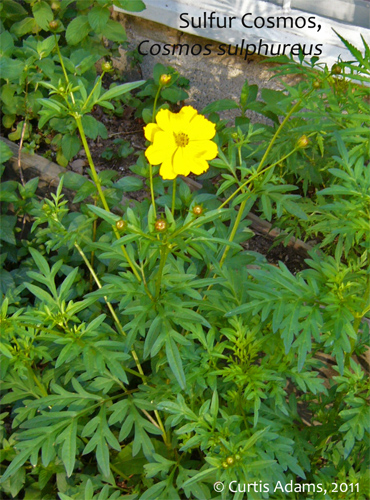
Sulfur Cosmos (Cosmos sulphureus) This native of Mexico (a part of North America) grows as an annual in the Northeast.  I had a crop that returned for 4-5 years until it got crowded out by some Bidens. I thought I would try to start it up again. While the bloom is similar to that of the swamp marigold (B. aristosa), this Cosmos starts blooming earlier and for a longer time.  Also, the foliage is not as dense.

American Pennyroyal (Hedeoma pulegioides) has been getting established from a planting 2 years ago, but I’d like to try more in some different locations. This will do well along a path.

Spotted Beebalm (Monarda punctata) was pretty successful last year and I need more to try with some clients.

Sweet Everlasting (Pseudognaphalium obtusifolium) has given me trouble on transplanting in the past two years. I’ll try this again, this time seeding directly in the garden in prepared soil (not in compacted turf).

One last try...
These three plants did not germinate for me last year, but I’ll try one more time with a lengthy stratification in moist starter mix.

Fern-leaf False Foxglove (Aureolaria peduculata) This biennial is parasitic on oaks, but, reportedly, does not need them for germination. I also have some of these scattered around a nearby oak. Stay tuned…

Tall Swamp Marigold (Bidens coronata) is an annual, with good-sized yellow flowers. I'm curious to see how if differs from the other Bidens I have around.

Brown-eyed Susan (Rudbeckia triloba) is a short-lived perennial, that while taller, has a more delicate appearance than the typical Black-eyed Susan (R. hirta).  I've posted a number of photos of this species over the past year.

Returning on their own:
I'm sure the Swamp Marigold (Bidens aristosa) will be back, but I will be pulling these up to make room for new plants.  I will have a lot of the biennial American Bellflower (Campanulastrum americanum) in 2011, judging by the large number of rosettes in the 2010 garden.  Also, I will keep an eye out for the return of any of the Texas native annuals: Indian Blanket (Gallardia pulchella), Drummond Phlox (Phlox dummondii) and Scarlet Sage (Salvia coccinea), that bloomed so nicely last year.