Monday, September 6, 2010

It's not Poison Ivy

As I was surveying which native species were growing successfully under my Norway Maple (for a future blog post), I came across many seedlings with ‘leaves of three.’ I thought, #Golly#, Poison Ivy! On closer examination, I realized that these were growing as individual plants, not a vine and the leaf shape, with its entire, unlobed margins, just wasn’t quite right for poison ivy. After checking some field guides and looking for similar plants growing in the area, I found out that these were seedlings of Wafer Ash, Ptelea trifoliata. The parent plant was growing behind the garage in an area I rarely paid any attention to.


Wafer Ash, also known as Hop Tree or Stinking Ash, is native to the Southeastern and Midwestern States, its native range does not extend up to Massachusetts, but it is listed as hardy to zone 5A.  I’m not sure how this tree got into my yard.  It’s not commonly used in the landscape trade and with a name like ‘Stinking Ash’ it’s not likely to be popular.  This name refers to the musky odor of its bark and leaves when crushed.  In this case, the name is a bit deceiving; I find that, while not pleasant, it does not smell as bad as something like wild Black Cherry.
Wafer Ash grows as a large shrub or small understory tree with irregular branching, usually growing to about 20 feet in height. The seedlings put down a tap root that can make them difficult to pull up.  It is native to dry rocky uplands and is very tolerant of shade. These two features make it suitable for growing under a Norway Maple, with its dense network of thirsty roots and dense shade canopy. Wafer Ash prefers neutral soils and is listed as deer highly resistant and tolerant of salt and ‘mine spoils’. The only conditions it does not tolerate are soil compaction and flooding.


This tree blooms in early to mid-June in the Boston area with terminal clusters of yellow-green, sweet smelling flowers. (Some sources list flower scent as unpleasant, but I found it quite nice and detectable several yards away.) The tree serves as a larval host for Eastern Tiger Swallowtail and Giant Swallowtail butterflies and is generally attractive to birds and pollinating insects. For more photos and information check out this link to the Wildflower Center.


The name ‘Hop Tree’ refers to its use in earlier times as a hop substitute in the brewing of beer. The dried seed pods (samara) can be decorative. My experience under the Maple and elsewhere in my yard is that these seeds high viability and offspring can appear just about anywhere. I don’t know if their spread is a result of being blown around naturally or from being caught up and thrown around by the lawn mower.


In my experience, the Wafer Ash is an excellent North American native understory tree with high wildlife value for dry, shady conditions. While it not commonly available in the landscape trade, there are a few commercial sources. Lacking that, I’ve got a bunch growing in my backyard. (You can reach me through the Adams Garden fan page on Facebook.)

Monday, August 30, 2010

Another Blazing Star, Liatris squarrulosa

 Blazing Stars, Liatris species, are widely used native plants with their distincive purple (and sometimes white) flower spikes. There are some 35 different species of Liatris native to the United States (not counting natural hybrids or variants). These can be broadly grouped into two flowering types, those with densely packed flower spikes and those with button-like flowers. A unique feature of both of these types is that the flower spikes begin opening from the top down, rather than from the base upwards.  In the nursery trade, the most commonly seen forms are those with the dense spikes, like Liatris spicata or Gayfeather. Many cultivars of Gayfeather are available, ‘Kolbold’ is used a lot in the Northeast. These types usually peak in early to mid-summer.

I would like to bring an example of a button-flowered type to your attention. In 2006, I planted two species of this type in a parking lot garden, the rare New England Blazing Star (L. scariosa Var. novae-angliae), the only Liatris native to all of New England, and Appalachian Blazing Star (L. squarrulosa Var. earlei). After 4 years, the New England Blazing Star has petered out, but the Appalachian Blazing Star is getting stronger. (Soil conditions on this site may be more attuned to the Appalachian species, whereas the New England species prefers sandy soils.) Besides being really drought resistant, this season it survived over 6 weeks of mid-summer temperatures on less than 2 inches of rain, it blooms several weeks later later than the spike-flowered forms.


This first photo shows it near the end of July, just beginning to open. The L. spicata had finished blooming a couple of weeks earlier. The second photo shows it still going strong at the end of August.


In the background is another native, Stiff Goldenrod, Solidago rigida (which has recently been changed to Oligoneuron rigidum). This is one of the earlier blooming of the goldenrods.**


This last photo is of the New England Blazing Star taken last year at the Wild Flower Meadow at Mount Auburn Cemetery. The conditions on this site are less severe than those experienced in the parking lot garden. One difference between these two species is that the flower heads are relatively broader than on the Appalachian blazing Star.  While the Cup-flowered Liatris are not what many people expect to see when they are asking for some Liatris for their garden, they are a way of extending the season for another 4-6 weeks, and the pollinators don't mind one bit.  Unfortunately, these plants are not broadly avalable at regular nurseries, I got mine from the New England Wildflower Society, an excellent source for native plants in the Boston area.


**Just a note about goldenrods. As I explained to a friend who asked about these plants today, Goldenrod pollen is not the cause autumn hayfeaver, its pollen grains are too heavy and sticky to float through the air. The main culprit for causing hayfever at this time of year is ragweed.


Friday, August 20, 2010

Some Surprising Finds this Week


As I was traveling through Mount Auburn Cemetery this week I was caught off guard by what appeared to be blooms on a Harlequin Glorybower, Clerodendron dichotomum. This was surprising to me because I recalled seeing it covered with pinkish blooms at the end of June. On closer examination I saw that these were actually bright red sepals surrounding a sapphire blue fruit (a drupe, actually). In a sense this shrub produces interesting ‘blooms’ twice in a season.


This Glorybower is not native to North America. It has it origins in China and Japan. It is cold hardy to Zone 6, and here in Boston it is approaching the northern limits of its range. Here at Mount Auburn, it has ‘died to the ground’ at least once, but as you can see it has regrown to a good sized shrub. For more information about this plant check out this link: http://hort.ufl.edu/trees/CLETRIA.pdf


Growing next to the Glorybower is a native shrurb, Bottlebrush Buckeye, Aesculus parviflora, a southeastern native anyway. The delicate white brush-like flowers that topped this plant at the beginning of July have grown into golf ball sized nuts that hit the ground with a small thud. Sometimes I wonder how could a flower like that turn into that fruit that looks so different.


The last big surprise, botanically anyway, was when I nearly bumped into this old Common Honeylocust, Gleditsia triacanthos. This particular tree is the straight species, not the thornless variety that is used in the landscaping trade. These water sprouts give a close up view of the 3” thorns that characterize this species.

Most of the commercially available plants available today are derived from a naturally occurring thornless variety G. triacanthos var. inermis, native to the Eastern United States. If it were not for this variety, I can imagine that the Common Honeylocust would only rarely be seen on any landscaped properties.


Thursday, August 12, 2010

Who is pollinating whom?

The past few weeks I have been watch may new plants to see what kind of pollinators they attract. Since most of these plants are new to the local area, they may not be normal fare for the local insects. It is quite likely that a plant that attracts many pollinator on its home turf, will be of little interest in a different region of the country.


 What I have seen so far is a mix of results. The Indian Blanket, Gaillardia pulchella, is a long way from its native range up here in Boston, but is quite popular with the native bumblebees. The beautiful bright red Drummond Phlox, Phlox drummondii, which is equally far from home, has had no visits from pollinators that I have seen.


Here are some photos of some of the insect pollinators that I have spied in the past 2 weeks. Somewhat disappointing to me is that other than a few cabbage moths, I can't recall having have seen any butterflies in my yard this year, save for one Firey Skipper.
 
These wasps really surprised me, both by their size (nearly 2”) and their excitement over the Spotted Beebalm, Monarda punctata. For the first few days of bloom there was no activity around these plants but now they are rarely without a wasp or two.


This Agastache did not appear to be getting much attention, then I realized that the insects were taking a short-cut to the nectar by feeding at the calyx tube at the base of the flower, rather than crawling down the long flower tube.

 
I have not noticed these Long-horned bees in past years. They really like the Coast Sunflower, Helianthus debilis, and Black-eyed Susans, Rudbeckia hirta, shown here.  These bees are hairier than many others and can get totally covered with pollen.


Hoverflys, shown here approaching the Red-Whiskered Clammyweed, Polanisia dedecandra, visit many of the smaller flowered plants, including American False Pennyroyal, Hedeoma pulegioides, and Snow-on-the-Mountain, Euphorbia marginata.


This Drone Fly, not a true bee, blends in quite well with the color scheme of the Orange Coneflower, Rudbeckia fulgida. 


The Green Bee, shown below, is kind of flashy when the sun catches it.


I must admit that I really don’t know bugs that well and I may not be entirely correct in the ID’s I have provided. I have been very favorably impressed with the information and photos at the Bug Guide and would recommend it are a great place to get started to ID insects.

Monday, July 26, 2010

Wildflower Meadow at Mount Auburn Cemetery

If you are in the Boston area and would like to see one of the area’s botanical treasures you should make a visit to the Mount Auburn Cemetery. The collection of trees dates from the early 19th century. Since many of the plants are labeled, it is a great resource for learning about trees and shrubs.  Also, if you are planning a landscape and would like to see some full grown specimens.

One of the newer plantings at the cemetery is a native wildflower meadow located around the Washington Tower, at the highest point on the grounds. The plantings were put in 4-5 years ago using a mixture of grasses and perennial wildflowers native to eastern North America, as well as some common weeds that were already present on the site. Once established, the plan is to allow these plants to spread and intermix naturally with a minimum of human intervention.

The east-facing slope of the meadow (shown here) was planted with a variety of native grasses. This photo shows a concentration of Little Bluestem (Schizachyrium scoparium). Other grasses planted in this meadow include Prairie Dropseed (Sporobolus heterolepis), Switch Grass (Panicum virgatum), Northern Sea Oats (Chasmanthium latifolium) and Indian Grass (Sorgastrum nutans).


From this view from the top of the tower looking west, you can see how some of the plantings were laid out and are beginning to intermix. In the opposite direction there is a great view of the city of Boston, but that wasn’t where I my mind was focused on this day.


Closer up you can better recognize many of the plants, such as Purple Coneflower (Echinacea purpurea), Black-eyed Susan (Rudbeckia fulgida), Nodding Onion (Allium cernuum), Beebalm (Monarda fistulosa, center back) and Shrubby cinquefoil (Potentilla fruticosa, at the very front). Some of the many other species that can be found in this meadow are Wild Petunia, Golden Alexanders, Butterfly Weed, Coreopsis and several Northeastern native asters.


Since my particular interest is in short-lived native species, I quickly focused in on a couple of my favorites like Brown-eyed Susan (Rudbeckia triloba) and Spotted Beebalm (Monarda punctata). These species reproduce by seed and, by nature, more around the meadow. I need to keep a watch for them as they do not stay exactly in the same location every year.


If you would like to visit all 176 acres of Mount Auburn Cemetery, they are located at 580 Mount Auburn St. in Cambridge (and Watertown) Massachusetts and are open every day. Here’s a link to their website where you can find directions and listings of upcoming events. You can also visit the Facebook Page of the Friends of Mount Auburn Cemetery site to see many recent photos.

Wednesday, July 21, 2010

Some Surprises in July

Redwhisker Clammyweed, Polanisia dodecandra, is a name I didn’t think I would be saying this year (who does?), but a few remaining seeds that I harvested from a lone plant germinated to give me a couple of strong seedlings. This annual is native to most of the U.S. and is often found in gullies and streambeds. It likes really well drained soils. With that in mind, when I transplanted these guys up I added sand and Perlite to my regular potting mix along with a layer of pea stones to the bottom of the pot to improve drainage.


This plant bears some resemblance to cleome, but is smaller and bushier. The white, cleome-like flowers have very long stamen.  Some reports refer to it being a stinky plant, but, to me, it does not smell as bad as a cleome. Check out the NPIN website for more information and photos of larger, more mature plants.


As a result of not mowing my lawn for nearly a month, due to droughty conditions, I got another surprise. Some seeds for a Philadelphia Fleabane, Erigeron philadelphicus, germinated and went into bloom without my noticing. The seeds came from a plant that I rescued during a weeding job and left in a pot next to my house. This species is a little less common than the Annual Fleabane, E. annuus, which occasionally shows up on the edges of my property. I wouldn’t mind having more of these, but that would make quite an obstacle course if I insisted on continuing to mown my lawn as well.


I was also pleased to see the American Bellflower, Campanulastrum americanum, growing in some difficult locations. In rich soil these plants get very tall and lanky. This one, growing in the shade of a Norway Maple is more compact. I’ll keep a watch to see if it continues to look nice through the season. As a biennial, it sends its first year as a rosette of leaves only a few inches tall. I have a bumper crop of these from last years flowering crop. I think I will be moving more of these under this dreaded maple.


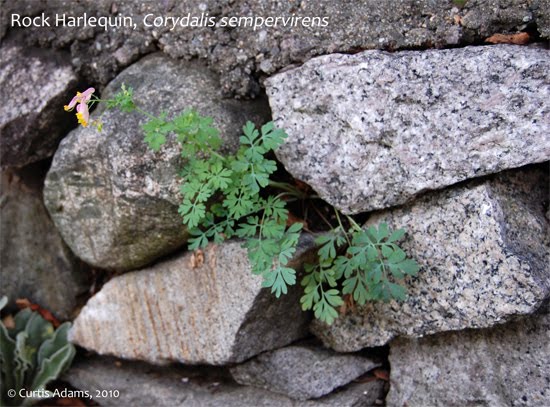
Lastly, here’s a recent photo of one of the Rock Harlequins that I planted in a rock wall. This is more akin to its natural environment. This has taken some extra irrigation to keep it going, since my wall is quite dry and does not collect moisture the way a real rocky cliffside would.

Tuesday, July 6, 2010

What comes after June? Native Blooms for the 4th of July

When I changed the calendar over from June to July I felt a little sad because it is really too late to put in any new plants in the ground for the season. Of course, I really should have finished all that at the beginning of June. But then I started to look around the garden and found that many of the native plants I have were just starting to bloom. For some, I think they are 2-3 weeks ahead of time due to the warm and sunny spring we had this year in the Boston area. Here is a round-up of my native plants that are in bloom at the beginning of July.


Winecups, Callirhoe involucrata, was one my first North American natives that I put in. The first time I saw it was during a wildflower photography class I took in the Ft. Worth area. This native to the west-central US, has settled nicely into a sunny spot in front of my house. In this photo it is backed up by a clump of Northern Sea Oats, with their newly formed seed stalks.


The Purple Coneflower, Echinacea purpurea, shown here was grown from wild seed that I got from NEWFS. These plants show quite a bit of variation in the blossoms and sizes of the plants. For me, I like the surprise of finding an unexpected flower, or plant, in the garden.


Whorled Rosinweed, Silphium trifoliatum, is a very unfortunate name for this tough native perennial. It is slightly smaller than the more familiar and more fortunately named Cup Plant (Silphium perfoliatum). I have had these plants growing within the dripline of a Norway Maple for 3-4 years and they are multiplying, that’s a tough plant!


Big-Leafed Aster, Aster macrophyllus (now Euribia macrophylla) grows well in dry shade and will spread by seed and underground runners. My colony started as a single plant and is now beginning to dominate the space. I think this one is blooming several weeks early this year. It provides some interest in what can sometimes be a very drab location. Another similar native plant for dry shade is the White Wood Aster, but that doesn’t bloom until fall.
  

Pink Tickseed, Coreopsis rosea, can be tricky to grow. This colony moved from the border to some cracks in the driveway and has been going strong for over 5 years. I tried moving some back into ‘good’ soil but the plants couldn’t handle the competition. I likes moist soil, so maybe there is runoff being channeled under the asphalt.


Wild Petunia, Ruellia humilis, will bloom for at least 2 months starting in late-June. It can survive dry conditions in poor soil, but it is not a strong competitor when mixed with other plants in good soil.


The next three plants are from my Native Annuals Experiment.  One is a return from seed and the other two are new for me. 

 
Beach Sunflower, Helianthus debilis, has retuned from seed from last year’s plants. This annual sunflower is a cultivar called ‘Pan’. 

Lacy Phacelia, Phacelia tanacetifolia, is an annual from the southwestern deserts. While it is reported to tolerate hot dry conditions, our recent heat wave has cooked at least one plant (3 weeks with no rain can be tough). These plants are recommended as an agricultural cover crop and as a great nectar source.  This one is only 6" tall, but it normally grows to 3' tall.  There are precautions about not letting it go to seed, as this species can get weedy.


 Annual Indian blanket, Gaillardia pulchella, is from one of the seed packets I got at the Wildflower Center in Austin. Compared to the hybrid and perennial Blanket Flowers this one appears to have a more relaxed habit.