Showing posts with label Ilex verticillata. Show all posts

Sunday, July 5, 2020

Getting More Fruits

Sassafras blooms in the first part of spring. 
This photo was taken on April 12th.

I have been planting more native trees and shrubs with the goal of increasing the amount of food available for birds.  Particularly fruits that are available in fall and winter.  In many cases these plants are dioecious. That is, an individual plant of the species is either male or female.  To get berries you need at least one male to fertilize the female flowers.  Sometimes getting male and female plants is easier when you are buying cultivars.  It is often documented somewhere (but not always) if a cultivar is male or female.  When buying seed-grown natives it is difficult to tell unless they happen to be in bloom when you are shopping.  If plants are not in bloom the recommended approach is to get 5 random plants so that there will be a good chance that you will get at least one of each.

This year I have spotted some firsts in my campaign to produce more native berries.  The first success that I noted was that my newly planted sassafras tree, Sassafras albidum, was a female [note structure of female flower].  There is a number of wild sassafras in the area, but the flowers are way up in the tree so I have not been able to distinguish their gender.  About a month after blooming I noted that there were a couple of berries forming.  They are green right now, but will turn dark blue when ripe.
Female flowers have 6 sterile stamen (staminodia) surrounding
a central pistil.  Male flowers have 9 stamen.
Here at the beginning of July you can see the green berries.  When ripe these berries
will turn dark blue and the pedicels will turn red.


The second species I spotted with fruit forming was persimmon, Diospyros virginiana.  There has been male tree on the property for some time.  I don’t know if it’s wild or was planted by the previous owners.  When I moved 7 years ago I planted a number of native persimmons all of unknown gender.  To improve the chances that I had at least one female I planted 6 new plants.  Last year one of them bloomed that proved to be a male.  This year two additional trees bloomed, both of which were female.  Shortly after the flower petals fell off I noticed that two of the female flowers had swollen ovaries.  Now I can hope that they survive long enough to ripen.  I may need to build a little fence around them to keep the deer away.  
Female flowers are usually solitary and have 8 sterile anthers around the pistil.
 On male trees flowers are clustered and are typically packed with 16 anthers.

About a month later this persimmon is developing. 
Green now it will turn orange when it ripens in the fall.


Another recently planted native tree that is now showing some berries is fringe tree, Chionanthus virginicus.  Fortunately these bloomed the second year after planting.  The first three of these I planted either appeared to be females or had not bloomed after two years.  The following year in early June I was in a native plant nursery when these were in bloom.   I was able to identify one specimen as a male (paddle-shaped anthers in throat of flower) and bring it home for the girls.  Now 4 years later I’ve spotted the first berries on the fringe trees.  Like with the sassafras these start out green then turn dark blue when ripe. 
This green berry on the fringe tree will turn dark blue when it ripens in early fall.


Two years ago I replaced some invasive leatherleaf mahonia, Mahonia bealii, with some inkberries, Ilex glabra.  I wasn’t able to get a male cultivar locally.  I found a suggestion on the internet that other hollies could fertilize inkberries.  To try this I planted an early blooming winterberry holly, Ilex verticillata ‘Jim Dandy’ nearby.  After planting my collection of inkberries including the ‘Nigra’ and ‘Shamrock’ cultivars I took a close look at the flowers.  While the flowers on ‘Nigra’ were exclusively female, ‘Shamrock’ appeared to have both male and female flowers.  Unfortunately this year I forgot to take a close look at these flowers to confirm my earlier observations.  I can say that this year I am seeing a lot of berries developing on the ‘Nigra’ plants, as well as on a single wild-type plant.  The ‘Shamrock’ cultivars bloomed this year but are lacking berries.  They had a lot of berries in their first year here.  
This female flower has a large central ovary surrounded by six sterile stamen. 
In male flowers these stamen will have yellow pollen on the anthers.

Also on the holly front, this year I added another winterberry holly, ‘Winterred.’  This is a later blooming female.  Its blooming cycle is perfectly timed with the male, ‘Southern Gentleman.’  While it was still in its pot I placed the ‘Winterred’ next to the ‘Southern Gentleman’ until the blooming period was nearly completed.  This should ensure some berries as long as it doesn’t get stressed too much from being planted out in late June.

Some other species that are not dioecious have mechanisms that encourage cross pollination. This ranges from clever flower construction that prevents self-pollination, to offset timing of pollen release and receptivity, to outright rejection of pollen with the same genetic material as the ovary.  To encourage fruit and seed production you should have at least two genetically distinct individuals within pollination range. 

This is what I’m thinking about my single American plum, Prunus americana.   Despite several years of impressive blooming I have not seen any fruits on this tree.  I don’t know how long these need to mature before they are ready to bear fruit.  To help with cross pollination I’ve planted several bare root American plums in the area but I think it will be a few more years before these begin to bloom.

Another fruit-bearing native that has appeared on my property is black raspberry.  I’d like to think that these have been encouraged by the removal/reduction of invasives like Japanese stiltgrass, wineberry and garlic mustard.
Black raspberry has round stems and first year canes are glaucous. 
Flowering occurs in mid-May

The black fruits ripen around the end of June and have a distinctive sweet flavor. 
These ripen a week or two before the wild blackberries, which are much tarter.

Tuesday, May 14, 2019

New Plants for 2019

Top and left are the female 'Blue Rug' junipers, lower right is the
supposedly male 'Andorra Compacta'.  Normal bloom time
for these is late May to early June.  So I will keep an eye out..
I had an established planting of creeping juniper, Juniperus horizontalis, die back last year.  This may have been due to a number of factors, but I think mostly the very wet weather causing the soil to stay very moist for most of the year.  While many folks poo poo junipers as too common, they have their place.  They are a durable, low-maintenance ground cover for sunny, dryish locations.  This species is native to the northern third of the US and most of Canada.  Their usefulness and adaptability has, however, made them a staple in the landscape trade.  One thing you don't see too often is berries on these plants.  Like other junipers, creeping junipers have separate male and female plants.  Ever since seeing cedar waxwings last year I have been looking to have more bird berries on our property.  To the extent that I could find gender information, it seems that most creeping juniper cultivars are female, such as the very popular 'Blue Rug' cultivar (aka 'Wiltonii').  Digging through the literature I found mention that the cultivars 'Bar Harbor', 'Blue Horizon', 'Plumosa' and 'Andorra Compacta' are male (or at least may be male).  In addition to a bunch of 'Blue Rug' junipers I was able to get an 'Andorra Compacta' to serve as a breeding partner. Now by having both male and female cultivars there is a better probability that berries will be produce to help support the winter bird population. 


These large-flowered bellworts came into bloom
just after our mid-season daffodils.
In an area just outside our kitchen window we have a large, somewhat wild perennial garden backed up by pine trees.  The shadier areas are dominated by several species of lamium and ground ivy.  I have had some success with shade-tolerant goldenrods here, particularly blue-stemmed and zigzag goldenrods.  To introduce some more natives to this area of potentially dry shade (assuming it will stop raining at some point), I ordered a few large-flowered bellwort, Uvularia grandiflora, as bare root plants.  We'll see how well these compete.  They have done well so far, all of them sprouted and bloomed this first year.


They say, planting trees is planning for the future, even one that I am not likely to see.  I have been dismayed that some of the big old trees here are dying.  Don't know if it's just their time or if there is something going on.  Besides the loss of their biological function, many of these trees are on a slope where they are helping to hold the soil.  Emerald Ash Borer is definitely one of the problems, causing a early death of many established ash trees.  But we have lost some big oaks and black cherries as well.  Besides these trees going away I am also actively targeting the invasive Alianthus trees and this is opening up the canopy even more.  While natural succession is kicking in, this is slowed by the number of deer that eat the tree seedlings.  I am more than a little concerned how many of these seedlings will reach maturity.  So I am looking for some shade tolerant trees that I can put in and protect to help nature along. 

I got these bare root American beech in the
ground the day they arrived. 
In the woods right now there are a lot of new beech trees, Fagus grandifolia.  These are quite shade tolerant, and seem to be well adapted to our location.  I found a source of bare root beech trees in southern Virginia, Mid-Atlantic Natives, so I ordered a few to see how that works out.  They were planted in early March and are just leafing out now, a bit behind the established beeches.  Beech are fairly slow growing trees, but will mature to be dominant elements in the canopy. 


These are the maple seedlings I gathered from around the property.  These may include
Red, Sugar, Silver and the hybrid Freeman maples. (Also one tulip tree in the mix.)
Red maples, Acer rubrum, are also quite shade tolerant but are much faster growing.  I am looking to add a few of these to fill in the gaps.  Sugar maples are another possibility.  These are slower growing, but better adapted to the near neutral soil pH we have here. (Based on the natural distribution of trees here (Box elder, Hickories, American hornbeam and Tulip tree) soil pH is probably running 6-7.5.)  My regular source of native trees, Stadler Nursery, is cutting back on its supply of reforestation plants (I don't know why), so I decided to harvest some of my own seedlings and nurse them along a little before planting them out.  I've got several species of maples growing here, so at this point I can't say for sure what each of these seedlings are.  Tulip trees also do well here and I've got lots of these seedlings too, so I could move those to some of the more open areas in the woods.

This Henry's Garnet Virginia sweetspire has flopped a little due to the weight of the rain. 
It is nearly full height, at 4' and should spread to about 6'. 
The racemes of white flowers are about to pop.

Another area that I have been trying to bulk up with native species is a  slope that has been built up with sandy clay and is dominated with Japanese stiltgrass, Japanese honeysuckle and garlic mustard.  I've been putting divisions of wild bergamot, Monarda fistulosa, and they are taking hold. I am focusing on shrubs that are colonizers.  These spread out by underground shoots and should help stabilize the soil to erosion.  This year I'm adding a Henry's Garnet sweetspire, Itea virginica 'Henry's Garnet', gray dogwood, Cornus racemosa, and some bare root smooth sumac, Rhus glabra.  Unfortunately my deer do like to munch on these so I need to stay on top of these with either fencing or repellent sprays until they get established.

Since deer like to browse on my gray dogwood I
put some fencing around this one right away.
You can see that the leaf buds on this smooth sumac
are about to pop.  I should get some fencing around this
one soon (in addition to the repellent spray).

In my battle with Japanese stiltgrass, I am planting native species to help displace that invasive grass.  One grass that does well in shadier locations is bottlebrush grass, Elymus hystrix.  I started some from seed this winter and planted them out in early spring.  These make take a year to get established, but should help fill in areas where the stiltgrass has been (is being) removed. 

I started this bottlebrush grass from seed in February and planted it out in April.
It may not get too big this year, but should form a dense clump next spring.

Last year I put in a Red Sprite winterberry holly along a sloping path.  I already had a mate, the early blooming Jim Dandy cultivar, Ilex verticillata 'Jim Dandy'.  To improve berry availability for winter time birds I added another early blooming female cultivar called Afterglow, Ilex verticillata 'Afterglow'.  This cultivar is also compact, like 'Red Sprite' and is supposed to be very dense with flowers and berries.


Also on the holly front, I put in some inkberries, Ilex glabra, in a shady location, near an English walnut tree, last year.  Of the three cultivars I put in, Shamrock and Nigra did well, but the Densa cultivar died.  I don't know if it was just the amount of shade or sensitivity to the juglone from the walnut.  I replaced it with another Nigra cultivar this spring, so we'll see if that one does better.  


Tuesday, December 11, 2018

Inkberry berries


This past spring I replaced some non-native Leatherleaf Mahonia, Mahonia bealei, with inkberries, Ilex glabra.  While moderately invasive, the mahonia did produce a decent crop of berries over the winter which was available to the resident bird population.  I wanted to make sure that these inkberries would also produce berries that the bird could use through the winter. Inkberries, like most other hollies, tend to be dioecious, that is have male and female flowers on separate plants.  Most inkberries commercially available are listed as being female.  The only male cultivar I could find listed is 'Nordic', which was selected for is cold hardiness.  Here in the relatively warm Mid-Atlantic, I couldn't find any for sale.  I did find a mention that you could use another species of male holly as long as it blooms at the same time as the inkberry.  Jim Dandy winterberry holly, Ilex verticillata 'Jim Dandy' (blooming in late May-early June), seemed to be a good fit for inkberries which bloom from about mid-May to mid-June.

The selection of native hollies that I put in to replace the leatherleaf mahonia.  Left to right:
Jim Dnady winterberry (male), Nigra inkberry and Shamrock inkberry (both female)

The selection of inkberries I settled on were two Shamrocks and one each of Densa and Nigra.  The Shamrock cultivars a supposed to top out at around 4' while the other two should grow larger to about 6'.  By having a mix of cultivars I hope to add a little extra texture and variation in height to this planting.  Right next to these I put in the Jim Dandy winterberry, to help with fertilization.

Here's the Shamrock inkberry at the end of May.  Looking closely
you can see some of the flowers have anthers with pale yellow pollen. 
Other flowers are lacking stamen, but have a large central ovary.

This Nigra inkberry has only female flowers.  The flowers are
not in dense clusters like many of the male flowers on the Shamrock cultivar.

At the end of May the flowers on this male winterberry are just opening up. 
This timing overlaps with the flowers on the inkberries.

As the inkberries were blooming I paid attention to when the flowers were opening up on each plant.  To my surprise I noted that the Shamrock inkberry seemed to have both male and female flowers on it.  The Nigra and Densa cultivars appeared to have only female flowers.  I would have thought that if the Shamrock cultivar is typically monoecious (have both flower genders on one plant) then that should be called out in the description of the plant as this would be a great benefit to wildlife gardeners. 

Fast forward to mid-fall and there are reasonable numbers of black berries on both the Shamrock and Nigra cultivars.  I can not say unequivocally that the Shamrock did all the pollination work since the male winterberry was right there in the mix, but at least I have been successful in replacing the leatherleaf Mahonia with a native evergreen shrub that provide berries for the resident bird population in the winter.

Got a few berries on this Shamrock inkberry.  It's missing
 quite a few leaves, my guess would be deer browse.
 Unfortunately the Densa cultivar died back by the end of summer.  Two possibilities are that it was in the shadiest spot of all the newly planted hollies, and/or that it is planted at the edge of the drip line of an English walnut, Juglans regia.  While not as potent as the native black walnut, Juglans nigra, the English walnut does produce juglone, a compound the inhibits the growth of a number of plants, including inkberries.  We'll see how the other inkberries overwinter before I find something to replace the Densa cultivar.


This Nigra inkberry also has a few berries, as expected.  It too
has taken some deer damage.  I've since sprayed them with some deer repellent.  


Wednesday, September 19, 2018

New Sloping Path

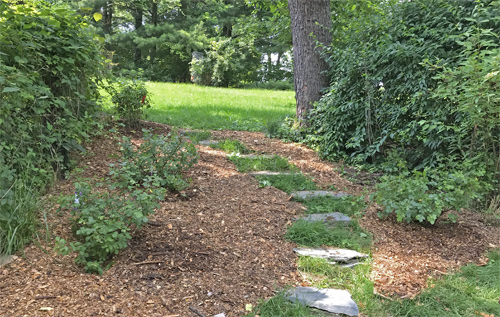
One area in my lawn has a steep grade, about 28%.  That is a rise of 4.5' over a 16' run.  The lawn tractor could make the climb, but usually left some tracks, particularly if the ground was moist.  Also when walking through that area it was a real chore.  This is a prime area to replace the turf with a lower maintenance planting and to put in some steps to make navigation easier.

When doing a project that involves both planting and hardscape (elements like steps, walls and patios) it is best to put in the hardscape first.  The positioning of plants has greater flexibility and there is usually less heavy lifting than when positions stones.

Overall Plan for this sloping site.  The 9 steps are shown as rectangles,
though in reality they are irregularly shaped.  The highest elevation is at the top,
sloping down about 4.5 feet to the lowest step.  Scale 1" = 3'.
The first step in putting in steps on a hill is to determine the slope of the hill and then position the steps.  Having a consistent rise and step length makes the steps easier to navigate.  The overall rise here was 54".  For a 6" rise/step, that calls for 9 total steps.  At this time you can also move the shrubs around, while they are still in pots, to determine how you would like to position them.

Here, after the steps were installed, you can see the level lines that were used to determine the overall slope
and to guide the installation so that the change in elevation from step to step was about the same.
(In the background you can see the tamper that is used to compact the soil and paver base.)

I try to use a sustainable approach to landscaping whenever possible.  In this case that means using stepping stone materials that were on site, left over from an earlier dry laid stone wall project.  These stones give a naturalistic appearance.  Also by using the same materials the two projects become visually and materially united.  One down side of using irregular stones as steps is that each step needs to be engineered individually to set it on a solid foundation.  Rectangular steps installed in a straight line require less customization.

For steps that get a lot of use a crushed stone base of 6 or more inches is recommended.  Since these steps are only for occasional use, I cut back a bit on the amount of base.  The riser for each step is supported by 2-3 inches of compacted paver base separated from the soil by a layer of landscape fabric over the compacted native soil.  Behind this reinforced riser is compacted fill.  Supporting the riser with a firm base gives the step a firm feel underfoot.  It's much more comfortable to step onto a firm, well seated step than one that wobbles even a little.

Here's a view underneath one of the steps showing the compacted paver base
underneath the the riser and the landscape fabric that is being used to hold the dirt
behind the dry-laid riser.  For some of the steps that were difficult to stabilize I used
construction adhesive to secure the step to the riser.

The standard formula for garden steps is that the tread length be about 26" minus 2 times the step height. 

Tread Length" ≈ 26" - (2 x step height")
So for a 6" step height the tread length should be approximately 14".  The formula is based on a comfortable stride length for the average person.  Had I put he steps in a straight row down the slope it would have been close to this formula.  Instead I spread the steps over a longer, curving course.  I thought that the slightly longer course would have made for an easier, more gentle climb, but instead the longer distance between steps makes the trip feel less certain, especially when going downhill.

However, the way I chose to do it created a more naturalistic look and used materials that were already on hand.  Also by following the existing slope I minimized the changes to the existing grading.  Looking back, if these steps were to be used on a regular basis or in a more formal setting I would have built a deeper foundation, used more regularly shaped stones and followed the formula more closely.

This is the area after scalping the grass with a string trimmer. 
I also used a garden torch (circled) along the edges to burn the areas that had
Japanese stiltgrass in an attempt to kill any new seeds/seedlings. 
Once the steps were in it was time to eliminate the existing grass and weeds.  (This could have been done before installing the steps, but I felt it was less disruptive to the stability of the slope to wait until the steps were in place.)  There were several options for getting rid of the existing turf and weeds:  dig it out, spray it with a broad spectrum herbicide, or cover/smother with cardboard and mulch.  Digging is a lot of work and could destabilize the slope.  Herbicide would be easy and would be less disruptive to the soil surface, leaving roots intact to hold the soil.  I opted for the cardboard smothering/mulching method.  It leaves the soil intact, is non-toxic, and there are limited debris to deal with.

I used thick cardboard from moving boxes to cover the unwanted grass.
After mowing/scalping the existing grass, I covered the slope with cardboard and pinned it in place with landscape staples.  After moistening the cardboard to make is more flexible to conform to the soil surface I covered it with 2" of wood chips.  Most of the lawn will die due to lack of light in a few weeks, but planting can be done sooner by cutting holes through the cardboard, removing all the exiting grass from around the area and inserting the new plant.  The re-exposed soil should be well mulched or recovered with scraps of cardboard to keep the old grass from growing through.

The cardboard was covered with about 2" of woodchips that were left by our
arborist this spring. I started planting about 10 days after spreading the chips. 
For the areas between the steps I dug out the grass by hand since it was hard to get small pieces of cardboard to stay in place and there will be a lot of gaps where the grass can peek out and get re-established.

Now it's time to plant...

The plants I chose for this area are all low maintenance natives that are from the mid-Atlantic area, mostly ones that grow nearby.  I chose plants that area fairly low-growing to minimize the amount of pruning needed to keep the pathway open, both physically and visually.  The selection of plants will have something in bloom from early spring through fall.  You can see the plant list in the drawing at the beginning of this post.

The Grow-Low sumac are at the foreground in this photo, with the Red Sprite holly at the back.
First to go in are the woody shrubs. I put in three Grow-Low aromatic sumac, Rhus aromatica 'Grow-Low' and one of the shorter female cultivars of winterberry holly, Ilex verticillata 'Red Sprite'.  I chose this sumac because it grows under a almost any condition, it only grows to about 3' tall and is a good choice for stabilizing slopes.  In addition it has a nice bright orange fall color and tends to be resistant to deer browse.  The female Red Sprite winterberry holly has a proper male mate in the nearby Jim Dandy.  I also transplanted in some extra black and brown-eyed Susans, Rudbeckia sp., to fill in around some of the newly planted shrubs.

As for flowering perennials, located 1-2 feet from the path, I chose foxglove beardtongue, Penstemon digitalis, short-toothed mountain mint, Pycnanthemum muticum, black cohosh, Actaea racemosa, and aromatic aster, Symphyotrichum oblongifolium. As the grass components I also put in some bottlebrush grass, Elymus hystrix, and wavy hairgrass, Deschampsia flexuosa.  I really like the looks of the bottlebrush grass and it is a species that commonly grows on the woodland edges in this area. Finally around the stepping stones and outer edges I put in the shortest species, two cultivars of moss phlox, Phlox subulata, and Pennsylvania sedge, Carex pensylvanica.

This is the completed installation.  I finished this in mid-July - later than is optimal for planting around here (mid-Jume would have been better).  I added in some old landscape timbers that were taken out from an earlier project to from the upper and lower edge of this garden.  Reusing materials on-site is part of being sustainable (and cheap).
As we are approaching fall the deer have come through and ate back the Penstemon and stripped most of the leaves and berries off of the holly.  I'm surprised about the holly, but our deer usually eat up most new plants no matter what they are, then leave them alone the following year.  Also the cohosh died back early, it may be getting too much sun, we'll see if it comes back next spring.


UPDATE
Here's the path in May 2019.  Everything has come back.  The bottlebrush grass is approaching 3' and all three cohosh have returned!


Friday, June 29, 2018

New Plants for 2018

One of my big plans for this year was to replace the non-native, invasive leatherleaf grape holly, Mahonia bealii, with some native shrubs.  Features of the grape holly that I wanted to preserve were flowers and berries for wildlife and some evergreen qualities that help define that space in the winter.  I decided to use inkberry hollies, Ilex glabra, to carry most of the load.  Also in this space I put a 'Snow Queen' oakleaf hydrangea, Hydrangea quercifolia 'Snow Queen' to continue a screening effect started with two older oakleaf hydrangeas nearby.  A few cinnamon ferns, Osmunda cinnomonea, completed the composition.

Shrubs from left to right are Jim Dandy winterberry holly, Nigra inkberry and Shamrock inkberry. 
Also new are the bright green cinnamon ferns toward the front.  The background is dominated
by a Carolina allspice, Calycanthus floridus.

To create some size variation in the evergreen I got a variety of inkberry cultivars.  'Shamrock' being the shortest (3-4') is in the front and behind it are a 'Densa' (8-10') on one side and 'Nigra' (4-6') on the other.  All three of these are listed as female plants.  To get berries a male plant is needed.  Unfortunately I was not able to get hold of a male plant (such as the 'Chamzin' cultivar).  I saw somewhere that any male holly that blooms at the same time is capable of fertilizing a female, so I put in a 'Jim Dandy' winterberry holly, Ilex verticillata 'Jim Dandy' nearby.  This bloomed at about the same time as the three inkberries. 
Since I was watch the flowers rather closely I noticed that while both 'Densa' and 'Nigra' had exclusively female flowers, 'Shamrock' appeared to have both male and female flowers.  I could find no mention of 'Shamrock' bearing both types of flowers.
Also on the holly front I added a 'Southern Gentleman' winterberry near a well established female.  A few years ago I but in an early blooming 'Jim Dandy' as a pollination partner, but berry production did not improve much.  The 'Jim Dandy' is usually finishing up blooming just as the established female is starting to bloom.  This new 'Southern Gentleman' here has started blooming about 2 weeks later than 'Jim Dandy', hopefully in better synch with the female.  Maybe this year we will get a bush full of red berries. 

Here's the slope prior to planting.  The winterberry is at the top left and
the lower growing aromatic sumac cultivars are on either side of the steps.
 In another area of the yard is a slope almost too steep to mow (about 30% grade).  This year I've decided to put in some steps and plant the slope with native shrubs, perennials and grasses so that it can be left alone.  New plants for this area include 'Grow-low' aromatic sumac, Rhus aromatica 'Grow-low', 'Red Sprite' winterberry holly, Ilex verticillata 'Red Sprite', and fireweed, Chamerion angustifolium.  The 'Red Sprite' is a female clone and was put in as a partner for the 'Jim Dandy' that I planted a few years back. 

Tried to grow fireweed from seed last year, but no luck. 
This year I got some as seedlings.
Here are two red oaks that I will be planting in the woods.
These saplings are about 4 years old.
In the woods around our house a number of older trees are dying.  Some of this may just be natural, some may be the work of the emerald ash borer.  I've also been identifying and killing as many tree of heaven, Ailanthus altissima, as I can.  To fill the open spaces I've been planting oak saplings.  This year I am putting in the more shade tolerant oak  species, red and black oaks, Quercus rubra and Q. velutina.  [P] 

We are also seeing a number of our white pines, Pinus strobus, in our wind break coming apart.  These were planted 40-50 years ago and are probably not in their ideal habitat.  To fill in the gaps in this row of evergreens I've planted some seedling of Canadian hemlock, Tsuga canadensis.  I've spaced these out widely so that any future attack by wooly adelgid will be slowed, since the plants won't be in contact with one another.  I've marked the location of each with a pink flag, otherwise these little plants would disappear into the undergrowth.
 
I also got a bunch of bare root wild ginger, Asarum canadense, in early spring.  I would like to use them as aground cover along with some Heuchera and violets.  So far most of these are surviving, but they do need some help by removing some of the competitive plants.  My previous attempt did not go so well as the plants were overwhelmed with vinca  and the leaves of an English walnut. 

Most of the American plums, Prunus americana, that were planted last fall survived winter.  One died rather suddenly this spring when all the leaves wilted.  There was a lot of insect activity near the roots, or it could have been too much shade from a neighboring box elder.


I've always loved the look of blue cohosh, Caulophyllum thalictroides, blanketing a shady hillside.  I've been reluctant to plant it in the past because I haven't seen it growing nearby, even though I seems like the right conditions.  This year I broke down and bought a couple of plants to put in on a shady, moist hillside.  This is an area where I have been removing garlic mustard and Japanese stiltgrass, so it's time to get some more plants in there to take their place. 


Post bloom, this Itea tends to blend in with the surrounding foliage.
A few years back I planted a small Virginia sweetspire, Itea viginica, possibly 'Henry's Garnet' under a tulip tree.  It has never got too tall.  Possibly due to the shade and possibly due to deer browse.  Despite its lack of size, this year it managed a couple of blooms.  Encouraged by this, this year I added a larger specimen to a sunnier location.  'Little Henry', a cultivar growing to about 3', was my choice.  It has a compact habit and large flowers.  While the flower display on this one this spring was impressive, now at the beginning of summer it's hard to recognize.  It should have good fall color, though.


Thursday, June 16, 2016

Finding a mate for my Plants, part 2

One of my goals in creating a more wildlife friendly landscape is to use plants that produce fruits and berries in addition to pollen, nectar and habitat.  While for some plants that is not a big deal.  A single specimen may be self fertile, or there are other nearby plants for cross-pollination.  Where I have been having more trouble is with some of the less common species to my neighborhood.

A good number of fruit bearing trees and shrubs are dioecious, that is, they have male and female flowers on separate plants.  You need one of each in order for the female to bear fruit.  The classic example of this in horticulture is with the hollies (Ilex sp.).  Fortunately, the industry knows that customers expect to see red berries on their winterberry hollies, so they have provided distinctly named male cultivars to interplant with the more attractive females.  Usually one male plant is sufficient to fertilize five females.

Finding information on the genders of other plant species is more challenging.  Many maples are dioecious, but it is rare to find its gender in the plant description.  Most folks don't care much about the flowers on a maple, they are too far away to see and the foliage is the main feature anyway.  However gender is an issue for many allergy suffers.  Male trees produce loads of pollen and if it's wind borne, that's a lot of pollen in the air.

This Sassafras was blooming at the beginning of April.
Males have showier flowers because of all of the stamen.
The female flowers are more subdued.
My goal is to have mating pairs so that I can get fruit production for the birds and other wildlife.  On my property I have a number single specimens.  In order to find out which genders I have, I need to be out there observing them while in bloom.  I learned that my big sassafras tree is a male since I was out there in early spring while it was blooming.  I didn't see any others in bloom.  I recently purchased a new seed grown sassafras, but it will be maybe 10 years before I learn its gender.

One approach to getting mates when buying young plants is just to buy a lot of them and then play the odds.  I often buy 3 at a time, but 5 gives you a better shot. This is only certain for seed-grown plants.  Plants propagated from cuttings will have the gender of the 'parent' plant.  Then you need to hope that the propagator started from a mix of plants and not a single cultivar.


This fringe tree is probably 4 years old and
has a few blooms on it.


Another approach is to be at the nursery and find plants in bloom.  I got lucky this year when I found small fringe trees in bloom at my favorite nursery.  I went home and saw that both of mine were also in bloom and they were both females.  I headed back to the nursery and looked though their plants until I found a male and bought it.  Now I'm all set for next year.

This is the female flower, there are two stigma held closely in the center.
The male flowers have two paddle-shaped anthers that protrude from the flower center.

Tupelo, Nyssa sylvatica, is another tree that is dioecious.  I put in two of them in a couple of years ago.  Then I realized it was a big gamble that I would have one of each, so a added a third this year.  These mature into fairly large trees, so I don't want to fill up the yard with a bunch of them.

I have a mature persimmon tree that is female.  The first year we moved here I added 5 more saplings.  Now, 4 seasons later they are about 10 feet tall, but still no sign of blooming.  Maybe next year.

Here's the female persimmon in bloom.  I haven's seen what the male looks like, yet.
CORRECTION: This is actually a male plant.  See comment 6-14-2020 below.


The native pussy willow (Salix discolor) also comes as separate male and female plants.  The male is showier with its large fuzzy stamen.  These plants do bloom when they are small, so you might have luck determining which to buy at the nursery.  These bloom in mid-April around here and, unfortunately, many nurseries aren't open for business then.  The one I purchased two years ago was male.  Willows are very easy to propagate by cuttings.  So I was able to quickly grow several new plants, but these will all be male.  I did pick up another this spring, but it was not in bloom.  The vendor said it was seed grown so I'm working blind.

The male flower of this pussy willow is adorned with bright yellow stamen.
The flowers on female plants are green and somewhat scaly in appearance.

I did get a couple of goatsbeard (Aruncus diocus) which turned out to be both male.  This is a case where I am happy not to have a mate.  The male has the showier flower and two plants take up more than enough to space in the garden.
The stamen on these male goatsbeard flowers really catch the light.

Thursday, November 28, 2013

Finding a Mate for My Plants

Berries of Winterberry Holly persist into well into winter
 when they provide late season food for birds.

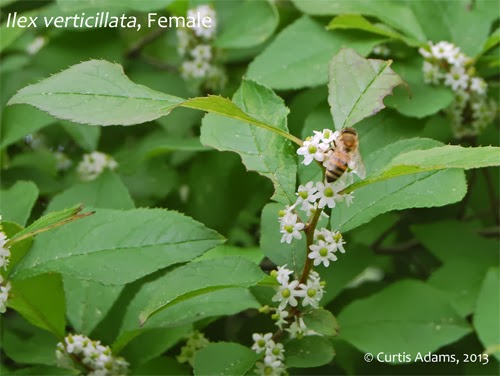
Shortly after we moved into to our new place I identified a nice looking Winterberry Holly (Ilex verticillata) growing near the front door.  It was mid fall and I didn't see any berries on the shrub.  This meant that either it was a male plant or that there were no compatible males within 100 feet to provide pollen.  The bright red berries of Winterberry are its main ornamental and ecological feature. 

Female flowers have a large central ovary surrounded by undeveloped
stamen-like structures (lacking anthers).  This plant was blooming in early June.

I had to wait until the following June to get a good look at the flowers.  After careful examination it turned out that this plant was in fact a female.  The solution was to find a suitable mate, that is one with a similar bloom time.  I found a male cultivar at a nearby nursery called ‘Jim Dandy’.  I sat him next to the established female for a few days while I located a nearby spot to plant him.  

Male flowers have well developed stamen and a very small ovary-like center.
The male plant seemed to attract smaller sized insects.


By September I noticed a few of red berries on the plant.  Success!  I hope to see more berries next year as there will be a much longer time for pollination to occur. 

These red berries were formed by mid-August.  

One of my goals in designing a landscape is its habitat value.  That is, what does the landscape gives back to wildlife in the form of food and shelter.  So when I select plants I look for ones that produce flowers, fruits and/or seeds that wildlife can use.  When selecting plants from a commercial nursery many of them are cultivars, which are genetically identical.  This becomes an issue in the habitat garden if the plants are single sexed (dioecious).  It is also a problem for plants that have both male and female flowers on the same plant (monoecious) or have perfect flowers (both male and female parts in the same flower) if the plants are not self fertile. 

All this plant fertility can have a down side.  In a formal garden production of viable fruits and seeds may lead to increased weeding and spreading of plants out of their designed boundaries.  Also, some consider that the mess that falling fruits create outweighs providing food for birds and other wildlife.  Personally I think of the landscape as a dynamic thing that changes over time.  In the designed landscape plants need to be kept under some degree of control, but I really enjoy seeing native species spreading to new areas where they are happier than in my initial design.

Here are the flowers of a female persimmon.  They have large ovary structures.
Male flowers are narrow at the base.
My experience with the Winterberry Holly has heightened my awareness of dioecious plants.  I want to generate as much natural food for wildlife as possible.  Also I would like to grow some ‘wild’ fruits and berries.  Persimmons (Diospyros virginiana) are dioecious.  My established persimmon is a female, but I have not seen any fruit on it.  I have brought in four more new wild-type plants, at least one of these should be male.  I don’t know of any named male cultivars of persimmon; however there is one called ‘Meader’ that is self-fertile. 

In general female plants need at least one pollen source (male) close enough that pollen can be transferred.  This transfer can be by wind (grasses and many trees) or by insects (vectors) most flowering plants.  For native hollies, like Winterberry, a male should be located with in 50 ft for effective pollination, though pollination over greater distances (100-200 ft) may be possible. 

Female Box Elders are covered with seed pods (samara) in the fall.
I noticed some squirrels eating them right off the tree.

Some other dioecious plants that I have are Box Elders (Acer negundo), Junipers, Tupelos (Nyssa sylvatica), Yews and Goatsbeard (Aruncus diocus). 

Some plants with perfect flowers are not self-fertile.  This may not be convenient for a habitat gardener with limited space for lots of plants. However, it works out on the larger scale to provide the greater genetic diversity adaptation to change and continuation of the species.  I have posted a number of times about the difficulty of getting Viburnums to bear fruit when only a single cultivar was planted.

There are some practical situations where limiting plant fertility and reproduction is called for.  In urban landscapes Ginkgos are very successful street trees.  The fruits, however, are loaded with butyric acid and smell of dog poo when stepped on.  For this reason most cultivars in the trade are males.  In my last post about Jerusalem Artichokes I noted that these are not self-fertile.  By only using only a single cultivar one limits the risk that this somewhat aggressive native will spread by seed. 

Another issue for some in urban and suburban landscapes is pollen allergies.  In many cases these are due to the (over) use of male cultivars.  Males don’t produce messy fruits, but they still send out their pollen.  This results in a type of air pollution that effects sensitive individuals.  While searching for information about dioecious plants I came across an excellent resource book by Thomas Ogren titled Allergy-Free Gardening.  This book contains a lengthy list of dioecous plants and the sex of individual cultivars.  There is also an allergy rating for a wide variety plants including monoecious plants and those with perfect flowers.  I did not realize that many maples, such as Red and Silver Maples, came as separate male and female plants.  Since I am more interested in facilitating plant fertility for enhancing habitat value I see using this book differently than the author intended.  But, if I had a client with particular allergy problems this book would be an excellent resource for plant selection to design a low-allergen garden.