Showing posts with label Chionanthus virginicus. Show all posts

Monday, April 1, 2024

Plant fertility as a factor in landscape design


When designing a landscape a lot of effort is put into plant selection.  Getting the right forms, colors and shapes, proper placement and repetition to establish rhythm and flow throughout the design are critical to its success.  Maintenance issues are often a secondary consideration. If the goal is to also support wildlife, use of native species and fruit and seed production is also of high importance.  An aspect of landscape plant selection that has a lasting effect on both maintenance and performance of the design is plant fertility.  That is the ability of the plants to reproduce.

Flowering plants have a variety of strategies for sexual reproduction.  Some species have perfect flowers, that is there are both male and female parts within the same flower.  Others have separate male and female flowers on the same plant, but in different locations.  These are referred to as monecious plants.  If the male and female flowers are borne on separate plants then they are referred to as being dioecious.  There are also shades of gray between these.  You can read more about the different flower types in this article from the Master Gardeners of Northern Virginia.

There is a strong bias for plants to encourage cross fertilization.  It improves the adaptability of species to evolve and cope with change.  Plants, even those with perfect flowers, have a variety of means to encourage cross fertilization:  In some, there are genetic mechanisms where pollen is unable to grow through the pistil and reach the ovary if they has the same genetic makeup.  In some there are physical barriers that keep pollen within a flower from reaching the pistil and there are timing mechanisms the pistils of a given plant are not receptive to pollen at the time that that plant is releasing its pollen.  In many species of oak, female flowers are concentrated near the top of the tree, while the males are lower down.  As the pollen is released it is carried by the wind where, hopefully, an updraft will carry it to the top of neighboring trees.

Even when self pollination is a viable option, seed production is generally higher when cross-pollination has occurred.  Pawpaw (Asimina triloba) and maypops (Passiflora incarnata) are two examples of North American fruits that benefit from this.

When considering plant fertility are two extreme ends of the spectrum.  For formal gardens and situations where consistency of appearance are of primary concern, minimizing plant fertility to minimize unplanned reproduction  is the goal.  If the plants are not producing fruits or viable seed then there won't be as many randomly placed plants popping up that need to be weeded out and there will be fewer fruits falling from the trees that require clean up.  
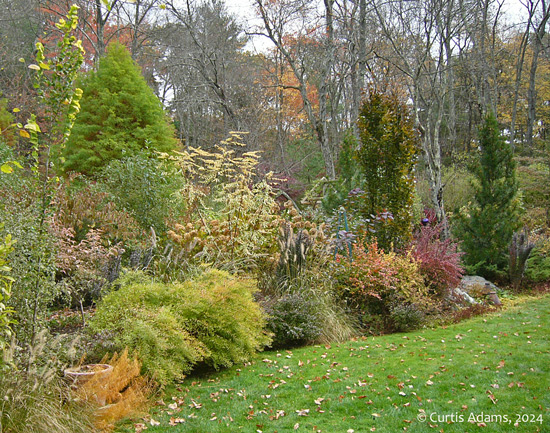

This semi-formal designed planting has a clearly defined placement of plants.

Conversely in landscapes intended to benefit wildlife with a less rigid, more naturalistic appearance, maximizing the ability of plants to produce fruits and seeds and to reproduce improves its function.  The composition of such a garden will change over time as more successful plants displace the weaker ones.

This parking lot island utilizes primarily native species adapted to dry conditions and
tolerant of summer heat.  Aside from the juniper and the chokeberry cultivars in the
back, all the perennials are wild type.  The installation here is 2 years old so
reseeding has not affected the appearance.

I live in a very naturalistic environment so for nearly every native species I plant I will make an effort to ensure that fertile seeds are produced.  The main reason for this is to support wildlife with natural sources of food.  However, there are a few cases where I will limit fertility such as using a non-native species or a North American species that is not a regional native or on those occasions where the properties of the cultivar are critical to the function of the design, particularly where size is concerned.  I these instances I would choose to use only a single cultivar (or gender).  

To the left, a freely reproducing/reseeding native garden bed.

In the photo above, the bed to the left consists of primarily native species and has been allowed to reseed naturally.  Over the course of 12 years, the dominant perennials have waxed and waned.  At first it was dominated by asters, mostly by Short's aster (Symphyotrichum shortii), then Phlox paniculata, then pale-leaved sunflower (Helianthus strumosus), and now there appears to be a return to aster dominance.  The 'October Skies' aromatic aster is the only one of that species in the bed and has remained in place for about 10 years with only two extra seedlings produced.

How to manage fertility...

Reproductive fertility in the landscape can be minimized by using single cultivars of a given species, using only one gender of dioecious species (often just males), choosing sterile cultivars or flowering plants with reduced numbers of fertile parts (double flowers), and having only a single individual of a species.

If you want to maximize fruit and seed production you should plant genetically diverse individuals (use seed grown plants, multiple wild type or a mixture of cultivars within a species), have both male and female partners of dioecious species, avoid cultivars with sterile flowers, plant mixed individuals of a species in proximity to increase cross pollination.

Back in the 1930's E. M. East of Harvard Univ. was compiling a list of plant genera, organized by family, and their propensity to self-pollinate (self compatibility).  Though not completed by the time of his death, this listing does give some clues about the ability of plants within a genus to self-pollinate.  Some notable genera that have multiple instances of self-incompatibility are: Trifoliums, perennial species of Festuca, and North American of Prunus (plums).  Species of Hamamelis, Fothergilla, Berberis and Spiraea are largely self-fertile.   

Examples of self-incompatible plants include many Asteraceae species.  Also apples, some cherries, and many grasses, e.g. Miscanthus, do not self-pollinate effectively.  Even though many of these have perfect flowers, that is their flowers have both male and female parts, there are genetic mechanisms (both mechanical and biological) in place that prevent or discourage self-pollination.  

Examples...

Examples of dioecious plants that you may want to use in your landscape are trees  fringetree,  persimmons, sassafras, tupelo, and willows, and shrubs such as bayberry, hollies, junipers, spicebush, and sumacs. In many cases male flowering plants produce showier flowers, with their larger pollen laden stamens.  Examples of these are spicebush, willows and fringetree.

The female fringetree, has a moderate f lowering display and will bear black berries
in early fall.  Male plants tend to be showier with somewhat larger and denser flowers.

Here are close ups of female and male spicebush flowers.  Female flowers have
a single style attached to the central ovary while the male flowers have up to
9 anthers loaded with pollen packed into each flower. 


The white catkins on these male pussywillows, Salix discolor, compete well with
forsythia in early spring.  Also, unlike forsythia flowers, the willow flowers are very
popular with the native bees.


Unfortunately, other than some ash trees and hollies, finding gender information from the retail nursery trade is pretty difficult.  This is understandable for seed grown wild type plants since the genders are not easily determined until the plant has matured, many years after the plants have sprouted.  For cultivars, plants reproduced asexually, the gender of the parent should be determinable and that information could easily be passed along.  Also be aware that any cultivars are generically identical to each other.  Planting 5 pots of 'October Skies' aromatic aster is the same as planting one as far as their genes are concerned.

The female flowers of this winterberry holly are dominated
 by the central ovary  surrounded by non-functional stamen
. 

Male flowers have 4-6 stamen tipped with yellow pollen. 
Male flowers are usually in tight clusters.

One notable species of the Asteraceae family is Jerusalem artichoke (Helianthus tuberosus) also known as sunchokes, , native to the Northeast and Midwest.  In the wild these plants are aggressive spreaders, however single cultivars, readily available from mail order nurseries do not readily self pollinate, so spreading by seed is not a concern.  

Viburnums are another example. To get berries you need at least two individuals of the same species.  If you are shopping at retail nurseries that would mean buying two different cultivars.  If you have access to seed grown wild type plants then any two will do you. Or you could do a wild type and any cultivar, if you wish. For more on this check out my viburnum blog post from a few years back.

One situation that gets repeated time and again is the use of Ginkgo trees, Ginkgo biloba, as street trees.  These ancient trees, native to Asia, are tolerant of many stressful conditions making them a good choice as an urban street tree.  The caveat is that the fruit of the female trees has a large amount of butyric acid in them which smells of rancid butter or, to me, dog poop.  The fruit is a little less than an inch long and have a rather slimy coating.  Altogether stepping on one, on a beautiful fall day, can ruin an otherwise delightful experience.  For this reason, many towns that have planted a mixture of ginkgo have opted to remove their female ginkgo trees.  You can read more in this story from CBS News.  


'Gro-low' Aromatic sumac is a horizontally spreading shrub.  This female cultivar
 is wind pollinated in spring before the leaves come out.

Another example of the importance of knowing the genders of the plants used in your landscape is the Gro-Low cultivar of aromatic sumac, Rhus aromatica 'Gro-Low'.  Gro-low aromatic sumacs are all females.  The design intent with this cultivar is as a ground cover/soil stabilizer that maintains a height of 3' or less.  Planting males nearby could result in seedlings that do not have the same growth characteristics of the mother plant.  The result would be an irregular planting with a scattering of taller (6 or more feet) plants.  (I don't know of a low growing male cultivar.  But even then there is no assurance that the offspring will share that shorter stature.)  The flip side is that without a male present for pollination no berries will be produced to help feed the birds.

A case of what was thought of as a safe introduction of a self-sterile exotic is the Bradford pear, Pyrus calleryana 'Bradford'.  Initially this single cultivar was not able to fertilize itself and it largely stayed put.   After a few years, the poor characteristics, particularly the weak branches, became evident and new 'improved' cultivars of Pyrus calleryana were introduced.  These new introductions were able to cross pollinate with the large existing population Bradfords leading to an explosion of in viable seedlings and a serious invasive species.  A similar situation is brewing with Chinese silver grass, Miscanthus sinensis.

If allergies are an issue, use more female plants to reduce the amount of pollen produced for wind-pollinated species, particularly Junipers, and ash, maple and Oak trees.  Also reducing the amount of lawn grass, as well as other grasses, which are 100% wind pollinated, will reduce the amount of pollen in the air.  For more on this see The Allergy-Fighting Garden, by Thomas Leo Ogren. 

To read more about managing fertility in your landscape check out chapter 3 of  Designing Gardens with Flora of the American East by Carolyn Summers.


Tuesday, October 27, 2020

Oh Deer

Even though as winter sets in deer metabolism slows and feeding/browsing damage becomes less obvious, deer still manage to cause some major damage to the landscape


A willow, Salix discolor, that has suffered multiple deer attacks, yet has survived. 
The trunk guards were put on after the fact.


Last February I came to the realization that if I wanted to grow new trees, especially conifers, I would need to protect them from the deer, especially the males during mating season. Here in the Mid-Atlantic November brings on rutting season, the time when white tailed deer mate.  During rutting season male deer rub their antlers against trees and shrubs to remove the velvet from the newly grown horns.  They also will rub trees to mark their territory and to take out their heightened aggressions as mating season kicks in.  What deer prefer for this rubbing behavior are trees and shrubs 1-4” in diameter with smooth bark, like willows and magnolias.  Aromatic cedar and other conifers are also favorites.  Once a tree is marked they will often return to the same one.  At one time I had a nice little Canaan fir, Abies balsamea var phanerolepis,  that I surrounded with chicken wire after it had been rubbed a little.  Two days later all that was left was a bare splinter of a tree.  Now is the time to put up some protection to save some of our precious young plants before they are destroyed.  Following are some of the actions I've taken.

Trunk Protection
Last year I tried horizontal fencing for the first time and did not have great results.  It did not protect a young magnolia from rubbing, but a number of small evergreens did not take any damage.  Based on the photos I have, the deer appeared to skirt the areas with fencing lying on the ground. 

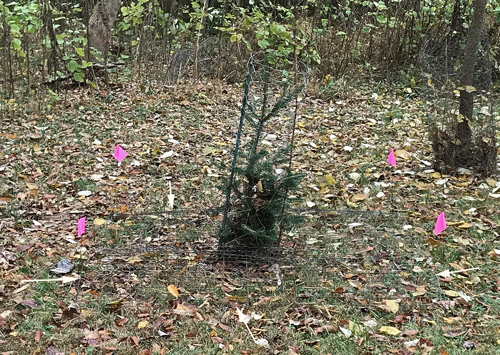
The pink flags indicate where I have put 2"x4"welded wire fencing on the ground around this little Canaan fir tree. 
The idea is that it creates unstable footing that the deer don't like.  The flags help me avoid the fence when mowing. 
I want to add some block underneath to lift the fencing further off the ground.

This year I have plastic mesh poultry fencing wrapped around the trucks of most of the stag-susceptible trees.  For others I have a heavier duty  4” drain pipe around the trunk.  (I’m a little concerned about heat build up under these black tubes.  For that reason I drilled ¾” holes every 6”to aid in ventilation.)  I also used some paper tree wrap on some smaller specimens.  One product that looks very good to me is a white spiral plastic.  It looks like it will protect the bark from rubbing and is open enough to prevent heat build up and not harbor insects.  I haven't bought any of that, yet.  A welded wire barrier surrounding the tree trunk has also proven very effective.  This is most efficient with single trunked trees with few lower branches.  Chicken wire may do a good job of limiting browsing but I've seen it ripped away from small trees that had been rubbed by a buck.

I wrapped the trunks of this fringe tree, Chionanthus virginicus, with plastic poultry fencing. 
It's easy to cut and can be tied together with zip ties or wire.  This material should protect the bark,
but will not support the trunk.


Here I am using a spiral cut 4" drain pipe to protect the trunk of this persimmon tree,
Diospyros virginiana.  I drilled holes in it every 6" to reduce heat build up.  This is
pretty tough material and should hold up to attack.


This Sassafras is being protected with a conventional welded wire cage. 
It's been here 4 years, but now it's of prime size for a deer attack. 
Hopefully the large size cage will be a good deterrent. 
I pulled the cage away during the summer to strengthen the trunk.  
  
Except for the open mesh materials it is a good idea to remove bark protection in the spring.  Heat and moisture build up can damage the bark and in some cases can harbor insects.  Also too much rigid support can keep a tree from developing a strong trunk.  I found this with my young sassafras.  It was getting floppy and the truck was not able to support the top growth on its own.  I pulled away the support this past spring and now the truck is much firmer.

Here  on this willow I'm comparing a variety of protection devices. 
On the right is a paper tree wrap.  Not sure how that would hold up versus a buck.


Repellents
In winter deer’s metabolism slows down, but they are still out there browsing.  Evergreens, branch tips and leaf buds are at risk.  Fencing and cages are effective at keeping deer far enough away to prevent browsing.  Burlap warps that are used to prevent winter burn on arborvitae should also work.  Repellents are also helpful.  In colder weather taste-based repellents have an edge because they do not need to be volatile.  It is often recommended to alternate among different repellants through the season so that deer don't get used to any one of them.   So far I haven't done that.  

Reading about all the different recommendations for deer repellants, as well as deer resistant plants, it has become clear that not all deer are the same in regards to their likes and dislikes. Be flexible and try different recipes and products.  I've had good success using Bobbex which contains a variety of taste and odor deterrents. 


Planning Ahead
I’ve seen a number of people on Facebook ask about starting gardens in areas with lots of deer.  My deer seem to test every new plant that goes in the garden.  For new shrubs I usually put a chicken wire cage around them.  As far as planning an new large planting, I like the advice I’ve read in ‘Deerproofing Your Yard & Garden’ by Rhonda Hart.  She recommends fencing in the new garden space before doing any planting.  This is because deer are creatures of habit.  If they have never found anything of interest in an area, then they are not likely to return.  But, once they have found something tasty there, they will make every effort to return.


On the Bright Side?
Deer browsing results in some unsightly damage to many landscape plants.  It is not uncommon to find hedges of arborvitae and junipers chewed back up to about four feet off the ground.  There are some aspects of deer browsing behavior that could be considered beneficial.  The following two photos show where deer have pruned away branches from the lower 4 feet of a yew and a rhododendron.  This sort of pruning opens up the ground plane for lower growing herbs to fill in. In the absence of deer these would be mounds of foliage.  I've also seen this with spicebush, Lindera benzoin, in the woods. This can happen when there is not excessive deer pressure.  Had there been more deer here say 10 years ago these shrubs may not have grown more than a foot tall before being destroyed, unless they were being protected with cages and repellants.

The lower branches of this yew have been munched away over the years.

This rhododendron has been 'limbed up' by deer.

What methods have worked for you during rutting season?  I'd love to hear about them.


Sunday, July 5, 2020

Getting More Fruits

Sassafras blooms in the first part of spring. 
This photo was taken on April 12th.

I have been planting more native trees and shrubs with the goal of increasing the amount of food available for birds.  Particularly fruits that are available in fall and winter.  In many cases these plants are dioecious. That is, an individual plant of the species is either male or female.  To get berries you need at least one male to fertilize the female flowers.  Sometimes getting male and female plants is easier when you are buying cultivars.  It is often documented somewhere (but not always) if a cultivar is male or female.  When buying seed-grown natives it is difficult to tell unless they happen to be in bloom when you are shopping.  If plants are not in bloom the recommended approach is to get 5 random plants so that there will be a good chance that you will get at least one of each.

This year I have spotted some firsts in my campaign to produce more native berries.  The first success that I noted was that my newly planted sassafras tree, Sassafras albidum, was a female [note structure of female flower].  There is a number of wild sassafras in the area, but the flowers are way up in the tree so I have not been able to distinguish their gender.  About a month after blooming I noted that there were a couple of berries forming.  They are green right now, but will turn dark blue when ripe.
Female flowers have 6 sterile stamen (staminodia) surrounding
a central pistil.  Male flowers have 9 stamen.
Here at the beginning of July you can see the green berries.  When ripe these berries
will turn dark blue and the pedicels will turn red.


The second species I spotted with fruit forming was persimmon, Diospyros virginiana.  There has been male tree on the property for some time.  I don’t know if it’s wild or was planted by the previous owners.  When I moved 7 years ago I planted a number of native persimmons all of unknown gender.  To improve the chances that I had at least one female I planted 6 new plants.  Last year one of them bloomed that proved to be a male.  This year two additional trees bloomed, both of which were female.  Shortly after the flower petals fell off I noticed that two of the female flowers had swollen ovaries.  Now I can hope that they survive long enough to ripen.  I may need to build a little fence around them to keep the deer away.  
Female flowers are usually solitary and have 8 sterile anthers around the pistil.
 On male trees flowers are clustered and are typically packed with 16 anthers.

About a month later this persimmon is developing. 
Green now it will turn orange when it ripens in the fall.


Another recently planted native tree that is now showing some berries is fringe tree, Chionanthus virginicus.  Fortunately these bloomed the second year after planting.  The first three of these I planted either appeared to be females or had not bloomed after two years.  The following year in early June I was in a native plant nursery when these were in bloom.   I was able to identify one specimen as a male (paddle-shaped anthers in throat of flower) and bring it home for the girls.  Now 4 years later I’ve spotted the first berries on the fringe trees.  Like with the sassafras these start out green then turn dark blue when ripe. 
This green berry on the fringe tree will turn dark blue when it ripens in early fall.


Two years ago I replaced some invasive leatherleaf mahonia, Mahonia bealii, with some inkberries, Ilex glabra.  I wasn’t able to get a male cultivar locally.  I found a suggestion on the internet that other hollies could fertilize inkberries.  To try this I planted an early blooming winterberry holly, Ilex verticillata ‘Jim Dandy’ nearby.  After planting my collection of inkberries including the ‘Nigra’ and ‘Shamrock’ cultivars I took a close look at the flowers.  While the flowers on ‘Nigra’ were exclusively female, ‘Shamrock’ appeared to have both male and female flowers.  Unfortunately this year I forgot to take a close look at these flowers to confirm my earlier observations.  I can say that this year I am seeing a lot of berries developing on the ‘Nigra’ plants, as well as on a single wild-type plant.  The ‘Shamrock’ cultivars bloomed this year but are lacking berries.  They had a lot of berries in their first year here.  
This female flower has a large central ovary surrounded by six sterile stamen. 
In male flowers these stamen will have yellow pollen on the anthers.

Also on the holly front, this year I added another winterberry holly, ‘Winterred.’  This is a later blooming female.  Its blooming cycle is perfectly timed with the male, ‘Southern Gentleman.’  While it was still in its pot I placed the ‘Winterred’ next to the ‘Southern Gentleman’ until the blooming period was nearly completed.  This should ensure some berries as long as it doesn’t get stressed too much from being planted out in late June.

Some other species that are not dioecious have mechanisms that encourage cross pollination. This ranges from clever flower construction that prevents self-pollination, to offset timing of pollen release and receptivity, to outright rejection of pollen with the same genetic material as the ovary.  To encourage fruit and seed production you should have at least two genetically distinct individuals within pollination range. 

This is what I’m thinking about my single American plum, Prunus americana.   Despite several years of impressive blooming I have not seen any fruits on this tree.  I don’t know how long these need to mature before they are ready to bear fruit.  To help with cross pollination I’ve planted several bare root American plums in the area but I think it will be a few more years before these begin to bloom.

Another fruit-bearing native that has appeared on my property is black raspberry.  I’d like to think that these have been encouraged by the removal/reduction of invasives like Japanese stiltgrass, wineberry and garlic mustard.
Black raspberry has round stems and first year canes are glaucous. 
Flowering occurs in mid-May

The black fruits ripen around the end of June and have a distinctive sweet flavor. 
These ripen a week or two before the wild blackberries, which are much tarter.

Thursday, June 16, 2016

Finding a mate for my Plants, part 2

One of my goals in creating a more wildlife friendly landscape is to use plants that produce fruits and berries in addition to pollen, nectar and habitat.  While for some plants that is not a big deal.  A single specimen may be self fertile, or there are other nearby plants for cross-pollination.  Where I have been having more trouble is with some of the less common species to my neighborhood.

A good number of fruit bearing trees and shrubs are dioecious, that is, they have male and female flowers on separate plants.  You need one of each in order for the female to bear fruit.  The classic example of this in horticulture is with the hollies (Ilex sp.).  Fortunately, the industry knows that customers expect to see red berries on their winterberry hollies, so they have provided distinctly named male cultivars to interplant with the more attractive females.  Usually one male plant is sufficient to fertilize five females.

Finding information on the genders of other plant species is more challenging.  Many maples are dioecious, but it is rare to find its gender in the plant description.  Most folks don't care much about the flowers on a maple, they are too far away to see and the foliage is the main feature anyway.  However gender is an issue for many allergy suffers.  Male trees produce loads of pollen and if it's wind borne, that's a lot of pollen in the air.

This Sassafras was blooming at the beginning of April.
Males have showier flowers because of all of the stamen.
The female flowers are more subdued.
My goal is to have mating pairs so that I can get fruit production for the birds and other wildlife.  On my property I have a number single specimens.  In order to find out which genders I have, I need to be out there observing them while in bloom.  I learned that my big sassafras tree is a male since I was out there in early spring while it was blooming.  I didn't see any others in bloom.  I recently purchased a new seed grown sassafras, but it will be maybe 10 years before I learn its gender.

One approach to getting mates when buying young plants is just to buy a lot of them and then play the odds.  I often buy 3 at a time, but 5 gives you a better shot. This is only certain for seed-grown plants.  Plants propagated from cuttings will have the gender of the 'parent' plant.  Then you need to hope that the propagator started from a mix of plants and not a single cultivar.


This fringe tree is probably 4 years old and
has a few blooms on it.


Another approach is to be at the nursery and find plants in bloom.  I got lucky this year when I found small fringe trees in bloom at my favorite nursery.  I went home and saw that both of mine were also in bloom and they were both females.  I headed back to the nursery and looked though their plants until I found a male and bought it.  Now I'm all set for next year.

This is the female flower, there are two stigma held closely in the center.
The male flowers have two paddle-shaped anthers that protrude from the flower center.

Tupelo, Nyssa sylvatica, is another tree that is dioecious.  I put in two of them in a couple of years ago.  Then I realized it was a big gamble that I would have one of each, so a added a third this year.  These mature into fairly large trees, so I don't want to fill up the yard with a bunch of them.

I have a mature persimmon tree that is female.  The first year we moved here I added 5 more saplings.  Now, 4 seasons later they are about 10 feet tall, but still no sign of blooming.  Maybe next year.

Here's the female persimmon in bloom.  I haven's seen what the male looks like, yet.
CORRECTION: This is actually a male plant.  See comment 6-14-2020 below.


The native pussy willow (Salix discolor) also comes as separate male and female plants.  The male is showier with its large fuzzy stamen.  These plants do bloom when they are small, so you might have luck determining which to buy at the nursery.  These bloom in mid-April around here and, unfortunately, many nurseries aren't open for business then.  The one I purchased two years ago was male.  Willows are very easy to propagate by cuttings.  So I was able to quickly grow several new plants, but these will all be male.  I did pick up another this spring, but it was not in bloom.  The vendor said it was seed grown so I'm working blind.

The male flower of this pussy willow is adorned with bright yellow stamen.
The flowers on female plants are green and somewhat scaly in appearance.

I did get a couple of goatsbeard (Aruncus diocus) which turned out to be both male.  This is a case where I am happy not to have a mate.  The male has the showier flower and two plants take up more than enough to space in the garden.
The stamen on these male goatsbeard flowers really catch the light.