Showing posts with label Rhus aromatica. Show all posts

Tuesday, June 9, 2020

Leaves of Three

Poison ivy has three leaflets, the center one has a longer stem.  Leaves have a central vein
with secondary veins branching off from it.  Young leaves are glossy, but older ones are variable
 and leaf margins are all over the place.
After a mild winter in the Mid-Atlantic, it's been a cool, damp spring.  This seems to have brought out a lot of growth in the understory.  Included in this lushness is plenty of poison ivy, Toxicodendron radicans, formerly, Rhus radicans.  As I have been doing some weeding I have been vigilant for ‘leaves of three’, the rhyme for identifying poison ivy.  But that is not the only plant out there that sports three leaflets. 

Following are some common plants that bare some resemblance to the dreaded poison ivy.  Probably the most common look alike in the Mid-Atlantic region is box elder, Acer negundo.  When I first encountered this tree I thought OMG it’s a  poison ivy tree!  This tree reseeds prolifically generating a myriad of seedlings with bright green leaves divided into three leaflets.  While superficially similar to poison ivy, on closer examination you can see that box elder has an opposite arrangement of leaves and branches, while those of poison ivy are alternate.
Box elder has three leaflets that appear very similar to
poison ivy, but branching is always opposite.  Leaf margins are variable
Here they are side-by-side.  Box elder seedling at top has opposite branching,
poison ivy in mid-frame is opposite.  The yellow flowers are green and gold,
  Chrysogonum virginianum.

A close second in my experience is Virginia creeper, Parthenocissus quinquefolia. This rambling and climbing vine has the same habit as poison ivy, but it usually have five leaflets rather than three.  The confusion comes because the younger shoots often sport leaves with three or sometimes four leaflets.  When I spot these I carefully trace the vine back a little ways to see if it also has leaves of five.  Some people have sensitivity to Virginia creeper, but the reaction is not as severe as the rash most people get from poison ivy. 

Virginia creeper is a vine with a similar habit as poison ivy. 
Most, but not all, leaves have 5 leaflets.

Another understory tree that has three leaflets is common hoptree or wafer ash, Ptelea trifoliata. This is not likely to be confused with poison ivy, although seedlings or growth from the base of the tree could cause some concern.  On the hoptree each leaflet does not have a distinct stem (petiolule), rather the leaf tapers sharply to the point of attachment.  While the leaflets of poison ivy are distinct with the central one considerably longer than the two lateral ones.  
Common hoptree grows well in shady locations not unlike poison ivy. 
Note how the leaflets lack distinct stems.

Aromatic sumac, Rhus aromatica, is less commonly encountered.  In the wild it is an upright shrub.  But in the landscape trade there is a shorter, spreading cultivar called ‘Grow Low’ that is becoming very popular.  When I’ve bumped into mine in the woodland edges I froze for a second until I noticed that the leaflets have different lobes and the leaflet stems (petiolules) are all the same length.  On poison ivy the middle leaflet has a longer stem than the other two.

The leaflets of aromatic sumac tend to have rounded lobes concentrated at the tips.

White avens, Geum canadense, has a number of leaf forms.  Some of its basal leaves can have three leaflets but they are not particularly glossy and are generally rough in texture.  Also this species grows in clumps, it is not viney.  


The younger leaves of white avens tend to have three leaflets.  To the lower left you
can see some of the more complex leaf forms.

Barren strawberry, Geum or Waldsteinia fragarioides and the non-native W. ternata, have leaves of three, but the leaf margins are more deeply toothed and the leaflet stems are all very short.
The glossy leaflets of barren strawberry appear to merge together looking
 more like lobes than separate leaflets.

  Mock strawberry, Potentilla  (or Duchesnia) indica, is another prolific ground cover with three leaflets.  It’s leaf margins are regularly toothed and it’s habit is different, spreading by stolons, not vining.  
The leaf surface of mock strawberry is much rougher in appearance than poison ivy.

Golden Alexanders, Zizia aurea, has leaflets that are twice divided, 3 sets of trifoliate leaflets (biternate).  The leaflets are ovate to lanceolate with finely toothed edges.  The long petioles may give the impression of young poison ivy stems.  
Leaflets of golden Alexanders can be seen in the circle at bottom right. 
Also present in this image is Virginia creeper and mock strawberry.

The native clematis, Virgin’s bower, Clematis virginiana, is a weak-stemmed vine with three part leaflets.  While you would want to routinely test the vine strength to distinguish it from poison ivy, an examination of the veins on the leaves would show the difference.  Virgin’s bower has a palmate pattern, with the major veins radiating from a single point; whereas poison ivy’s veins branch out along a central middle vein.  
The ribbed stems of virgin's bower are too weak to support itself
 and it needs something to climb on.

The list of trifoliate plants seems to go on and on.  After I thought I had this pretty well wrapped up I took another look and noticed the leaves of Jack-in-the-pulpit, Arisaema atrorubens, and that reminded me of the trilliums.  These can be recognized by their relatively large leaf size and regular arrangement of leaves.  Arisaema leaves are in a ‘T’ arrangement and those of trilliums are arranged in a regular triangle pattern (120 deg apart).  Can you think of any more poison ivy look-alikes to be on the watch for?

Wednesday, September 19, 2018

New Sloping Path

One area in my lawn has a steep grade, about 28%.  That is a rise of 4.5' over a 16' run.  The lawn tractor could make the climb, but usually left some tracks, particularly if the ground was moist.  Also when walking through that area it was a real chore.  This is a prime area to replace the turf with a lower maintenance planting and to put in some steps to make navigation easier.

When doing a project that involves both planting and hardscape (elements like steps, walls and patios) it is best to put in the hardscape first.  The positioning of plants has greater flexibility and there is usually less heavy lifting than when positions stones.

Overall Plan for this sloping site.  The 9 steps are shown as rectangles,
though in reality they are irregularly shaped.  The highest elevation is at the top,
sloping down about 4.5 feet to the lowest step.  Scale 1" = 3'.
The first step in putting in steps on a hill is to determine the slope of the hill and then position the steps.  Having a consistent rise and step length makes the steps easier to navigate.  The overall rise here was 54".  For a 6" rise/step, that calls for 9 total steps.  At this time you can also move the shrubs around, while they are still in pots, to determine how you would like to position them.

Here, after the steps were installed, you can see the level lines that were used to determine the overall slope
and to guide the installation so that the change in elevation from step to step was about the same.
(In the background you can see the tamper that is used to compact the soil and paver base.)

I try to use a sustainable approach to landscaping whenever possible.  In this case that means using stepping stone materials that were on site, left over from an earlier dry laid stone wall project.  These stones give a naturalistic appearance.  Also by using the same materials the two projects become visually and materially united.  One down side of using irregular stones as steps is that each step needs to be engineered individually to set it on a solid foundation.  Rectangular steps installed in a straight line require less customization.

For steps that get a lot of use a crushed stone base of 6 or more inches is recommended.  Since these steps are only for occasional use, I cut back a bit on the amount of base.  The riser for each step is supported by 2-3 inches of compacted paver base separated from the soil by a layer of landscape fabric over the compacted native soil.  Behind this reinforced riser is compacted fill.  Supporting the riser with a firm base gives the step a firm feel underfoot.  It's much more comfortable to step onto a firm, well seated step than one that wobbles even a little.

Here's a view underneath one of the steps showing the compacted paver base
underneath the the riser and the landscape fabric that is being used to hold the dirt
behind the dry-laid riser.  For some of the steps that were difficult to stabilize I used
construction adhesive to secure the step to the riser.

The standard formula for garden steps is that the tread length be about 26" minus 2 times the step height. 

Tread Length" ≈ 26" - (2 x step height")
So for a 6" step height the tread length should be approximately 14".  The formula is based on a comfortable stride length for the average person.  Had I put he steps in a straight row down the slope it would have been close to this formula.  Instead I spread the steps over a longer, curving course.  I thought that the slightly longer course would have made for an easier, more gentle climb, but instead the longer distance between steps makes the trip feel less certain, especially when going downhill.

However, the way I chose to do it created a more naturalistic look and used materials that were already on hand.  Also by following the existing slope I minimized the changes to the existing grading.  Looking back, if these steps were to be used on a regular basis or in a more formal setting I would have built a deeper foundation, used more regularly shaped stones and followed the formula more closely.

This is the area after scalping the grass with a string trimmer. 
I also used a garden torch (circled) along the edges to burn the areas that had
Japanese stiltgrass in an attempt to kill any new seeds/seedlings. 
Once the steps were in it was time to eliminate the existing grass and weeds.  (This could have been done before installing the steps, but I felt it was less disruptive to the stability of the slope to wait until the steps were in place.)  There were several options for getting rid of the existing turf and weeds:  dig it out, spray it with a broad spectrum herbicide, or cover/smother with cardboard and mulch.  Digging is a lot of work and could destabilize the slope.  Herbicide would be easy and would be less disruptive to the soil surface, leaving roots intact to hold the soil.  I opted for the cardboard smothering/mulching method.  It leaves the soil intact, is non-toxic, and there are limited debris to deal with.

I used thick cardboard from moving boxes to cover the unwanted grass.
After mowing/scalping the existing grass, I covered the slope with cardboard and pinned it in place with landscape staples.  After moistening the cardboard to make is more flexible to conform to the soil surface I covered it with 2" of wood chips.  Most of the lawn will die due to lack of light in a few weeks, but planting can be done sooner by cutting holes through the cardboard, removing all the exiting grass from around the area and inserting the new plant.  The re-exposed soil should be well mulched or recovered with scraps of cardboard to keep the old grass from growing through.

The cardboard was covered with about 2" of woodchips that were left by our
arborist this spring. I started planting about 10 days after spreading the chips. 
For the areas between the steps I dug out the grass by hand since it was hard to get small pieces of cardboard to stay in place and there will be a lot of gaps where the grass can peek out and get re-established.

Now it's time to plant...

The plants I chose for this area are all low maintenance natives that are from the mid-Atlantic area, mostly ones that grow nearby.  I chose plants that area fairly low-growing to minimize the amount of pruning needed to keep the pathway open, both physically and visually.  The selection of plants will have something in bloom from early spring through fall.  You can see the plant list in the drawing at the beginning of this post.

The Grow-Low sumac are at the foreground in this photo, with the Red Sprite holly at the back.
First to go in are the woody shrubs. I put in three Grow-Low aromatic sumac, Rhus aromatica 'Grow-Low' and one of the shorter female cultivars of winterberry holly, Ilex verticillata 'Red Sprite'.  I chose this sumac because it grows under a almost any condition, it only grows to about 3' tall and is a good choice for stabilizing slopes.  In addition it has a nice bright orange fall color and tends to be resistant to deer browse.  The female Red Sprite winterberry holly has a proper male mate in the nearby Jim Dandy.  I also transplanted in some extra black and brown-eyed Susans, Rudbeckia sp., to fill in around some of the newly planted shrubs.

As for flowering perennials, located 1-2 feet from the path, I chose foxglove beardtongue, Penstemon digitalis, short-toothed mountain mint, Pycnanthemum muticum, black cohosh, Actaea racemosa, and aromatic aster, Symphyotrichum oblongifolium. As the grass components I also put in some bottlebrush grass, Elymus hystrix, and wavy hairgrass, Deschampsia flexuosa.  I really like the looks of the bottlebrush grass and it is a species that commonly grows on the woodland edges in this area. Finally around the stepping stones and outer edges I put in the shortest species, two cultivars of moss phlox, Phlox subulata, and Pennsylvania sedge, Carex pensylvanica.

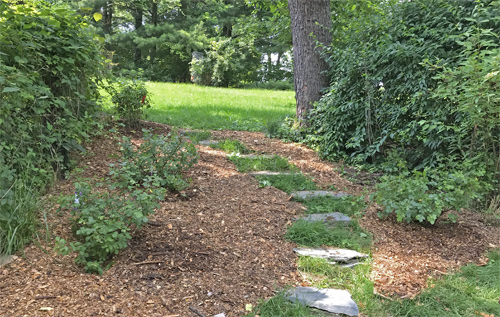
This is the completed installation.  I finished this in mid-July - later than is optimal for planting around here (mid-Jume would have been better).  I added in some old landscape timbers that were taken out from an earlier project to from the upper and lower edge of this garden.  Reusing materials on-site is part of being sustainable (and cheap).
As we are approaching fall the deer have come through and ate back the Penstemon and stripped most of the leaves and berries off of the holly.  I'm surprised about the holly, but our deer usually eat up most new plants no matter what they are, then leave them alone the following year.  Also the cohosh died back early, it may be getting too much sun, we'll see if it comes back next spring.


UPDATE
Here's the path in May 2019.  Everything has come back.  The bottlebrush grass is approaching 3' and all three cohosh have returned!


Friday, June 29, 2018

New Plants for 2018

One of my big plans for this year was to replace the non-native, invasive leatherleaf grape holly, Mahonia bealii, with some native shrubs.  Features of the grape holly that I wanted to preserve were flowers and berries for wildlife and some evergreen qualities that help define that space in the winter.  I decided to use inkberry hollies, Ilex glabra, to carry most of the load.  Also in this space I put a 'Snow Queen' oakleaf hydrangea, Hydrangea quercifolia 'Snow Queen' to continue a screening effect started with two older oakleaf hydrangeas nearby.  A few cinnamon ferns, Osmunda cinnomonea, completed the composition.

Shrubs from left to right are Jim Dandy winterberry holly, Nigra inkberry and Shamrock inkberry. 
Also new are the bright green cinnamon ferns toward the front.  The background is dominated
by a Carolina allspice, Calycanthus floridus.

To create some size variation in the evergreen I got a variety of inkberry cultivars.  'Shamrock' being the shortest (3-4') is in the front and behind it are a 'Densa' (8-10') on one side and 'Nigra' (4-6') on the other.  All three of these are listed as female plants.  To get berries a male plant is needed.  Unfortunately I was not able to get hold of a male plant (such as the 'Chamzin' cultivar).  I saw somewhere that any male holly that blooms at the same time is capable of fertilizing a female, so I put in a 'Jim Dandy' winterberry holly, Ilex verticillata 'Jim Dandy' nearby.  This bloomed at about the same time as the three inkberries. 
Since I was watch the flowers rather closely I noticed that while both 'Densa' and 'Nigra' had exclusively female flowers, 'Shamrock' appeared to have both male and female flowers.  I could find no mention of 'Shamrock' bearing both types of flowers.
Also on the holly front I added a 'Southern Gentleman' winterberry near a well established female.  A few years ago I but in an early blooming 'Jim Dandy' as a pollination partner, but berry production did not improve much.  The 'Jim Dandy' is usually finishing up blooming just as the established female is starting to bloom.  This new 'Southern Gentleman' here has started blooming about 2 weeks later than 'Jim Dandy', hopefully in better synch with the female.  Maybe this year we will get a bush full of red berries. 

Here's the slope prior to planting.  The winterberry is at the top left and
the lower growing aromatic sumac cultivars are on either side of the steps.
 In another area of the yard is a slope almost too steep to mow (about 30% grade).  This year I've decided to put in some steps and plant the slope with native shrubs, perennials and grasses so that it can be left alone.  New plants for this area include 'Grow-low' aromatic sumac, Rhus aromatica 'Grow-low', 'Red Sprite' winterberry holly, Ilex verticillata 'Red Sprite', and fireweed, Chamerion angustifolium.  The 'Red Sprite' is a female clone and was put in as a partner for the 'Jim Dandy' that I planted a few years back. 

Tried to grow fireweed from seed last year, but no luck. 
This year I got some as seedlings.
Here are two red oaks that I will be planting in the woods.
These saplings are about 4 years old.
In the woods around our house a number of older trees are dying.  Some of this may just be natural, some may be the work of the emerald ash borer.  I've also been identifying and killing as many tree of heaven, Ailanthus altissima, as I can.  To fill the open spaces I've been planting oak saplings.  This year I am putting in the more shade tolerant oak  species, red and black oaks, Quercus rubra and Q. velutina.  [P] 

We are also seeing a number of our white pines, Pinus strobus, in our wind break coming apart.  These were planted 40-50 years ago and are probably not in their ideal habitat.  To fill in the gaps in this row of evergreens I've planted some seedling of Canadian hemlock, Tsuga canadensis.  I've spaced these out widely so that any future attack by wooly adelgid will be slowed, since the plants won't be in contact with one another.  I've marked the location of each with a pink flag, otherwise these little plants would disappear into the undergrowth.
 
I also got a bunch of bare root wild ginger, Asarum canadense, in early spring.  I would like to use them as aground cover along with some Heuchera and violets.  So far most of these are surviving, but they do need some help by removing some of the competitive plants.  My previous attempt did not go so well as the plants were overwhelmed with vinca  and the leaves of an English walnut. 

Most of the American plums, Prunus americana, that were planted last fall survived winter.  One died rather suddenly this spring when all the leaves wilted.  There was a lot of insect activity near the roots, or it could have been too much shade from a neighboring box elder.


I've always loved the look of blue cohosh, Caulophyllum thalictroides, blanketing a shady hillside.  I've been reluctant to plant it in the past because I haven't seen it growing nearby, even though I seems like the right conditions.  This year I broke down and bought a couple of plants to put in on a shady, moist hillside.  This is an area where I have been removing garlic mustard and Japanese stiltgrass, so it's time to get some more plants in there to take their place. 


Post bloom, this Itea tends to blend in with the surrounding foliage.
A few years back I planted a small Virginia sweetspire, Itea viginica, possibly 'Henry's Garnet' under a tulip tree.  It has never got too tall.  Possibly due to the shade and possibly due to deer browse.  Despite its lack of size, this year it managed a couple of blooms.  Encouraged by this, this year I added a larger specimen to a sunnier location.  'Little Henry', a cultivar growing to about 3', was my choice.  It has a compact habit and large flowers.  While the flower display on this one this spring was impressive, now at the beginning of summer it's hard to recognize.  It should have good fall color, though.


Tuesday, February 17, 2015

Planting Plans for spring 2015

Every year brings another opportunity to grow my native plant collection.  This year I'm focusing on 4 areas:  Clean up and replanting around the swimming pool, clean up and expansion of the meadow, replacing the vinca along the driveway and build up a privacy hedge with the neighbor.  After learning a bit about the current conditions, what is already here and what might be expected to grow here naturally, I've put together a shopping list of natives to get this year.

This moss phlox is pretty happy growing along the pool deck,
A good portion of it is on the concrete slab.
The colors can be intense, so I use mostly one color at a time.
The area around the swimming pool is infested with common evening primrose (Oenothera biennis).  While native, there is just too much of it and it is not that attractive close up.  The soil is mostly a fast draining fill with a moderately high pH (ca. 7.5).  Since this is far from native soil I put a greater focus on what would look good growing in this setting.  Since I had already started using this area for plants native to Texas (my wife's home state) I will be adding two of my favorites, Wine Cups (Callirhoe involucrata) and Indian Blanket (Gaillardia pulchella).   I got some seed on a recent visit to the Wildflower Center.  These will be great for the full sun areas and they tolerate alkaline soils.  The moss phlox could use some bolstering up as well.  I am attempting to remove the English ivy from the enclosure and this phlox seems to be a good candidate to fill back in.

This species of wine cups grows close to the ground, filling gaps around taller plants.
Seed requires a hot water treatment and  30  days cold stratification for germination. 


This is the annual species of Indian blanket, Gaillardia pulchella.


Small's Penstemon is long blooming in shady locations.
The contrasting lavender and white blossoms show up at a distance.


In the shadier areas I will be trying out Greek Valerain (Polemonium reptans aka Jacob's Ladder) and Small's Penstemon (Penstemon smallii).  Despite its common name the valerain is actually a native to the of the US.  This had confused me for a while.  Looks like the name Greek valerain is used for a number of species in the Polemonium genus.  One of them with particularly showy flowers, P. caeruleum, is a European native.  P. reptans grows more like a ground cover

I've ordered some more Indian Pink (Spigelia marilandica) for an area in the pool enclosure with more moisture and organic soils.


This cottonwood seedling appeared in the vegetable garden.
I'll transplant it this spring to a moist part of the new meadow.

I have an area that has been overrun with invasives that I am trying to convert to a meadow.  I cleared half of it last year and hope to finish this spring.  After removing the bad guys I am backfilling with native species.  I realize that I'm making more work for myself by trying to kill off invasivies at the same time as introducing new plantings.  By planting mostly shrubs I think I can more easily manage the area with an annual mowing/whacking of the undesirable plants.  For the right way to convert a weedy area to a meadow or prairie check out this link.

Last year I planted an American plum (Prunus americana) and several elderberries (Sambucus canadensis).  This year I will add some chokecherries (Prunus virginiana) and smooth sumac (Rhus glabra).  I also have a Cottonwood (Populus deltoides) seedling to put on the edge.


The pawpaw blooms in early May,
just before the leaves open up.  

Way in the back I have a large grove of Pawpaw (Asimina triloba) trees.  I've been watching them for 2 years and I have yet to see any fruit.  Since pawpaws produce better with cross-pollination, I will be adding a couple of new individuals to the area,  It is possible that my entire grove is really just one clone.  We'll see if this helps, in a couple of years.


These goldenstar have more than doubled in size after a year in the ground.
I'll get some more to speed up coverage.

In the shady area around the driveway I have been ripping out the vinca and replacing it with shade tolerant natives.  I started with foamflower (Tiarella cordifolia) and Heucheras and these are taking hold.  In addition to these I've seen some really good results with Goldenstar (Chrysogonum virginianum, aka Green and Gold) in open shade areas.  These are relatively easy to find in a regular nursery, sometimes marketed with the plants that you can walk on.  Another plant that I've used in dry shade is big-leaf aster (Eurybia macrophylla), It has dense foliage and spreads by rhizomes so it should do a good job competing with the vinca.


This shiny summer foliage pf aromatic sumac turns red and orange in the fall.
We'll see how it performs in a shadier location.

The boundary between our nearest neighbor is defined with a double row of white pines.  At 40+ years old they are now limbed up fairly high and not providing much screening.  We have already put in a juneberry (Amelanchier canadensis), hazelnut (Corylus americana) and Hoptree (Ptelea trilfoliata).  There was also a pawpaw already there, doing a pretty good job despite the drier conditions.  We are looking to add some additional shrubs to fill in this gap and obscure the view.  A local native plant nursery has listed maple-leaf viburnum (Viburnum acerifolium) for sale this year.  I've been told that this is a very difficult shrub to propagate.  It does well in shady woods so I'm looking forward to trying it here.  I should get two since they don't self pollinate.  I am also looking to get some aromatic sumac (Rhus aromatica).  The wild form grows 5-12 feet, just the right size for our area.  I already have some of the 'Gro-low' cultivar.  At about 3 feet it is a great ground cover shrub for many difficult locations.

Now with may list in hand, I can hardly wait until spring!