Showing posts with label Rosa multiflora. Show all posts

Wednesday, March 2, 2022

Managing Invasives 2022


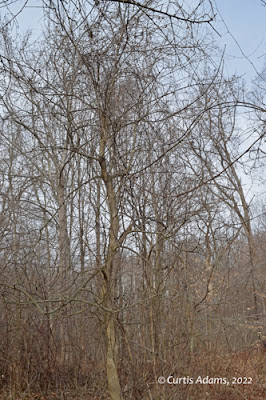
This is pretty typical of an 'invaded' tree with
Japanese honeysuckle and oriental bittersweet
 twining among its branches.

We’ve been on our central Maryland property for about 9 years now.  From day one we have been battling a slew of invasive species that were covering the ground and trees through the woodland landscape.  While we still have a ways to go I feel that we have made some good progress.  As I am getting ready to start another season managing the landscape I thought I would organize my plan around actions and timing, rather than looking at one species at a time. 

First 

My first activity for the year will be to treat any visible garlic mustard, Alliaria petiolata, with a 2% glyphosate spray.  I'll do this sometime in the middle of March, when the temperatures  will be above 40°F with no rain for a couple of days. I started doing this 2 years ago and it seems to have helped me get the upper hand.  Prior to that I had  been only been pulling up plants in mid-spring as they grew tall prior to blooming. This link to my post on garlic mustard control options describes winter spraying in more detail and shows some of the desirable native species that may be visible at that time.  It also summarizes control options throughout the year.  The timing is critical as it is before the spring ephemerals, like spring beauties and Dutchman's breeches begin to sprout.  This lowers the chances of harming native species.   
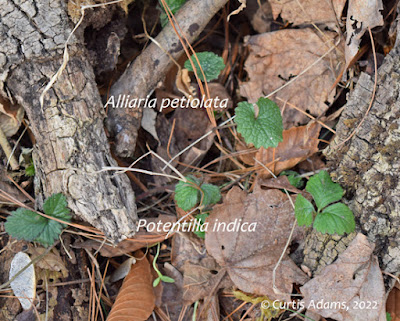
Here you can see what a small garlic mustard, Alliaria petiolata,
looks like in winter.  Indian mock strawberry, Potentilla indica,
is also green through the winter.  Unfortunately, that weed is not
 as sensitive to glyphosate as the garlic mustard. 
See this link for methods to manage it.

Second

Cutting woody invasives and vines and stump treating with 20% glyphosate can be done anytime of the year that the temperatures will be over 40°F for a few days in a row.  Winter is a good time to do this as it is easier to get to the base of many or these plants and there is less chance of getting the herbicide on desirable plants.  Particularly troublesome on my property are multiflora rose, Rosa multiflora, oriental bittersweet, Celastrus orbiculatus, Japanese honeysuckle, Lonicera japonica, and to a lesser extent Autumn olive, Eleagnus umbellata.  An excellent reference for managing invasives in the Mid-Atlantic region is Plant Invaders of Mid-Atlantic Natural Areas. 

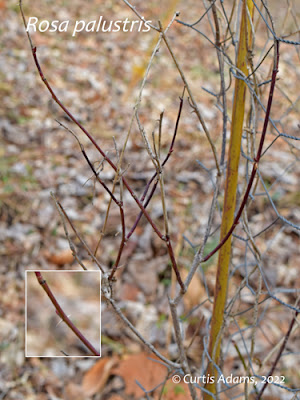
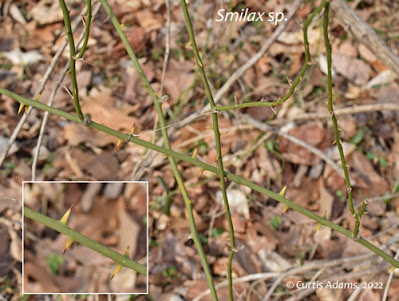
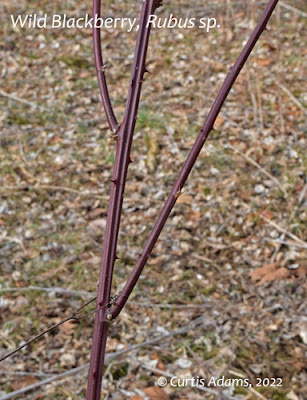
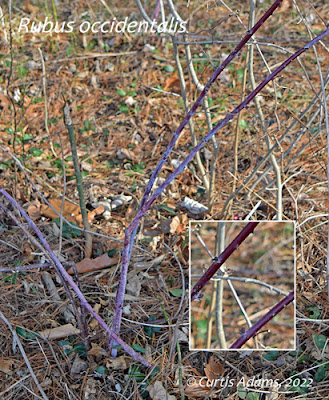
In doing dormant season treatments it is critical to be able to distinguish friend and foe.  Below are some images of multiflora rose and other native species that it might be confused with.  
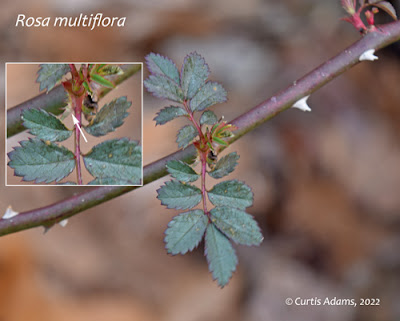
Here is multiflora rose in the winter.  Some distinguishing features are
its round olive green branches and its curved thorns.  The most
distinctive feature are the fringed stipules at the base of the petiole,
shown in the inset above.  It is the only species with this type of stipule.


Most native roses do not have green branches in
winter. Thorn shapes vary.  Here, swamp rose has
straight needle-like thorns.


Cat briar has bright green branches in winter
and it has straight almost pyramidal thorns.


Wild blackberry has smooth red stems in winter
armed with stiff red spines. Older branches
are square with indentions on each face.   


Black raspberry has red canes with somewhat smaller thorns. 
It is distinguished by the white bloom on the older branches 

You can read more about  dormant season treatment of multiflora rose at the link.  This technique is also effective on English ivy, Hedera helix.  Even if you don't use herbicides to treat the cut stumps, cutting vines climbing trees and over shrubs is helpful in controlling the spread of these invasives.  This is because many of these species are only able to bloom on vines that are elevated and/or exposed to plentiful sunlight.
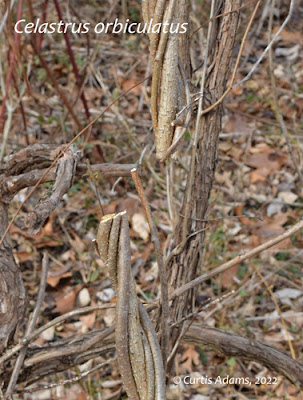
Oriental bittersweet can twine against itself to get
stiffer and climb higher.  I cut these a while back
but left them long so I could easily find them. 
I'll cut them shorter and treat with glyphosate later.


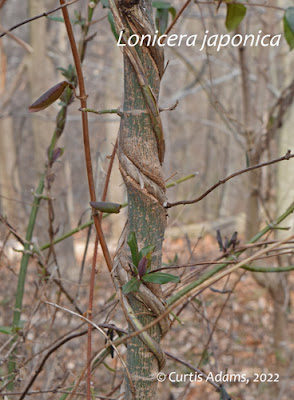
This is typical of the damage that Japanese
 honeysuckle can do to a tree.  This vine can be
 recognized in winter in that it still has leaves and
 the older branches have shaggy bark.  

Third

Around the end of March I will use a brush cutter and mower to cut down last years growth of vines and undesired woody plants in the meadow and woodland edges.  The biggest problem in my meadow is wineberry, Rubus phoenicolasius. In addition to the wineberry there are the aforementioned multiflora rose, autumn olive, and oriental bittersweet.  

Spring mowing and pulling has been pretty effective at reducing wineberry in shady areas. This is a short-lived species and not deeply rooted so it is usually easy to pull up.  Cutting to the ground in spring seems to keep it from blooming, but it is still able to reproduce by it ability to put down roots wherever a branch touches the soil.   It is recommended that mowing/cutting should be done several times each season to be truly effective.  This is particularly true in sunnier areas where the cut plants can rebound quickly.  Oriental bittersweet can also resprout easily after being cut.
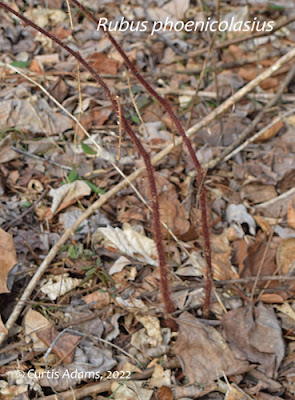
Wineberry is easily recognized by its dense
coating of stiff hairs mixed with red spines. 
While formidable in appearance these are
easily crushed with a gloved hand.

I will return about a month later and do a foliar spray on the wineberry sprouts. While burning is not considered an effective option of wineberry control I will test out targeted ‘cooking’ of individual crowns with my garden torch to see if that kills them in place.  (Standard burns do not selectively kill the wineberry, rather it clears out the competition and allows it to grow unhindered.

Fourth

At about the time that the forsythia is beginning to bloom is the time for me to get started on Japanese stiltgrass, Microstegium vinineum, control.  Stiltgrass has definitely been reduced in the lawn by use of a pre-emergent herbicide originally used for crabgrass control.  It should be applied when forsythia are beginning to bloom.  If you want to be more precise you can use a growing degree day tracker geared toward turf management. like GDD Tracker 4.0. The product I use contains only dithiopyr (Dimension™) and no added fertilizer.  Most of my lawn is fescue based and not that hungry for added nutrition.  This link lists some other preemergent products that have shown effectiveness against stiltgrass.  I wrote about my year long plan for controlling stiltgrass in this post.  In the woods pulling and weed whacking, particularly in late summer has reduced, but not eliminated the amount of stiltgrass.  As a result of thinning out the stiltgrass, I am seeing more native species filling in such as white avens and Virginia jumpseed.  I am also seeing an increase in perennial grasses (perhaps a Glyceria species) in areas where stiltgrass had dominated. 

In the sunny meadow stiltgrass has been harder to eliminate.  The preemergent has not been as effective on the rougher soil and I am hesitant to use it every year as it may negatively affect the growth of desirable plants from seed.  Summertime pulling and the addition of tough native grasses and forbs is helping to displace the stiltgrass.  Weed whacking close to the soil level in late summer as the stiltgrass is beginning to bloom is effective.  However this will also damage other desirable species.  The best method or methods to use depend on the situation in a given location. 

Rest of Year

Mid-spring is the time when I will be watch for the rapid growth of garlic mustard as it prepares to flower.  Pulling it out and leaving it in the sun to dry is my method of choice at that time.  

Late-July and August are the time for pulling out stiltgrass as it prepares to bloom.

So there appears to be an awful lot to do, but it is encouraging that I have seen some progress.  I realize that I am talking about using a lot of herbicide, but these treatments are targeted on the actual plants and done at a time that has little negative impact on native species.  In this battle I feel it is necessary to properly use all the tools that are available.  Another aspect of invasive species control, is limited resources, especially time.  It is better to do one area really well, then move on to the next, rather than doing a little bit everywhere.

I wish you all good luck as another growing season is upon us!


Thursday, June 6, 2013

Discovering My Invasives

As we are coming into late spring and I have been marveling about all the native plants I have found a crop of invasive plants has manifested themselves.  I know some of these were lurking out there, others were plants that I had misidentified, but have now reveled themselves now that they are in bloom.  Here a run down on what I've got, but wish I hadn't, and I plan to do about it.

Multiflora Rose, Rosa multiflora, is scattered around the property, mostly in the woodland edges.  These roses can be identified by their frilly stipules (leafy appendages at the base of the petioles), but now are very obvious by the clusters of fragrant, small white flowers.  I had hoped that I had some native roses out in the field, but so far it looks like they are all Multifloras.

Left to its own Multiflora Rose will send stems high into a tree.  
For the plants out in the open I am continuing to mow over them.  For the more established plants I will cut and treat the stumps with concentrated Round-Up in August.  I will do an earlier cut on some plants to prevent this crop of seeds from maturing, but I want to leave enough for easy application of the herbicide later in the season.


It turns out that a couple of small trees that I thought were Pin Cherries are actually Autumn Olives, Elaeagnus umbellata.  My mistake was made clear at the beginning of May when these plants were coming into full bloom.  I was drawn to the wonderful sweet scent.  When I saw the flowers I realized that what I had was definitely not a cherry of any kind.

These two Autumn Olives are nicely situated on either side of a path.
I'll cut them down soon and replace with something native,
maybe Winterberry Holly and Tupelo

These fragrant tubular flowers
were very popular with the bees.


I decided to let these finish flowering before cutting them back to a stump and then treating the fresh cuts with Round-Up concentrate.  This seems to be a pretty general method for killing undesired shrubby vegetation.  I did this to a very large Euonymus alatus in mid-March and I have seen very little if any regrowth so far this season.


When we first moved in last fall I noticed a lot of honeysuckle vines growing everywhere.  I had hoped that they were the native Coral Honeysuckle, Lonicera sempervirens.  There were no berries present (Japanese Honeysuckle has black berries, L. sempervirens has red berries) so I couldn't tell by that.  Also a cross section of the stem appeared to solid, not hollow, so I assumed it wasn't Japanese Honeysuckle.  Now that they are coming into bloom with their sweet-smelling white flowers, I see that I have a lot of the invasive honeysuckle.  A check of the stem shows that these are in fact hollow, so looking at the cross-section of the stem may not be a great late season indicator for this species.

Japanese Honeysuckle flowers start off white, then turn yellow after a couple of days.

I'm not sure what approach to take on all the trailing stems on the ground.  Pulling and late season herbicide applications can be effective (as long as the leaves are still photosynthesizing).  In the interim I have been cutting the stems of the vines up in the trees to minimize seed production.

Garlic Mustard, Alliaria petiolata, is well establish in the wooded areas on and around our property.  I am trying to remove all of it from an area before moving on to a new area.  This is a more effective strategy for elimination than just pulling a few plants here and there from a much wider space.  The seed heads are just about to mature so it's time to take a break from pulling.  If you are pulling plants that are shedding seeds, it's kind of like planting more of them.


Year old rosettes of Garlic Mustard remain green here over the winter.  This gives me the option of either pulling or spraying when most of native plants are dormant.  Because of the diversity of native plants in the woods, I will continue pulling up any Garlic Mustard I see each spring and fall.  this will be a multi-year effort.
Same area after clearing.  The ground plane is now opened up.

Note the white center vein on the leaf.
Japanese Stilt Grass is wide spread in this area.  It fills in shady borders with a dense mass that can smoother out other plants.

As an annual it can be controlled if you can keep it from going to seed.  Cutting it back when it begins to flower in late summer can keep it from successfully setting seed.  Cutting it back earlier may stimulate earlier flowering.  For plants in the woods I will go after them with the weed wackier in August. This grass has a weak root system and is easily pulled up, but there is just so much!

This is a very leafy grass and is soft to the touch.  The shiny mid-rib is a feature that sets it apart from other grasses


This is a recently opened-up area where the stilt grass is going to town.
It is joined by some garlic mustard and  bittersweet.
The near-by poison ivy is slowing my progress here.


Note the triangular leaves of Mile-a-minute vine.
There are nasty thorns forming on all  parts of this vine.


Mile-a-Minute Vine is a very fast growing invasive.  Once I noticed it I took some time out from writing this post to pull it out right away.  It is really important to do this before its many thorns begin to harden.  In my enthusiasm I accidentally pulled up a new Redbud tree, because its heart-shaped leaves looked similar to the triangular leaves of Mile-a-minute.

To combat this invasive, a weevil has been introduced and has been found to be very effective, and selective, at consuming this plant.  I examined the plants I pulled but saw no signs of this insect.  

To keep from going crazy I've realized that these invasives did not appear overnight and that any reasonable action is a step in the right direction.


Monday, November 5, 2012

Getting Aquainted

View upstream toward Harper's Ferry, WV a few days before Hurricane Sandy.
We've been in the new house for a little over a month now and we are starting to get into a new rhythm.  We are about a mile from the Potomac River, near Harper's Ferry.  As the leaves are falling it is easier to see the landscape features on the grounds and also identify some of the plants that were previously inaccessible through the brush.

The woolly leaves of Sweet Everlasting are similar
to those of Pearly Everlasting (see below). 
As I was tramping through the less explored areas, one familiar plant that stood out for me was the annual, Sweet Everlasting, Pseudognaphalium obtussifolium.  This can be distinguished by its nearly pure white flowers, compared to the yellow-centered flowers of the similar looking Pearly Everlasting.


The flowers of Pearly Everlasting have yellow centers.


The reddish-brown stipe of Ebony Spleenwort
is not as rigid as those of Christmas Fern.

As I made my way into the ravine at the back of the property I saw some familiar Christmas Ferns growing in the shade.  I turned around and saw another similar looking fern that turned out to be Ebony Spleenwort, Asplenium platyneuron.  These are both 'once-cut' ferns with boot-shaped leaves (pinnae), but the spleenwort has a reddish brown stem (stipe) and is generally more delicate in appearance.


One of the projects I have in mind is to 'develop' a portion of the property as a meadow area.   I was planning on covering the area with cardboard (a material I have an ample supply of after unpacking) to kill off the existing lawn.  However, a good portion of this area has been going wild for a couple of years and, on closer examination, I have found many of the desired grasses already present.  Now I think I will take a different approach, rather than starting with a clean slate, I will augment the existing native species and edit out the invasives.  This will be a tedious job, but  it would be a shame to remove the indigenous gene pool and replace them with the same species from some other ecoregion.  Currently in this meadow to be there are a lot of Multiflora Rose.  There also appear to be some other rose species.  I will need to wait for some fresh growth to make a determination of which rose is which.  
Multiflora Rose can be identified by the comb-like stipules.
Most native roses less complex stipules.
Anyone familiar with this plant?

There are a number of wildflowers growing in this area.  One that was still in bloom in October is what I believe to be a species of Helianthus.  I would appreciate any thoughts as to which species this is.  Since there was only one plant in bloom, I did not want to generalize too much based on one (partial) flower.  I'm leaning toward Jerusalem Artichoke, H. tuberosus, but there are so many other possibilities.

Some of the native grasses that are well represented in this meadow area are Little Bluestem, Switch Grass, and Deer Tongue Grass.  In the deciduous woods there are many clumps of Spreading Sedge, Carex laxiculmis.

Little Bluestem comes into its glory in the fall
when the seedheads glow in the low sunlight
Deer Tongue Grass stands out among the other grasses in the sunny meadow with its relatively short, broad blades.  The plume-like seed heads are lost early in the season.  
Clumps of Spreading Sedge are scattered
through the moist deciduous woodlands.

Fall projects include clearing out some of the fallen trees and thinning the River Grape vines and other overgrown shrubs from around the trees.