Showing posts with label Adlumia fungosa. Show all posts

Saturday, February 8, 2014

New Seeds for 2014

Since I have been focusing on buying more native perennials from local sources I have scaled back on the number of plants I am starting from seed.  I felt a little guilty about not starting any seeds, then remembered, what about native annuals.  There are quite a few annuals in the nursery trade with native parentage, but in general  finding seed for wild-type annuals can be a challenge. 

Most of the native-derived annuals are from the southern parts of North America, particularly the tropical regions.  The past few years I have mostly been using annuals with North American origins in pots on our deck.
Other than the Ivy Geraniums all these annuals have North American heritage:
Lantana camera, Melanopodium divaricatum, Zinnia 'Profusion' series, Salvia farinacea.

Last year I planted out some native annuals that are also found naturally in the Mid-Atlandtic region, Partridge Pea (Chamaecrista fasciculata) and American Pennyroyal (Hedeoma pulegiodes) as well as some short lived perennials Rudbeckia hirta and Monarda punctata which I started from seed.  I will be watching to see if these will reseed successfully.  What I like about the indigenous annuals is that if they find suitable conditions, they will reseed and fill in gaps in the garden and add spontaneity to the landscape that is lacking with plants that only spread vegetatively.

My first choice is to plant regionally native annuals and biennials.  If suited to the site, these plants will naturally spread to fill open gaps between shrubs and perennials.  My second choice is to use visually appealing annuals from tropical North America like Zinnias and Cosmos, that have a low risk of spreading out of control.  Some of these may reseed in protected locations, but they are unlikely to escape into the wild.  I avoid using North American annuals from other regions (or any plants for that matter) with a high risk of spreading.  You can identify many of those on the USDA Plants database by checking under the 'Legal Status' tab for a given plant.  An example is that California Poppy (Eschscholzia californica ) is listed as an invasive weed in Tennessee.  You can also check the Invasive Plant Atlas.

I've sorted my North American annuals for this year into two groups, those native to or naturalized in Maryland and those not found growing naturally in Maryland.

Native annuals found in Maryland
Plains Coreopsis, Coreopsis tinctoria, is originally from the centrals plains but has escaped and is now found growing across most of the US.  It tolerates a range of soil conditions in full to part sunlight.  It is a good nectar source and is reportedly deer resistant!  The long blooming season (June-Sept.) of golden flowers with red centers makes it a good filler plant.  I have not grown this species before, but from what I've read it looks to be easy to grow. 

This Beach Sunflower grew to about 4 ft in a pot.
Beach Sunflower, Helianthus debilis 'Pan'  is native to coastal areas from Texas to North Carolina but has spread as far north as New England.  It would not be found growing naturally in mountainous part of Maryland where I am located.  This annual sunflower differs from the Common Sunflower (H. annuus) in that it is highly branched and, although the stems are long, at 5-7 feet, it tends bend over and weave into neighboring plants.  The branches are usually mottled with purple or white.  The flower is of the typical sunflower form, though smaller, measuring 2-4 inches across and blooming is from July into October.  It likes full sun and well drained soils.  As expected for the beach, this plant will tolerate salty soils.  It performed nicely for me in pots up in Boston.  This species likes warmer soil for germination which is more easily achieved in planter pots or a raised bed. 


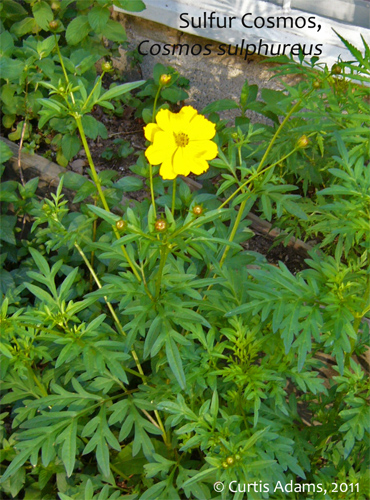
These Sulfur Cosmos are competing
for space with some culinary mint.
Sulfur Cosmos, Cosmos sulphureus  is native to Northern and Central Mexico where it is found in open areas along roads and rivers, in forest openings and pastures.  It has escaped cultivation in the United States and populations have been found from Texas to New York and Connecticut and in California.  This species is listed in as a pest plant in Tennessee and Florida.  In my experience in Boston, this species will reseed itself for a couple of years, then fade out unless some new plants are brought in.  What I like about this Cosmos is that it comes into bloom very early in the summer and that it does not flop over as bad as Garden Cosmos, C. bipinnatus.


After blooming the flowers of this Sneezeweed turn white
and disappear into the foliage. These did reseed
 into the pot the following year.
Sneezeweed, Helenium amarum 'Dakota Gold' grows to about a foot in height and is covered with self-cleaning yellow flowers from early summer to frost.  It is originally a native of the Ozarks but has spread throughout the southeast and as far to the northeast as Massachusetts.  It tolerates dry soils and is also resistant to deer.  When I tried these a few years ago I had excellent germination without any pretreatment of the seed.  The small size and intensity of bloom make this a good candidate for the front edge of a border.

The native ranges of these next two plants actually include the Mid-Atlantic region.

Adlumia blooms from late June to frost.  The shiny black seeds
are easily collected by shaking the dried flowers on the vine.
Allegheny Vine, Adlumia fungosa  is a biennial vine, native to mountain woods of the American East.  I have blogged about this plant in the past.  It's one of my favorites.  This is a true biennial, the first year is spent as a tight rosette of finely divided leaves.  The second year the vine climbs about 10 feet and it blooms with pale pink dangling heart-shaped flowers.  The vine is rather delicate so it needs support and not too much sun.  I have lost some due to the wind causing the plant to twist.  In its native state it often climbs over rocks, rather than scaling trees.  


Miami Mist, Phacelia purshii, is a winter annual that is native to Mid-Atlantic states and lower Mid-West.  It has small, fringed lavender-colored flowers that bloom in spring.  As a winter annual, it needs to get its start in the fall, as temperatures cool and moisture increases.  From what I have read, the seed should be exposed to warm summer temperatures to break the seed dormancy.  So I will direct sow some of these in June and also put some outside in small pots where I can keep an eye on them.  They overwinter as a rosette of leaves, then put forth a flowering stalk the following spring.

North American Annuals Not Hardy in Maryland
These last three plants have not been found growing in the wild in Maryland.

These Bluebonnets were growing at the Lady Bird Johnson Wildflower Center in Austin, Texas.
I doubt I will have such good results in Maryland, but I'll try.
Texas Bluebonnet, Lupinus texensis  is a Texas native and my wife's favorite flower.  I have tried these once before with limited success.  This is due at least in part to the very different growing conditions in the Northeast.  Besides soil composition, it takes much longer for the northern soils to warm up relative to Texas.  On doing a little more reading, I found that it is helpful to inoculate the seeds with the correct bacteria to help with nitrogen fixation.  I found that Prairie Moon Nursery offers a variety of  inoculum for different legumes in small packets at a reasonable price.  Also, the Bluebonnets are winter annuals, like the Phacelia above.  I will plant some seeds this spring, like regular annuals and I will hold some back for fall planting.  My concern is that our winters may be a bit too cold for them to survive.  Anyway, we have a little garden for Texas plants (south-facing, drier soils) and we'll see what happens. 

Spanish FlagIpomoea lobata, is an annual vine from Mexico that grows to 5-10 feet.  I found no records that show it to be self-sustaining in the contiguous US.  It produces racemes of tubular flowers in mid-to-late summer that change from red to orange and then white as they mature.  These flowers are favored by hummingbirds.  I've seen  this vine used to quickly cover a chain-link fence.  When starting from seed, scarification and presoaking in warm water is recommended.


Texas Sage blooms from late July to frost.
Texas or Hummingbird Sage, Salvia coccinea, is native to the southern states. But I've had it reseed in Boston for several years in protected locations. I've grown it successfully in both pots and in a raised bed.  I like the taller more open form of this red Salvia compared to the heavier dense blooms found on the commonly available annual Scarlet Sage, S. splendens.  

As I recall, bumble bees would get nectar by landing on the top of the flower and sticking their tongues into the calyx tube at the base of the flower.  It will be interesting to see how our hummingbirds approach this flower.

Thursday, October 20, 2011

Under the Norway Maple - Part 2

As the growing season is slowly coming to a close I thought I would revisit the status of the native species I have be evaluating under my Norway Maple.  There have been some improvements and some failures and one plant that I thought I lost has returned in a different spot.  In general many of the plants continuing to grow, only slower and smaller due to competition from the mature Maple.


Maturing berries of Winterthur Viburnum start off
bright green, then turn pink, then finally dark blue.
First the good news.  After 4 years of growing with no berries, I finally got a good crop from my Winterthur Viburnum (Viburnum nudum 'Winterthur').  While it had been slogging along at the edge of the tree canopy, it produced no fruit until I brought in a native form last fall.  This year, with the cross pollination, mature berries were produced for the first time here.

Another plant the seems to be catching on is the Northern Sea Oats (Chasmantheum latifolium) that I moved in last year.  These overwintered and grew fairly well in the shade along the back fence.  I would like this grass to grow up and obscure the chain-link fence.  A new addition, that seems to be working out is the Bluestemmed Goldenrod (Solidago caesia).  The native habitat for this plant is in open woods, so at least this plant is used to the shade.


The Northern Sea Oats are doing well along the fence. 
The new Bluestemmed Goldenrod is in full bloom (late September)
and the Witchhazel is just getting started 

The Green and Gold (Chrysogonum virginianum) that I thought had faded away returned in a new spot and looked healthier this year than when it was first planted 4 years ago. 

I transplanted a lot of 2nd year American Bellflowers (Campanulastrum americanum, a biennial) along the back edge of the garden.  These did well though early and mid-summer until they died out after completing their bloom cycle.  The test will be whether new plants return from the seed. 

The biennial Allegheny Vine (Adlumia fungosa) did not come back with any new seedlings this year (unless they were lost in the spreading Virginia Creeper).  A new addition that I thought would work but did not do well was Canada anemone (Anemone canadensis); I will keep a eye out for this next spring.

Successes
Other plants that are expanding are:
The Rosinweed is standing tall while the Smooth Aster
and Showy Goldenrod have flopped forward toward the sun.
American Pennyroyal (Hedeoma pulegioides, an annual returning from seed), Smooth Aster (Symphyotrichum laeve), Heartleaf Aster (Symphyotrichum cordifolium), Rosinweed (Silphium integrifolium), Showy Goldenrod (Solidago speciosa), Virginia Creeper (Parthenocissus quinquefolia, now the dominant grond cover), and Wafer Ash (Ptelea trifoliata).

I should give a shout out to the Rosinweed.  While it does not have the prettiest flowers, it was in bloom all summer.  Then, I cut the spent blooms back to some new flower buds and got the second flush shown in the photo.  (Cutting back when no buds are present just leaves you with a leafy stem; I tried that last year.)


Plants holding their own:
  
Christmas Fern, Bellwort and Wild Bleeding Heart
have looked good all season.
 Male Fern (Dryopteris filix-mas), Christmas Fern (Polystichum acrostichoides), Rosey sedge (Carex rosea), Alumroot (Heuchera villosa),  Black Huckleberry (Gaylussacia baccata), Black-eyed Susan (Rudbeckia hirta), Lowbush Blueberry (Vaccinium angustifolium), Dutchman's Pipe (Aristolochia macrophylla), Largeflower bellwort (Uvularia grandiflora), Twinleaf (Jeffersonia diphylla), Wild Bleeding Heart (Dicentra eximia), Witchhazel (Hamamelis virginiana )


Fading or gone:
Barren Strawberry (Waldsteinia fragariodes) has disappeared and the Canada Mayflower (Maianthemum canadense) was down to only two sprigs in the spring before it disappeared.  Hairy Solomon’s Seal (Polygonatum pubescens) has been in this area for 4 years but it now seems to be in decline.  I put in a new one this fall and am hoping for its return.

Plants that should work, planned for next season:
Last year I planned to put in Labrador violet (Viola labradorica) and Maple-leaf viburnum (Viburnum acerifolium) but didn't.  I'll try to get those for next spring.  I will will also give the Canada Anemone another shot.  I also have some Large-leaf Aster (Eurybia macrophylla) that I should move over, seeing as it usually does well in dry shade.
In addition to using plants that are strong competitors that can get their share of moisture there are some maintenance practices that will help the understory plants survive under the Norway Maple (or other mature tree for that matter).  Limbing up and thinning the canopy to let in more sunlight helps a lot. Also, new plants should be irrigated deeply the first year to get them established, as well as under droughty conditions (mid-summer). I have a rain barrel with a special low pressure soaker hose to help with this.  Returning the leaf mulch to the understory area helps to build the soil.

Monday, January 24, 2011

Native Seeds for 2011

After assessing what did and did not do well last year, I placed my seed orders for native seeds. Here’s a run down on what I’ll be trying this year.

New Plants
Pearly Everlasting (Anaphalis margaritacea) A perennial with white, long lasting flowers. I’ve been frustrated growing the related annual Sweet Everlasting (see below), so I thought I would try a perennial version.

Butterfly Weed (Asclepias tuberosa) This perennial that does well in dryer sunny locations and attracts many pollinators. I’ve seen a few plants commercially available but I wanted to make sure I had some growing this year.

Rosey Sedge (Carex rosea) I was given a small clump of this foot-tall perennial grass for nearly 5 years ago. I thought I should test it out in some different locations. This sedge prefers part to full shade.

Flowering Spurge (Euphorbia corollata) This perennial is also known as Prairie Baby’s Breath. I thought this could be good for general landscape use, with white flowers through mid-summer.

Woodland Sunflower (Helianthus divaricatus) This perennial sunflower grows well in dry shade. It can be weedy in the garden, but I really want to test it out under the Norway Maple. I’ve seen this brightening up shady oak woodlands in the middle of summer.  This is the first year that I have been able to find seed.


Repeats
Alleghany vine (Adlumia fungosa) I’ve written a lot about this biennial vine. I just can’t get enough. Note that these seeds need 90 days of cold stratification, so don’t wait if you want to try this one!

Orange Hummingbird Mint (Agastache aurantica ‘Navaho Sunset’) grew quite well last year and now I need more to try with clients. I really like the scent of the gray-green foliage and the flowers are pretty nice, too.

Rock Harlequin (Corydalis sempervirens) This another plant that I love.  I just need more rocky places to put it.

Sulfur Cosmos (Cosmos sulphureus) This native of Mexico (a part of North America) grows as an annual in the Northeast.  I had a crop that returned for 4-5 years until it got crowded out by some Bidens. I thought I would try to start it up again. While the bloom is similar to that of the swamp marigold (B. aristosa), this Cosmos starts blooming earlier and for a longer time.  Also, the foliage is not as dense.

American Pennyroyal (Hedeoma pulegioides) has been getting established from a planting 2 years ago, but I’d like to try more in some different locations. This will do well along a path.

Spotted Beebalm (Monarda punctata) was pretty successful last year and I need more to try with some clients.

Sweet Everlasting (Pseudognaphalium obtusifolium) has given me trouble on transplanting in the past two years. I’ll try this again, this time seeding directly in the garden in prepared soil (not in compacted turf).

One last try...
These three plants did not germinate for me last year, but I’ll try one more time with a lengthy stratification in moist starter mix.

Fern-leaf False Foxglove (Aureolaria peduculata) This biennial is parasitic on oaks, but, reportedly, does not need them for germination. I also have some of these scattered around a nearby oak. Stay tuned…

Tall Swamp Marigold (Bidens coronata) is an annual, with good-sized yellow flowers. I'm curious to see how if differs from the other Bidens I have around.

Brown-eyed Susan (Rudbeckia triloba) is a short-lived perennial, that while taller, has a more delicate appearance than the typical Black-eyed Susan (R. hirta).  I've posted a number of photos of this species over the past year.

Returning on their own:
I'm sure the Swamp Marigold (Bidens aristosa) will be back, but I will be pulling these up to make room for new plants.  I will have a lot of the biennial American Bellflower (Campanulastrum americanum) in 2011, judging by the large number of rosettes in the 2010 garden.  Also, I will keep an eye out for the return of any of the Texas native annuals: Indian Blanket (Gallardia pulchella), Drummond Phlox (Phlox dummondii) and Scarlet Sage (Salvia coccinea), that bloomed so nicely last year.

Monday, January 3, 2011

Native Annual Seeds that I tested in 2010

As I get ready to order seeds for 2011, I’m looking back on the native annuals and biennials that I tried out last year.  Some were successful and bear repeating while others went nowhere.  Some of the failures were not surprising while others just wouldn’t germinate and I’m not sure why.  So here’s a review of last years seeds.

Native to Massachusetts:

Adlumia fungosa (Allegheny vine, biennial) I got a few more plants from seed I collected in 2009.  Even better, I saw several plants coming up on their own from the previous season’s plants! 

Aureolaria pedicularia (Fernleaf yellow false foxglove, annual)  None of these germinated.  Since these plants are partially parasitic on oaks, my seed starting mix may not have been right, or they may not have been conditioned properly.

Bidens coronata (Crowned beggar’s ticks, annual)  Very few of these seeds germinated and those few that did failed to mature.  This was a surprise to me since other Bidens species tend to run wild in the garden.  I’ll give this one another try, directly in the garden.

Corydalis sempervirens (Rock harlequin, short-lived perennial)  These had good germination and transplanted well. I really love this plant.  I’ll need to find more places with thin rocky soil for this plant.


Hedeoma pulegiodes (American pennyroyal, annual) sprouted freely in the garden near where I had planted seedlings in 2009 – even under the Norway Maple.  While I couldn’t see them all, I could detect their aromatic aroma whenever I stepped on or mowed over them in the lawn.  It is reported that these plants act as an insect repellant when rubbed on the skin.  I hope to give that a try this year. 

Neither the Hypoxis hirsuta (Eastern yellow star grass, perennial) nor the Polygala sanguinia (Purple milkwort, annual) seeds germinated for me this year.  I will give up on these two for now, also I have run out of seed. 

Pseudognaphalium obtusifolium (Sweet everlasting, annual)  These seeds germinate well, but the transplants do not mature well in the yard or in pots.  Its native habitat is in depleted soils with little competition from other plants. However, I was surprised to find one out of the lawn, near the one successful plant from 2009.  I’ll try these again with direct seeding in a prepared area. 


Native to New England:

Monarda punctata (Spotted bee balm, biennial) germinated and transplanted well.  It also bloomed quickly and was a big hit with the bees and some very interesting wasps in the garden.  Since this Monarda prefers drier conditions, I have a roadside spot that would benefit from this plant that I would like to try it in this year.

Rudbeckia triloba (Brown-eyed Susan, biennial) failed to germinate for me.  The germination conditions on the packet were fairly complex, especially when compared to relative Rubeckia hirta (Black-eyed Susan) which germinates freely after a month of cold moist stratification.  A small population of R. triloba is getting established at the Wildflower Meadow at Mount Auburn Cemetery in Cambridge, MA.


For plants Native to other parts of North America I found the following:

Salvia, Spotted Beebalm, Agastache and Gallardia
all mixed together in my South-facing bed.
Agastache aurantiaca ‘Navaho Sunset’ (Golden hyssop, perennial)  This cultivar germinated reasonably well and while it was a little slow to get started growing in the garden, it was up to full size and blooming by mid-July, producing a cloud of orangy-pink flowers.  The foliage also smells really good when disturbed. We’ll see how well these overwinter/reseed.  I’ll be growing more of these this year!

Cleome serrulata (Rocky Mountain Bee Plant, annual) again failed to sprout for me, either indoors or out. I can get the seeds to germinate, but not develop into seedlings.  Again, there may be something wrong with my starter mix or the newly germinated seed may be too delicate to sow into the growing mix.  In either case, I think I need to move on. 

Eschscholzia californica (California poppy, annual/tender perennial) germinates well in the garden, but my site is a bit too cool to allow many of them to reach maturity.  I usually get only a handful of blooms each year. This plant also shuts down when it gets too hot.  While I loved this plant in my native California, I think it is time to move on from this one too.

Euphorbia marginata ‘Summer Icicle’ (Snow-on-the-Mountain, annual) is a tap rotted annual and is reported not to transplant well.  So after soaking the seeds in warm water for a few hours these were planted directly in the ground in early June.  When mature they provided foot-tall mounds of white foliage and flowers.  This cultivar is shorter than the species (1-3’). 

Gallardia pulchella (Annual blanket flower, annual)  These seeds came from the Wildflower Center in Austin, TX.  These germinated and transplanted well after 30 days of cold stratification (may not have been necessary).  This species has a laxer form than the commercial cultivars, but it bloomed well both in pots and in the garden where it intermingled with the Spotted Beebalm and the Agastache.  This plant was very popular with the bees. I allowed the flowers to go to seed so we’ll see if they are still viable in the spring. 


Helianthus debilis ‘Pan’ (Beach sunflower, annual) reseeded itself into the same pot from last year.  This is not too surprising since there are naturalized populations of this Texas native scattered along the Eastern seaboard up to the Northeast.  This second generation had the same upright branching form of its parent.

Phacelia tanacetifolia (Lacy phacelia, annual) germinated very well and grew well in potting soil, but did not take well to being transplanted.  It has been recommended as a cover crop, with the warning not to let it go to seed in agricultural fields.  I may try this again as a direct sow plant.

Phlox drummundii (Drummond phlox – straight species, annual) also came from the Wildflower Center. These seeds germinated and transplanted well.  The flowers were true to the species scarlet red, but there was some variation in flower shape.  While I am not too hopeful that about the seeds overwintering outside, I did get a second generation late in the summer.  Relative to other flowers in my Massachusetts garden, these flowers were not very attractive to the pollinating insects.


This petal shape, with the white edging,
was unique from the other plants I had this year

Salvia coccinea (Texas sage, annual/tender perennial) is another Texas native.  Seeds for this plant germinated and transplanted well.  It grew equally well in a pots and in the garden bed and was very attractive to the bees.  Based on the native range of this species I don’t expect that any of the seeds would overwinter in my garden.

If you have any advice for growing the plants I listed here, I love to hear it.  What new native plants are you thinking about trying for next year?

Monday, May 31, 2010

The Natives are Restless - What's happening as Summer approaches

As spring is drawing to a close, many of the summer blooming natives are getting ready to pop. This week I wanted to give an update on how the Native plants in my garden are doing.


I was very pleased to see that the Alleghany Vine, Adlumia fungosa, has begun to bloom with its little pale pink hearts. Last year it did not begin to bloom until mid-late June. This year I am letting it find its way in a more natural way, rather than forcing it to climb a trellis. In this way it is less likely to be twisted and broken off in the wind. IOt is a little difficult to see with its delicate frilly foliage and light colored flowers.  Now I just have to avoid stepping on it.

If these plants do well I will add in some new ones that I started from seed this year.  I hope that will get a stable population growing.


The little Rosy Sedge that I talked about a few weeks back is getting closer to bloom. This particular plant is so heavily shaded that the inflorescence, in fact, the whole plant is about half the size it gets in a more open location. I would never have spotted this development if I were not actively watching for it. I hope I can show you a good image when its flowers are actually open.
Correction: Two Stems of Meadowsweet


I have two native Spiraea growing here, Steeplebush and Meadowsweet, S. tomentosa and latifolia (or alba), respectively. While there can be easily distinguished by the different shapes of the flower spike, the leaves are also different. This is the first year that I could clearly detect the difference in the leaves. Steeplebush has a soft fuzzy leaf relative to the smooth leaf (glaborous) of Meadowsweet. In the photo you can also see that leaves of the Meadowsweet and more relaxed, but that is hard to tell if you don’t have a side-by-side comparison. While the habit of these two spiraeas is rather open, relative to the tightly mounded Japanese Spirea (S. japonica), I am surprised that these native species are not used more often in the residential landscape. In my garden Meadowsweet has proven to be a very versatile shrub, growing under a wide variety of conditions and blooming throughout the summer. It also can be pruned to tame it exuberant growth without compromising its ability to bloom.

The Red Columbine, Aquilegia canadensis, is still blooming away. Here it is shown with one of my Meadowsweet bushes just behind it.


Lastly, I planted two Winterthur Viburnums (V. nudum ‘Winterthur’) 4 years ago and they are both hitting stride now. (Their slow development was due at least in part to their proximity to the shade of a Norway Maple.) These buds will open to form corymbs of small white flowers. More interesting will be the pink and blue berries to follow.

Monday, April 5, 2010

Adlumia fungosa!!!


Adlumia fungosa, if pronounced ad-LOO’mee-uh” fun”-GOE’suh, may sound like an incantation from the Harry Potter series. Instead, it is fast growing biennial vine native to the Northeastern United States. It is also known by many common names, such as Climbing Fumitory, Allegheny Vine and Mountain Fringe Vine. The genus Adlumia is named for John Adlum a 19th century American Horticulturalist and fungosa means spongy in Latin, may refer to the consistency of the faded bloom which persists long after its peak. 

The flowers form clusters of white to pale pink bells from June to September, similar to those of its cousin, bleeding heart (Dicentra). As the flowers age, they take on an antique sepia shade. The seed ripens throughout the season, with September being the best time to harvest the small, shiny black seeds. Jane Loudon recommended this plant for the English flower garden in her ‘Ladies Companion’ (1865). I was fortunate to get both some second year plants from the New England Wildflower Society this last year, as well as seed from Summer Hill Seeds. This should help me to develop a continuous supply of first and second year plants and I am looking forward their continuing presence in my garden.


Its fern-like gray-green foliage is typical of other members of the Fumariaceae, like the Dicentra and Corydalis.  In early spring it is difficult to distinguish this vine from Wild Bleeding Heart and Squirrel Corn (D. eximia and D. canadensis).  The vine forms a rosette, growing to about 8” the first year and in the second year takes off to form an 8-10’ clamoring vine.  Its structure is rather delicate and it requires the support of strings or a trellis, on which the thin leaf stems intertwine, to grow vertically. The plants prefer partial shade in average, well drained soil. Too much sun will damage this vine. The first time I tried this plant in my garden, one poorly supported plant was irreparably twisted and killed by a strong wind.
The reported native habitats are moist coves, rocky woods, ledges, alluvial slopes, and thickets with a range from Virginia, north to Quebec and Manitoba. In Massachusetts it is listed as a threatened species where it is native to the western half of the state (west from Worcester County).

Recently, fellow plant blogger Alice Joyce wrote a article featuring this vine in the March/April 2010 edition of American Gardener (on-line access for AHS members only). Also, more information and some fine photos can be found in a post from Kathy Purdy in Cold Climate Gardening (August 2009).