Friday, December 31, 2021

Why Won't My Garden Grow?

 I’ve noticed that I’ve been having less success growing vegetables from seed in my garden over the past few years.  That is particularly the case for small seeded crops like lettuce and chard.  This is in spite of increased organic fertilization.  True, I don’t water as much as I should for seedlings, but I never do.  I tend to rely on rain.  Still I have become suspicious that something else may be going on.  This has led me to consider allelopathy.  My question is whether there is something that is growing or has grown recently in the garden is affecting the ability of new seeds to germinate and develop?
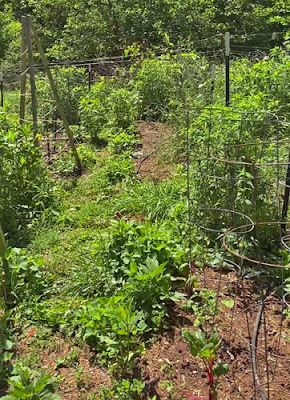
Garden in mid-June: Vegetables still small in
 relatively clean beds, but Monardas
and Rudbeckias are coming on strong.

Allelopathy refers to the beneficial or harmful effects one plant has on another. It arises from the release of allelochemicals from plant tissues though leaching from leaves or roots, volatilization or decomposition of plant parts in or on the soil.  Through these allelochemicals one plant is able to suppress germination or development of other plant species in the immediate area.  In some cases these chemicals may have a beneficial effect on some neighboring species while having a negative effect on others.  There is a lot of research in this area, particularly to find crop plants that are able to produce their own weed suppressive chemicals rather than relying on added herbicides.

There are a couple of non-traditional practices that I have been employing in my vegetable garden that I am beginning to question.  One is that I allow native species to run rampant along the edges and between the rows of vegetables, particularly wild bergamot (Monarda fistulosa) and black- and brown-eyed Susans (Rudbeckia hirta and triloba).  The other is that I leave the roots of the previous year’s plants in place.  I just cut the old plants off at ground level and throw them into the compost pile.  I do this as a means of increasing the organic matter in the soil and reducing soil disturbance. 

Following the adage, “a month in the laboratory can often save an hour in the library” (Frank Westheimer) I decided to do a little research first.  I searched the internet for information on the allelopathic potential of all the native and non-native species that are growing in my vegetable garden.  After searching those, that I turned to looking at the vegetable themselves. 

The tables below list many of the weeds, native species and lastly the vegetables that are common in my garden along with the existence of any documented evidence that these plants possess any allelopathic properties.

Garden Weeds:

Common Name

Botanical name

Evidence of Allelopathy

Chickweed

Stellaria media

        Yes

Ground ivy

Glechoma hederacea

        Yes

Hairy bittercress

Cardamine hirsuta

        No

Indian strawberry

Duchesnea indica

        No

Mulberryweed

Fatoua villosa

        No

Ladies thumb

Polygonum persicaria

        Yes

Nut sedge

Cyperus esculentus 

        Yes

Persian speedwell

Veronica persica

        Yes


Native Annuals & Perennials:

Common Name

Botanical Name

Allelopathic?

Annual sunflower

Helianthus annuus

        Yes

Common Milkweed

Asclepias syriaca

        Yes

Butterfly weed

Asclepias tuberosa

        No?

Common and Daisy Fleabanes

Erigeron philadelphicus and annuus

        Yes

Honeyvine

Cynanchum laeve

        No

Wild Bergamot

Monarda fistulosa

        No

Scarlet beebalm

Monarda didyma

        Yes

Purple Coneflower

Echinacea purpurea

        Yes

False sunflower

Heliopsis helianthoides

        No

Goldenrods

Solidago sp.

Yes (some species, at least)

Browneyed Susan

Rudbeckia triloba

        No

Wild Blackberry

Rubus sp.

        ?

Sealheal

Prunella vulgarus

        No

Pennsylvania smartweed

P. pensylvanicum

        Yes

Wingstem

Verbesina alternifolia

        No*

*Golden crownbeard, V. encelioides, a native of western North America does have allelopathic properties.

Garden Vegetables:

Vegetable

Botanical Name

Allelopathic?

Arugula

Eruca vesicaria ssp. Sativa

        No

Basil

Onicum basilicum

        Yes

Collards

Brassica oleracea var. viridis

        Yes

Cucumber

Cucumis sativus

        Yes

Green Beans

Phaseoleus vulgaris

        Yes

Lettuce

Lattuca sativa

        No

Peppers

Capsicum annuum

        Yes

Squash

Cucurbita pepo

        Yes

Swiss chard

Beta vulgaris var. cicla

        Yes

Tomato

Solanum lycopersicum

        Yes


While doing these searches I came across some interesting studies on the potent allelopathic effects of many invasive species.  This is one of the factors that allow invasive species to outcompete native ones.  One study treated radish seeds with the aqueous extracts from leaves of a number of invasive species.  The radish seeds were then evaluated for germination rate and root growth.  The following list is ranked in order of negative effect on germination, most to least:  Ailanthus altissima, > Microstegium vimineum, Alliaria petiolata, Celastrus orbiculatus,> Ligustrum vulgare, Rosa multiflora, Rubus phoenicolasius, and Acer platanoides.  There are multiple studies that document the allelopathic effects of Japanese knotweed, Polygonum cuspidatum.  It seems that many species of the genus Polygonum have some allelopathic character.

From this research it looks like the fleabanes (Erigeron annuus and philadelphicus) and purple coneflower would be the most likely allelopathic culprits among the native species in my garden.  However, most of the allelopathic candidates on these lists are from the weeds and garden vegetables.  Of these, ground ivy, nut sedge and ladies thumb are the most prolific weeds in my garden.  Among the vegetables in my garden, collards, peppers and cucumber are the most likely suspects to be causing some troublesome effects.

Allelopathy experiments.  In general experiments that measure allelopathy are tricky to interpret.  Many are based on bioassays, where the allelopathic effect is measured by such things as the germination rates and root growth of a target species.  In many cases radish or lettuce seeds are used.  Many of these studies use extracts of leaves, stems or roots of the species being studied applied at various concentrations to isolated seeds of the target species in a Petri dish.  Another approach is to test the soil itself.  Due to the complex nature of plant-soil and plant-plant interactions, most studies on allelopathy are correlative rather than causative. 

To help me understand whether there was a problem with the soil (and all the things that come with it), or the cultural effects like moisture and sunlight, I decided I would try a bioassay comparing surface soil samples from various parts of the yard and garden.  I tested to see how each of these soils affected germination and growth of some lettuce seeds which had performed well when started indoors this past spring.
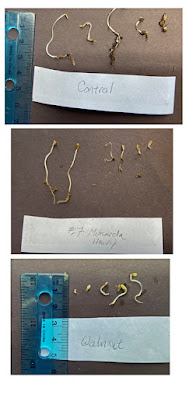
Germinated seeds:  Control (top);
near wild bergamot (middle);
 under English walnut (bottom)
I adapted a procedure from Environmental Inquiry/Cornell University for performing lettuce seed bioassays using materials I had on hand.  I took three samples of surface soil, 0-1/2” deep, from each area of interest.  This is the zone that I normally plant small seeds like lettuce in.  I mixed the soil samples in a baggie then pulled out about a tablespoon’s worth.  This was put into a fresh baggie (as I didn’t have any Petri dishes) and moistened with a few drops of water to make the soil damp, but not wet.  I disinfected the lettuce seeds in dilute bleach, according to the procedure, and then put 8 seeds into each baggie.  The baggies were sealed, put into the dark for 5 days at 60-80°F.  I used a moistened, peat-based seed starting mix as the control.  Samples were taken in November so there was no active growth of vegetables except for the sample near actively growing collards.  I tested the following areas: 1) garden soil under green beans, near daisy fleabane; 2) garden soil under wild bergamot; 3) garden soil near where tomatoes and cucumber had grown; 4) garden soil near collards; 5) typical lawn soil (fescue and weeds); 6) under an English walnut with vinca groundcover.

After five days I separated out the germinated lettuce seeds, counted the number of germinated lettuce seeds and measured the length of the roots.  I found I was able to pluck out the germinated seeds from the soil in the baggies by suspending the entire sample in water with a little dish soap.  This allowed the soil to fall away from the roots without damaging them.  The root growth measurements had a lot of variation.  This is not too surprising considering the many uncontrolled variables, like variable soil moisture and soil contact within each baggie, and small sample size.


Graphical comparison of various soil samples on germination and root
growth of 'New Red Fire' lettuce seeds.

Results and Conclusions

While the differences in root length and germination rate among these samples are not highly significant, due to the small samples size, there is an indication that the soil around the collards is not as favorable to seed germination and growth as any of the other garden samples and is on the order of that for soil under an English walnut tree.  (English walnut, Juglans regia, is much less allelopathic than our native black walnut.)  These results also indicate that the presence of wild bergamot (Monarda) is not detrimental to the initial stages of seed growth.  Another indication was that root growth in the soil around the green beans was less than the control sample.  This is consistent with a study that looked at the effect of leaf extracts of several lines of common beans on seedling growth, including lettuce.  That study made no mention of the effect on seed germination.

Lettuce or radish seed bioassays are also good for checking for herbicide residues in soils and mulches.  General information about testing whole soil samples for herbicide residues can be found at this link from NC State.

Based on the literature it seems like many of the plants in my garden have some degree of allelopathic behavior.  This brings up another important question; how long does that effect last.  The sense I get is that it’s more on the order of weeks than months.  In field trials some brassica family cover crops have shown allelophatic effects on the order of weeks to months after being tilled in. I found another post discussing the use of cover crops, many of which are allelopathic.  It suggested waiting 3 weeks after tilling them in before planting.  Leaving allelopathic plant residues in place as a mulch, will increase the time over which they have the suppressive effect.

 So, based on my little experiment and all the literature I scanned, it seems there is no single clear cut culprit exerting a negative influence on my gardens fertility.  This research has led me instead to a list of suspects and actions to control their effects.   It may be that my practice of leaving roots in the ground, particularly the collards, over the winter may be negatively affecting my gardens ability to grow grow directly from seed. I will need to dig these out at least a month before planting in the spring.  I will also pull out any remaining roots of the curcurbits and chard which remain, as well.  The ubiquitous weeds, particularly chickweed, ground ivy, and ladies thumb need to be removed, especially during the growing season.  As much as I like the prolific flowers of the native daisy fleabane, I will be removing those from the vegetable beds, as well.

Another less traditional garden practice I have been using is flame weeding.  This involves using a hand-held propane torch to kill weed seedlings before they can establish.  This was done prior to planting, or transplanting crops.  An advantage of this practice is that it doesn’t disturb the soil surface.  I have not looked into any literature on possible negative effects of this practice, but for next year I will not use this method in the growing beds themselves. 

So with these changes we will see if I get any better results in the garden, or will I need to dig deeper?

Wishing you all the best for the New Year!!!

Saturday, October 30, 2021

Nativars?

What are Nativars?

Nativars are the subject of much discussion in the native plant community right now.  The comments I've seen have ranged from mild interest to deep concern.  I originally formed my opinion on these cultivated native plants over ten years ago.  Before writing this post I thought I should do a little refresher on the subject and I learned that the world is a complicated place.

Nativar is not a true botanical term but rather a word coined by Robert Armitage for a cultivar of a native plant.  It’s a combination of native, for native species, and cultivar.   A cultivar is short for cultivated variety and is reproduced by asexual means, not from seed.  Anytime you see a botanical name followed by a capitalized word (or words) in single quotes you are dealing with a cultivar.  Alternatively, cultivars may be call using common names.  For example Jim Dandy Winterberry Holly is the same thing as Ilex verticillata 'Jim Dandy'. 

Here are two inkberry cultivars, Ilex glabra 'Nigra' on the left and 'Shamrock' on the right. 
These have been in the ground here for about 3 years.  'Nigra' has darker green
 leaves and nice branching.  'Shamrock' has narrower bright green leaves and
is also well branched.  'Nigra' should grow to be over 6' tall, 'Shamrock to about 4'.

This is a wild type inkberry.  I don't know how big
 this will get, but it should grow to 6-8' tall.  Unlike the
cultivars this one has few lower branches.


Advantages of Nativars:

  • May possess improved traits like disease resistance or improved blooming (size or quantity).  For example, mildew resistance in phlox.
  • Predictable performance as design elements for color, shape and size.  Size is particularly important when you are working close to structures.  You can avoid a lot of  maintenance pruning by electing a properly sized cultivar.
  • Greater commercial availability as a result large scale, asexual reproduction.
  • As a nursery propagated cultivar there is no risk that it was collected illegally from the wild.
  • For dioecous species the gender is often known, e.g. male and female hollies.  This is important if fruit production desired.
  • Good introduction to native species for the novice.


Concerns about Nativars

There is concern that cultivated natives may not be as good of a food source for pollinators and herbivores.  The potential impact is both on pollinator preference and acceptability as host plant.  In some cases plant breeders have gotten creative and, in order to create some very interesting forms, have sacrificed ecological function.  Examples of this include double coneflowers such as Echinacea 'Pink Double Delight' which does not produce significant amounts of nectar, pollen or seeds.  There is also evidence that unusual colored foliage, particularly reddish, is less attractive to larval insects.

This wild-type purple coneflower grew from seed. 
Its parents were about 10' away.  It is 'fully functional'
producing  pollen, nectar and seeds.
 

When you get into the details of a native ecosystems it can get complicated.  Native insects depend on plants, mostly native ones, for food.  This food consists of  not only the pollen and nectar from flowers that everyone loves, but also on the leaves, stems and other plant parts that not our focus when we think of how we want to support our insects.  Insects consuming biomass is a key step in how sunlight is able to nourish all life on earth.  Insects convert plant matter into a higher protein form that that is consumed by retiles, birds and other small predators, particularly those that are feeding their young. These first line predators then supply food energy for larger predators and so on.  If these insects are not able to survive then the food web comes crashing down.

As clones, nativars lack the genetic diversity of wild-type, seed-grown plants.  In sufficient quantity the cloned population may have an adverse effect on the wider eco-system.  This may be from introducing either under or over-performing traits to the population.  This possibility of introducing an overly advantageous trait is an aspect I had not considered, an example of which was brought out in an article found on the University of Maryland Extension website by Dr. Sara Tangren which identifies many of these issues around nativars.  The article cites a case where the stronger growth habit of 'Shelter' switch grass, Panicum virgatum 'Shelter', may allow it to out-compete other meadow species and throw off the ecological balance in that system.

 In most cases there is a lack of science based evidence for actual damage, but there is a strong basis for concern.  The Budburst project is using citizen scientists to collect data on pollinator preference between cultivars and wild-type plants.  In general the more that the cultivar resembles the wild-type plant the more similar the interaction with pollinators. Factors to consider are bloom size, quantity of blooms, seasonal timing, color and the accessibility of pollen and nectar to pollinators.  This addresses one piece of the puzzle.  The effect of the narrower genetic diversity of nativars on the surrounding natural communities will be much harder to establish and I expect it will be different for each cultivar.  

One study out of the University of Delaware has shown clear evidence that as foliage color shifts from green to purple hues (increasing anthocyanin) that feeding by insect herbivores (e.g. caterpillars) decreases.  Other features of cultivars like varigation, fall color, disease resistance, habit  and fruit size did not significantly affect how insects fed with these plants compared with their wild type relatives.  This would be a factor in choosing among the new red-leafed ninebark cultivars.  This study was focused on insect feeding on woody plants and did not get into pollinator behavior.  

A much more positive spin on nativars can be found in this article from Nursery Management Magazine by Jolene Hansen.  It cites the findings in the University of Delaware study.

An article  by Rhonda Burnett and Carol Davit on the Grow Native! website also takes a cautious and critical view of nativars.  But it also offers one of the best, though least satisfying, answers to the use of nativars, from Douglas Tallamy, "It depends."

Problem is when there is an imbalance.  Questions to ask: Will my planting adversely affect the surrounding ecosystem?  Is there a local native population that may be affected.  What is the scale of my installation.  Is it a single clone or is it from open pollinated seeds?  Another quote from Dr. Tallamy (from the GrowNative! article) is the assertion that “It’s not the presence of cultivars, but the absence of natives that’s a problem.”

A major concern with cloned native species is their lack of genetic diversity.  The question is whether a large-scale injection of one set of genes will negatively impact the larger population.  This impact may be seen as a change in the native population or as a loss diversity leading to a decreased ability to adapt to environmental changes.  Plant genetics is complicated.  In many cases observable traits are passed on by the interaction of multiple genes.  

To make this issue even more complicated consider that many nativars and hybrids do not reproduce true to type (if they can reproduce at all).  Anecdotal evidence from my yard is that seedlings from 'October Skies' aromatic aster, Symphyotrichum oblonifolium 'October Skies' have very different forms.  One is gangly and another is nicely rounded but about 50% larger.  To my knowledge there are no other aromatic asters within 200 yards or mine (probably further).  So these are probably the result of self pollination.  So despite this being a cultivar, there is still a lot of variability packed into its genes.  I watched the insects visiting the flowers, there was no obvious preference among the three plants.  One advantage of having both was that the effective bloom time was increased over just having a single plant.


October Skies is a compact, early blooming cultivar of aromatic aster, seen here
in the foreground.  To its right is another aromatic aster that is likely a seedling
from the cultivar.  It bloomed a couple of weeks later, with fewer flowers
and it has a more open habit.

This is the first seedling I got from the original planting
of October Skies.  It is about 25% taller, floppier and
blooms a little later than its parent.  

Reversion of an individual cultivar to the wild form is not uncommon, dwarf Alberta spruce and Henry Lauder walking stick are two examples.  Though when being developed for commercial sale genetic stability is an attribute that is selected for.  An obviously unstable plant will not make it to market (or stay there long).

How and when to use Nativars

For many residential gardeners in urban and suburban developments there may not be much of a remnant ecosystem nearby that would be adversely effected by your plant choice.  Closer to natural areas and especially when doing large scale restoration work, using locally adapted, or even locally sourced plant (local ecotype) material becomes much more critical. There are several companies that can help with suppling large quantities local plants.  For example Ernst Conservation Seeds, Cardno, Carolina Native Plant Nursery, and  Archewild.  When concerned use seed grown native species from local eco-types.  This is easy to say but much harder to do.  

At this time there are many more questions than answers, but studies are underway to begin to answer some of these concerns.  Based on examples of disastrous plant introductions such as kudzu and Japanese knotweed it is understandable to be cautious when introducing new plant materials, especially when we are doing it in quantity and for what we believe is a 'good reason'.

For me, in my rural location I will the following guidelines.

  • Within 50' of my house where design aspects such as color, shape and particularly size are important, cultivars are fine to use. 
  • As I move outside that designed space I will use mostly wild-type or straight species.  Most, if not all of these are seed grown and are species native to this ecoregion (foothills of the Blue Ridge Mountains).  
  • As I get into natural spaces I try to avoid adding any new species not already present in the area.  In many cases I am just managing the native species that are existing on-site (or have blown in) and most of the work involved is the removal of undesired and invasive species.

So I've written a lot of words but I'm afraid the conclusion comes down to the less than satisfying 'it depends'.


Friday, July 30, 2021

It's Stiltgrass Time Again

As summer is peaking so is the time to focus on removing Japanese stiltgrass, Microstegium vimineum.  At this time (beginning of August) in the Mid-Atlantic region this invasive grass is putting on a growth spurt, but has not yet begun to develop viable flowers. In one of my previous blog posts on this subject I prepared this table to help keep track what to do to combat stiltgrass at each point in the season.

Season

Actions

Pros

Cons

Comments

Late Winter Early Spring

Pre-emergent treatment

Effective in lawns and smoother (even) surfaces with access to soil surface.  Allows lawns and perennials to get a head start.

Will affect all germinating seeds for several months.  Uneven coverage on rough surfaces.  Application needs to be at the right time.

Takes at least 2 years to knock down seed bank to see significant progress.  More time to complete elimination, if ever. 

Late spring-Summer

Herbicide

Grass selective herbicide leaves broad leaf plants and some sedges intact. Try products containing Fluazifop-p-butyl 

Difficult to control collateral damage, especially with non-selective herbicides

Targeted application and use of selective materials may limit side effects.

Late spring-Summer

Pulling

Non-toxic and selective.  Opens space for other species.

Labor intensive; left over stilt grass will expand to fill gaps.

If removal is not complete this will need to be repeated at the end of summer

Late summer/Early fall

Cutting/ pulling/ burning

All methods to reduce the amount of seed

Need to complete actions before seed begins to ripen.

Copious amounts of seed being produced, need to be thorough and avoid spreading any ripened seed.

While it is too late to count on herbicides cutting close to the ground level and pulling at very effective methods to employ at this time in order to prevent Japanese stiltgrass from reproducing.  Because this is an annual grass, keeping it from reseeding goes a long way to eliminating from your environment.  In wooded areas and existing beds where there are many desirable plants intermixed with the stiltgrass I opt for pulling as my preferred approach.  Since it has grown fairly tall by this time, I usually pull it by the handfuls then leave it out in the sun to dry.  If you are weed whacking it you could leave the cut grass in place to dry; however, I’ve read that doing this can generate a thick layer of thatch that can be difficult for other plants to grow through.  Whenever possible I will rake out the cut grass and leave it in the sun.  If I’m confident that there is no viable seed in the stiltgrass I will mow over the dried grass to help return that organic material to the soil.

For several years I have been removing stiltgrass manually from this
shady mossy lawn.  This year I treated it with a preemergent herbicide
 in late April and am seeing only a few instances of stiltgrass.  In addition
to the moss and some fine fescue and sedges there are patches of selfheal,
Virginia jumpseed and white avens. 

I’ve noticed that this year that the stiltgrass is more brittle and harder to pull cleanly out of the ground.  This may be due to the drier weather that I am experiencing at this time.  I’m afraid that I may be leaving more rooted fragments that may be able to regenerate.  I will try to time my next pulling campaign to be after a significant rainfall to soften the soil. 

Another thing I’ve noticed this year is that the plants that I am pulling up have multiple rooting points along the stem.  I’m thinking that as I am reducing the number of stiltgrass plants, year by year, there is more room for them to spread laterally.  So a partial success, but it means that there is still more work to be done.


I've treated this woodland path for two consecutive years with a
preemergent as indicated by the white line.  You can see the
bright green stiltgrass to the back and on the right. In the treated area
are a variety of grasses and sedges.  Deer tongue grass is the
largest species here.  In late March this area is covered with spring beauties.

Looking over my property I see that the most significant reduction in Japanese stiltgrass is where I have applied a preemergent herbicide in early spring.  This year I applied Dimension™ (dithiopyr) at the higher recommended rate.  This is expected to be effective for 3-4 months.  It was applied at the time recommended for crabgrass control (380 GDD(32°F)), or about the time when the forsythia were coming into full bloom.  I am seeing next to no stiltgrass in many parts of the lawn as well as in the treated parts of my ‘mown meadows’.  Better results are seen where I have treated for at least two consecutive years.  In these meadows and in the more natural areas I try to avoid treating the same area with a preemergent two years in a row.  This is to allow the seeds of the many desirable plants to germinate on the off-years. 

As far as native plants that compete well against Japanese stiltgrass, golden ragwort, Packera aurea, seems to actually suppress the growth of stiltgrass.  Virginia wild oats, Elymus virginicus, and bottlebrush grass, E. hystrix,  compete well.  What I believe to be fowl manna grass, Glyceria striata, has been able to out compete Japanese stiltgrass in shady moist areas.  This grass develops early in the year with tall, thick growth that shades the ground.  The downside of this grass is that it dies back to the ground after going to seed in late June.  

This photo, taken at the end of May, shows thick growth of
a grass that I believe to be fowl manna grass.  The area inside
the white circle has been free of stiltgrass for the past two years.

 I have been posting blogs about my battle with Japanese stiltgrass since 2014, probably 3-4 times a year.  Following are links to several of the more informative posts.  Getting Ready for Stiltgrass 2021, July 2020 What to do about Stiltgrass Now, The Forsythia are in bloom, Now is the Time, and Making a Plan to manage Japanese Stiltgrass.

Friday, July 16, 2021

I Planted ...What???

For a long time I’ve wondered why the great interest in exotic barberries and no mention of our native species, American barberry, Berberis canadensis.  From the design standpoint, Japanese barberry offers a wide variety of foliage colors and forms while, as it stands today, there is only the native form of B. canadensis available.  Of course the Japanese barberry, B. thunbergii, we see today is the result of much work in the horticultural field to develop all those unique forms.  This widespread use of Japanese barberry in the landscape has led to its spread into the wild.  Birds do like the red berries and deposit them throughout the landscape through their droppings.  Once established in the wild it is able to out-compete native vegetation as it is rarely browsed by deer.  Instead the deer turn to native vegetation, in many cases severely decimating the native plant populations.  Japanese barberry has also been associated with the spread of Lyme disease due to its tendency to harbor ticks.

This American barberry was planted in early spring
and has more than doubled in size since then.
 

Identifying features of American barberry are the
 three-pronged thorns and the teeth or bristles
on the leaf margins as indicted by the arrows.


American barberry, B. canadensis, is a mounding shrub growing from 2 to 6’ tall that can spread via underground stems.  It has 1-2 inch long spatulate leaves with widely toothed margins.  Its thorns are three pronged, which differentiates it from the single pronged Japanese barberry.  In the spring it bears drooping clusters of yellow flowers.  The flowers give way to red, edible fruits in late summer to early fall.  One concern with American barberry is that it is an alternate host for black stem fungus (rust) in wheat.  (European barberry, B. vulgaris, is the major offender which led to its near total eradication in wheat farming areas.  Japanese barberry does not act as a host for this disease.)  However this is not as significant of a problem within its native range south from PA to GA.  Native habitats include savannah and open woodlands, but these areas are decreasing due, in part, to fire suppression leading to increases in shade.  Some gardening sources indicate that American barberry will grow under a variety of conditions, in the wild it favors shallow, neutral to basic soils.


The reason I wanted to try now American barberry is as a replacement for Asian spireas.  In particular I’m looking for a mounding shrub that blooms in the summer and grows 3-4’ tall.  I would also expect that this barberry would be resistant to browsing by deer, but that is not confirmed.  I'm also looking at NJ Tea, Ceonanthus americana, as possible spirea substitutes.  More on that later.


I found this Eastern Wahoo growing in Beaver Brook Reservation
 in Belmont, MA.  The inset shows the deeply furrowed bark which
 appeared to take on a diamond-like pattern
.

 The other new plant that I got this spring is Eastern Wahoo, Euonymus atropurpureus. It is a small tree or large shrub native to the eastern U.S.  I have generally been in the business of ripping out Euonymus species whenever I saw them.  This has applied particularly to burning bush, E. alatus, and wintercreeper, E. fortunii, both invasive species.  A number of years ago I came across an Eastern wahoo growing in an unmanaged suburban woodland in the Boston area.  The bright colored seed pods in fall and the diamond patterned bark were two attributes that sparked my interest.  What I found may have been a garden escapee since it is not native to the New England states. Its native range is primarily in the Mid-West; however, it does extend into parts of Maryland, as well as Pennsylvania, Virginia and West Virginia.  So when I saw that it was available at a regional native plant nursery I decided to give them a go.  It is quite shade tolerant so I put them in an area where I have been removing established tree of heaven, Ailanthus altissima, as well as seedlings of burning bush.


This photo, taken in early November, shows that Wahoo holds onto its leaves
fairly late into the year.  Most of the red arils have fallen from the flowers. 

One of the tricky aspects of planting eastern wahoo, while actively removing winged euonymus seedlings is that I will need to tell them apart, lest I remove a desirable plant.  The obvious thing is to make sure that I keep a recognizable tag on the wahoo and remember where they are planted.  Comparing young wahoo to burning bush seedlings show both to have some corkiness, but the Wahoo has it in straight lines and it is not as pronounced as on burning bush.  Also, the leaves of burning bush are stiffer and more narrow and pointed than those on a young wahoo. 

Here's a comparison of an existing burning bush (left) with
 an Eastern Wahoo seedling (right).


Tuesday, May 25, 2021

Native Annuals revisited

The ubiquitous black-eyed Susan, Rubeckia hirta,
can bloom in its first season from seed
but may persist for up to 3 years.

A little over 10 years ago I kicked off this blog with an introduction to the idea of using native annuals in the home landscape.  I thought it was time to revisit this theme and add a little more detail with a focus on native annuals and biennials that can be used in the Mid-Atlantic garden.

While there is a growing interest in native trees, shrubs and herbaceous perennials there are very few native annuals promoted for landscape use in native landscape designs.  This lack of focus is due in large part because the longer-lived species can be counted on year after year to uphold the integrity of the design.  When included in a design, conventional annuals are often used as temporary accent pieces, just to add interest or fill a gap in the permanent landscape. 

In general, many of the annuals used in designed landscapes and home gardening are of exotic origin and have been further improved horticulturally for maximum visual affect.  These plants and methods are not bad or evil; they are just a several steps away from what would be considered natural to a given area.  While beautiful, these plants lack local character, certainly on a regional, if not continental scale.  To the extent that they are different from the local flora, they may not provide the same ecological value, such as food and shelter for wildlife in the area, as native species do. 

In contrast, native annuals may function more as perennials.  Those that are adapted to the local environment will die back after a season or two, but they will maintain a presence in the garden, by reseeding, though not necessarily in the same location.   For some people, this may be a problem since the plants will move around, disrupting the design.  Others would consider this as a natural phenomenon and appreciate how plants are able to find their proper niche.  The ideal native annual could be considered as a plant that develops quickly with more flowers, a longer flowering cycle than perennials, and that reseeds but is not invasive.

Plant Selection for the Mid-Atlantic

To generate my initial list of Mid-Atlantic annuals and biennials I used the USDA Plants database.  This database contains a listing of all plants identified as growing wild in the United States.  It does not, however, distinguish whether the plants in a location are indigenous or have escaped cultivation. Using the 'Advanced Search' function I first selected North American native species. Then I selected NJ, PA, MD, WV and VA as my Mid-Atlantic States.  For duration I selected annual and biennial and I selected 'forb' for plant type.  This resulted in a list of over 700 taxa.  This list of plant names included some duplication since varieties and sub-species are listed in addition to the species.  This database has since been revised but you can get similar results for your region using its new “Characteristics Search” feature.  Alternatively you can use the Wildflower Center’s combination plant search function on their database, but there you would be doing one state at a time.

Here are three short-lived Mid-Atlantic natives,
spotted beebalm over growing a patch of
American pennyroyal and
 backed up with black-eyed Susans.

Next, I scanned the list for species that I was familiar with that, in my opinion, had some garden value.  The attributes I considered included form, appearance of foliage or flower, scent of flower or foliage, or value to wildlife.  I came up with a list of over 40 species that I have or would like to have in my gardens.  These criteria are of course arbitrary in the sense that I am looking at features from a human perspective.  In reality each of these species has evolved to fill an ecological niche and, as such, has a real value in their natural home.  Most gardens, however, are created and curated by humans, and are not complete, natural ecosystems.  This is especially the case in urban and suburban settings where soils, water courses and wildlife corridors have been disrupted; although, we can aspire to create naturalistic areas where some semblance of a natural ecosystem can catch hold, particularly with the use of native plant species.

The Plants

Here’s a partial listing of the native annuals and biennials grouped according to their garden function.

Big Plants

Bearded beggarticks can grow from seed to about
5' tall in a season.  Bloom time is in late summer.
Despite their short life times some native annuals and particularly biennials can grow quite large, 4-6 feet tall.  These plants are best located in the background or in a larger format setting.

Bearded beggarticks (Bidens aristosa), American bellflower (Campanulastrum americanum), tall thistle (Cirsium altissimum), biennial gaura (Oenothera gaura, formerly Gaura biennis), jewelweed (Impatiens capensis), and evening primrose (Oenothera biennis).


Showy Plants

These species are of more manageable size and have good sized and/or showy flowers.

Climbing fumitory (Adlumia fungosa), partridge pea (Chamaecrista fasciculata and C. nictitans), plains coreopsis (Coreopsis tinctoria), Corydalis sempervirens, fleabanes (Erigeron annuus and E. philadelphicus), firewheel (Gaillardia pulchella), annual sunflower (Helianthus annus), cucmberleaf sunflower (Helianthus debilis), sneezeweed (Helenium amarum), standing cypress (Ipomosis rubra), spotted beebalm (Monarda punctata), sweet everlasting (Pseudognaphalium obtussifolium), black-eyed Susan (Rudbeckia hirta), clasping Venus looking glass (Triodanis perfoliata), and blue vervain (Verbena hastata).


Partridge pea returns reliably from seed
each year if open soil is available


Philadelphia fleabane is a prolific reseeder and
can grow anywhere there is an opening, such as a thin
 lawn.  Commonly grows as a biennial in my yard.

 Fillers

These plants will fill in space and while each has some interesting features, will not steal the show.

Hog peanut (Amphicarpaea bracteata), yellow corydalis (Corydalis flavula), American pennyroyal (Hedeoma pulegioides), Indian tobacco (Lobelia inflata), clearweed (Pilea pumila), red-whisker clammyweed (Polanisia dodecandra), Pennsylvania smartweed (Polygonum pensylvanicum), field pansy (Viola bicolor), and common blue violet (V. sororia).

American pennyroyal has very small flowers
but produces a strong minty scent when disturbed. 
Its tiny seeds can find their way into the smallest cracks.

Special Requirements.  

Most native annuals owe their long-term success to being adapted to some form of disturbance which makes it difficult for long-lived plants to get established.  Some species are adapted to very special conditions.  One common example is jewelweed (Impatens capensis).  This annual can grow quite large and sports distinctive orange flowers but it needs very wet soils to survive. 

Some interesting native annuals are hemiparasitic, their roots tap into nearby plants to help them develop fully.  Two examples are the False foxgloves, such as fernleaf false foxglove (Aureolaria pedicularia), which are parasitic on oaks, and Scarlet Indian paintbrush, (Castilleja coccinea), which grows with assistance from the roots of grasses. 

Winter annuals are a group of plants that have adapted their life cycles to avoid the heat and dryness of summer, or competition for sun light in a wooded setting, by doing most of their growth from fall into springtime, when light and moisture are more plentiful.


Spring blue-eyed Mary germinates in the fall and
blooms in early spring.  It is often found growing
under deciduous trees.

Some winter annuals found in the Mid-Atlantic include: Spring blue-eyed Mary, (Collinsia verna), Yellow fumewort (Corydalis flavula), Old field Toadflax (Nuttallanthus canadensis), Fernleaf phacelia (Phacelia bipinnatifida), Miami mist (Phacelia purshii), and Field pansy (Viola bicolor).

One trick with growing winter annuals is that you need to avoid pulling them out while you are cleaning up flower beds in the early spring. 


This clasping Venus looking glass came up on its
 own and bloomed in early June.  To encourage its
 return I avoided mowing the area so that it could
 set seed, but it will need open soil the following
 year so that it can grow.

A few of these species are commercially available as potted plants right now.  Others may be had by getting seed from native plant suppliers.  For others, these plants may occur naturally on your site and one just needs to be observant when they show up and then to take care that they are able to develop and set seed to create a new generation.