Wednesday, January 22, 2014

Native Plant Wish List for 2014

With a new planting season approaching I am planning on continuing my crusade to replace  the invasive species with native, mostly indigenous, plants.  I have another round of brush clearing to do this winter, especially the removal of some Autumn Olive tree/shrubs.  I am also looking to reduce the number of Butterfly bushes and Forsythia on the property and replace them with higher value native shrubs. 

Over Christmas I took the time to finish reading Designing Gardens with Flora of the American East, by Carolyn Summers.   The chapter on 'showy substitutes for invasive plants' was very inspirational in making up my plant list for this season.  This book is an excellent resource for anyone interested in designing native plant gardens.  There is sound reasoning behind each of the recommendations in this book.  I found this to be  much more useful than just a list of what should or should not be done when designing a garden or landscape.   To enhance the wildlife value of our property I am trying to  use a combination of plants that have something in bloom throughout the season for the pollinators as well as berries and fruits for the birds and small mammals.

Anyway, here's a list of my target plants for 2014:

Pussy Willow, Salix discolor.  I was surprised that this is a native species.  I is used so commonly in early spring decor that I figured it had to be imported.  The catkins swell in very early spring, first as white, silky buds, then opening to reveal either yellow (male) or greenish (female) flowers.  Pussy Willows are dioecous, male and female flowers are borne on separate plants.  My plan is to use the pussy willows as replacements for Forsythia.  The color intensity will be much less, but the wildlife value will be so much higher with the willow.  For all its flowers, I have seen very few bees visiting a forsythia in bloom.    Pussy Willows like full to part sun and prefer moist soils but will tolerate some dryness.  They are larval hosts for Viceroy and Mourning Cloak butterflies and they tolerate deer.  
I'm not sure of the exact species.  This photo is from the end of March in Boston.
I took this photo of a shrubby willow at the Arnold Arboretum about 5 years ago.  I did not record the name at the time.  As I was trying to find out more info about it, I went to the arboretum's web site and found that they have actually made an Internet accessible map of their plantings.  Using that map and my memory of where I took the photo, the willow in question is either the native Bebb's Willow, S. bebbiana, or an introduced Black Willow, S. gracilistyla 'Melanostachys'.  Based on the light color of the catkins, I guess that it's the former.

Another substitute for Forsythia is Spicebush, Lindera benzoin.  Its flowers impart a yellow haze to the forest understory about the same time as the Forsythia are in bloom.   It grows better in shadier situations than either Pussy Willow or Forsythia. 

For a partly shady area I would like to try replacing the Forsythia with Red Osier Dogwood, Cornus sericea.  This plant is in bloom from mid-late May and follows up with nutritious berries in mid-late summer.   Besides the flowers and fruits this dogwood also has purplish fall foliage and red-colored stems in winter, features definitely lacking in the one-trick pony, Forsythia.  Species plants can get large (6-10') but there are compact cultivars like 'Isanti' and 'Arctic Fire'.  A big problem with dogwood is that deer find most of the plant pretty tasty, but I have seen large plantings doing well along the roadsides.  This dogwood serves as the larval host for the Spring Azure butterfly.


This 'Isanti' cultivar is in full bloom at the end of May and should grow to about 6 feet.
Cutting back the older growth each year will keep the size down
and give more new red stems in the winter.

As far as replacing the Butterfly Bushes, Buddleia davidii, a multi-shrub approach may be needed.  Butterfly Bush has a long period of bloom and is very attractive to pollinators.  But it's like candy.  The plant does not act as a host for any native insects.  Thus, as it displaces native species, it excludes useful host plants, and degrades the habitat value of the garden.
 
The seed heads of Sumac make them easy to spot.  Not sure which species this is.
The stems of R. glabra are smooth, while those of R. typhina are hairy.
For the early part of the summer I am looking to Smooth Sumac, Rhus glabra.  This is also a common roadside plant, but not so common in the nursery trade.  It's chartreuse panicles do not stand out to humans, but they do to butterflies.  What is most noticeable in this shrub is the scarlet fall foliage and the deep red berries through the fall and winter.  It grows to about 15 feet, similar to many of the mature butterfly bushes around here. The larvae of the Hairstreak butterfly use Sumac as host plants.


For  the second part of the season I will put in some American Elder, Sambucas nigra ssp. canadensis (often S. canadensis).  American Elder likes medium to moist soils and part to full sunshine.  I have seen this growing in roadside ditches covered  with white umbels in the middle of summer.  Dark, palatable berries follow in early fall.   This shrub does not have a neat compact form, but neither do most forms of Butterfly Bush.  I am somewhat concerned about deer browsing on the young plants, so some protection will be needed. 

This native Spiraea blooms throughout the summer
and is a magnet for bees.

Other shrubs that provide mid and late summer flowers which  I put in last year include dense St. John's Wort, Hypericum densiflorum, and Meadowsweet, Spiraea alba var. latifolia (this one blooms all summer long).

In the areas where I have cut down the Autumn Olive, Elaeagnus umbellata, I am looking for native plants to provide lots of mid-summer  flowers, a large crop of fruits, and fairly dense branching to provide cover for birds.  Cockspur Hawthorn, Crataegus crus-galli, looks to be a good fit.  It blooms through mid-June and has lots of berries from late summer into winter.  It has dense horizontal branching and long thorn that provide a lot of protection for birds.  (For use closer to people there is a naturally thornless variety, var. inermis.

I would also consider Chokecherry, Prunus virginiana, while blooming earlier, it is faster growing and has fewer disease problems.  Chokecherry lacks the thorns of Hawthorn, but can form a thicket-like colony.  Looking in Douglas Tallamy's book Bringing Nature Home,  the cherries are near the top of the list as far as their ability to support butterfly species.  Hawthorns come in 12th, both way ahead of an invasive species like Elaeagnus. 

'Blue Muffin' is noted for it's sapphire berries,
as long as there is another Arrowwood around for pollination.
The other shrub that I will be putting in place of the olives is Arrowwood Viburnum, Viburnum dentatum.   These bloom in late May through mid-June and produce dark blue berries from late summer through autumn.  As I have mentioned before in this blog, Viburnums are self-sterile, so you need to have more than one genetic individual of each species to get berries.  Fortunately a local nursery is offering seed grown, wild-type plants so I won't have to worry about self incompatibility.  Wild-type Viburnums can get too large for many landscaping situations.  There are a number of more compact cultivars for garden use, such as the 'Blue Muffin' (aka 'Christom') shown here.  Together the Viburnums and the Hawthorn or Chokecherry will provide a nice edge habitat for with both food and shelter for wildlife.


Tuesday, December 3, 2013

Making a Holiday Swag

The past two years we have passed over the circular evergreen wreathes at the garden center and opted for something home made.  We thought about making our own wreath using a wire form.  But this requires a lot of careful weaving and/or wiring the evergreen boughs to the form.  Instead we have been making swags.

These are essentially a bundle of greens and other decorative items tied together at one end and hung on a door or wall.  The hard work is getting the pieces to stay in place.  The fun part is going out in nature to gather the parts for your swag.  As a matter of courtesy, you should not harvest cuttings from your neighbor's lands without permission.

The composition of the swag is entirely up to you.  I usually make a background of evergreens that are tied together at one end.  Then I tie in other interesting items, singly or in bunches.

Step One:  Get out into Nature.  We actually did not find a lot of interesting flowers in the woods themselves.  Most of the neat things were growing along the edges and in the meadows.  We did find some invasive barberry in the woods.  While I cringed a little when I collected them, I make a point of bagging these and putting in the trash when I 'm done with them.  At least these seeds aren’t being spread around in the woods.


We started in the woods, but found a lot more stuff along the edges.

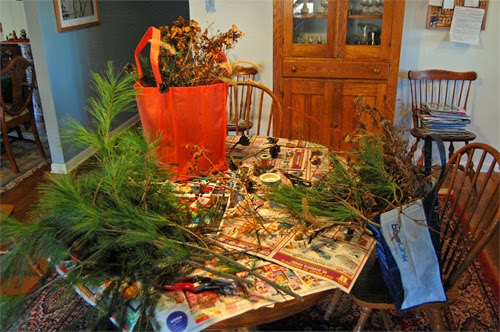
Step Two:  Pick a variety of interesting things.  This includes dried flowers, seed heads and pods, grasses as well as the obligatory evergreens.  Bags with wide openings and non-snagging insides are easier to fill and empty.    I like to feature native plants, but for this project I look for almost anything interesting.

Some things we collected are  (from left) White Vervain, White Pine, Tree Peony, Sweet Everlasting, Rose of Sharon, Thistle, Foxtails, a Wineberry stem, Oakleaf Hydrangea and Yew branches. 

Some examples of common plants that you can use in a swag are listed below.  I grouped these into
  • Evergreens, like Pine, Spruce, Juniper, Fir, and Thuja
  • Broad Leaf Evergreens, like Rhododendron, Mountain Laurel, Boxwood, Photina, and Hollies
  • Berries such as Hollies, Aronia, Dogwood, Crabapples, Bayberry, Rose hips, and Cotoneasters as well as invasives like Barberry and Bittersweet (unless you have the native one).    
  • Dried flowers/seed heads, like Everlastings (pearly and sweet*), White Vervain, Asters, Goldenrods, Thistles, Agastache, Ironweed, Hydrangea, Dock, Lunaria, Coneflowers, Teasel, Pennyroyal*, and Beebalm.*
  • Seed Pods, like Baptisia, Tree Peony, Lotus pods, Sumac, Pine cones and Milkweeds.
  • Grasses such as Little Blue Stem, Panic grass, Dropseed, Riveroats, and Foxtails.
  • Ferns with interesting winter structures include Ostrich, Sensitive Fern.
  • Interesting stems like Red Raspberry stems, Red Twig Dogwood, grape vines, and crooked branches from Witchhazel and Fothergilla.
You could also use persistent leaves like those of Oaks and Beech trees.  You can get some unusual textures by using interesting stems.  A recent post at 'My Weeds are Very Sorry' shows many of these plants in a well made wildlife garden.

*Some of these have an aromatic aroma that adds another dimension to the swag.

Step Three:  Clear a work Surface.  You will make a mess with seeds and leaves flying around.  Also, all these things will stick together so the more space the better to keep the pieces from snagging.

Cover the work surface with paper.  Besides seeds you will want
to contain any sap from the evergreens.  
Also its handy to have a trash can ready for all the extra stems and what not.  When we were done most of the debris was still on the newspapers so we just folded them carefully and poured the mess into the trash.

Step Four:  Assemble

It's a good idea to wear a glove or two when handling some of these materials.
Even with the gloves we decided the thistle and raspberry stems were too difficult to work with.
We had a lot of other stuff to work with anyway.
Assembly is the creative part.  We usually use steel or copper wire to tie the pieces together. These are stiff enough to push through the bundles of stems.  You could also use fishing line if you need an invisible tie.  Don't use your pruners to cut the wire, you could ruin the edge.  Use wire cutters or pliers instead.

As I mentioned, I usually assemble a bunch of evergreens as a background.  These can be a mixture of textures (e.g. juniper, pine and yew) or all one type.  Then I add layers of of other materials to add color and form.  I finished off with decorative pieces to hide the wire where the bundle is tied together.

Finally, hang it up and admire your work:

This swag features evergreen holly, spruce cones, ostrich fern, barberry,
and oakleaf hydrangea over layers of pine, yew and little bluestem grass.


When its time to take your swag down most of it can be composted or used as a winter mulch.  If you used any invasive plant materials like barberries or bittersweet, separate those out and put them in the trash so they won't end up back in nature.


This swag starts with tree peony pods, evergreen holly, oakleaf hydrangea,
foxtails and sweet everlasting over a spray of Norway Spruce.

Thursday, November 28, 2013

Finding a Mate for My Plants

Berries of Winterberry Holly persist into well into winter
 when they provide late season food for birds.

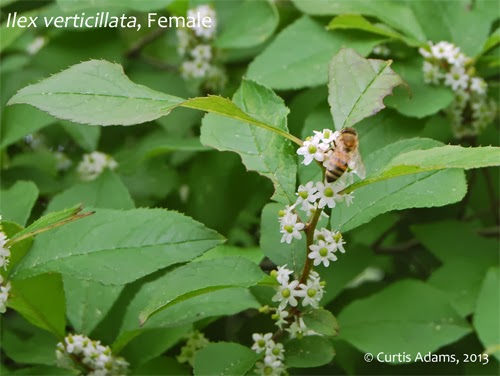
Shortly after we moved into to our new place I identified a nice looking Winterberry Holly (Ilex verticillata) growing near the front door.  It was mid fall and I didn't see any berries on the shrub.  This meant that either it was a male plant or that there were no compatible males within 100 feet to provide pollen.  The bright red berries of Winterberry are its main ornamental and ecological feature. 

Female flowers have a large central ovary surrounded by undeveloped
stamen-like structures (lacking anthers).  This plant was blooming in early June.

I had to wait until the following June to get a good look at the flowers.  After careful examination it turned out that this plant was in fact a female.  The solution was to find a suitable mate, that is one with a similar bloom time.  I found a male cultivar at a nearby nursery called ‘Jim Dandy’.  I sat him next to the established female for a few days while I located a nearby spot to plant him.  

Male flowers have well developed stamen and a very small ovary-like center.
The male plant seemed to attract smaller sized insects.


By September I noticed a few of red berries on the plant.  Success!  I hope to see more berries next year as there will be a much longer time for pollination to occur. 

These red berries were formed by mid-August.  

One of my goals in designing a landscape is its habitat value.  That is, what does the landscape gives back to wildlife in the form of food and shelter.  So when I select plants I look for ones that produce flowers, fruits and/or seeds that wildlife can use.  When selecting plants from a commercial nursery many of them are cultivars, which are genetically identical.  This becomes an issue in the habitat garden if the plants are single sexed (dioecious).  It is also a problem for plants that have both male and female flowers on the same plant (monoecious) or have perfect flowers (both male and female parts in the same flower) if the plants are not self fertile. 

All this plant fertility can have a down side.  In a formal garden production of viable fruits and seeds may lead to increased weeding and spreading of plants out of their designed boundaries.  Also, some consider that the mess that falling fruits create outweighs providing food for birds and other wildlife.  Personally I think of the landscape as a dynamic thing that changes over time.  In the designed landscape plants need to be kept under some degree of control, but I really enjoy seeing native species spreading to new areas where they are happier than in my initial design.

Here are the flowers of a female persimmon.  They have large ovary structures.
Male flowers are narrow at the base.
My experience with the Winterberry Holly has heightened my awareness of dioecious plants.  I want to generate as much natural food for wildlife as possible.  Also I would like to grow some ‘wild’ fruits and berries.  Persimmons (Diospyros virginiana) are dioecious.  My established persimmon is a female, but I have not seen any fruit on it.  I have brought in four more new wild-type plants, at least one of these should be male.  I don’t know of any named male cultivars of persimmon; however there is one called ‘Meader’ that is self-fertile. 

In general female plants need at least one pollen source (male) close enough that pollen can be transferred.  This transfer can be by wind (grasses and many trees) or by insects (vectors) most flowering plants.  For native hollies, like Winterberry, a male should be located with in 50 ft for effective pollination, though pollination over greater distances (100-200 ft) may be possible. 

Female Box Elders are covered with seed pods (samara) in the fall.
I noticed some squirrels eating them right off the tree.

Some other dioecious plants that I have are Box Elders (Acer negundo), Junipers, Tupelos (Nyssa sylvatica), Yews and Goatsbeard (Aruncus diocus). 

Some plants with perfect flowers are not self-fertile.  This may not be convenient for a habitat gardener with limited space for lots of plants. However, it works out on the larger scale to provide the greater genetic diversity adaptation to change and continuation of the species.  I have posted a number of times about the difficulty of getting Viburnums to bear fruit when only a single cultivar was planted.

There are some practical situations where limiting plant fertility and reproduction is called for.  In urban landscapes Ginkgos are very successful street trees.  The fruits, however, are loaded with butyric acid and smell of dog poo when stepped on.  For this reason most cultivars in the trade are males.  In my last post about Jerusalem Artichokes I noted that these are not self-fertile.  By only using only a single cultivar one limits the risk that this somewhat aggressive native will spread by seed. 

Another issue for some in urban and suburban landscapes is pollen allergies.  In many cases these are due to the (over) use of male cultivars.  Males don’t produce messy fruits, but they still send out their pollen.  This results in a type of air pollution that effects sensitive individuals.  While searching for information about dioecious plants I came across an excellent resource book by Thomas Ogren titled Allergy-Free Gardening.  This book contains a lengthy list of dioecous plants and the sex of individual cultivars.  There is also an allergy rating for a wide variety plants including monoecious plants and those with perfect flowers.  I did not realize that many maples, such as Red and Silver Maples, came as separate male and female plants.  Since I am more interested in facilitating plant fertility for enhancing habitat value I see using this book differently than the author intended.  But, if I had a client with particular allergy problems this book would be an excellent resource for plant selection to design a low-allergen garden.


Thursday, November 7, 2013

Fall's First Fruits

We are finally getting some frosty weather here in Knoxville, MD.  That was a signal to take in our first harvest of Jerusalem artichokes.  The flavor of the tubers is supposed to be improved by a little cold weather.  I wasn't sure how many to expect.  From what I've read, yields are high and it is important to dig out all of the tubers; otherwise the plants will spread throughout the garden.

View to South Mountain from the southern end of Pleasant Valley in Maryland in early November.
Foliage is about a week past peak.
A mass of 4 Helianthus tuberosus
'Stampede' in mid-September.  

I selected the cultivar called 'Stampede' (from Oikos) because the tubers stay close to the base of the plant making them easier to harvest.  This was generally the case, however there were a few longer runners with large tubers at the far end.  While this cultivar was supposed to be early maturing, it did not begin to bloom until late summer, a bit later than I expected.  The plants grew to about 12 feet in height.  They were holding themselves up OK until a big storm hit in early October.

As you can see in the photo the yield of tubers from the four plants gave me a wheelbarrow full, well over 20 pounds.  Now we need to find some recipes for how to prepare them.  One caution about these tubers is that the form of starch in them is inulin.  This is not easily digestible by most people, resulting in some gastro-intestinal discomfort (to be discreet).  One article suggested eating small amounts of them at first to help your digestive system adjust.  This is a warning not to serve heaping portion at a dinner party to uninitiated guests.

These tubers will keep for about 3 months if stored in a cool dry location.
We need to find some ways to prepare them soon,
or at least some folks will to take them off our hands.

I've eaten a few slices raw and am surviving.  The taste is slightly sweet and refreshing.  They are crispy like jicama, but much more flavorful.  Soaking them in vinegar keeps them from turning brown like a potato.

As I mentioned above, keeping these plants under control is a concern for the gardener.  They are large and prolific plants that can take over if they escape.  There are a number of things that can be done to control there spread in and around the garden.

First, as already mentioned, harvest all the tubers each year to reduce the number of plants in the ground. Don't allow bits of the tubers to be spread while tilling the soil. Second, Helianthus species are generally not self-fertile.  So if you only have one cultivar (clone) and there are no wild plants growing nearby, you will not get any fertile seeds.  If you do have potential mates, cutting off the flowers before they set seed is the way to go.  Lastly, the deer around here really like to eat the stems and leaves of Jerusalem Artichoke.  I planted a few tubers outside of the garden enclosure and these never got taller than about 8 inches due to deer browsing on the young shoots.  After the deer broke into the garden, they ate all the leaves up as far as they could reach.  So I would expect any plants that escaped the garden to fall to a similar fate.

These seeds from 'Stampede' are really  hollow husks.
If they were viable, the entire seed would be full and firm.
Some other fall vegetables that I hope to harvest soon are from my Collards and Swiss Chard.  These are plants that I started in the spring.  They have survived the beetles and a deer attack and are now putting out some fresh leaves.

Thursday, October 10, 2013

New Gardens for Fall

Autumn is a great time to do planting of trees, shrubs and perennials.  The weather is cooling down but the soil is still warm.  This allows new plantings to get established with less stress.  The roots do not need to pump as much water and nutrients to support leaf growth, rather they can focus on growing out and adapting to their new home.  Although we have had a nearly rainless September in Maryland, fall is usually a moister time than late summer.

Another factor that makes fall a good planting time is that many plants are on sale.  While somewhat picked over and tired looking there are many good deals especially for perennials at the nurseries.  There are also a number of native plant sales that occur in the Fall.

I visited a native plant sale in Virginia that featured locally native plants for the Chesapeake Bay Watershed.  I found some plants that I had been searching for for a long time (Aromatic Sumac and Yellowroot) and some that I had never heard of (Astilbe biternata - a North American species of Astilbe).

While not the actual location, this is similar to what we started with.
First my wife cut off the runners, then I dug out the roots.
One of the long term projects for the new property is the elimination of English Ivy.  Our local deer like to eat it; that is one of the few positive things I can say for them.  In the fenced areas, however, the ivy is taking over.  I have been holding off removing the English Ivy from an area until I have something on hand to replace it.  At this fall's Loudoun Wildlife Conservancy native plant sale I found an American Strawberry Bush, Euonymus americanus.  The Strawberry Bush was just the plant I needed for this shady moist corner where the ivy was dominating.


This shrub can grow 6-12' tall.  You can see a little of it's fall color.

The American Strawberry Bush is one of two native Euonymus species that I know of.  The other is Eastern Wahoo, E atropurpureus.  I'm not sure why these plants are not more available in the trade.  While not as showy as the invasive Burning Bush, E. alatus, they each have decent reddish fall foliage and the color of their fruits are outstanding, a red exocarp with fluorescent orange seeds inside.  I did read that deer really like to eat the Strawberry Bush, so finding it the wild can be difficult if there is any amount of deer pressure.

'Hearts-a-burstin' is one of the common names for E. americanus.
The orange seeds are not as bright as when the fruit first opened up.

With the Strawberry Bush as the focal point in this renovated corner I picked up a pair of Goat's Beard, Aruncus diocus to fill the back corner.  The white plume-like flowers should brighten this area in the early summer.  Since this plant comes as separate male and female plants I bought two to increase my chances of producing some viable seed.  (Usually it is recommended to get 3 plants when you want both male and female, but I don't have the space here.)


Goat's Beard should grow to about 5' tall and wide.
These are starting at about 1 foot.
This seed-grown selection of Jumpseed has the pronounced red markings
like those on the cultivar 'Lance Corporal'.


To fill in the ground plane I was imagining buying all sorts of natives like Heuchera, Tiarella and Labrador Violets.  On my trip to a local nursery I noticed that they had a bunch of escaped Jumpseed, Polygonum virginianum, with well defined red markings on the leaves  Since I already have these growing in the woods nearby, I thought it would be great to integrate this species into the plantings around the house.  It worked out that the nursery owner would give me the plants if I provided the labor of digging them out.  What a deal!!!  So I loaded up 9 pots full of this native ground cover, indigenous to my site.


At a distance the long racemes of red flowers look similar to those of Coral Bells.
(The name for this plant has been changed to Persicaria virginiana.)

To complete this design I need to remove the Japanese Honeysuckle on the back fence, then I would like to bring in some wild ginger (also growing nearby) and maybe some Solomon's Seal in the back to add a different texture.

Here's the corner without the ivy and just after planting.  The Aruncus is in the back,
the Euonymus is in front and the Jumpseed is in between.

Friday, September 20, 2013

Late Summer's Larger Blooms

Now that summer is nearly over I thought I would do a run down of some of the showier native plants that I have around the property.  Most of these are found naturally in Maryland.  A few are true wild flowers that have arrived on their own, though most of these have been introduced to this site.

The most common wildflower to this area is Wingstem, Verbesina alternifolia.  It is tall (4-6 ft) in full sun, though shorter in shadier locations.  The bright yellow compound blooms have been evident since the beginning of August.  In this area it is currently the dominant roadside wild flower.

This wildflower was just fading out at the beginning of October last year and I could not figure out what it was.  The northern edge of it range is in New York state, so it would be uncommon in the Boston area.  The form of the plant is similar to Sneezeweed (Helenium) but the shape and quantity of the petals are different.  Sneezeweed has wedge-shaped petals tightly arrayed around the center disk.

The arrows point out the winglike appendages
on the stems, hence the common name.  


Before the Wingstem was in full bloom, Common Evening Primrose, Oenothera biennis, was dominating the roadsides.  This is a true biennial.  It spends the first year as a low growing leafy rosette.  The second year the flower stalk shoots up to 6 ft or more with spikes of yellow blooms.  Each flower opens in the evening and only lasts a day (maybe a little longer if it is cloudy).  I have a bunch of these growing around our patio, while the flowers are nice and bright, they have unsightly lower stems.  For this reason I would banish them to the background.  The biennial lifecycle is well adapted to highly disturbed environments.  The seeds need an open sunny area to germinate and for the low-growing rosette to get plenty of sunlight.  So this is a good plant for open roadsides that get cleared once or twice a year.  But not so good for an area with an established dense undergrowth.


Evening Primrose gets way too leggy
to use near the front of a border.


I noticed that the Japanese beetles were eating a lot of the Evening Primrose leaves.  I collected quite a few in my soapy water jug (aka, Jug of Death).  Could these plants be used as a magnet to draw the beetles away from more desirable garden crops?


This next group of wildflowers are native to Maryland, although I am pretty sure they are not indigenous to our little valley.  New York Ironweed, Veronia noveboracensis, is scattered around our house, but I have not seen it growing in the woods or along the roadside.  The deep purple flowers are long lasting and provide a wonderful contrast to all of the yellow flowers that are dominating the gardens at this time.  In protected areas these wildflowers can get quite tall, more than 6 ft.  In open areas the deer have pruned them back to 2-3 ft tall, but they have still managed to bloom.  At this smaller size they actually fit in better to the garden scale.


This Ironweed was not eaten back by deer and
grew to about 5 ft in partial shade.

Speaking of yellow flowers, there are lot of Yellow Cone Flowers, Rudbeckia fulgida, growing in the neighborhood.  Probably most are the 'Goldstrum' cultivar.  They all grow to the same height and bloom at the same time, making a definite statement in the garden.  As a advocate for native annuals and biennials (i.e. short lived, freely seeding plants) I have been using more of the Black-eyed Susans, Rudbeckia hirta.  These have a more relaxed habit and a longer blooming cycle than the more common cone flower cultivars.  (note some variation to the flower shape).


These Black-eyed Susans were raised from seed this year.
They are not all identical, note the double-side blossom on the right.

In the shadier areas of the garden I have added them more demure Brown-eyed Susan, R. triloba, and the shade tolerant Elm-leaved Goldenrod, Solidago ulmifolia.  This is the first year that this goldenrod has bloomed.  It is an early bloomer and really brightened up the shady area, but the color only lasted a couple of weeks.  I just planted in some Bluestemmed Goldenrod, S. caesia, to beef up the appearance.  I just read that these two species can hybridize - so I guess that the bloom times will be similar.


This plant was eaten back once.  If unpruned
it would reach 304 ft tall.
This is an early blooming species of Goldenrod
that does well in shadier locations.

I found that I had problems with the deer and possibly rabbits eating back both the Rudbekia and Solidago.  I gave these plants a little assistance with some hot pepper spray (cayenne pepper) and some scent-based deterrents like 'Repels-All.'  I need to get on a regular application schedule with products because waiting for the plants to be eaten is usually too late.  I have also gone too far with over application on new plants resulting in killing much of the tender foliage with the liquid sprays.  For these plants I am favoring the pelleted products.

Partridge pea, Chamaecrista fasciculata, is a true native annual that I planted this spring.  I had better results with plants started indoors than outdoors, but much of this was due to grazing by unwelcome animals.  After a little hot pepper spray I was rewarded with stems full of loose yellow blooms.  These open blossoms were visited primarily by larger bees.  These peas need a specific symbiotic bacterium to assist with nitrogen fixation.  This was supplied with the seeds I bought.

The leaves of the Partridge Pea will fold up when it is dark or particularly windy.

In the vegetable garden I'm growing the 'Stampede' cultivar of Jerusalem Artichoke, Helianthus tuberosus.  Now that they have reached 10-12 ft they are just starting to bloom.  I selected this cultivar for its more easily harvested tubers.  I've seen Jerusalem artichokes recommended for use in edible landscaping; however, to be effective a shorter earlier maturing selection would be more appropriate.  Before I put up the deer fence around the garden these plants were being grazed down to the ground on a regular basis.

These towering blooms are supposed to have a chocolaty scent.
I will need to pull some down to find out.

The color of the bracts ranges from pale green to pink.
On close examination  you can see the black dots
on the yellow flowers between the leafy bracts.


Among the deer resistant plants I put in around the garden were two native species of Bee Balm.  The Wild Bergamot, Monarda fistulosa, has been growing larger but has not bloomed this year.  However, the Spotted Bee Balm, M. punctata, has grown and flowered in the first year from seed.  These two plants have been untouched by the deer while the nearby Rudbeckia have been routinely munched.


While not native to the east coast the midwestern Blue Giant Hyssop, Agastache foeniculum, has been an excellent garden plant.  It is long blooming, attractive to pollinators, nicely textured and untouched by deer.  The biggest concern with this plant is its tendency to set a lot a seed.  We'll see what happens over the next couple of years.

There were lots of bluish spikes at the end of July.
These have faded to a mauve color in September,
but have maintained their shape.


In addition to these plants I have observed a number of truly wild flowers including Heal-all (Prunella vulgaris), Maryland Hawkweed (Heiracium marianum), Spanish Needles (Bidens bipinnata) and several goldenrods that I still need to ID.

As we transition into Fall there are a number of asters coming into bloom as well as a variety of goldenrods.  As I walk through the woods I will keep an eye on the ground for anything new


Friday, September 6, 2013

Stilt Grass is in Bloom

I have been watching my invasive Japanese stilt grass, Microstegium vimineum, to try and cut it down it before it started blooming.  On Sept. 2 I noticed that just about every plant starting to bloom.  (I am in zone 7a, so if you are in a cooler zone, this may be happening very soon in your area.)  My plan was to weed whack it down just when the flowers were forming so that it would not have time to regrow new flowers and set seed this season.  Since stilt grass is an annual, if I can deplete the seed bank, I should be able to bring it under control.  Several references agree that Microstegium seeds remain viable for up to 7 years.

Japanese Stilt Grass in bloom

One nasty feature of this grass is that it also has a set of self-fertile flowers hidden down in the stem.  These are known as cleistogamous flowers.  So it is necessary to cut these off as well as the upper exposed flowers at the stem tips.

A cleistogamous flower in the stem about 4 inches off the ground.

On Sept 3 I used my gas-powered string trimmer to cut down all the plants I could find growing in the woodland edges.  I made one pass to cut the tops and a second pass closer to the ground to go after the stem flowers.  Cutting the plant in smaller pieces may reduce the likelihood of an fertilized seed from maturing (I sound like a lawyer).  In some areas I found that the stilt grass would bend over, rather than getting cut on the first pass.  So the second low pass was really needed.  Where ever possible I tried to avoid any natives I saw.  These included some Panicled Tick Trefoil, Jumpseed and some, as yet unidentified goldenrods.

For some smaller areas, with other species mixed, in I hand pulled the plants.  Since stilt grass has relatively shallow roots, it comes up more easily than perennial grasses and herbs.

If I can keep this up for a few more years I may be able to eliminate scenes like this:
Stilt grass has filled area to left.  Area to the right is less disturbed
(unmown) and shows less invasion by the stilt grass.