Sunday, August 28, 2011

North Point Park, Cambridge, MA

I have heard, on and off, about the construction of North Point Park as a 'set aside' from Boston's Big Dig.  It's in an area I always shied away from because of the the traffic.  But on a quiet day last Sunday and a reminder from some landscaping associates I finally made the short trip into East Cambridge.

The 8.5 acre park was opened in Dec. 2007 and is on the north bank of the Charles River just east of Boston's Science Museum.  For backgound on the history and construction I will refer you to a Wiki article and item from the Boston Globe.  The design was done by Carr Lynch & Sandell of Cambridge and Oehme van Sweden of Washington, DC.  Van Sweden is noted for their use for grasses, and it shows well in this park. 


View looking northeast into Cambridge.
 The park is designed for multiple uses and, on my visit, it seems to do them well.  The landscape is varied.  There are large open areas for lounging or more active pursuits.  There are playground areas that are clean and modern.  There are areas with dense plantings that offer some privacy and there are a couple of islands, linked by bridges.  All of these work together to form an interesting and diverse experience.  Another aspect that I found to be very nicely done is to have separate path systems for various modes of transport: Walking paths, Bike paths and Channels for kayaking. 

Playground with fountain spary.

A more secluded gathering area. 
I'm curious how this will be used.


A section of bike path around a stand of Prairie Coneflower.

View to the east.  Plantings had to be selected to deter use by geese.


One of the Kayaking channels.


Looking at the plant palette, I was expecting to see all native plants, but what is here is a pragmatic mix of natives and non-natives with the focus on design and survivability, rather than strict use of native species. Personally, would have like to have seen more natives, but visually, this design 'works'.


Mix of grasses including native Panicum and non-native Pennisetum.

View south toward Boston through a hedge
of non-native Corneilian Cherries (Cornus mas).

  
Liriope and a dwarf Summersweet (Clethra alnifolia)
form an effective groundcover.


My favorite combination: Joe-Pye Weed and Hibiscus hybrid ('Lord Baltimore'?)
 On this day the most striking plant compostition was the Joe-Pye Weed (Eupatorium dubium) and the hybrid Hibiscus.  One of the reasons I like this is that they are both wetlands plants native to the eastern U.S. (or at least derived from eastern natives).

My biggest concern for this park is how it will be maintained.  Will the beds be weeded out of invasives and plants blown in from other parts of the park, or will a form of succession be allowed.  I noticed a few patches of purple loosestrife and bittersweet growing among the plantings.  I also found a patch of Horsenettle (Solanum carolinense), a native of the southeastern U.S. that has spread across the continent.  This is a really well defended plant with thorns on its stems and its leaves.  Currently the park is not getting a lot of visitors.  I hope people come and take notice of it and insist that it get the maintenance attention that it needs in the coming years. 


Wednesday, August 17, 2011

Getting Viburnums to bear Fruit

Last year I posted a blog on how using cloned plants may reduce the viability of seed produced in the garden. In some cases this is not a bad thing from a design point of view, if it is desirable to limit the number of ‘spontaneous’ seedlings and maintain a 'clean' ground plane. If your goal is to produce seeds and berries for wildlife, then the use of sterile, or self-sterile plants is of no advantage. The situation that brought this up was that the Viburnum nudum ‘Winterthur’ that I have has never produced more than a couple of small berries each year. After 5 years of this I investigated the situation and leaned that in order for Viburnums to produce seed it must be pollinated by a genetically distinct individual. (You see most cultivars are clones of the same individual.)  So last summer I picked up a straight species form of Viburnum nudum and planted it nearby.

These pale green berries will turn pink, then dark blue as they ripen.
This year I’ve got many, many more berries forming on the ‘Winterthur’, as well as the species plant. The species and ‘Winterthur’ bloomed at the same time; this is very important for cross-pollination. There is a difference in form and fall color between the two plants. ‘Winterthur’ is more upright and the fall colors on a single plant vary from light orange to red. The species plant is more lax and turn a rich burgundy color in the fall. Now I’m looking forward to seeing some of those brightly colored berries later in the fall.

Fall color for 'Winterthur' cultivar
Viburnum nudum species in early November.


Only a few of the signature blue berries
matured on this lone Arrowwood Viburnum.

Earlier this year I also added an Arrowwood Viburnum, Viburnum dentatum ‘Christom’= Blue Muffin®, to fill a gap in a shrub border. To my knowledge there are no other Arrowwoods in the neighborhood. This species of viburnum blooms 3-4 weeks earlier than the ‘Winterthur’ and only two clusters of late blooms overlapped with the opening of the flowers on the ‘Winterthur’. On inspection today, the Arrowwood has just a few mature berries on the plant, all of the other flowers just fell off shortly after blooming. So it may be that the pollen from these two species is compatible, but their blooming times are so different that they are not practical mates.
In any case, now when I recommend Viburnums in a wildlife-friendly garden, I try to include two different cultivars of the same species, or look to see if there are some other plants of the same species growing nearby. I will need to look for a chart with bloom times for all of the Viburnums to see if there any other possibilities for interspecies compatibility, as is done with Holly.


Friday, July 29, 2011

A Rainbow of Colors


As I was trying to think of some deep topics to discuss on my blog in late July, I was working in the garden and realized that just about everything was in bloom. In fact there are North American natives blooming in all the colors of the rainbow right now. So I thought I would share examples of each color from my garden.


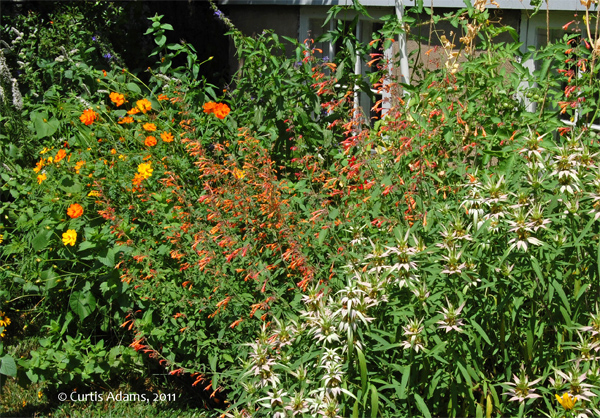
Mixed border with Cosmos, Agastache and Spotted Beebalm


I’ll start with some of the warmer shades. I reintroduced the annual Sulfur Cosmos, Cosmos sulphureus, this year (it had been pushed out by the overly vigorous Bearded Beggarticks). These along with Orange Hummingbird Mint, Agastache aurantiaca ‘Navaho Sunset’, and the Spotted Beebalm, Monarda punctata, form a rather dense border on the south side of the house. 
 

A self-seeded Blood Sage


 Mixed in with these are a few Blood Sage, Salvia coccinea, a Texas native that reseeded from last year. Overall the red shades are underrepresented, the only other red is some Drummond Phlox, Phlox drummondii, also from Texas.


A native bee is sampling from a Wine Cup


For a really hot magenta I have Wine Cups, Callirhoe involucrata, native to the central U.S. This viney perennial has been doing well on it’s own for 5-6 years on the east side of the house. 


Cooling down to the pinks, I have been really surprised with the Pink Tickseed, Coreopsis rosea; a Massachusetts native. It prefers moist soils and this one seems very happy growing in a crack in the driveway. There must be runoff collecting under the pavement. Another pink flowering native I have is Butterfly Gaura, Gaura lindheimeri. While native to Texas and Louisiana, it can be found growing in many gardens in the Northeast.

This Pink Tickseed has been growing in the driveway for more than 5 years.


Butterfly Weed

A new addition for me is the orange Butterfly Weed, Asclepias tuberosa. As it is quite drought tolerant, I’m trying it out in the ‘Hell Strip’ along the road.  This area is exposed to a lot of sun and it is difficult to get water to soak in.  Hopefully this tap-rooted plant can get established here.


Yellow seems to be the most commonly seen color for native plants. You see Black-eyed Susans and Yellow Coneflowers everywhere. I have them too. A couple of less commonly used species are the Prairie Coneflower, Rabitida pinnata, with its paler, more lax petals, and Whorled Rosinweed, Silphium trifoliatum. The coneflower has been just getting by, popping out from a dense border of Purple Coneflowers and a variety of native asters. On the other hand the Rosinweed stands tall (actually it leans forward) in the dry shade under a Norway Maple.

Whorled Rosinweed, leaves in whorls of three.


Prairie Coneflower


Inland Sea Oats turn golden in fall.
There is lots of green in the garden from all the leaves, but there are also some other green features. The green flowers of my Strawberry Blite, Chenopodium capitatum, are forming now, to be followed by bright red berries. Also there are grasses, such as the Inland Sea Oats, Chasmantheum latifolium, shown here.


'Victoria'


Moving on to blue, may last post was about the American Bellflower that is all over my garden. Instead I’ll show you the Mealycup Sage, Salvia farinacea ‘Victoria’, that I have in my flower boxes. This tender perennial native to the south-central U.S. it a common garden annual available at many nurseries in the Northeast. While not native up here it does get a fair amount of traffic from both native and honey bees.


For lavender I’ll show you my Wild Petunias, Ruellia humilis. This plant is native to the Eastern U.S., but not New England. I started this one from seed in 2007 and it slowly spreading into some of the sunnier and drier spots around the house.

Wild Petunia, late to emerge,
but in full bloom in early July.


Of course there is the ever popular Purple Cone Flower, Echinacea purpurea. Mine are from seed and I am seeing a lot of variation in size and color. Instead I’ll show the less popular Swamp Verbena, Verbena hastata. This somewhat weedy plant is found all over North America. It reseeds vigorously and will grow under a wide variety of conditions. I have been cutting mine back by half in mid-June to control their size and get a few more blooms. I started seeds for both the species (violet) and a naturally occurring pink form, ‘Rosea’, in 2008. As you can see I am still seeing examples of each, though the violet is much more prevalent.
A pink form of Swamp Verbena along with the more common Violet form.

Philadelphia Fleabane is found throughout North America


I have no black native flowers, but I do have a lot of white ones. There’s the long-blooming shrub Meadowsweet, Spiraea latifolia, the Bigleaf Asters, now known as Eurybia macrophylla, and purple-leaved Heuchera villosa. All of which I grew from seed from the New England Wildflower Society. Here I have Philadelphia Fleabane, Erigeron philadelphicus, that just blew in on its own.


Blooming is not over, there are still more plants to come, but it nice to see everything that is going on despite the heat of summer.


Sunday, July 17, 2011

American Bellflower Update

American Bellflower, in bloom from
late June through August

Over a year ago I posted some information on the American Bellflower, Campanulastrum americanum.  This plant, or it's progeny anyway (it's a biennial) have been growing in my yard since 2008.  It spends its first year as a rather innocuous rosette of leaves, but in its second year it shoots up to form a flower stalk between 2 and 6 feet in height, depending on location.  This spring I had an over abundance of second year plants within about 5 feet of the 2009 plants that I let go to seed. This spread is consistent with the smooth round seed just falling to the ground from the tall flower stalks.  Not wanting to throw any of these seedlings out, I redistributed them to a variety of areas in my yard that are normally difficult for growing flowering plants. 


A spontaneous composition on
the edge of the driveway with
Spiarea latifolia, the blue
Campanulastrum and
Rudbecia hirta.
The Campanulstrum growing in
dry shade under a Crabapplealong a foundation.


Along the North side, here the Hostas
hide the legginess of the Bellflower


Growing in rocky soil from under the
deck - plants forming a screen.


It seems that the plant looks better in some of the more challenging locations, where its vigor is moderated.  In rich soil with lots of sun it can become a floppy 6 foot monster.  Some places where it is doing nicely are : cracks in the driveway, a sterile rocky area under a deck, north side of the house, under a Norway Maple and in the deep shade of a Crab Apple along a dry foundation.  I think this latter location shows the American Bellflower at its best.

As far as pollinators, it seems that there is one particular bee, probably a type of Mason or Miner Bee (can anyone ID this for me?), that really loves this plant.  The first couple of years I didn't see much action with bees, but this year the bee activity has taken off!  A few larger bumblebees drop in, but they prefer the Meadowsweet (Spiarea latifolia var. alba) for the most part.

The meadowsweet is preferred by the bumblebees
I have been a little concerned with how vigorously this plant reproduces, however it is fairly easy to pull up so it can be controlled in the garden fairly easily.  It is not as aggressive a reseeder as my Bearded Beggarticks (Bidens aristosa), which I am glad to say is easily edited out by selective pulling.  The question of persistance of the seed remains.  How many years will it lie dormant in the soil? 

Also, since this bellflower is not a Massachusetts native, I wouldn't recommend its use near wild areas in this state.  But I do think it works well as a North American native that is well adapted to the conditions of the modern residential landscape, particularly under trees and along shady foundations.

Friday, June 24, 2011

Update: Native Seeds for 2011

Following up on the Native Seeds for 2011 post, here’s a status report on what has and has not worked so far…

Did not germinate:

Allegheny vine (Adlumia fungosa) I’ve written a lot about this biennial vine. I just can’t get enough of it. I was surprised that the new seeds I bought this year did not germinate; however, I do have one self sown plant that is doing great and should be blooming soon. I also have overwintered and planted out some from last year. I’ll need to make a point of harvesting my own seeds this year.

Fern-leaf False Foxglove (Aureolaria peduculata) This biennial is parasitic on oaks, but, reportedly, does not need them for germination. None of these have germinated, despite trying several different germination conditions. 


Butterfly Weed (Asclepias tuberosa) This is the first year I’ve tried these and alas, none had germinated. Fortunately I did get some bare root plants from Prairie Moon Nursery, and these are developing nicely.


Rosey Sedge (Carex rosea) I’ve had a small clump of this perennial grass for nearly 5 years. I was not able to get the seeds I bought this year to germinate. I understand that Carex is generally a difficult plant to grow from seed.


Good germination:

Pearly Everlasting (Anaphalis margaritacea) This is a perennial with white, long lasting flowers similar to the annual Sweet Everlasting (Pseudognaphalium obtussifolium) that I’ve tried several times before. These germinated really well, but have grown on very slowly and so far have not transplanted well. I just may not have the right touch, or location, for these plants.


Tall Swamp Marigold or Crowned Beggarticks (Bidens coronata) is an annual, with good-sized yellow flowers. These did not germinate last year when I cold stratified them in moist sand for 60 days, so this year I got a new batch of seed and conditioned them in moist soil for 60 days in the refrigerator. I was thrilled to see that they were sprouting within 5 days of coming to room temperature. I’ve got these blooming in the garden already! So far I would rate these better than the Bidens aristosa, for early bloom and a manageable size; however it’s still early so we’ll see how long the bloom continues and how vigorously they reseed themselves (a little, a lot or none at all?).

Browneyed Susan and American Pennyroyal in a pot.


Brown-eyed Susan (Rudbeckia triloba) is a short-lived perennial, that while taller has a more delicate appearance than the typical Black-eyed Susan (R. hirta). Last year when I conditioned these in damp sand I got no germination. This year moist stratification in the soilless mix resulted in good and rapid germination after just 4 days of coming out of the refrigerator. I’ve moved some of these to pots and some into the garden. I don’t know if these will grow on to bloom this year, or if they need a season to get established.


Some germination:

Flowering Spurge (Euphorbia corollata) Perennial also known as Wild Baby’s Breath. I thought this could be good for general landscape use, with white flowers through mid-summer. I got a low rate of germination and the plants seem slow to develop. Once the temperatures got over 90, the seedlings began to take off. I’m trying this in several locations and have this one in a pot. So I’m hopeful that at least one of these will mature.


Woodland Sunflower (Helianthus divaricatus) Perennial for dry shade. This plant can be weedy in the garden, but I really want to test it out under the Norway Maple where its vigor may be tempered by this challenging environment. Only 4 of these germinated, but these are developing nicely. I’ve already moved a couple under the 'nasty' Maple and they are continuing to grow.


Repeats, with good results:

Orange Hummingbird Mint (Agastache aurantica ‘Navaho Sunset’) grew quite well last year and I got good germination from the same crop of seeds as last year. Last year’s plants are a dense mass about 18” tall, not ready to bloom yet, but the foliage smells really great, even as tiny plants.


Native to rocky slopes, these transplants
are doing well among some Bearded Iris.
Rock Harlequin (Corydalis sempervirens) Even though the seed was for 2010, still gave a very good rate of germination. Some seedlings that I transplanted into rich humusy soil died immediately, while those interplanted with the Bearded Iris, in unimproved soil, are doing quite well.


Sulfur Cosmos (Cosmos sulphureus) these germinated well both indoors under lights and direct sown in the garden. I was concerned that I would confuse the seedlings with those from the Bidens aristosa that has reseeded itself all over the garden beds. There are a couple of features that distinguish the seedlings. The first pair of leaflets from the Cosmos are each nearly an inch long, compared to about ¼” for the Bidens, the Cosmos germinate about 2 weeks later than the Bidens (although the Bidens continue to germinate from late April to the middle of June) and while the leaves of both species are deeply divided, the Cosmos have broader rounder tips than those of the Bidens. I am pulling up and discarding the Bidens seedlings, this will be a test of whether I can eliminate this species from the garden so that I can test other plants.


Note the long cotyledon leaves and rounded leaf tips
 
Compare the first pair of leaves with
those of the Cosmos.


The annual American Pennyroyal (Hedeoma pulegioides) has been getting established from a planting 2 years ago. I’ve found that these reseed themselves rather well and grow well under lights (after 30 days cold stratification), but did not come up where I seeded them directly in the garden. I guess these do better when they find their own home. I’ve planted out a few of these and am growing some in pots. I plan to snag a few leaves to rub on my arms to test their mosquito repellent properties.


Spotted Beebalm (Monarda punctata) had germinated within 6 weeks in damp sand, while still in the dark in the refrigerator. I moved the germinated seedlings to starter mix and still ended up with a healthy crop of little plants.


Sweet Everlasting (Pseudognaphalium obtusifolium) has given me trouble on transplanting in the past two years. An this year is no exception – lots of seedlings that do not transplant well. The directly sown seeds did not germinate. I think need to be put into really well drained coarse soil and are not appropriate to my garden conditions.


This seedling is developing faster than ones transplanted from
indoors.  Monarda and Agastache are also cropping up.

Some other seedlings that are showing up on there own in the garden are from the Scarlet Sage (Salvia coccinea), Biennial Gaura (Gaura biennis), Strawberry Blite (Chenopodium capitatum) and of course the Swamp Marigold (Bidens aristosa). I was not certain if the seeds of the Salvia could overwinter here in the Northeast.  Seeing these appear in new locations points out the importance of knowing what the seedlings for these annuals and biennials look like, otherwise I would have weeded them out as I was preparing the beds for other plants.


The reseeded catnip has deeper teeth on the leaf margin than for the Salvia coccinea,
the catnip leaf is also has a fleshier texture.


Thursday, June 9, 2011

American Smoke Tree

As I was driving through Mount Auburn Cemetery yesterday, the ‘blooms’ of a cluster of American Smoke Tree, Cotinus obovatus, caught my eye. Actually, the true fertile flowers are past, but it’s the fuzzy remains of the infertile flowers that line the flower panicle that are providing the show. This tree is dioecous, meaning that there are separate male and female plants. All of the trees in this cluster appeared to be female, judging by the seeds that were forming at the ends of the panicles. I have not, to my knowledge, seen a male tree in bloom; however, at treetrail.com they say that the male is actually showier. So although you can be sure whether you are getting a male or female plant, either way the smoke effect will be striking.

A few seeds from fertile flowers are at the tips of the panicle.


Close up of the 'smoke'


The species name, obovatus, refers to the distinctive oval shape of the blue-green leaves. It grows as a small tree or upright shrub , 20-30 feet tall. Young tree have a fairly ungainly appearance. These trees are probably about 8 years old. When they were planted here about 3 years ago, they were gangly stems without too many branches. So they have developed very nicely in just a few years.


Buds forming on a younger plant in early May


The native distribution of C. obovatus is scattered across the south central U.S. It is found in neutral to alkaline well drained soils, but will tolerate the more acidic soils in New England, as well. This preference of alkalinity may make it a good choice for planting on residential sites, with their limed lawns and cement foundations.

More commonly seen is the Purple Smokebush, Cotinus coggygria, which mostly grows as a multistem shrub with broad purple tinged leaves. The American Smoke Tree is harder to find, I purchased mine last year from New England Wildflower Society, but I have also found it at commercial nurseries.


Cotinus obovatus at the end of October

While the smoke-like inflorescence is an attractive feature, the fall color of these trees is really the feature that will knock your socks off. This photo was taken of the same tree in late October last year.

So far I’ve planted two of these (one for me, one for a client) and I am looking forward to watching them mature.


Thursday, June 2, 2011

Celandine Poppy

Note the single yellow flowers and the fuzzy, drooping seed pod.

The newest native addition to my garden is the Celandine Poppy, Stylophorum diphyllum. It is a Midwestern native, but I have seen it growing in gardens here in the northeast where its large, clear yellow flowers and light blue-green foliage brighten up a shady spot. It is a mid-spring bloomer. Another reason I was interested in knowing this plant is its similarity to the introduced and quite weedy Greater Celandine, Chelidonium majus, a Eurasian native.


I had gotten into the habit of weeding out any plant with divided leaves, yellow flowers and light green foliage, assuming it was always Greater Celandine. One day I started to rip some out in a client’s garden and was told that this was not a weed and was in fact the native Celendine. So I figured I should learn to tell these plants apart.
Anyone who has pulled up either of these plants has seen the bright yellow or orange juice that can stain clothes. So that does not help distinguish the plants. The leaves are different, but both are deeply lobed and of the same general color. The easiest way I see to distinguish these plants is with the flowers and seed pods. The native Celandine poppy has large (nearly 2 inches) yellow flowers, borne singly, which matures to a single fuzzy pod that droops toward the ground.


Note the upright seedpods
of Greater Celandine
Greater Celandine has much smaller yellow flowers (1/2 inch) borne in small umbels. The seed pods are bean-like and project upwards. Also the leaves are arranged alternately on the stem, while for the Celandine Poppy all of the leaves occurs opposite one another; however this can be tricky to spot in a mass of foliage.


The plants have only been in for a week in a shady area that maintains slightly moist soil. Now we’ll see how it performs over the rest of the summer and how it looks when it comes back next year.


Since there are no natural populations of Celandine Poppy in Massachusetts, I’m sure I did not damage any native plants, but still it’s good to know how to tell these plants apart, especially now that I have some in the ground.