Showing posts with label pre-emergent herbicide. Show all posts

Monday, August 15, 2022

Pull! Pull! Pull!


 Yes Pull!  Now is the time to pull out Japanese stiltgrass, Microstegium vimineum.  This invasive species is rampant in the eastern U.S. from Georgia to Massachusetts and west to the Mississippi River.  It affects home landscapes and natural area alike.  Here in the Mid-Atlantic region the grass is putting on a growth spurt prior to going into bloom.  So the plant is expending a lot energy now to grow taller and produce flowers.  It also means that it is a lot easier to pull out without getting on you knees.  Since this grass in an annual, keeping it from going to seed can go along way to controlling its spread and reducing its numbers.  

Early in the growing season Japanese stiltgrass stays relatively low, rooting at several nodes along the stem.  In late July it starts growing upward to gets its flowers higher off the ground.  If it were only that simple.  Stiltgrass not only produces flowers at the top of the stem it also has flowers at most of the vertical leaf nodes buried within the stems.  These are referred to as cleistogamous flowers.  
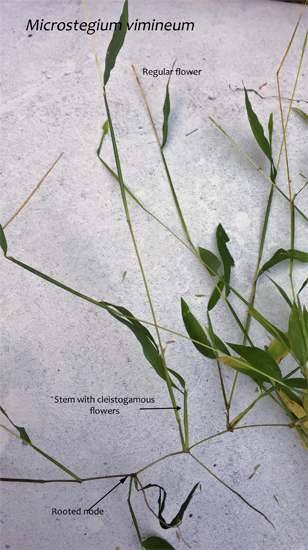
  This image shows flowers at the top and at the
lowest nodes. Cleistogamous flowers can occur all
along the stem as well.  Roots can also form roots at each
node where they contact the ground. If the grass is not
cut early in the season most of the flowers are
concentrated toward the top of the stem.

These cleistogamous flowers are one of the reasons stiltgrass is so hard to eliminate.  If you cut or mow stiltgrass early in the season without removing it completely, these stem flowers will form even lower on the plant requiring even more careful pulling later on.  I've seen a recommendation to leave the stiltgrass grow until late summer so that most of the flowers are higher in the plant.  Then when you pull you are able to get most all of the flowers with the least effort.  (Sounds good to me.)

Here are some highlights of my nearly 10-year battle with stiltgrass here in Maryland:

Pre-emergent herbicides are very effective in existing lawns and smooth surfaces.  These chemicals interfere with the development of germinating seeds but do not have a strong effect on established plants.  These must be applied in early spring prior to the germination of the stiltgrass seeds.   I have been using a preemergent containing Dimension (dithiopyr) for several years.  I took two years of successive treatments to get nearly complete removal of stiltgrass from the lawn in treated areas.  Moss has not been effected. 

Late summer pulling of previously uncut stiltgrass, especially in shady areas, has reduced the amount of stiltgrass in subsequent years.  This does require a multiyear effort.  Since nasty things like poison ivy, multiflora rose and wineberry can hide in the tall stiltgrass, it is important to wear gloves and arm protection when pulling.


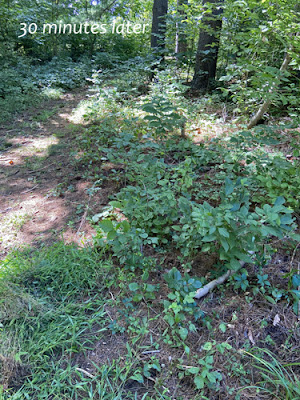
Here's the before photo.  I wonder why there is so much
stiltgrass just in this area, and why so close to the path. 
It could be from the lawn mower blowing seed from
 the other side of the path where there is a lot more stiltgrass


After about 30 minutes of labor you can see the
existing plants reappear. (Some of the freshly
pulled stiltgrass is piled in the foreground-left.)

Weed-whacking and raking of the cut grass before it begins to bloom is very effective, BUT you need to get really close to the ground to remove all the stiltgrass. Raking up the cut grass helps existing plants bounce back. 

Identify and plant native species that can compete with stiltgrass. Two exceptional plants that seem to outcompete stiltgrass are golden ragwort (Packera aurea), and mayapple (Podophyllum peltatum).  Other plants that are strong competitors include clearweed ( Pilea pumila) and grasses that grow well in shade: river oats (Chasmantheum latifolium), mannagrass (Glycera sp.), Virginia wildrye (Elymus virginicus), and  nimblewill (Muhlenbergia schreberi).  Also there are a number of sedges that will persist under cover of stiltgrass and can form a dense cover if given the chance.  Rosy sedge (Carex rosea) is one example that does quite well on my property.  I recently noticed that there was much less stiltgrass growing in an area where celandine poppy (Stylophorum diphyllum) and mannagrass have been spreading.  The exclusion of stiltgrass is not as great as with Packera, but it is noticeable.


This opening under the trees is free of both garlic mustard and stiltgrass now. 
In early spring it is fully covered with mayapples and a few woodland phlox.

The area just beyond the bench has benefited from annual late
summer pulling and by a dense crop of mannagrass that totally
shaded the area from late April to early June.  The stiltgrass that is
growing there now is only a few inches tall.  Compare that
to the 2 foot tall stiltgrass in the foreground-left.

It's not just pulling in late summer and fall.  There are things you can do earlier in the year to control stiltgrass.  Here is a table summarizing some removal strategies:

Japanese Stiltgrass Control

Season

Actions

Pros

Cons

Comments

Late Winter Early Spring

Pre-emergent treatment

Effective in lawns and smoother (even) surfaces with access to soil surface.  Allows lawns and perennials to get a head start.

Will affect all germinating seeds for several months.  Uneven coverage on rough surfaces.  Application needs to be at the right time (same time as for crabgrass).

Takes at least 2 years to knock down seed bank to see significant progress.  More time to complete elimination, if ever. Many pre-emergents for crabgrass control are also approved for Japanese stiltgrass (aka Mary's grass, on the label)

Late spring-Summer

Herbicide

Grass selective herbicide leaves broad leaf plants and some sedges intact. Try products containing Fluazifop-p-butyl 

Difficult to control collateral damage, especially with non-selective herbicides

Targeted application and use of selective materials may limit side effects.

Late spring-Summer

Pulling

Non-toxic and selective.  Opens space for other species.

Labor intensive; left over stilt grass will expand to fill gaps.

If removal is not complete this will need to be repeated at the end of summer

Late summer/Early fall

Cutting/ pulling/ burning

All methods to reduce the amount of seed

Need to complete actions before seed begins to ripen.

Copious amounts of seed being produced, need to be thorough and avoid spreading any ripened seed.


You can read more information about my on-going battle with Japanese stiltgrass in previous blog-posts by entering 'Microstegium' in the 'Search this Blog' box at the top of this page.

Good luck and I would like to hear about your experiences battling this invasive species.

Friday, July 30, 2021

It's Stiltgrass Time Again

As summer is peaking so is the time to focus on removing Japanese stiltgrass, Microstegium vimineumAt this time (beginning of August) in the Mid-Atlantic region this invasive grass is putting on a growth spurt, but has not yet begun to develop viable flowers. In one of my previous blog posts on this subject I prepared this table to help keep track what to do to combat stiltgrass at each point in the season.

Season

Actions

Pros

Cons

Comments

Late Winter Early Spring

Pre-emergent treatment

Effective in lawns and smoother (even) surfaces with access to soil surface.  Allows lawns and perennials to get a head start.

Will affect all germinating seeds for several months.  Uneven coverage on rough surfaces.  Application needs to be at the right time.

Takes at least 2 years to knock down seed bank to see significant progress.  More time to complete elimination, if ever. 

Late spring-Summer

Herbicide

Grass selective herbicide leaves broad leaf plants and some sedges intact. Try products containing Fluazifop-p-butyl 

Difficult to control collateral damage, especially with non-selective herbicides

Targeted application and use of selective materials may limit side effects.

Late spring-Summer

Pulling

Non-toxic and selective.  Opens space for other species.

Labor intensive; left over stilt grass will expand to fill gaps.

If removal is not complete this will need to be repeated at the end of summer

Late summer/Early fall

Cutting/ pulling/ burning

All methods to reduce the amount of seed

Need to complete actions before seed begins to ripen.

Copious amounts of seed being produced, need to be thorough and avoid spreading any ripened seed.

While it is too late to count on herbicides cutting close to the ground level and pulling at very effective methods to employ at this time in order to prevent Japanese stiltgrass from reproducing.  Because this is an annual grass, keeping it from reseeding goes a long way to eliminating from your environment.  In wooded areas and existing beds where there are many desirable plants intermixed with the stiltgrass I opt for pulling as my preferred approach.  Since it has grown fairly tall by this time, I usually pull it by the handfuls then leave it out in the sun to dry.  If you are weed whacking it you could leave the cut grass in place to dry; however, I’ve read that doing this can generate a thick layer of thatch that can be difficult for other plants to grow through.  Whenever possible I will rake out the cut grass and leave it in the sun.  If I’m confident that there is no viable seed in the stiltgrass I will mow over the dried grass to help return that organic material to the soil.

For several years I have been removing stiltgrass manually from this
shady mossy lawn.  This year I treated it with a preemergent herbicide
 in late April and am seeing only a few instances of stiltgrass.  In addition
to the moss and some fine fescue and sedges there are patches of selfheal,
Virginia jumpseed and white avens. 

I’ve noticed that this year that the stiltgrass is more brittle and harder to pull cleanly out of the ground.  This may be due to the drier weather that I am experiencing at this time.  I’m afraid that I may be leaving more rooted fragments that may be able to regenerate.  I will try to time my next pulling campaign to be after a significant rainfall to soften the soil. 

Another thing I’ve noticed this year is that the plants that I am pulling up have multiple rooting points along the stem.  I’m thinking that as I am reducing the number of stiltgrass plants, year by year, there is more room for them to spread laterally.  So a partial success, but it means that there is still more work to be done.


I've treated this woodland path for two consecutive years with a
preemergent as indicated by the white line.  You can see the
bright green stiltgrass to the back and on the right. In the treated area
are a variety of grasses and sedges.  Deer tongue grass is the
largest species here.  In late March this area is covered with spring beauties.

Looking over my property I see that the most significant reduction in Japanese stiltgrass is where I have applied a preemergent herbicide in early spring.  This year I applied Dimension™ (dithiopyr) at the higher recommended rate.  This is expected to be effective for 3-4 months.  It was applied at the time recommended for crabgrass control (380 GDD(32°F)), or about the time when the forsythia were coming into full bloom.  I am seeing next to no stiltgrass in many parts of the lawn as well as in the treated parts of my ‘mown meadows’.  Better results are seen where I have treated for at least two consecutive years.  In these meadows and in the more natural areas I try to avoid treating the same area with a preemergent two years in a row.  This is to allow the seeds of the many desirable plants to germinate on the off-years. 

As far as native plants that compete well against Japanese stiltgrass, golden ragwort, Packera aurea, seems to actually suppress the growth of stiltgrass.  Virginia wild oats, Elymus virginicus, and bottlebrush grass, E. hystrix,  compete well.  What I believe to be fowl manna grass, Glyceria striata, has been able to out compete Japanese stiltgrass in shady moist areas.  This grass develops early in the year with tall, thick growth that shades the ground.  The downside of this grass is that it dies back to the ground after going to seed in late June.  

This photo, taken at the end of May, shows thick growth of
a grass that I believe to be fowl manna grass.  The area inside
the white circle has been free of stiltgrass for the past two years.

 I have been posting blogs about my battle with Japanese stiltgrass since 2014, probably 3-4 times a year.  Following are links to several of the more informative posts.  Getting Ready for Stiltgrass 2021, July 2020 What to do about Stiltgrass Now, The Forsythia are in bloom, Now is the Time, and Making a Plan to manage Japanese Stiltgrass.

Friday, February 19, 2021

Getting Ready for Stiltgrass 2021


My battle against Japanese stiltgrass, Microstegium vimineum, is a nearly year round effort.  To help me focus my efforts I’ve prepared the following table to remind me of where I will get the most for each hour of work in each season.

Japanese Stiltgrass Control

Season

Actions

Pros

Cons

Comments

Late Winter Early Spring

Pre-emergent treatment

Effective in lawns and smoother (even) surfaces with access to soil surface.  Allows lawns and perennials to get a head start.

Will affect all germinating seeds for several months.  Uneven coverage on rough surfaces.  Application needs to be at the right time.

Takes at least 2 years to knock down seed bank to see significant progress.  More time to complete elimination, if ever. 

Late spring-Summer

Herbicide

Grass selective herbicide leaves broad leaf plants and some sedges intact. Try products containing Fluazifop-p-butyl 

Difficult to control collateral damage, especially with non-selective herbicides

Targeted application and use of selective materials may limit side effects.

Late spring-Summer

Pulling

Non-toxic and selective.  Opens space for other species.

Labor intensive; left over stilt grass will expand to fill gaps.

If removal is not complete this will need to be repeated at the end of summer

Late summer/Early fall

Cutting/ pulling/ burning

All methods to reduce the amount of seed

Need to complete actions before seed begins to ripen.

Copious amounts of seed being produced, need to be thorough and avoid spreading any ripened seed.

 Because Japanese stiltgrass is an annual there are two points of vulnerability based on its life cycle.  As an annual all plants start new from seed each spring.  If you can disrupt germination you can make a significant dent in how much stiltgrass you will have to deal with.  This is where I have found preemergent herbicides to be very useful.  Products labeled for control of crabgrass have proven effective.  The other weak spot is seed production in early fall.  More on that below.


On the left you can see the effect of a single treatment with
a preemergent crabgrass herbicide.  The right side is thick with
bright green Japanese stiltgrass.  Photo taken in early July.
Springtime

An important part of using a preemergent is getting it applied at the proper time, neither too early or too late in the spring.  There are tools on the internet that track growing degree days, such as GDD Tracker 4.0.  The idea is that plants will develop at a rate controlled by how much heat they receive over time.  For germination, the soil temperature is particularly important.  It is important to realize with a preemergent it is critical to have the material well distributed on the soil prior to the onset of germination.  That’s why I like a really like the calculator, it builds in the time when you should actually apply the product.  Another way to time the application is to watch for when forsythia are in bloom.  In my limited experience just before peak bloom is a good time to do the preemergent application.

I have found that preemergent use on the lawn is very effective.  There was a significant reduction in stiltgrass in the lawn after treatment for two consecutive years.  Also the red fescue that I overseeded is really starting to knit together.  I should do a test this year to see if I can skip treating a portion of the lawn for a year without a resurgence of stiltgrass?  Maybe for a small area.  I'd hate to lose the progress I've made so far.

I have also experimented with preemergent treatments in a meadow area.  Here the ground is much coarser and there is a lot of debris on the ground.  It is very difficult to get an even application of the granular herbicide.  I have seen a decrease in the amount of stiltgrass seedlings in areas where the preemergent was applied.  But there are also patches where the stiltgrass still comes in densely.  I assume that these are due to uneven application.    

Another concern I have with this meadow area is that the preemergent treatments will inhibit the germination of other desirable plants.  The meadow area I have is dominated by wingstem (Verbesina alternifolia), wild blackberry, smartweed and a variety of sedges.  In addition there are the usual invasives: Wineberry (Rubus phoenicolasius), Oriental bittersweet, Japanese honeysuckle and multiflora rose.  Besides reducing the amount of Japanese stiltgrass I have also noticed a significant reduction in the amount of bull thistle, Cirsium vulgare, a non-native species.  (Of course having a thick layer of JSG will also inhibit or kill anything that is not well established, so one needs to balance the effects of the herbicide with not doing anything.)  Last spring I transplanted in a number of black- and brown-eyed Susans (Rudbeckia hirta and R. triloba) and some wild bergamot (Monarda fistulosa) in the gaps that opened up.  It is particularly important for the ‘Susans’ that they be allowed to reseed.  For this year (2021) I will not do the preemergent treatment in the areas with these reseeding perennials.  Instead I will focus on some areas that have not been treated before.

Last year I did experiment with surface burning of stiltgrass seedlings.  While it did provide some temporary control, more seedlings appeared a week or two later.  For me burning with a torch is a maintenance activity and it’s easier than bending over to pick out seedlings.  Spring fire does not work as a one-time treatment in my hands.

Mid-Season

I have been reading more about grass specific herbicides and how they would fit into a plan for eliminating Japanese stiltgrass.  I can see using them as a tool in maintaining a perennial bed or in a well defined, designed landscape.  For me I don’t expect to be using them because most of my landscape is more like managed wildlands.  I generally welcome any native species that pops up annual, perennial, shrub or grass.  So I don't want to run the risk of killing something new and unexpected.

This patch of unmown grass has benefited from both regular pulling
of stiltgrass and a single treatment with a preemergent. 
As I've opened spaces I've planted in natives such as switch grass
and wild bergamot (taller plants to the back right).  The yellow flowers
are wingstem and goldenrods that have come in naturally.

Most of my mid-season activity is focused on pulling and back-filling with desirable, native species.  This year I will be moving many of my excess plants from the vegetable garden, Rudbeckias and Monarda, as well as some overgrown New England asters and goldenrods into spots where I will have weeded out the stiltgrass.  Native species that are competing well against stiltgrass include golden ragwort, mayapple, wild bergamot and grasses and sedges such as river oats, deertongue grass, Virginia wild oats, and rosey and sallow sedges (Carex rosea and C. lurida).


This patch of golden ragwort, seen here in mid-April, started from a
single clump planted 2 years earlier.  This species is very effective
at excluding both Japanese stiltgrass and garlic mustard.

6 years ago I seeded in Virginia wild rye.  It is particularly evident
in unmown, shady areas around trees.  This cool season grass gets
started early in the season, well before stiltgrass, and grows 2-4 feet tall.

If pulling is not complete, the remaining stiltgrass will refill newly created voids.  One thing I learned last year was that it can put down roots anywhere a node comes in contact with the soil.  I will try to limit my efforts on mid-season pulling and burning to when I have something to fill back into the open space or where there are new natives trying to get established.  I will store up my energy for late summer when there is less time for the stiltgrass to regenerate and have enough energy to produce flowers and seeds.

Late Summer and Fall

This is a time when you can make a significant dent in the amount of seed that is produced for next year with the least effort.  Pulling stiltgrass that is 3+ feet tall in late summer will remove a huge amount of potential seed.  It’s also easier on the back than pulling shorter plants.  Timing is important.  It should be done early enough that any seed present on the plants will not be able to mature and late enough that and remaining fragments of plants won’t have time to recover and put up additional flowers.  Here in the mid-Atlantic August is about the right time for that. 

If you find yourself pulling stiltgrass later in the season after seeds have started to form you will need to be more careful about disposing the pulled grass.  You don’t want to risk spreading any seed around.  While I knew that stiltgrass has flowers hidden within the stem, I had not realized until last year that there may be flower stalks buried in nearly every leaf node of a healthy stiltgrass stem.  That is a lot of potential seed!

By my index finger you can see one of the flower spikes
 that was hidden within the stem.  These are able to
self pollinate and produce seed without ever opening up.

Cutting or mowing close to ground level is most effective at this time, too.  Burning with a torch at ground level (when safe and where allowed) is also effective.  I’m not certain, but there is a possibility that some cuttings or unburned stem parts may reroot if they contact the soil under favorable conditions.  I will often rake up the cuttings and put them in a separate pile where they can decompose without mixing in with other materials.

In years past I have spent a lot of time in the late summer and early fall raking stiltgrass out of the lawn.  This was probably of little use since much of the stiltgrass had probably developed seed by then.  Last year I combined raking with overseeding with cool season turf grasses.  The hope was that the cool season grasses would germinate quickly and fill in the gaps left from the stiltgrass.  That should work, in theory, but I can't comment on the results.

So the plans are in place and it's almost time to get started!


Sunday, March 15, 2020

Japanese Stiltgrass Spring 2020. Time to get started!


Woodland edge inundated with Japanese stiltgrass in 2014.  This was my starting point

Japanese Stiltgrass, Microstegium vimineum, is an invasive annual grass that has taken over many natural woodland areas as well as suburban lawns.  Infestations are particularly bad in the Eastern US from Connecticut, south to Florida and Texas.  I have been posting blogs on my progress battling this grass a couple of times a year for the last 7 years.  Now that spring is rolling around it’s time to get into action.  Here a link to my initial post.

Stiltgrass germinates around the time of annual crabgrass and several pre-emergent herbicides used for crabgrass are effective at controlling stiltgrass.  I have been using a product containing Dimension™ (dithiopyr) on my lawn for 3 years now and it has significantly reduced the amount of stiltgrass present.

This is a comparison of treated and untreated areas in 2019 when the
pre-emergent was applied late.  The stiltgrass seedlings are about
an inch tall at this time.
Last year I tested this product in a mowed meadow area, but the application was at the end of the recommended application time (about 2 weeks late).  I saw a slight reduction in stiltgrass.  I was also concerned that the treatment would affect other plants growing in the meadow, but most of them are perennial species and not as strongly affected as annuals.  On casual inspection last year I didn’t see much difference in the types of plants growing in the treated and untreated areas.  This year I expanded the coverage treating both the lawn and the meadow at the same time at the beginning of the recommended treatment window.  (The meadow was mowed several days before treatment so that the treatment could have direct contact with the soil.)

Here's the mowed meadow after the pre-emergent was applied.  Lots of bare soil now. 
Various grass and sedges are starting to grow.  The wingstem, Verbesina alternfolia,
which dominates this area, has not started growing yet.

I use a website called GDD Tracker 4.0 to tell me when to apply the treatment.  It tracks the days that the average temperature is above 32F.  250 degree-days is the trigger for crabgrass pre-emergent treatment.  Here at my home we hit that on March 10 and I applied the treatment March 12.  (Optimum application time is projected to last through at least 3/21 in my zip code.  Watch out, time is running out!)


Wild Bergamot, Monarda fistulosa, that I planted last year is starting
 to sprout in the meadow with its purple-tinged leaves.  

Saturday, April 6, 2019

Stiltgrass actions for Spring 2019

I have been battling Japanese stiltgrass, Microstegium vimineum, for the past 5 years or so.   Pulling stiltgrass out, particularly in late summer, in the shaded woodlands has been effective in reducing the amount of stiltgrass over several years.  Getting it out of the lawn is another matter.  I've tried raking it out in late summer, and over planting with more desirable grasses (particularly fine and tall fescues).  This has helped, but stiltgrass as a warm season annual, is very adept at filling any gaps in the lawn starting in mid-spring.  While I really like the look of the fine fescues,  particularly the no or low-mow fescue blends, these are slow to establish.  The tall fescues are more aggressive than the fine fescues.  When over-seeded in late summer, these do a better job of getting established and filling in the gaps. 

The area outlined in black has been burned with a garden torch in late summer for the past two years. 
The control patch in the middle was not burned; it has slightly less coverage with perennial grasses.

More recently I've used a garden torch in late summer to eliminate it before it can set seed.  This has been somewhat effective but that is not so practical for a large area.  

Last year I used a pre-emergent herbicide, like those you would use for crabgrass, for the first time.  It was very effective at suppressing the stiltgrass for an entire season.  (I should say that the chemical's effect is probably gone after 2-3 months, but by that time the stiltgrass germination rate has dropped.)  Other perennial grasses were able to start filling in.  I will expand the area of application this year and also test it in some of the meadow areas, as well.

The treated areas have a little more coverage with perennial, mostly cool season, grasses than the untreated areas. 
The brownish spots are mostly zoysia or nimblewill, both warm season species.

While Japanese stiltgrass has a very high rate of germination, I expect that there may be some that waits a season of two to germinate, so these pre-emergent herbicide treatments may need to be repeated for several years.  I will try to leave a small area that I treated last year  untreated this year to see how strongly the stiltgrass comes back. 

In a blog post last year I mentioned several pre-emergents that were effective.  This year I will be using the same as last year, dithiopyr, sold as Dimension.  It has the advantage that I could find it alone, without added fertilizers.  Also, it was less expensive than Preen garden weed preventer (trifluralin).  Timing-wise, the general recommendation is to put the pre-emergent herbicide down when the forsythia are in bloom.  Last year I did this on the early side, just before peak bloom.  This year I will wait just a little later.  My thought is that this will give the existing grasses a little more time to spread before I put down the herbicide, which works by inhibiting new root growth near the soil surface.  I recently found a website that give guidance on when to apply pre-emergent herbicides and other turf related IPM activities called GDDTracker.  A nice feature is that it compares the current and previous year's temperature histories.

I will also try the pre-emergent herbicide in an area that I mow only once a year then leave to grow as a meadow.  In one section I burned off the surface debris.  Half of this I will treat with the pre-emergent, the other half will be untreated (Burn Only).  I will also treat an unburned area with the herbicide to see if burning makes a difference.  The rest of the meadow will serve as the 'control' group.  I am a little concerned about using the pre-emergent herbicide in' wilder' areas.  It could have a negative effect on some of the native annuals there like sweet everlasting, Pseudognaphalium obtussifolium, and yellow fumewort, Corydalis flavula.  But, then again, the stiltgrass has a definite negative effect.

Here is a section of my 'Mown Meadow' where I will do a Stiltgrass/Pre-emergent experiment.  This will give me an idea of how much prep work is needing in this wilder area.

Another action that I will be doing is to plant some bottlebrush grass seedlings, Elymus hystrix, into areas that are infected with Japanese stiltgrass (some herbicide treated, others not).  Bottlebrush grass does particularly well in open shade, conditions that Japanese stiltgrass excels in.  Just removing the stiltgrass alone is not enough, I need to establish some desirable native species to keep the stiltgrass out.