Showing posts with label Hydrangea arborescens. Show all posts

Saturday, July 2, 2022

Smooth Hydrangea

 Smooth hydrangea, Hydrangea arboescens, is a North American native shrub with a native range is from New York and Massachusetts, south to Florida and west to Oklahoma and Kansas.  In the wild it is found in dry to moist woods and hillsides.  I thought that the name Hydrangea referred to it growing in, or preferring wet areas.  In fact, the name refers to the shape of its seed capsule which resembles that of a water vessel, a hydriai, in Greek.


Here's an example of wild type of smooth hydrangea growing along the
Potomac River near Sharpsburg, MD.  This photo was taken in mid-spring. 
I was surprised to see that flower buds had already formed.   

I really like this plant for landscaping purposes, particularly in the colder regions.  Unlike many of the blue and pink bigleaf hydrangeas (H. macrophylla), which bloom on year-old stems, smooth hydrangea blooms on new wood.  So whether you prune it or not you will reliably get blooms.  Also there is no need to protect the plants from winter cold.

This shrub grows really well in shade, in average to moist soils, and will tolerate sun if provided consistent moisture.  It is also tolerant of juglone produced by black walnut trees.  This makes it an excellent choice for growing under the canopy of walnuts and hickories.  Depending on how and when you prune them smooth hydrangea grows as a mounding shrub 3-5’ tall and wide.  Flower types are either mophead, large balls of mostly sterile flowers, or lacecap, flattish inflorescences of small fertile flowers surrounded by a rim of larger sterile blooms.  One drawback to smooth hydrangea is that, at least in my area, deer really like to eat the leaves.  I’ve found that surrounding young plants with chicken wire cages and using deer repellant on larger plants are sufficient to allow the plant to survive deer browsing.  Another problem, particularly with the large-flowered cultivars, is flopping.  I help support them by running a matrix of strings about 30" off the ground around and between 5 or 6 posts.


Here's a mass of the 'Annabelle' cultivar a couple of days after
a heavy June rainstorm.  Once the large blooms dry out,
they usually bounce back up.  


At the end of May flower bud formation is well underway. 
This is the stage when I will selectively cut back the taller, bud-bearing stems
by about a foot, just above the leaf  node.  This will lead to a
second flush of flowers in late summer.

My usual maintenance routine starts in early spring when I cut all the stems back to 1 or 2 pairs of viable leaf buds.  This will give me a rounded mass about 3-4 feet tall.  (Unpruned, they would grow to 5’ or more.)  When flower buds begin to form in mid spring I cut  about half of the tallest stems by about 1/3.  This will give me a second flush of flowers in mid to late summer, as the first set of blooms are fading.  I usually leave most or all of the stems in place through the winter since the dried up flower heads still have some interest.  Also some bees are able to use the cut stems as nesting sites.


A typical mophead inflorescence of  an 'Annabelle' hydrangea. 
This one is about 9" across. The large sterile flowers start out
greenish white, then become white as they fully open. 
A very few fertile flowers are buried in the center. 

 ‘Annabelle’ is the most widely known cultivar.  I was discovered in the wild in 1910 by Harriet Kirkpartick in the woods near Anna, Il.  It has a large white mophead inflorescence of mostly sterile florets.  They maintain their appearance for 6-8 weeks.  They age to a straw color that is also attractive.  These flowers can be dried and used in arrangements for several months (sometimes years).  As I have become more aware of how our landscapes affect nature I’ve decided to try to broaden the selection of smooth hydrangea and include some more ecologically useful species and cultivars.  In particular I wanted ones that would support pollinators.

Recently the Mt. Cuba Center published an exhaustive trial of smooth hydrangea cultivars and related species.  In addition to the horticultural aspects this trial looked at the number and types of pollinators that visited the flowers.  Not surprisingly, the lacecap types, both wild type and cultivars, had at least 3 times as many insect visitors as the ‘Annabelle’ cultivar.  Two years ago I planted some quart sized lacecap ‘Haas Halo’ cultivars.  This year they are producing large blooms.  


Here's a photo of the lacecap type of flower, this one is from the 'Haas Halo' cultivar. 
Note that the middle of the inflorescence consists of fertile flowers,
 evidenced by their erect stamen.  The large white flowers along the rim are sterile.   
On closer examination you can see that there are also a variety of insects
on the fertile flowers, collecting nectar and pollen.

This year I’ve also added a wild-type plant.  I don’t know exactly what this will look like when it blooms, but in general these carry much less visually impressive flowers (to humans) but provide a good source of pollen and nectar for the insects and a big increase in genetic diversity for any seeds that may be produced. 

So if you are looking for a medium sized native shrub that blooms in shade take a look at smooth hydrangea, especially the lacecap types that offer a little more back to your wildlife.


Thursday, February 10, 2022

Plans for 2022


For 2022 I have a smaller list of plants that I will be adding to my landscape than in years past.  There are a number of reasons: I’m running out of space to tuck in new plants, I’m moving more seedlings of successful native species around, rather than purchasing new plants, and I am getting more selective about using regionally native species.  However, I am not beyond adding a few species for decoration.  New plants that I am adding are prairie willow (Salix humilis), creeping lespedeza (Lespedeza repens), a wild type smooth hydrangea (Hydrangea arborescens) and I’m trying winecups (Callirhoe involucrata) again in a less competitive environment.

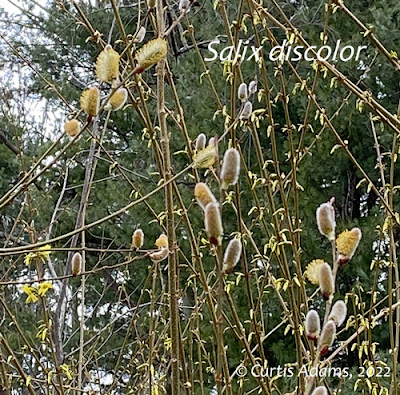
I have been looking for native willows to replace the mounds of forsythia on my property.  Willows bloom early in the spring, like forsythia.  But unlike them, willows do provide a benefit to the native insects: early flowers for bees and as a host species for a number of insects.  Early on I put in some native pussy willows (Salix discolor).  These are doing well but mine tend to have a taller upright form (nearing 20’) rather than a more rounded shape that I was looking for.  Prairie willow has the form I’ve been after, 4-7’ tall with a loose vase-shaped habit.  It is also tolerant of drier conditions than most willows.  I’ve got some on order, so we will see later this spring if my search is finally over. 

Pussy willow blooms at about the same time as
forsythia (shown here in the background).  


Another species that I have been trying to expand in my landscape is smooth hydrangea.  Most of mine are the huge mophead type, most likely ‘Annabelle’.  These grow really well with lots of flowers, but since most of these flowers are sterile, they offer little benefit to wildlife.  Two years ago I planted planted some tiny pots of the ‘Haas Halo’ cultivar.  These were highly rated in a recent study done at the Mt. Cuba Center.  These have large lace cap flowers which consist of mostly small fertile flowers in the center surrounded by a ring of large sterile flowers.  The plants grew to over 2’ tall last season, so I’m hoping I might see some flowers this year.  To build on this diversity I ordered a wild-type smooth hydrangea to add to the mix.  Wild-type plants usually have smaller flowers than the cultivars, but I’m hoping to see a benefit in the production of some seeds that could help the birds.

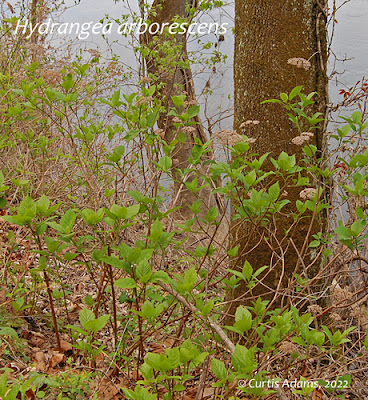
These wild hydrangeas are growing along the Potomac River
in Maryland. This photo was taken in late April. 
It seems kind of early for buds to be forming, considering
that 'Annabelle' hydrangeas normally bloom in June
.


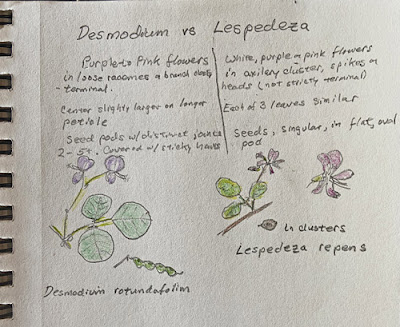
An ongoing project that I have is to find replacements for vinca, particularly in dry shade.  I am expanding the scope to include a replacement for the yellow archangel (Lamiastrum galeobdolon) that is spreading in my pine woods.  Last year I got some round leafed tick trefoil (Desmodium rotundifolium) for which I had been searching for 10 years (we’ll see how that has overwintered). It trails along the ground sporting three round leaflets on each stem. While examining catalogues I came across another trailing plant for dry shade, creeping lespedeza (Lespedeza repens).  While not super attractive on its own, it may work nicely in a matrix planting. 

I didn't have a photo of the Lespedeza, so I'm sharing an image
from my botanical sketchbook.  Included are some notes on
how to tell Desmodium and Lespedeza species, both
members of the pea family, apart.


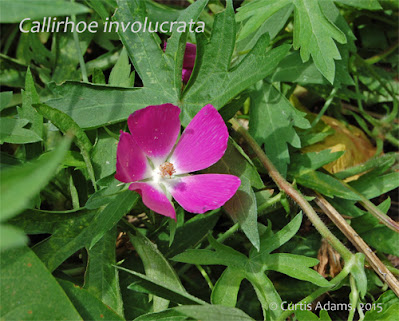
The wine cups are an exception to my focus on regional natives.  These are native more to the mid-west and southern plains, than to the east, but I became enamored with them ever since I saw them in a field in the Ft. Worth area.  I was able to grow them in the Boston area and had them for awhile here in Maryland.  The problem was that they were not able to compete with dense growth of asters, goldenrods, and Virginia creeper that surrounded them.  This time I will plant them where they have a little more of their own space to get established.

The magenta flowers of wine cups are hard to miss.  It has a
sprawling habit and can form a ground cover 
where competing vegetation is sparse.


As I mentioned above (and last year at this time) I will also be moving many native seedlings out of my vegetable garden, particularly Rudbeckia sp., Monarda fistulosa, Asclepias tuberosa, and Echinacea purpurea, and into the beds where I am fighting Japanese stiltgrass.  I started that process last year.  It’s too soon to see a difference, though some of the transplants appear to have overwintered.  Their real value will be if they are able to reseed themselves and become self-sustaining.


Saturday, July 1, 2017

Red, White and Blue for the Fourth and other times, too

Happy Fourth Of July!  When I think of the 4th it's all about red, white and blue.  In the garden these colors are not usually used together, unless you are doing a theme planting or a flower arrangement.  Occasionally it happens, though, by accident.

This mostly native arrangement has 'Annabelle' Hydrangea for white,
Monarda didyma and non-native Salvia splendens for red, and the blue
 is supplied by Campanulastrum americana and Salvia farinacea 'Victoria blue'.
The green fireworks are bottlebrush grass, Elymus hystrix.
While I didn't plan this color scheme, this combination of
blue flag iris, Iris versicolor, and the red and white striped flowers
of myrtle-leaf mountain laurel, Kalmia latifolia 'Minuet'
made a pretty nice display in late May. 
Here are some North American native plants that can supply you with red white and blue flowers for each season of the year.

Reds:
Scarlet sage is not hardy here so I grow it as an annual.
However, its seed will overwinter with a little protection
 In picking out these plants I looked for true reds rather than the many pinks and purples that are out there.  Roughly in the order of bloom from spring to fall  there is red trillium (Trillium erectum), wild columbine (Aquilegia canadensis), Indian pinks (Spegelia marilandica), fire pink (Silene virginica), red beebalm (Monarda didyma), various red salvias (Salvia ssp.), standing sypress (Ipomopsis rubra), turkscap (Malvaviscus arboreus), scarlet  rosemallow (Hibiscus coccineus) and cardinal flower (Lobelia cardinalis).
Cardinal flower makes a strong statement in late summer in sunny moist locations
White:
The pure white flowers of bloodroot are one
of my favorites in early spring.
There seems to always be something white in bloom. Here are 10 native plants with white flowers roughly in order of appearance:  Bloodroot (Sanguinaria canadensis), Phlox (all species have some white forms blooming from early spring to late summer), beardtongue (Penstemon digitalis), elderberry (Sambucus canadensis), hydrangea (H. arborescens and quercifolia), summersweet (Clethra alnifolia), swamp rosemallow (Hibiscus moscheutos, often with a scarlet center), tall snakeroot (Ageratina altissima), white turtlehead (Chelone glabra) and various asters.
Elderberry has large flat flower clusters
for nearly a month in late spring.


Blue:
There are also native blue flowers throughout the growing season.  These plants tend to prefer shady locations.  Also their blue flowers show better in part shade than they do in full sun.  Many of the blues tend toward lavender or purple, I've tried to select more mid-range blues.  Here are a few, again in order of bloom:
Virginia bluebells carpet moist ground in early spring.
Virginia bluebells (Mertensia virginica), Jacob's ladder (Polemonium reptans), Ohio spiderwort (Tradescantia ohioensis), blue flag iris (Iris virginiana), American bellflower (Campanulastrum americanum), gayfeather (Liatris spp.), mealycup sage (Salvia farinacea), blue mistflower (Conoclinum coelestinum), great blue lobelia (Lobelia siphilitica) and various blue asters.

This smooth aster is one of the bluer (less purple) native asters in the eastern US.
(Should be Syphyotrichum laeve, sorry)

There are many other red, white and blue blooming natives out there and I would appreciate hearing what your favorites are.  And again, Happy 4th!!!