Showing posts with label Lonicera sempervirens. Show all posts

Saturday, March 18, 2017

It looked like a mild winter until...

We've been having a pretty mild winter this year.  The average temperature in the U.S. in February 2017 was 7.3 F above the 20th century average.  Comparing photos I'd taken in 2014 and 2015 with this year indicates that this year we are 2-4 weeks ahead, based on the blooming of the crocus and forsythia.  On March 14th we finally got a good dose of snow in our neck of the woods (west-central Maryland).

This late snow is out of place with the forsythia that has been blooming since late-February this year.

About a week before the snow storm I took a walk around the woods to see what was starting to come up.  The first thing I checked on was the spicebush.  It usually begins blooming shortly after the forsythia.  This year, while the forsythia had been in bloom for a couple of weeks, the spicebush was just getting started.
March 10th and the flower buds on the spicebush were just opening.

The next plant I checked was the pussy willow, Salix discolor.  This native tree/shrub is one of the earliest blooming native plants and is an important source of pollen to early season native bees.  Since this species is dioecious, only the male plants are sources of pollen; however both male and female flowers have nectar.
The buds of this pussy willow are just opening.  When fully in
bloom the flower buds of this male plant will be covered
with yellow pollen-bearing anthers.

Looking down on the ground in the leaf litter I found a number of Virginia bluebells, Mertensia virginica, that had just come up.  Sometimes the new leaves have a purple tinge to them, but that color quickly fades to green.  The spikes of flower buds follow quickly after this first flush of leaves.
These Virginia bluebells have just come up.

Also showing up on the ground was white avens, Geum canadense, which is pretty common in this area.  While its not particularly beautiful in bloom, it does fill in gaps in the shady understory and its wispy white flowers break up the sea of green leaves.  In the early spring it is by the light colored veins on the deeply divided leaves.
The leaf markings on this white avens rival those of some Heucheras;
however, as it matures the dominant leaves will be smaller and the veination less noticeable.
The plant to the left in this photo is purple deadnettle, Lamium purpureum.  This introduced species is scattered throughout the shady areas.  While weedy, it does not appear to be causing too much trouble with the other plants.


These violets look a little like garlic mustard, ...
Also noted among the fallen leaves were fresh leaves of some native violets, probably woolly blue violet, V. sororia.  These nearly round leaves have finely serrated margins (crenate) and fairly smooth leaves.

They can be distinguished from the over-wintering garlic mustard rosettes that have longer, slender petiole and leaves that are deeply veined and more deeply toothed serrate leaf margins.


Garlic mustard has deeply veined leaves that
look tired, having been out all winter.
Garlic mustard is not the only invasive species that is evident right now.  In fact late winter is a good time to spot some invasive species since they tend to come to life a little before most of the native species.  Multiflora rose and barberry are both leafing out now making them stand out in the woods.  Since the soil was soft I was able to pull a number of these bad guys out of the ground.  This is also a good time to spot Japanese honeysuckle growing up in the trees.  Now is a good time to  cut these climbing vines and deny the roots an early burst of energy.

Most native honeysuckles have the two terminal leaves fused together
like this just below the flower bud.


While not growing with the same vigor as the Japanese honelysuckle at this time, the native coral or trumpet honeysuckle is also leafing out. Flower buds are beginning to form, though the normal bloom season is closer to mid-spring.


Sunday, January 4, 2015

A Winter Walk

Seeing as we were having a spell of dry weather on New Year's day, I decided to take a walk through the woods to see what was happening.  Now that essentially all the leaves are gone there's a whole other world of things to see.  Instead of focusing on the foliage, trees can be recognized by their bark, branching patterns and leaf buds.  On the ground level the few evergreen grasses and perennials are easy to find.  In particular, the evergreen ferns jumped right out.  Following are some photos of plant features that I came across.

The buds of this 2 year old seedling are
smooth and reddish brown.
The first place I checked out were some tree seedlings that I identified in the vegetable garden last summer.  Since I already knew what they were I could learn about how they look in the off season and store that away for future reference.


The end bud of the Sycamore was smooth and pyramidal.  Kind of like those of ash trees, but the sycamore has a single false-end bud (not centered at the absolute end of the twig), while ashes have a terminal bud flanked by two smaller, opposite buds.   

Another tree that sprouted in the garden was an Eastern Cottonwood, Populus deltoides.  Here the bud end is true and the scales are visible.  To me the most notable feature is that the year-old wood looks like it has shrunken back. leaving the stem somewhat squarish with wings, or ridges along the corners. 

Cottonwoods are often considered rather messy trees.  This spring I will transplant it into a moist area of the meadow that I am clearing of invasives.


The  dry leaves on this American beech
make it easy to spot in the woods.

Moving into the woods a young American Beech caught my eye.  In the winter these can be recognized by their tendency to hold onto their leaves until the spring and by their smooth white bark.

Another tree that has smooth white bark is the American Hornbeam, Carpinus caroliniana.  While the beech has a smooth rounded trunk, The hornbeam's trunk is grooved, giving it a muscular or sinewy appearance.  Another way to distinguish these two white-barked trees is their leaf buds.  The buds of the hornbeam are small and dark brown while those of the beech are orangy-brown, long and pointed with many obvious scales.


Another tree with unique bark is the Hackberry.  Though highly variable many trees develop warty knobs and/or ridges that is easy to recognize.  Despite the unappealing name, the hackberry is a valuable wildlife plant, both as a butterfly host species and for producing a crop of 'sugarberries' in the fall for birds and small mammals.
The bark of the Hackberry is hard to miss.

Looking onto the ground plane I found several different evergreen grasses, which remain unknown.  More easily identified were the several species of evergreen ferns.  The most easily ID'ed was the Christmas fern.  This is a common species here growing mostly in shady moist areas.  

Christmas Fern is 'once-cut' and the pinna (leaf)
has a single lobe that makes it look like a boot.


A much smaller fern common here is the Ebony Spleenwort, Asplenium platyneuron.  This one is found in partly sunny location with average moisture.  Mine usually grow to about 6" long and hide in the undergrowth.


The frond of this Evergreen Wood Fern
appears to have been stepped on,
but otherwise looks pretty good.  

While poking around a steeply sloped area I found a fern that was new to me.  Unlike the previous two species this one was much frillier (thrice divided).  I took a bunch of photos and pulled out my fern ID books to come up with a name.  Turns out that I was an Evergreen Wood Fern, Dryopteris intermedia.  This is a common species in the eastern US, but just not that common to my piece of the woods.  It's relatively healthy green appearance in the middle of winter would make it a good addition to a home landscape.


When ID'ing ferns look on the bottom sides of the fronds for the sporangia or sori.
Their shape and location are distinctive for many species.

An unknown fern growing at the base of a tree.


There was one fern that I could not figure out.  It was small (3-4") and had fairly simple leaves (pinna).  It's grow in a gap between roots of a large tree.  I checked the underside of the frond for sporangia, but none to be seen.  I'll need to come back later in the spring to see how it develops.

I would appreciate any ideas on what this might be.


Underside of fronds shows no additional clues.

The last group of plants I checked on were some vines that I planted last summer.  My property is inundated with Japanese honeysuckle.  While I am trying to remove those I am also adding some native ones to fill the voids,  I put in a native Coral Honeysuckle along a fence in the spring.  It quietly grew to a span of over 6'.  Looking forward to seeing some blooms in the spring.  I also added some cultivars, 'Honey Coral' and 'Sulfurea'.  
Can see some flower buds forming on this Coral Honeysuckle.  OOPS, this is actually
Carolina jessamine, Gelsemium sempervirens.  I think it was a tag mix-up in the nursery.
It was covered with yellow blossoms in 2016.

The leaves of this Carolina Jasmine have turned red,
 but are holding on.

On an impulse I also picked up a Carolina Jasmine cultivar called 'Margarita'.  This species is hardy to zone 7, naturally occuring as far north as southeastern Virginia.  However, this 'Margarita' cultivar is good into zone 6.  So far it is holding onto its leaves.  This one may be too small to bloom come February, but I will be happy if it just survives and starts growing when the weather warms.

Wednesday, December 12, 2012

Making Progress, Inch by Inch

As the leaves are falling and the undergrowth is dying back I am able to get a better idea of what is actually growing on my new property.  My goal is to (re)establish a population of native plant species that is consistent with this geographical area (Mid-Atlantic Piedmont).  The first step is to learn what is already present.  That is becoming more difficult as the leaves and flowers of most to the plants are now gone.  I am moving ahead with step two, removing those invasive species that I had already identified.

Ailanthus trees are fast growing, these ca. 10 year old trees were about 25 ft tall.
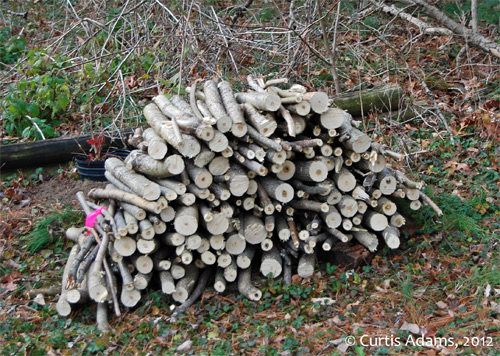
My most recent targets are the Tree Of Heaven, Ailanthus altissima, that are scattered along the edges of the woodlands.  Spring to early summer are better times to cut this tree down, after the tree has used up much of its stored energy putting out new growth.  However, now that the undergrowth is thinning, I have better access to the trunks to cut them out.  I will need to follow up with cutting and/or treating the new growth in the spring.  The Virginia Department of Forestry has a detailed bulletin on Control and Uses of Tree-of-Heaven. From this I learned that Ailanthus makes decent firewood, so rather than throwing them in the brush pile, I'm stacking up the pieces for use in the fireplace next season (Ailanthus has a high moisture content and needs seasoning to burn well).

Ailanthus wood, when properly dried, can be for building furniture,
but burning it as firewood will be more satisfying
Other species currently on my removal list are the Multiflora Rose, Winged Euonymus and Oriental Bittersweet.  I will thin the thickets now to make them more accessible so that I can cut-and-treat the main stems in the best season (late summer for the Rose and Euonymus, and nearly anytime for the Bittersweet, as long as the ground isn't frozen).


Sycamores along Israel Creek.  
While I was clearing the trees I realized just how beautiful the bare trees can be.  The the native Sycamores, Platanus occidentalis, have strikingly white branches against the brown backdrop of the woodlands. The white bark of these trees made be think of Paper Birches, more common in the northern forests; although the Sycamores have a very different branching form.  I have also begun to appreciate the forms of the other trees, especially when the sun is low and they are silhouetted in the dim light.


Beautiful color at sunrise on a partly cloudy morning...

...but ground fog creates a more dramatic effect.

I was very surprized to find a few blooms on a Coral Honeysuckle, Lonicera sempervirens.  These vines are everywhere, but this one close to the house is the only one in bloom right now.  Since we didn't move in until late September, we missed the peak blooming of these vines earlier in the summer.  I'm looking forward to seeing how many of these vines put out blooms.


For the rest of the winter my main chore will be to continue cutting back the thickets of invasive shrubs as I make out my shopping list for native shrubs to replace them in the spring.