Showing posts with label Polystichum. Show all posts

Friday, April 2, 2021

Picking the Right Ferns


When I think of planting ferns I usually think of shady, moist conditions.  But that’s not all.  There are ferns that do well in dry conditions and some that can handle a fair amount of sun.  One aspect of fern selection I had not thought of much was soil pH (or acidity).  My only knowledge here was that maidenhair fern, Adiantum capillus-veneris, needed alkaline conditions, but that was about it.  (However, Northern maidenhair fern, A. pedatum, is less demanding, preferring neutral conditions.)  My eyes were opened a bit further when I read an article in Fine Gardening by C. Colston Burell on Hardy Native Ferns.  In it is a table listing light and soil tolerance of about 25 native ferns.   I thought that I now had a definitive decision making tool.  However, as I did some more research for this blog post I started finding conflicting information on what conditions particular species preferred.  One reason for the confusion may be the difference between ‘preferred conditions’ and ‘conditions tolerated.’  While some species are very particular about what they need to grow, others are more tolerant of variation.  Lacking a full understanding how growing conditions were measured and of what truly unacceptable conditions are, I am inclined to treat published growing conditions as more what you’d call guidelines than actual rules. 

With that in mind, the table got me to thinking about the ferns I had planted that were not doing very well.  Three particular ferns that are not excelling in my plantings are royal fern, cinnamon fern and hay-scented fern.  The soil in my area is neutral to alkaline and these struggling ferns are listed in Burell’s table as preferring acidic soils. 

The royal fern, Osmunda regalis, is in a moist shady spot.  I was hoping that this taller fern would form a diffuse back ground to highlight smaller plants planted in the foreground.  After three years it has not grown more than 6 inches tall and has only put out a few stems.  This year I will try transplanting over some ostrich ferns, Matteuccia struthiopteris, into that area.  These are listed as growing in alkaline conditions and they have a very strong vase shape, though they are visually more dense than royal ferns.

Ostrich fern grows to about 3' tall with a strong vase-shaped
habit, reaching full size by mid-spring.  Its preference
for neutral to alkaline conditions makes it a good choice
for foundation plantings.


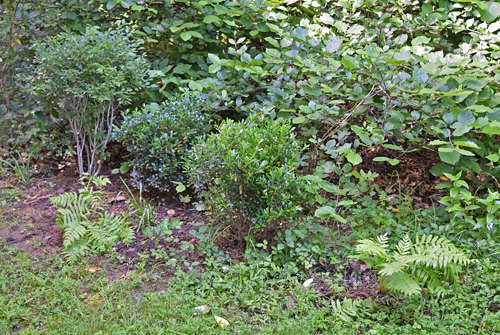
The cinnamon fern, Osmunda cinnamomea, is doing somewhat better.  It’s planted in part sun with similar moist soil.  I was hoping that the light green fronds of the vise-shaped fern would stand out on the edge of a shrub border.  So far the plants are just holding on.  Perhaps here I could add some sulfur to make the soil just a bit more acid.  (That would also benefit the nearby hollies.)


These 2 cinnamon ferns were chosen for there bright green color and
vase-shaped form which contrasts with the darker green of the
hollies behind.  All of these plants would benefit from a bit more soil acidity.

The third fern that is under-performing my expectations is hay-scented fern, Dennstaedtia punctiloba.  My understanding was that this aggressive fern would grow just about anywhere.  That’s why I am using it in my vinca replacement project where the conditions are dry shade.  Three years in and only one clump has spread a little, and two others have died. 

These hay-scented ferns, growing in a gravel bed, are just unfurling
in mid-April in the Boston area.  They will grow to be about 2' tall.

Considering that my soil is pretty much neutral (6.8-7.2) I should avoid ferns that need acidic conditions and focus more on those that are happy with neutral conditions. 


Ferns suited to neutral to alkaline conditions include: ostrich fern, Matteuccia struthiopteris, marginal wood fern, Dryopteris marginalis, lady fern, Athyrium  filix-femina and sensitive fern, Onoclea sensibilis.  One uncommon fern I found growing in the woods was blunt-lobed cliff fern, Woodsia obtusa, which prefers alkaline conditions.

This cliff fern is growing on a east facing rocky slope.

Ferns that I have found noted as indifferent to soil pH are Christmas fern, Polystichum acrostichoides, and ebony spleenwort, Asplenium platyneuron.  These are both very common ferns on my property.

Christmas fern is evergreen and has a more relaxed upright habit. 
Even in January this fern looks pretty good.


Ebony spleenwort is a smaller fern more useful as a ground
cover component than as a feature plant.  This specimen was
growing in full shade and was about 8" tall.  In sunnier locations
it stays closer to the ground.  Ebony spleenwort will grow on a
variety of soils whereas other species of spleenworts prefer
neutral to alkaline conditions.

Maybe it's best to proceed cautiously when there is a question.  If you’re uncertain, rather than doing a massive planting, put in one or two and see how they do. 


Sunday, January 4, 2015

A Winter Walk

Seeing as we were having a spell of dry weather on New Year's day, I decided to take a walk through the woods to see what was happening.  Now that essentially all the leaves are gone there's a whole other world of things to see.  Instead of focusing on the foliage, trees can be recognized by their bark, branching patterns and leaf buds.  On the ground level the few evergreen grasses and perennials are easy to find.  In particular, the evergreen ferns jumped right out.  Following are some photos of plant features that I came across.

The buds of this 2 year old seedling are
smooth and reddish brown.
The first place I checked out were some tree seedlings that I identified in the vegetable garden last summer.  Since I already knew what they were I could learn about how they look in the off season and store that away for future reference.


The end bud of the Sycamore was smooth and pyramidal.  Kind of like those of ash trees, but the sycamore has a single false-end bud (not centered at the absolute end of the twig), while ashes have a terminal bud flanked by two smaller, opposite buds.   

Another tree that sprouted in the garden was an Eastern Cottonwood, Populus deltoides.  Here the bud end is true and the scales are visible.  To me the most notable feature is that the year-old wood looks like it has shrunken back. leaving the stem somewhat squarish with wings, or ridges along the corners. 

Cottonwoods are often considered rather messy trees.  This spring I will transplant it into a moist area of the meadow that I am clearing of invasives.


The  dry leaves on this American beech
make it easy to spot in the woods.

Moving into the woods a young American Beech caught my eye.  In the winter these can be recognized by their tendency to hold onto their leaves until the spring and by their smooth white bark.

Another tree that has smooth white bark is the American Hornbeam, Carpinus caroliniana.  While the beech has a smooth rounded trunk, The hornbeam's trunk is grooved, giving it a muscular or sinewy appearance.  Another way to distinguish these two white-barked trees is their leaf buds.  The buds of the hornbeam are small and dark brown while those of the beech are orangy-brown, long and pointed with many obvious scales.


Another tree with unique bark is the Hackberry.  Though highly variable many trees develop warty knobs and/or ridges that is easy to recognize.  Despite the unappealing name, the hackberry is a valuable wildlife plant, both as a butterfly host species and for producing a crop of 'sugarberries' in the fall for birds and small mammals.
The bark of the Hackberry is hard to miss.

Looking onto the ground plane I found several different evergreen grasses, which remain unknown.  More easily identified were the several species of evergreen ferns.  The most easily ID'ed was the Christmas fern.  This is a common species here growing mostly in shady moist areas.  

Christmas Fern is 'once-cut' and the pinna (leaf)
has a single lobe that makes it look like a boot.


A much smaller fern common here is the Ebony Spleenwort, Asplenium platyneuron.  This one is found in partly sunny location with average moisture.  Mine usually grow to about 6" long and hide in the undergrowth.


The frond of this Evergreen Wood Fern
appears to have been stepped on,
but otherwise looks pretty good.  

While poking around a steeply sloped area I found a fern that was new to me.  Unlike the previous two species this one was much frillier (thrice divided).  I took a bunch of photos and pulled out my fern ID books to come up with a name.  Turns out that I was an Evergreen Wood Fern, Dryopteris intermedia.  This is a common species in the eastern US, but just not that common to my piece of the woods.  It's relatively healthy green appearance in the middle of winter would make it a good addition to a home landscape.


When ID'ing ferns look on the bottom sides of the fronds for the sporangia or sori.
Their shape and location are distinctive for many species.

An unknown fern growing at the base of a tree.


There was one fern that I could not figure out.  It was small (3-4") and had fairly simple leaves (pinna).  It's grow in a gap between roots of a large tree.  I checked the underside of the frond for sporangia, but none to be seen.  I'll need to come back later in the spring to see how it develops.

I would appreciate any ideas on what this might be.


Underside of fronds shows no additional clues.

The last group of plants I checked on were some vines that I planted last summer.  My property is inundated with Japanese honeysuckle.  While I am trying to remove those I am also adding some native ones to fill the voids,  I put in a native Coral Honeysuckle along a fence in the spring.  It quietly grew to a span of over 6'.  Looking forward to seeing some blooms in the spring.  I also added some cultivars, 'Honey Coral' and 'Sulfurea'.  
Can see some flower buds forming on this Coral Honeysuckle.  OOPS, this is actually
Carolina jessamine, Gelsemium sempervirens.  I think it was a tag mix-up in the nursery.
It was covered with yellow blossoms in 2016.

The leaves of this Carolina Jasmine have turned red,
 but are holding on.

On an impulse I also picked up a Carolina Jasmine cultivar called 'Margarita'.  This species is hardy to zone 7, naturally occuring as far north as southeastern Virginia.  However, this 'Margarita' cultivar is good into zone 6.  So far it is holding onto its leaves.  This one may be too small to bloom come February, but I will be happy if it just survives and starts growing when the weather warms.

Tuesday, May 1, 2012

Remembering Bloom Times -my Gardening Oops

The first of every month is Gardening Oops day at Joene's Garden blog.  There she describes a recent garden miscues with the goal of educating other gardeners.  This month I found a garden oops of my own to share.

Early Tulips:  Added Apricot Emperor Tulips
to a large mass of early yellow Tulips and Daffodils
While I work primarily with native plants, I have also been doing more and more bulb plantings.  The intense color of bulbs in the spring brings a welcome end to winter.  I've tried to make things interesting by putting together some less common color combinations.  In addition to working out colors, you also need to consider bloom times to get those combos to show up together.

Putting in a few orange tulips was pretty effective for adding a little more interest to a nearly all yellow bed.  These also went well with the few grape hyacinths scattered around.

Late Tulips: Orangy 'Dordogne' with purple 'Cum Laude'
and some mid-season 'Purple Prince' in the background.


Another combination I thought long and hard about was combining orangy and purple shades.  In this example I used late season varieties (normally blooming in May).  Some late season Daffodils in the background crank up the color intensity of this combination.


I really like the color of the 'Dordogne' tulip.  I got a bunch of these bulbs and used them in several clients gardens.  I had a few left over so I decided I should use them in my own yard.  This is where the Oops comes in.   Since I don't have too much extra space I looked hard for a place to put them.  I finally settled on putting a few clumps under the Moss Phlox in the front border.  This seem to be the perfect space.  I imagined these beautiful tulips coming up through the mossy green foliage of the Phlox.  At least that what I thought when I planted them in October.

It turns out that this tulip blooms at the same time as the 'Emerald Blue' Phlox.  This is not a combo I would have consciously put together.

'Dordogne' with blue Moss Phlox,
not the prettiest picture.

OOPS.  Not what I expected last October!

But if you zoom back a little further on this scene, you can really get assaulted by adding in the intense red of this Azalea.  So while I did find a great place in space for my new tulips, it turned out to be the wrong place in time, considering the colors of the existing plants.  

Other options for planting tulips in front of intensely colored shrubs are to use bulbs that aren't blooming when the shrub is in flower, or to better match the color of the bulbs to the shrubs.  Perhaps an all white tulip or one with red streaks in it would work better.


Well, when it gets too intense in the front yard I can always head around to the back yard where the native ephemerals paint a much more calming scene.
Fiddleheads of Christmas Fern unfurling in front
of some Large Flowered Bellwort and  Twinleaf