Showing posts with label Lindera benzoin. Show all posts

Tuesday, October 27, 2020

Oh Deer

Even though as winter sets in deer metabolism slows and feeding/browsing damage becomes less obvious, deer still manage to cause some major damage to the landscape


A willow, Salix discolor, that has suffered multiple deer attacks, yet has survived. 
The trunk guards were put on after the fact.


Last February I came to the realization that if I wanted to grow new trees, especially conifers, I would need to protect them from the deer, especially the males during mating season. Here in the Mid-Atlantic November brings on rutting season, the time when white tailed deer mate.  During rutting season male deer rub their antlers against trees and shrubs to remove the velvet from the newly grown horns.  They also will rub trees to mark their territory and to take out their heightened aggressions as mating season kicks in.  What deer prefer for this rubbing behavior are trees and shrubs 1-4” in diameter with smooth bark, like willows and magnolias.  Aromatic cedar and other conifers are also favorites.  Once a tree is marked they will often return to the same one.  At one time I had a nice little Canaan fir, Abies balsamea var phanerolepis,  that I surrounded with chicken wire after it had been rubbed a little.  Two days later all that was left was a bare splinter of a tree.  Now is the time to put up some protection to save some of our precious young plants before they are destroyed.  Following are some of the actions I've taken.

Trunk Protection
Last year I tried horizontal fencing for the first time and did not have great results.  It did not protect a young magnolia from rubbing, but a number of small evergreens did not take any damage.  Based on the photos I have, the deer appeared to skirt the areas with fencing lying on the ground. 
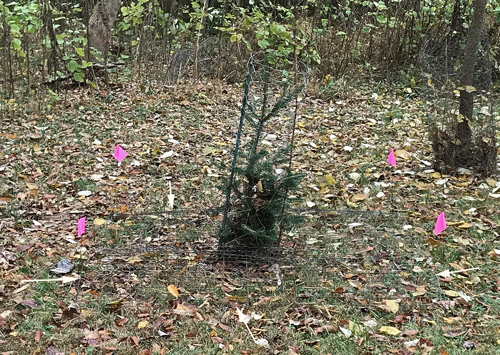
The pink flags indicate where I have put 2"x4"welded wire fencing on the ground around this little Canaan fir tree. 
The idea is that it creates unstable footing that the deer don't like.  The flags help me avoid the fence when mowing. 
I want to add some block underneath to lift the fencing further off the ground.

This year I have plastic mesh poultry fencing wrapped around the trucks of most of the stag-susceptible trees.  For others I have a heavier duty  4” drain pipe around the trunk.  (I’m a little concerned about heat build up under these black tubes.  For that reason I drilled ¾” holes every 6”to aid in ventilation.)  I also used some paper tree wrap on some smaller specimens.  One product that looks very good to me is a white spiral plastic.  It looks like it will protect the bark from rubbing and is open enough to prevent heat build up and not harbor insects.  I haven't bought any of that, yet.  A welded wire barrier surrounding the tree trunk has also proven very effective.  This is most efficient with single trunked trees with few lower branches.  Chicken wire may do a good job of limiting browsing but I've seen it ripped away from small trees that had been rubbed by a buck.

I wrapped the trunks of this fringe tree, Chionanthus virginicus, with plastic poultry fencing. 
It's easy to cut and can be tied together with zip ties or wire.  This material should protect the bark,
but will not support the trunk.


Here I am using a spiral cut 4" drain pipe to protect the trunk of this persimmon tree,
Diospyros virginiana.  I drilled holes in it every 6" to reduce heat build up.  This is
pretty tough material and should hold up to attack.


This Sassafras is being protected with a conventional welded wire cage. 
It's been here 4 years, but now it's of prime size for a deer attack. 
Hopefully the large size cage will be a good deterrent. 
I pulled the cage away during the summer to strengthen the trunk.  
  
Except for the open mesh materials it is a good idea to remove bark protection in the spring.  Heat and moisture build up can damage the bark and in some cases can harbor insects.  Also too much rigid support can keep a tree from developing a strong trunk.  I found this with my young sassafras.  It was getting floppy and the truck was not able to support the top growth on its own.  I pulled away the support this past spring and now the truck is much firmer.

Here  on this willow I'm comparing a variety of protection devices. 
On the right is a paper tree wrap.  Not sure how that would hold up versus a buck.


Repellents
In winter deer’s metabolism slows down, but they are still out there browsing.  Evergreens, branch tips and leaf buds are at risk.  Fencing and cages are effective at keeping deer far enough away to prevent browsing.  Burlap warps that are used to prevent winter burn on arborvitae should also work.  Repellents are also helpful.  In colder weather taste-based repellents have an edge because they do not need to be volatile.  It is often recommended to alternate among different repellants through the season so that deer don't get used to any one of them.   So far I haven't done that.  

Reading about all the different recommendations for deer repellants, as well as deer resistant plants, it has become clear that not all deer are the same in regards to their likes and dislikes. Be flexible and try different recipes and products.  I've had good success using Bobbex which contains a variety of taste and odor deterrents. 


Planning Ahead
I’ve seen a number of people on Facebook ask about starting gardens in areas with lots of deer.  My deer seem to test every new plant that goes in the garden.  For new shrubs I usually put a chicken wire cage around them.  As far as planning an new large planting, I like the advice I’ve read in ‘Deerproofing Your Yard & Garden’ by Rhonda Hart.  She recommends fencing in the new garden space before doing any planting.  This is because deer are creatures of habit.  If they have never found anything of interest in an area, then they are not likely to return.  But, once they have found something tasty there, they will make every effort to return.


On the Bright Side?
Deer browsing results in some unsightly damage to many landscape plants.  It is not uncommon to find hedges of arborvitae and junipers chewed back up to about four feet off the ground.  There are some aspects of deer browsing behavior that could be considered beneficial.  The following two photos show where deer have pruned away branches from the lower 4 feet of a yew and a rhododendron.  This sort of pruning opens up the ground plane for lower growing herbs to fill in. In the absence of deer these would be mounds of foliage.  I've also seen this with spicebush, Lindera benzoin, in the woods. This can happen when there is not excessive deer pressure.  Had there been more deer here say 10 years ago these shrubs may not have grown more than a foot tall before being destroyed, unless they were being protected with cages and repellants.

The lower branches of this yew have been munched away over the years.

This rhododendron has been 'limbed up' by deer.

What methods have worked for you during rutting season?  I'd love to hear about them.


Saturday, March 18, 2017

It looked like a mild winter until...

We've been having a pretty mild winter this year.  The average temperature in the U.S. in February 2017 was 7.3 F above the 20th century average.  Comparing photos I'd taken in 2014 and 2015 with this year indicates that this year we are 2-4 weeks ahead, based on the blooming of the crocus and forsythia.  On March 14th we finally got a good dose of snow in our neck of the woods (west-central Maryland).

This late snow is out of place with the forsythia that has been blooming since late-February this year.

About a week before the snow storm I took a walk around the woods to see what was starting to come up.  The first thing I checked on was the spicebush.  It usually begins blooming shortly after the forsythia.  This year, while the forsythia had been in bloom for a couple of weeks, the spicebush was just getting started.
March 10th and the flower buds on the spicebush were just opening.

The next plant I checked was the pussy willow, Salix discolor.  This native tree/shrub is one of the earliest blooming native plants and is an important source of pollen to early season native bees.  Since this species is dioecious, only the male plants are sources of pollen; however both male and female flowers have nectar.
The buds of this pussy willow are just opening.  When fully in
bloom the flower buds of this male plant will be covered
with yellow pollen-bearing anthers.

Looking down on the ground in the leaf litter I found a number of Virginia bluebells, Mertensia virginica, that had just come up.  Sometimes the new leaves have a purple tinge to them, but that color quickly fades to green.  The spikes of flower buds follow quickly after this first flush of leaves.
These Virginia bluebells have just come up.

Also showing up on the ground was white avens, Geum canadense, which is pretty common in this area.  While its not particularly beautiful in bloom, it does fill in gaps in the shady understory and its wispy white flowers break up the sea of green leaves.  In the early spring it is by the light colored veins on the deeply divided leaves.
The leaf markings on this white avens rival those of some Heucheras;
however, as it matures the dominant leaves will be smaller and the veination less noticeable.
The plant to the left in this photo is purple deadnettle, Lamium purpureum.  This introduced species is scattered throughout the shady areas.  While weedy, it does not appear to be causing too much trouble with the other plants.


These violets look a little like garlic mustard, ...
Also noted among the fallen leaves were fresh leaves of some native violets, probably woolly blue violet, V. sororia.  These nearly round leaves have finely serrated margins (crenate) and fairly smooth leaves.

They can be distinguished from the over-wintering garlic mustard rosettes that have longer, slender petiole and leaves that are deeply veined and more deeply toothed serrate leaf margins.


Garlic mustard has deeply veined leaves that
look tired, having been out all winter.
Garlic mustard is not the only invasive species that is evident right now.  In fact late winter is a good time to spot some invasive species since they tend to come to life a little before most of the native species.  Multiflora rose and barberry are both leafing out now making them stand out in the woods.  Since the soil was soft I was able to pull a number of these bad guys out of the ground.  This is also a good time to spot Japanese honeysuckle growing up in the trees.  Now is a good time to  cut these climbing vines and deny the roots an early burst of energy.

Most native honeysuckles have the two terminal leaves fused together
like this just below the flower bud.


While not growing with the same vigor as the Japanese honelysuckle at this time, the native coral or trumpet honeysuckle is also leafing out. Flower buds are beginning to form, though the normal bloom season is closer to mid-spring.


Thursday, April 3, 2014

Spring is making an Appearance

With all the snow and low temperatures the Winter of 2013-14 seemed like it would never end.  But looking back at photos from this time last year, native plant growth is only a week or so behind 2013.  I almost did not venture out into the woods for an informal survey, but I'm glad I did.  While only a few native species were in bloom, many have broken ground and are forming flower buds.  Here are some photos of the highlights.

When walking through the woods, it pays to look up once in a while.
Many of the native spring wild flowers most active while the tree canopy is open.  Now they have have enough light to photosynthesize and store up energy.  Once the trees leaf out there is not enough light for these plants to continue to grow so many of them shut down for the summer.  These plants are known as the spring ephemerals.  

The first plants I noticed were the Virginia Bluebells, Mertensia virginica.  These first appear as purplish-gray buds through the leaf litter.  If last year is a guide they should be blooming in about 2 weeks.
As the leaves of these Virginia Bluebells mature they lose the purplish blush.

I was surprised to see the Spring Beauties in bloom.  There are only a few of them now.  Their number should continue to increase into May.  These grow from corms, so technically they are native bulbs.  If I happen to dig up any later this spring I will move them up into the bulb gardens closer to the house.  
These blooms are mostly white, pinkish ones appear later in the season.

The finely divided foliage of Dutchman's Breeches, Dicentra cucullaria, is also making an appearance.  I don't know if this species can be distinguished from Squirrel Corn, D. canadensis, just by the foliage.  I am making the assignment based on only seeing the former species last year.

The new foliage of all 3 eastern Dicentra species is very similar.
Off to the right are some leaves from Spring Beauties.

White Avens, Geum canadense, will bloom until later in the summer, but it is producing fresh foliage now.  It is recognizable by its deeply divided gray-green foliage.

One of the large basal leaves of White Avens  is at the lower right in the photo above.  

I saw a lot of leaves of Toothwort, Cardamine diphylla, and a few with flower buds. I also saw some leaves of cut-leaved Toothwort, C. laciniata.  These have similar coloration, but the leaves are deeply cut into five or more fingers.  These species were formally classified in the genus Dentaria.

You can see a mauve-colored flower stalk just left of center, above.

I purchased a couple of Golden Ragwort, Packera aurea, at a native plant sale last fall.  You can see that they over wintered well and it looks like they have already begun to spread.
Golden Ragwort should produce yellow daisy-like flowers on
long stems through spring and summer.


It's amazing that these little flowers will go on
to produce a couple of hazelnuts


The new growth was not limited to the perennials.  The shrubs are also beginning to bloom.  I got this American Hazelnut, Corylus americana, last fall.  It was bearing several nut clusters which grew to maturity last season.  This spring I only noticed the small red female flowers.  There were no male catkins on the shrub.  I don't know if their absence is due to the cold, or the deer.

I would have missed seeing the buds forming on this Yellowroot, Xanthorhiza simplicissima, if I had not remembered where it was planted.  The tops of the plant had been 'cut' back a bit.  Again, I don't know if this was from frost damage or deer browse.  
The flower buds of Spicebush, Lindera benzoin, are about to burst.  The flowering time of Spicebush is similar to Forsythia, but the color of the Spicebush is much more delicate.  In a week or so this area will be in a yellow haze of Spicebush flowers.  
Close examination of a Spicebush branch shows that the flower buds occur in pairs.
This helps with plant ID.

 All the new activity in the woods was not limited to the plants.  A small red speck racing along a a branch caught my attention.  It measured about 1/4 inch long and is 8 legged, like a spider.  Comparing images on a Google search for 'little red spider' led me to tentatively identify this as a Velvet Mite.  This is a predatory species feeding primarily on Arthropods.

This looks like it could be a Red Velvet Mite.  It moved very quickly for an insect so small.


Tuesday, April 23, 2013

More Maryland Wildflowers - 2nd Week of April

Deciding which native plant to use in a developed suburban landscape was fairly straightforward for me.  I could choose the plants I wanted without regard for to how it would impact the surrounding plant communities.  [Re]-introduction of nearly any native species into a sea of Euonymus and Barberries and the like would be a step in the right direction.

Now that I am working in a rural landscape I am becoming more sensitive to how my new plantings will affect the existing plant and animal communities.  I am cautious about introducing species that don't belong, native or not.  One very helpful resource for me is Native Plants for Wildlife Habitat and Conservation Landscaping Chesapeake Bay Watershed from the US Fish and Wildlife Service.  This publication lists many native species found in the Chesapeake watershed including their native ecoregion (Mountain, Piedmont or Coastal) and state where each is found.  

As a designer I also want to insert some visual effects with form and color.  This may require broadening the plant palette, drawing in materials from other areas and even a few well behaved non-native plants to achieve a particular aesthetic effect.  In general I will utilize a wider variety of plants in the immediate vicinity of a house or other man-made feature.  As I move out to the edges of a property I narrow the plant selection to the regionally native species.  I try to avoid introducing any species that don't naturally belong there.  

So before I get too far in planning and planting new native gardens I need to do some surveys of what is already present.  This (finally) brings me to the topic of what I found growing during the second week of April.  The tree canopy was still pretty open and the woodland floor was really greening up.


The first thing that really hit me was the masses of Virginia Bluebells that were coming into bloom.  These started coming up about a month ago.  Some had purple tinged foliage that has since turned green.


I was very pleased to see large masses of Mayapples coming up, especially I had just bought a half dozen to plant along the driveway.  These look somewhat alien when they first break ground.  They have a large white flower that stays just under the leaf.  


Mayapple leaves open up like umbrellas, 6-8 inches across.  


Once leafed out Spicebush can still be identified by the spicy scent of its bark.


The number of Spring Beauties has finally peaked,
now the blooms remain only in the shadier spots.
Note the garlic mustard off to the right.


Spicebush was another plant that I had just purchased to add to driveway area.  I was very happy to see a large mass of these growing near the creek.  The little flower clusters add an 
ethereal yellow haze to the scene.  These are not as garish as the Forsythia that are also in full bloom at this time.  


The Spring Beauties, Claytonia virginica, are continuing to come out - now the ground is sprinkled with the pale pink blooms.  The Dutchman's Breeches, Dicentra cucullaria, have also come into fuller bloom.  Some are white and others have a yellowish cast.  


Flowers started out a pale green
before opening up and turning white.

In with the Dutchman's Breeches is a plant with similar finely divided foliage, but this one had tubular yellow flowers.  It turns out that this is Yellow Fumewort, Corydalis flavula.  This native annual is 4-12 inches tall and has glaucous green foliage similar to other Corydalis.  I had never seen this before and was suspicious that it may some of the non-native Yellow Corydalis (C. lutea) that escaped from a garden.  The distinguishing feature from other yellow Corydalis (C. aurea and lutea) is that the upper lip of the flower is toothed.  This species is rare in New England, but not uncommon further south and west.


This winter annual was probably among the
early foliage seen back in January
The upper lip of the flower is toothed.  Also,
 seed pods are visible just below the flower on the left.


Should be getting some yellow flowers from these Trout Lilies in a couple of weeks.
If they are white, then these would be White Trout Lily, E. albidum.
Down in the leaf litter I noticed the spotted leaves of Trout Lily, Erythronium.  No blooms or buds were evident at this time, so I will need to get back down to these is a week or so to catch them in bloom.  As I was climbing back up away from the stream I noticed that the Toothwort were finally in bloom.  The dangling white flowers are not spectacular on their own, but they complement the other ephemerals. The Woodland Phlox, Phlox divaricata, are putting up flower buds, but I did not see any in bloom.  Back up on the lawn I am seeing Common Blue Violet, Viola papilionacea, complemented by the yellow flowers of Rough Cinquefoil, Potentilla norvegica.  Oops, these are actually the non-native Indian Strawberry, Duchesnea indica, see the comments below.


Each flower stalk of these toothworts has a pair
of deeply tri-lobed leaves, hence the epithet  'diphylla'.


Woodland Phlox has formed it flower buds.  Opps, this is actually Cardamine laciniata.
Common Blue Violet has hairless flower stalks,
otherwise this could be Woolly Blue Violet, V. sororia.


Unlike other weedy Cinquifoils, Rough Cinquifoil has
trilobed leaves and relatively large blunt-tipped flowers.  However, this is actually
Indian Strawberry, Duchesnea indica. with larger flowers than the Cinquifoil
and later a red berry.

Along with all of these natives there is a large population of garlic mustard that are beginning to bloom now.  Removing these will be a long and tedious process.  I have put a supply of black trash bags around the property to collect these.  In areas where the soil is moist it is possible to get most of the root out by gently pulling the plant by its crown.  Garlic mustard has a lot of stored energy in its root and may be able to set seed even though it has been pulled out of the ground.  A good practice is to bag them up and let them bake in the sun for a while before sending them to the landfill.  Garlic mustard should not be put into your compost. However, it is edible and you can make a decent pesto from it.