Showing posts with label Persicaria virginiana. Show all posts

Sunday, November 27, 2016

Not all plans work out

Three years ago we cleared out a section of garden that was over run by English ivy.  The plan was to put in some new native species as well as watching to see what would sprout up from the soil that had been covered with ivy for a number of years.  To the newly cleared space I put in some goatsbeard (Aruncus dioicus), and a strawberry bush (Euonymus americanus).  As a ground cover I got a bunch of Virginia jumpseed (Persicaria virginiana), which looked like the 'Lance Corporal' cultivar, with reddish chevrons on each leaf. These were followed up the following spring with American alumroot (Heuchera americana), Indian pink (Spigelia marilandica) and Solomon's seal (Polygonatum biflorum).

A jumbled mass.  Blue lobelia is recognizable on the left with spent flower stems of the alumroot.  The glossy leaves of Solomon's seal are evident on the right.  In the center you can make out the red flowers of the jumpseed, but the leaves are barely discernible.
Over the next 3 seasons I let the plantings develop without much interference, except for pulling out Japanese honeysuckle and garlic mustard.  Additional species that cropped up included natives like white avens (Geum canadense) and great blue lobelia (Lobelia siphilitica) as well as introduced species like mock strawberry (Duchesnea indica) and a cultivated species of columbine that had been reseeding itself for a number of years through the ivy.

In September as the flowers of the jumpseed are opening up,
something goes after the leaves, eventually skeletonizing them.
While it was interesting to see 'new' plants coming in, the overall planting was too chaotic to look good as a whole.  One problem with the new scheme was that the goatsbeard gets tattered by mid-summer if it gets too dry.  This can be fixed with a little more care and watering through the season. Also the long flower stems of the alumroot add to the confusion. The biggest disappointment was the jumpseed.  It looks nice early in the season with its striped leaves, but by late summer the leaves are decimated by some insects.  What remains is a jumble of wiry stems going every which-way that detracts from the spikes of red flowers.

After letting this area go for several years and not seeing any improvement I decided it was time to make it a little more formal by adding more defined layers to the garden.  While a random planting works in the distance, close up the human eye is looking for more defined structure and order.  In general, lower plants will go in the foreground, near the stepping stones.  Medium sized perennials go to the middle and the bushy goatsbeard stays in the back.  This new planting will be easier to maintain because it will be easier to identify the 'weedy' plants over a background of low sedges than it was before.

First I removed as much of the jumpseed as I could see.  Then I pulled out any encroaching English ivy and honeysuckle.  I also pulled out some native trees that seeded in, like butternut and box elder.  The lower-growing alumroot was already near the path.  For additional low-growing plants, I transplanted several species of sedges from elsewhere on the property.  Their lower stature, defined form, and contrasting texture will help show off the taller perennials.

Here's the garden after removing the jumpseed.  The back right is dominated by two goatsbeard, and the fencing is getting covered with virgin's bower (Clematis virginiana) that was planted in 2013.

In the foreground is one of the sedges I moved into the garden.
It could be Carex laxiculmis but I won't be sure until it blooms.
Also shown here are Alumroot and white avens,
at top with its deep red autumn color.
Since the Indian pinks don't like to be moved I left them in place and instead transplanted all the columbine to the middle ground.

The Solomon's seal was doing well, but they were getting hidden by the jumpseed.  I put some sedges around the Solomon's seal to give them some vertical space.

One of the sedges I chose has 1/4-1/2" wide blades and  grows in clumps about a foot wide.  These went in along the path and are scattered with the perennials to provide some height variation. Also it's evergreen so it will be around all year.  The white avens that is indigenous to this site has deeply lobed leaves that blend well with the alumroot.  The avens can get lanky and will benefit from some cutting back late in the season.

The other sedge is also clumping but has very thin, light green blades.  I'm pretty sure this is rosey sedge (Carex rosea).  It grows very well on partly sunny to shady sites.
The strawberry bush is known for these brightly colored seed pods in early fall.
Where the branches are touching the ground I am seeing new roots forming.
I'll separate these from the parent plant next season.  This is an easy way to propagate this shrub.

This unknown columbine was planted by a previous owner and
has been reseeding itself for a number of years.  Definitely not a native, but it looks good here.


So here's the garden after clean-up and planting.  It looks a little sad now since leaves are falling off and the plants are settling in for winter.

Weeded and replanted, we'll see what happens next year.

If all the transplants come back and the weeds don't return in force the new garden may look something like this overlay drawing.

As drawn here the goatsbeard, Indian pinks, and columbine are shown in bloom.
The sedges and alumroot line the stepping stones, from lower right to upper left.

Friday, August 28, 2015

Stiltgrass is in bloom - The time to act is now!

The flower heads of Japanese stiltgrass are just opening up.
The weedy plants have just had a growth spurt
bringing some of them to nearly 4' tall.
I am in midst of a multi-year battle to get rid of, or at least control, the Japanese stiltgrass, Microstegium vimineum, on our property.  Last year I came up with a plan to bring this invasive species under control.  The key element is to prevent this annual grass from setting seed.  Eventually (5-7 years) the seed bank will be depleted.  Also I am encouraging the existing native plant population to back fill the gaps to suppress re-invasion.

In late August stiltgrass goes into a growth spurt as the flower heads develop.  It is critical to cut it down or pull it out before seed set begins.  By killing the plant before the seeds can mature, you can dispose of the plants by composting.  Otherwise the plants would need to be segregated (e.g. bagged and sent to landfill) to prevent another generation of seed from spreading.  The taller stiltgrass is easier to find and pull than it is earlier in the season.  You should try to remove the plant close to the ground since it also produces a second hidden (cleistogamous) flower in the lower stem.


The following two photos show a moist shady area just before I removed the stiltgrass.

One year after close cutting stiltgrass in late August (2103) the growth is still rather dense.

After two years of cutting there appears to be more gaps in the stiltgrass converage.

In a couple of areas I was weed whacking and composting in place.  After 2 years of this I am seeing some minor decreases in the density of the stiltgrass coverage.  This year I raked the cut grass off and into a pile.  By removing the dense thatch I am hoping to seed some other species move in.  I have another large area where I will leave the cut grass in place.  We'll see if that makes a difference.


American germander blooms in late July and the seed is still maturing,
so I'd like to keep these standing a little longer.


One of my challenges is to remove the stiltgrass while leaving as much native vegetation in place.  Many of the earlier blooming natives, such as the beebalms (Monarda sp.) and tick trefoils (Desmodium sp.) have already gone to seed.  However, there are a number of later blooming species that I'm trying to preserve by carefully hand-pulling around them.  These include American germander, (Teucrium canadense), Virginia knotweed (Persicaria virginiana), white vervain (Verbena urticifolia), white avens (Geum canadense), and the native annual, clearweed (Pilea pumila).  While not beautiful plants on their own these species do fill the woodland edge with a variety of colors and textures largely obscured by the invasive stilt grass.

Clearweed is a fairly common native annual found in shady moist sites.
Currently in bloom, the flowers are yellow tassels in the leaf axils.


Here I'm halfway done with a section revealing some American germander (center).  To the left is my new grass whip.
I recently got a double edged grass whip which does a great job of ripping stiltgrass out of the ground while leaving single bladed grasses largely intact.


This low-growing sedge was hardly disturbed as the weed whip tore out the stiltgrass.

I am also finding a number of native grass species under and within the stiltgrass.  These include the evergreen, spreading sedge (Carex laciculmis) and deer-tongue grass (Dichanthelium clandestinum).

Sunday, August 31, 2014

It's late August and I'm seeing Red.....and some other colors, too


In direct sun the red of this Lobelia stands in
perfect contrast to the green background.
This is the first year for my Cardinal Flowers, Lobelia cardinalis, to bloom and I must say it really pops on a grass green back ground.  I planted these as seedlings last year and they never got very big.  Part of that was due to deer browsing.  This year the deer ate a little early in the season, but did not come back after the buds began to form.  I don't know if that has to do with a change in the taste of the maturing plant, or if it was due to spraying the plants with a new deer repellent, Bobbex.  Besides delighting the eye, the cardinal flowers are a big hit with the butterflies.

This Scarlet Sage is growing in a partly sunny garden.


Before I had a place with moist soil I relied on this Blood or Scarlet Sage, Salvia coccinea, to get an intense shade of red in late summer.  It grows well in moist to dry soils and will tolerate some shade.  Scarlet sage is usually grown as an annual.  In the past it has reseeded itself in my warm zone 6 garden in Boston.  We'll see how it does in my less protected Maryland garden next year.  I have seen hummingbirds feeding on this sage, as well as many bees. 

This photo taken early in the morning contrasts the yellow of evening primrose,
Oenothera biennis, with the violet of NY ironweed, Veronia noreboracensis.
These two tall plants complement each other toward the back of this planting.
Another major presence in the garden is New York Ironweed, Veronia noveboracensis.  This year they are growing to 8 feet.  I cut one back by 1/3 at the beginning of July and it quickly grew back fuller than before.  This plant is very attractive to butterflies, it has about as many as a nearby exotic butterfly bush.

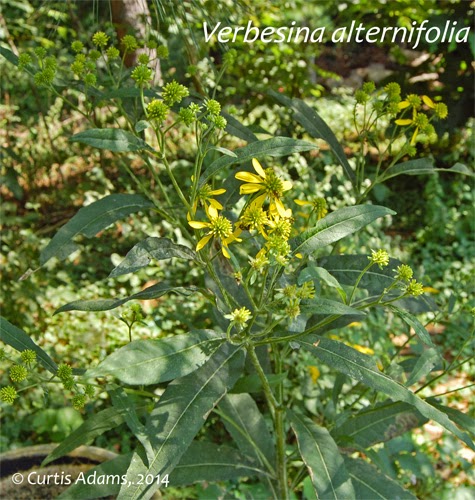
Wingstem is named for the rough appendages growing along its stems.


The predominant open meadow flower of late summer here is Wingstem, Verbesina alternifolia.   In the full sun they grow straight up to 3 to over 8 feet.   I have allowed a few to grow in the partly sunny gardens near the house.  Under these conditions they still grow tall, but they lean forward to get more sun, eventually flopping over.  Blooming period is about a month long, mid August to late September.

Under the shade of pines I am trying out several species of Goldenrods. The first to bloom is Elm-leaved Goldenrod, Solidago ulmnifolia.  As with the cardinal flower, these were browsed heavily by the deer in their first year, but this year they are reaching bloom (maybe with the help of Bobbex).  Other goldenrods I am trying in the shade are Zigzag, Bluestemmed and Showy Goldenrods.


The little whitish flowers of Jumpseed wiggle their way out of the undergrowth.
The foliage of this plant is tattered since it is often eaten by some as yet unidentified insects.
Another shade-tolerant native that is blooming now is Virginia Jumpseed, Persicaria virginiana.  Not particularly showy by itself, en mass it adds some interesting texture to a shady scene.  There are some forms of this plant with more colorful leaves and red flowers, but those are not in bloom just yet. 


Aromatic Aster is just beginning its long season of bloom.
One of the newer additions to the garden is Aromatic Aster, Symphyotrichum oblongifolius 'October Skies'.  Despite its name it has started blooming in late August (this cultivar is actually named for the flower color, not the bloom time).  This cultivar is compact and densly blooming.  Growing to about 2 feet tall it is a great choice for near the front of a border.  In addition to the good-sized blooms the foliage of this little bush has a pleasing scent.

I just wanted to share this last image of a patriotic color combination of Hibiscus moscheutos, Lobelia cardinalis, and L. siphilitica. It's not a great photographic composition, but it is an example of red, white and blue native flowers blooming at the same time (mid-August).  

This photo could have been improved had I bothered to remove the
chicken wire protection from around the Hardy Hibiscus.  

Friday, May 23, 2014

New Seedlings and Sprouts


While a few established plants did not make it through this past winter most did and are performing quite well now.   A number of plants that I put in last fall which I had written off as lost 'suddenly' reappeared in the middle of May.  These include a Passion Vine,  some New York fern and False Goatsbeard (Astilbe biternata).  It was very fortunate that I left the plant tags in the ground otherwise I may have totally missed these late arrivals and possibly removed them as weeds or planted something else on top of them.   The False Goatsbeard is an excellent example.  This was a new plant for me so I did not know when it would resprout or what it would look like.  As the photo shows the new shoot could easily be mistaken for a dead twig.  Now that it has leafed out it looks like what I would expect for and Astilbe.

The new shoot comes up reddish-brown with tightly curled leaves.

Astilbe biternata is the only North American species of Astilbe.  It grows to over 3' tall.


The intensity of the red markings on the leaves is variable in the wild type plants
I have mentioned many times before that we are on a mission to remove the Garlic Mustard from our property.  In addition to improving the biodiversity it is giving us the opportunity to closely observe the other plants that were growing under the mustard canopy.  The other day after pulling some garlic mustard I found a patch of Jumpseed, Persicaria virginiana, (formerly Polygonum virginiana) that was growing in an unmanaged area.  I wanted to compare this to some red-flowered Jumpseed that I got from a nearby nursery.  

These Jumpseed from a nursery have a similar number of leaf veins,
but the shapes of its leaves is variable.
 Because most Jumpseed blooms with whitish flowers I was uncertain whether the red flowered plants were North American (var. virginiana f. rubra) or from an Asian species (var. filiformis) which normally has red flowers.  These varieties have different leaf shapes and number of veins on the leaf.  See this link for the original publication.  The characteristic leaf shape for the Asian species is obovate with an attenuate or cunnate base.  The nursery-grown plants have similar number of veins as the wild type (5-9 pairs), but the leaf shape is variable with a single plant having leaf shapes that match either species description.  Bottom line... I'm just not sure.


No garlic mustard in these Mayapples, but there
was woodland phlox and some galium species mixed in.
Another thing we noticed was that there was a large patch of Mayapples (Podophyllum peltatum) that was nearly devoid of garlic mustard.  I don't know if the Mayapples are actively defending against garlic mustard invasion or if this area has just not been invaded yet.  It does support the practice of having a good dense ground cover to shade out/exclude invasive species.  


Seedlings
I am seeing seedlings returning from 2 native annuals that I set out last year.  I am finding large masses of American Pennyroyal, Hedoma pulegioides,  near where I had planted them last year.  The seed that I sowed last spring did not germinate well last year (only 1 or 2  plants).  But seeds that had over-wintered are germinating like gang busters.  So despite what the seed packet says, some cold, moist stratification or fall planting of this species gives much better results.  I am encouraging these in my vegetable garden because they are reported to repel crawling insects due to the strong aromatic scent.  I am hope that it will have a similar effect on mammals as well.
 
These seedlings look similar to those of some Salvia species;
however, they can be distinguished by their strong aromatic scent even at this age.

The other annual that is coming back is Partridge Pea, Chamaecrista fasciculata.  Last year I started most of these indoors after  2 weeks cold, moist stratification and pretreatment with an rhizobactrium innoculant.   These germinated quite well both indoors and out.  This spring I am seeing many new seedlings near to their parent plants. 
The leaflets of Partridge Pea will fold up at night and when briskly jostled.

These blooms have just opened, the white petals
doubled in length a couple of days later.
As I was coming back from pulling more garlic mustard I stumbled upon another plant that I did not see last year.  I believed that it was Robin's Plantain, Erigeron pulchellus, because of the larger flowers and the spatulate basal leaves.  On digging a little deeper I realized that this was Common Fleabane, E. philadelphicus.  This species is indicated by the clasping leaves on the flower stalk. While not a beautiful garden plant is a pleasant surprise in the woods.  Most of my plants are actually growing on the path on the more compacted soil.  Perhaps I didn't see them last year because they had gotten trampled before they could bloom.

Just a note on the invasives front:  The garlic mustard is starting to go to seed now (late May), so we are trying to bag it up right away; also Mile-a-minute vine is starting to grow and the stilt grass is about an inch tall now.  It is really best to pull the mile-a-minute now before the thorns develop later in the season.


Thursday, October 10, 2013

New Gardens for Fall

Autumn is a great time to do planting of trees, shrubs and perennials.  The weather is cooling down but the soil is still warm.  This allows new plantings to get established with less stress.  The roots do not need to pump as much water and nutrients to support leaf growth, rather they can focus on growing out and adapting to their new home.  Although we have had a nearly rainless September in Maryland, fall is usually a moister time than late summer.

Another factor that makes fall a good planting time is that many plants are on sale.  While somewhat picked over and tired looking there are many good deals especially for perennials at the nurseries.  There are also a number of native plant sales that occur in the Fall.

I visited a native plant sale in Virginia that featured locally native plants for the Chesapeake Bay Watershed.  I found some plants that I had been searching for for a long time (Aromatic Sumac and Yellowroot) and some that I had never heard of (Astilbe biternata - a North American species of Astilbe).

While not the actual location, this is similar to what we started with.
First my wife cut off the runners, then I dug out the roots.
One of the long term projects for the new property is the elimination of English Ivy.  Our local deer like to eat it; that is one of the few positive things I can say for them.  In the fenced areas, however, the ivy is taking over.  I have been holding off removing the English Ivy from an area until I have something on hand to replace it.  At this fall's Loudoun Wildlife Conservancy native plant sale I found an American Strawberry Bush, Euonymus americanus.  The Strawberry Bush was just the plant I needed for this shady moist corner where the ivy was dominating.


This shrub can grow 6-12' tall.  You can see a little of it's fall color.

The American Strawberry Bush is one of two native Euonymus species that I know of.  The other is Eastern Wahoo, E atropurpureus.  I'm not sure why these plants are not more available in the trade.  While not as showy as the invasive Burning Bush, E. alatus, they each have decent reddish fall foliage and the color of their fruits are outstanding, a red exocarp with fluorescent orange seeds inside.  I did read that deer really like to eat the Strawberry Bush, so finding it the wild can be difficult if there is any amount of deer pressure.

'Hearts-a-burstin' is one of the common names for E. americanus.
The orange seeds are not as bright as when the fruit first opened up.

With the Strawberry Bush as the focal point in this renovated corner I picked up a pair of Goat's Beard, Aruncus diocus to fill the back corner.  The white plume-like flowers should brighten this area in the early summer.  Since this plant comes as separate male and female plants I bought two to increase my chances of producing some viable seed.  (Usually it is recommended to get 3 plants when you want both male and female, but I don't have the space here.)


Goat's Beard should grow to about 5' tall and wide.
These are starting at about 1 foot.
This seed-grown selection of Jumpseed has the pronounced red markings
like those on the cultivar 'Lance Corporal'.


To fill in the ground plane I was imagining buying all sorts of natives like Heuchera, Tiarella and Labrador Violets.  On my trip to a local nursery I noticed that they had a bunch of escaped Jumpseed, Polygonum virginianum, with well defined red markings on the leaves  Since I already have these growing in the woods nearby, I thought it would be great to integrate this species into the plantings around the house.  It worked out that the nursery owner would give me the plants if I provided the labor of digging them out.  What a deal!!!  So I loaded up 9 pots full of this native ground cover, indigenous to my site.


At a distance the long racemes of red flowers look similar to those of Coral Bells.
(The name for this plant has been changed to Persicaria virginiana.)

To complete this design I need to remove the Japanese Honeysuckle on the back fence, then I would like to bring in some wild ginger (also growing nearby) and maybe some Solomon's Seal in the back to add a different texture.

Here's the corner without the ivy and just after planting.  The Aruncus is in the back,
the Euonymus is in front and the Jumpseed is in between.