Showing posts with label Ceanothus americanus. Show all posts

Saturday, March 4, 2023

Plans for 2023

 2022 was a particularly bad year  for me in the vegetable garden.  Conversely it was a great year for our local ground hog and rabbits.  The chicken wire fencing that I had sunk in around the perimeter had sufficiently rusted away to allow too many access points to control.  So may first garden job this year is to  rebuild the subsurface groundhog fence.  I've adopted a design I found on the Massachusetts Audubon site.  The key feature is that it extends the fencing horizontally outward from the fence.  This is supposed to make it more frustrating for critters to dig under the fence.  In preparing the area for the new fencing I needed to clear out the wild blackberries that are encroaching on the garden.  A future headache will be when blackberries start growing up through the horizontal welded wire.
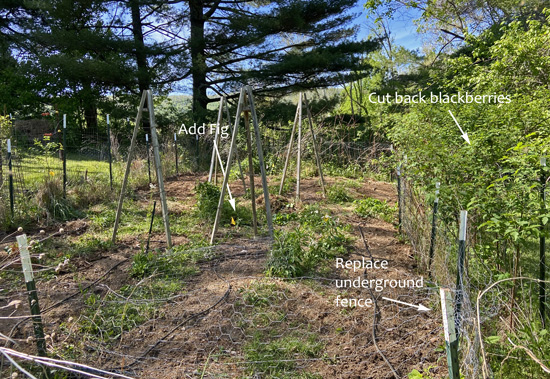
Here's the garden last spring.  You can see the dense growth of
blackberries on the left that is encroaching from the outer fence. 
The inner fence need to be re-established at the base. 
I'm planning on transplanting a fig to the center.

Here's the plan for the buried welded wire fencing that should
keep the ground hog from burrowing under.  The loosely attached
chicken wire creates an unstable barrier that the ground hogs
find difficult to climb on.

While many folks do not like these somewhat weedy blackberries, with a little management they can produce some good quality fruit.  The secret is to prune back the long flowering branches to 4-8 buds in late winter/early spring.  This reduces the number of berries produced, but increases their size and sweetness.  In fact last year the blackberries were the best performing food plant in the garden.  In addition the tall blackberry canes around the garden help deter the deer from jumping over the double fence.  For a good resource for keeping deer out of a garden take a look at Deerproofing your Yard and Garden by Rhonda Hart.

Last year I started growing a 'Brown Turkey' fig outdoors in the ground.  It should do fine with the cold, it's cold hardy in USDA zones 5-9.  It does, however, get browsed by deer.  For this reason I will move one out to the center of the fenced in vegetable garden.  


Replacing Exotic Spireas

Over the past couple of years I have been accumulating native some native shrubs as replacements for exotic spireas and forsythia.  First was New Jersey tea (Ceanothus americanus).  This grows about 3' tall and wide in part to full sun and dryish, slightly acidic soils.  A major drawback is that deer and rabbits like to eat it. I will be using those in the pool enclosure where at least the deer are excluded.  Sizewise this is a good replacement for the spireas that I currently have.  

I have been growing meadowsweet, Spiraea alba for awhile.  This species is a vigorous grower with a rather rangy habit.  It is better suited as background plant, rather than a feature.  Last year I got a couple of shinyleaf meadowsweet, Spiraea corymbosa.  This Mid-Atlantic native has a habit more similar to that of its Asian relatives.  I will give this one a try in pool enclosure as well.

Another plant that I have been seeking for a long time is prairie willow (Salix humilis).  This Northeastern native willow is early spring blooming and only grows 4-6' tall.  It seems to be a good visual substitute for forsythia.  A couple have overwintered well in the ground.  If these continue to perform well I should be able to make more, since willows are particularly easy to propagate.    

this is the shinyleaf meadowsweet as it arrived last summer. 
If it has overwinter successfully, I will get it in the ground later this spring.

Woodland Management

Managing a landscape is as much about taking plants out as it is expanding and adding new plants.  In one area that is an early successional woodland (trees 15-20 years old) I have been aggressively killing off Tree of Heaven (Alianthus altissima).  As the larger ones are coming down the canopy is opening up and I'm seeing an increase in the undergrowth.  I need to manage this area by selective removing killing invasive species like multiflora rose (Rosa multiflora) and garlic mustard (Alliaria petiolata).  Late winter/early spring is a good time to hit these with herbicide, while the native species are dormant.  For the larger roses I've been doing cut stem treatments (apply 20% glyphosate to freshly cut stumps with foam paint brush).  Garlic mustard and dense masses of rose with leaves get the standard foliar spray.  


I'm trying to eliminate the Tree of Heaven that has dominated
this young woodland.  Most of the trunks laying on the ground
are ones that I have successfully treated using the Hack and
Squirt method.  In the center is one of the musclewoods
that grow well in this mostly shady area.

These trees were treated two years ago with a commercial
mixture of 2,4-D and dicamba.  The one in front is being
helped along by some currently unknown critter.

My goal here is to maintain this as a high quality woodland.  A couple of years ago I started adding some young 2 gallon oaks and red maples, but these did not survive in this minimally cared for location.  There is some debate about how effective humans are at forest regeneration and that letting trees grow from the natural seed bank may be more effective.  So now I am just adding protective cages around desirable seedlings especially oaks, maples, black cherry and musclewood (Carpinus caroliniana).  The most prolific native tree in these woods are box elders (Acer negundo).  These don't need any protection.

I am, however, adding some bare root evergreens to our windbreak to the north and west of our house.  The white pine trees here are aging out and I would like to get some replacements established before these have to come out.  This year I am adding some red cedar (Juniperus virginiana) and Canaan firs (Abies balsamea var. phanerolepis).  Of the fir trees I've tried to grow here in the neutral pH soil in Pleasant Valley, the Canaan fir seems to be the happiest. 


This Canaan fir is still in the wire cage I
put around it to protect from deer rubbing.

Shade Management

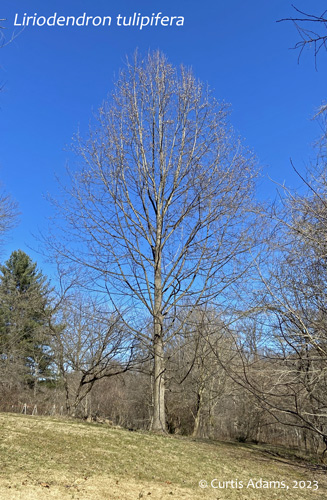
Another bit of shade management I did was to take out a rapidly growing tulip tree that was too close to the house and swimming pool and would soon cast too much shade on some smaller trees and shrubs.  I figured I could cut it myself this year while it was under 40' tall, any bigger and I would want professional help.  Many of the other tulip trees here are 80+ feet tall.  I really hated removing a native tree like this but in this location it would soon dominate the landscape.

The tulip tree I removed was only about 10 years old
(see inset) but was already nearly 40' tall.  It was
casting a lot of shade on a nearby persimmon. 
The box elder may be next.

This nearby tulip tree is probably in the 70-80' range
and growing.  A good choice here, but much to big to
be close to the house.

Invasives Management

And of course I'm am continuing a broad fight against the invasive plants.  In addition to early spraying for garlic mustard and multiflora rose, I am starting to go after the Japanese honeysuckle growing on the ground.  I have just a little more time to treat these with glyphosate before the spring ephemerals come out in force.  Also with the warm winter we've had it is almost time to apply a pre-emergent  herbicide to control the Japanese stiltgrass that will start sprouting in early May.  These pre-emergent treatments have been very effective at reducing the amount of stiltgrass growing in the lawn.  They also seem to have reduced that amount of hairy cress (Cardamine hirsuta) in the lawn.


Thursday, January 21, 2021

Plans for 2021

The New Year brings new opportunities for trying new things in the garden as well as continuing projects from last year. 

One project that I will be continuing from last year is removing and replacing vinca from a wooded area.   I will be expanding that to begin removing yellow archangel, Lamiastrum galeobdolon, from an adjacent area.  While this species is not currently on any official state invasive plant lists in the Mid-Atlantic, it is a species of concern.  (It is a state listed invasive in Washington State.  More locally it is on the Arlington County Virginia invasive plant list.)  It does spread aggressively by runners and root fragments.  Pulling is effective as long as all of the plant is removed.  I sprayed some of it with glyphosate last fall when doing garlic mustard treatments, but I don’t know if that will be effective.  Triclopyr is reported to be effective.


I really love the round leaflets of the trefoil and the way winds
its way along to ground, finding openings. 
 In addition to the plants added last year to replace the vinca, this year there will be some white wood aster, Eurybia divaricata, and round-leaved ticktrefoil, Desmodium rotundifolium.  Both of the species are well adapted for growing in dry, partly shady locations.  While the aster is fairly easy to come by I have been searching for the ticktrefoil ever since I first saw it in the wild back in 2005.  I’ve got a lead on it at a not-too-far-away nursery and hope to secure a few plants for this year.  The name trefoil refers to its having three leaves.  This particular species is notable for its distinctly round leaves.  An other common name is prostrate ticktrefoil, for its ground-hugging habit.  This makes a good partner in a matrix planting.  I can see using it around upright perennials like Solomon's seals and clumping ferns.

Virginia waterleaf has deeply incised leaves with whitish splotches
 that resemble water spots.  The plants shown here are in a moist
shady area near the Potomac River.  Other plants in this area include
Virginia bluebells, trilliums and bedstraw.  Photo taken early late April.

Another invasive that I have been fighting for a while and making some headway is Japanese stiltgrass, Microstegium vimineum.  I will continue fighting it with a multipronged assault, including preemergent herbicides and lots of pulling.  As I’m opening up space I’m backfilling with native species.  In addition to more of the Obedient Plant, Physostegia virginiana, that I put in last fall I‘ll be adding some Virginia waterleaf, Hydrophyllum virginianium, to a moist shady area.  This area is already populated by Virginia bluebells, Mertensia virginiana, lady fern, Athyrium filix-femina, and a variety of grasses and sedges.  (In writing this I wonder if I should look into creating a display garden of plants with only the specific epithet of virgini--.  Talk about being a plant nerd.)


The foliage on this NJ tea looks an awful lot like many Japanese spireas. 
Its compact size and tight clusters of white flowers in mid-summer
makes an excellent replacement for exotic Spireas.
While looking over the property it dawned on me that I have a number of exotic spireas that I have been ignoring, but now I’ve decided it’s time to explore some native replacements.  In the past I’ve worked on properties that have had hundreds of spirea seedlings popping up in mulched beds.  I’ve been fortunate here that I have not seen many seedlings at all.  This may be because of the half dozen plants I have all are the same cultivar, and that cultivar is less fertile.  Or the areas where the spireas are do not see much soil disturbance so seeds are less likely to get a foothold.  In any case I set about looking for a compact native shrub that grows to about 3’ and is relatively low maintenance.  Shrubby St. John’s wort, Hypericum prolificum, and the smaller cultivars of summersweet, Clethra alnifolia cv., are two candidates that I already have.  I instead am going for something new, New Jersey tea, Ceanothus americanus.  These are readily available as small plants by mail order but are not very common in larger sizes at area nurseries.  I have some seedlings on order.  Some of these I will plant out directly and some I will bring along in pots for a season.  According to Missouri Botanical Garden website, these will make good container plants that I can grow on my deck.


Prairie dropseed is notable for its dense mounds of fine foliage. 
In late summer it sends up panicles of pink-tinged flowers. 
I see it as a native alternative to exotic fountain grasses.
Another focus for this year will be to relocate the plants I have into the right place.  High on my list is to move my swamp mallow, Hibiscus moscheutos, to a sunnier location.  I put it on the edge of a swale but over the years it has gone light to heavy shade and is now barely surviving.  Another plant that I’ve allowed to get overshadowed is prairie dropseed, Sporobolus heterolepis.  This beautiful fine bladed grass can grow into 2-3’ mounds, topped by wispy flower plumes in late summer.  While primarily a plant of the Mid-West it is also found on a few sites in the East, possibly prairie remnants.  I allowed mine to get swallowed up and shaded over by some exceptionally healthy coral honeysuckle, Lonicera sempervirens.  I will be getting some new plants and put them into more open locations where they can reach full size.  These are also good candidate for container gardening, so I may set 1 or 2 aside for that purpose.


While I had planted tomatoes here, there was also a crop of black-
and brown-eyed Susans coming in.  These were all first year
rosettes so they did not compete much with the tomatoes for air-space,
but I imagine there was a lot of root competition.
In the vegetable garden I have the opposite problem.  The surrounding wildflowers, particularly the black- and brown-eyed Susans, Rudbeckia hirta and R. triloba, have invaded the beds.  Rather than throw them out I will move them to an area where I am battling Japanese stiltgrass.  The timing should work out where I can use a torch to burn off the first crop of stiltgrass seedlings at the beginning of May and then transplant in the Rudbeckias as the veggie garden is getting prepped.


Speaking of fire, last year I used the garden torch to control weeds in the vegetable garden.  Areas that were cultivated followed by flaming seemed to have fewer weeds than areas that were only cultivated.  However weeds did continue to germinate through the spring so burning is not a one-time thing.  A couple of weeks ago I went out to find a garden bed covered in hairy cress, a winter annual weed.  I got out the torch to see if I could kill these weeds without disturbing the soil.  I checked the bed about 10 days later and most of the cress was dried up.  Aside from keeping the fire under control, my biggest concern is damaging any in-ground irrigation lines.  A quick pass of a torch is enough to melt a soaker hose.   I find the use a the torch most effect at clearing areas where the fencing is buried beneath the soil.  The fire is able to reach between the holes in the chicken wire that would be otherwise inaccessible with a hoe. 

The upper image is immediately after flaming the bed on the right. 
The cress has taken on a darker green color.  10 days later most
of the cress is brown, but a few cress evaded the flame. 
Note that I pulled the soaker hose out of the bed before burning.