Showing posts with label Cornus sericea. Show all posts

Wednesday, January 22, 2014

Native Plant Wish List for 2014

With a new planting season approaching I am planning on continuing my crusade to replace  the invasive species with native, mostly indigenous, plants.  I have another round of brush clearing to do this winter, especially the removal of some Autumn Olive tree/shrubs.  I am also looking to reduce the number of Butterfly bushes and Forsythia on the property and replace them with higher value native shrubs. 

Over Christmas I took the time to finish reading Designing Gardens with Flora of the American East, by Carolyn Summers.   The chapter on 'showy substitutes for invasive plants' was very inspirational in making up my plant list for this season.  This book is an excellent resource for anyone interested in designing native plant gardens.  There is sound reasoning behind each of the recommendations in this book.  I found this to be  much more useful than just a list of what should or should not be done when designing a garden or landscape.   To enhance the wildlife value of our property I am trying to  use a combination of plants that have something in bloom throughout the season for the pollinators as well as berries and fruits for the birds and small mammals.

Anyway, here's a list of my target plants for 2014:

Pussy Willow, Salix discolor.  I was surprised that this is a native species.  I is used so commonly in early spring decor that I figured it had to be imported.  The catkins swell in very early spring, first as white, silky buds, then opening to reveal either yellow (male) or greenish (female) flowers.  Pussy Willows are dioecous, male and female flowers are borne on separate plants.  My plan is to use the pussy willows as replacements for Forsythia.  The color intensity will be much less, but the wildlife value will be so much higher with the willow.  For all its flowers, I have seen very few bees visiting a forsythia in bloom.    Pussy Willows like full to part sun and prefer moist soils but will tolerate some dryness.  They are larval hosts for Viceroy and Mourning Cloak butterflies and they tolerate deer.  
I'm not sure of the exact species.  This photo is from the end of March in Boston.
I took this photo of a shrubby willow at the Arnold Arboretum about 5 years ago.  I did not record the name at the time.  As I was trying to find out more info about it, I went to the arboretum's web site and found that they have actually made an Internet accessible map of their plantings.  Using that map and my memory of where I took the photo, the willow in question is either the native Bebb's Willow, S. bebbiana, or an introduced Black Willow, S. gracilistyla 'Melanostachys'.  Based on the light color of the catkins, I guess that it's the former.

Another substitute for Forsythia is Spicebush, Lindera benzoin.  Its flowers impart a yellow haze to the forest understory about the same time as the Forsythia are in bloom.   It grows better in shadier situations than either Pussy Willow or Forsythia. 

For a partly shady area I would like to try replacing the Forsythia with Red Osier Dogwood, Cornus sericea.  This plant is in bloom from mid-late May and follows up with nutritious berries in mid-late summer.   Besides the flowers and fruits this dogwood also has purplish fall foliage and red-colored stems in winter, features definitely lacking in the one-trick pony, Forsythia.  Species plants can get large (6-10') but there are compact cultivars like 'Isanti' and 'Arctic Fire'.  A big problem with dogwood is that deer find most of the plant pretty tasty, but I have seen large plantings doing well along the roadsides.  This dogwood serves as the larval host for the Spring Azure butterfly.


This 'Isanti' cultivar is in full bloom at the end of May and should grow to about 6 feet.
Cutting back the older growth each year will keep the size down
and give more new red stems in the winter.

As far as replacing the Butterfly Bushes, Buddleia davidii, a multi-shrub approach may be needed.  Butterfly Bush has a long period of bloom and is very attractive to pollinators.  But it's like candy.  The plant does not act as a host for any native insects.  Thus, as it displaces native species, it excludes useful host plants, and degrades the habitat value of the garden.
 
The seed heads of Sumac make them easy to spot.  Not sure which species this is.
The stems of R. glabra are smooth, while those of R. typhina are hairy.
For the early part of the summer I am looking to Smooth Sumac, Rhus glabra.  This is also a common roadside plant, but not so common in the nursery trade.  It's chartreuse panicles do not stand out to humans, but they do to butterflies.  What is most noticeable in this shrub is the scarlet fall foliage and the deep red berries through the fall and winter.  It grows to about 15 feet, similar to many of the mature butterfly bushes around here. The larvae of the Hairstreak butterfly use Sumac as host plants.


For  the second part of the season I will put in some American Elder, Sambucas nigra ssp. canadensis (often S. canadensis).  American Elder likes medium to moist soils and part to full sunshine.  I have seen this growing in roadside ditches covered  with white umbels in the middle of summer.  Dark, palatable berries follow in early fall.   This shrub does not have a neat compact form, but neither do most forms of Butterfly Bush.  I am somewhat concerned about deer browsing on the young plants, so some protection will be needed. 

This native Spiraea blooms throughout the summer
and is a magnet for bees.

Other shrubs that provide mid and late summer flowers which  I put in last year include dense St. John's Wort, Hypericum densiflorum, and Meadowsweet, Spiraea alba var. latifolia (this one blooms all summer long).

In the areas where I have cut down the Autumn Olive, Elaeagnus umbellata, I am looking for native plants to provide lots of mid-summer  flowers, a large crop of fruits, and fairly dense branching to provide cover for birds.  Cockspur Hawthorn, Crataegus crus-galli, looks to be a good fit.  It blooms through mid-June and has lots of berries from late summer into winter.  It has dense horizontal branching and long thorn that provide a lot of protection for birds.  (For use closer to people there is a naturally thornless variety, var. inermis.) 

I would also consider Chokecherry, Prunus virginiana, while blooming earlier, it is faster growing and has fewer disease problems.  Chokecherry lacks the thorns of Hawthorn, but can form a thicket-like colony.  Looking in Douglas Tallamy's book Bringing Nature Home,  the cherries are near the top of the list as far as their ability to support butterfly species.  Hawthorns come in 12th, both way ahead of an invasive species like Elaeagnus. 

'Blue Muffin' is noted for it's sapphire berries,
as long as there is another Arrowwood around for pollination.
The other shrub that I will be putting in place of the olives is Arrowwood Viburnum, Viburnum dentatum.   These bloom in late May through mid-June and produce dark blue berries from late summer through autumn.  As I have mentioned before in this blog, Viburnums are self-sterile, so you need to have more than one genetic individual of each species to get berries.  Fortunately a local nursery is offering seed grown, wild-type plants so I won't have to worry about self incompatibility.  Wild-type Viburnums can get too large for many landscaping situations.  There are a number of more compact cultivars for garden use, such as the 'Blue Muffin' (aka 'Christom') shown here.  Together the Viburnums and the Hawthorn or Chokecherry will provide a nice edge habitat for with both food and shelter for wildlife.


Sunday, February 19, 2012

Winter Field Trip

So after writing about the 'Winter Weeds' around my house for a couple of weeks I decided to take a walk through a nearby meadow to see what's still standing.  For me the closest meadow is Rock Meadow, in Belmont, MA.  This erstwhile farm has been conservation land for the town of Belmont since 1969.  With decreasing maintenance budgets over the years this area was undergoing succession with open meadows being closed up with a variety of native and non-native, invasive species.  This severely  degraded its value as a bird nesting habitat and reduced it general value as a recreational space.  In 2005 the Friends of Rock Meadow worked with the town in securing funds to do a renovation.  Most of this work was completed between 2007 and 2009, with the removal of many invasive plants, clearing shrubbery from the meadow and improving trails.  So with map in hand I set out to see what interesting plants I could find...

The burrs on this Burdock catch the afternoon sun
as easily as they do to a passing hiker.
The first plant I came across was Burdock.  This old world introduction is a common weed of waste spaces, but its strong structure helps it persist in the winter landscape.  The burs on the seed pod are hooked which help them attach to passing animals, thus dispersing the seed to a wider area.


Next I walked by a thicket rich with Red Twig Dogwood.  I am assuming these are the native Cornus sericea (formerly, C. stolonifera), even with leaves and flowers some of these species are difficult to tell apart.

The Red-twig Dogwood was easily identified among
all the other brown branches in the thicket.


Large sections of Rock Meadow are consistently wet.  These areas are easily identified by their large populations of Cattails.  There are two common species in the Northeast, one with broad leaves and one with narrow (Typha latifolia and T. angustifolia, respectively).  I did not investigate which was present, or if both were there.

One of the wet areas in Rock Meadow that is home to Cattails

Steeple Bush, just upstream
of a wet meadow.
Steeple Bush (Spiraea tomentosa) is another native spirea.  Unlike the Meadowsweet I have growing at home, the flowers of Steeple Bush are held in tightly erect panicles.  Also I found it here, Steeple Bush prefers moister soils.

While not a true pre-Colombian native species, Queen Anne's Lace has become naturalized throughout North America.  Even without its flower petals, this plant still has a presence in the winter landscape.  

The bare bones of Queen Anne's Lace

The few remaining seeds on this Little Bluestem
still catch the  winter sunlight.


Little Bluestem is a widespread native grass.  It seems to look its best growing on really poor soils and is often seen growing along the highway.  In richer soils it gets tall and floppy.  In the fall and winter it can be picked out by its orangy appearance and the way that the fuzzy seeds catch the light.


One plant I almost passed right by was this Tower Mustard.  It just looked like some sticks poking out of the ground.  On closer examination I noticed the dimpled membranes that once held the seed in an alternating pattern.  I didn't know this plant at first, but I looked in my copy of  'Weeds in Winter' and it led me to the mustard family.  After that, I was able to locate the species by referring to my copy of Newcomb's.

The seed pods of Tower Mustard still show
the impressions of the seeds they held.
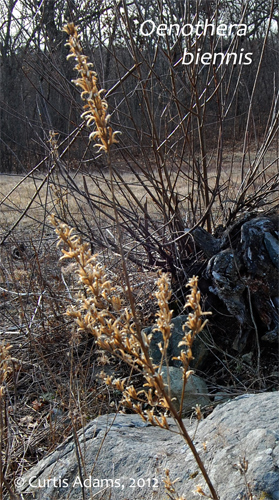
The opened seed pods of Evening Primrose
 look like dried flowers.

Evening Primrose is a plant that is easy to recognize in its dried form.  When I walked by I realized that I knew this plant, I just could not remember its name.  The stiff, four-parted seed capsules on the tall, upright stems are unique and hard to forget.  I quickly flipped through the field guide until I found a drawing that matched this plant dead on.


I'm pretty sure this is Sweet Everlasting.
Had I used my nose as well as my eyes I would no for sure.
After returning to the path I looked down and saw another familiar plant.  There was a single stem of what I believe was Sweet Everlasting (Pseudognaphalium obtussifolium).  However, it could also have been Pearly Everlasting (Anaphalis margaritacea) which also has woolly stems and leaves and persistent papery bracts.  Crushing a flower would have told me which, Sweet Everlasting has a sweet, tobaccoy scent, while Pearly Everlasting has no smell.  Also, the bracts of Sweet Everlasting have a dingy tone, while those of Pearly Everlasting are reported to stay white (forever?).

As I moved into a shadier area, a large patch of Raspberry vines became evident.  These stood out as a purple mass of branches against an otherwise dull brown background.  Closer examination showed the little red thorns on the purple branches.  A couple of years ago I attempted to ID some raspberries but was quickly overwhelmed by the possibilities.  Right now I will just appreciate their contrast to the shades of brown.

Raspberries of some sort; the thorns are too small to be Blackberry

When I first saw these berries I thought this might be an Arailia of some sort.
A little research indicated that this was actually Carrion-Flower.
Carrion-flower was a surprise find as I was heading back to the parking lot.  Most of the members of the genus Smilax are rather unpleasant to deal with, like Catbriar (Smilax rotundifolia), with its tangle of thorny branches.  Carrion-flower, S. herbacea, on the other hand, has few, if any, thorns and only grows to about 8' in length.  As its common name indicates, the flowers have an unpleasant scent.


While Rock Meadow has been cleaned up of many of its  invasive species, some still remain.  In the winter months Winged Euonymus is easily recognized by the little wing-like projections along its stems.  Another common invasive is Black Swallowwort.  It can be recognized by the remains of its seed pod that looks like a dried leaf.  This vine is very hard to eradicate since it will resprout from small fragments of roots left behind after pulling or digging.

The arrow in the photo points to some of the wings
on this Winged Euonymus.
The old seed pods on this Black Swallowwort looks kind of like those of Milkweed.  In fact these are both members of the Asclepiadaceae family.